- The risk of an unprecedented default on US sovereign debt amplifies the global risk aversion of market agents and stimulates the search for safe-haven assets, strengthening the dollar.
- Heated economic data in the United States should suggest that the country is still expanding and that the Federal Reserve will need to keep its interest rates higher for longer, contributing to strengthening the dollar.
- Approval of the fiscal framework bill in the Chamber of Deputies with improvements in the guarantees of compliance with the established targets may reduce the perception of Brazilian assets' fiscal risks and strengthen the BRL.
- Brazilian GDP growth can improve the valuation of Brazilian assets and contribute to attracting investments to the country, strengthening the BRL.
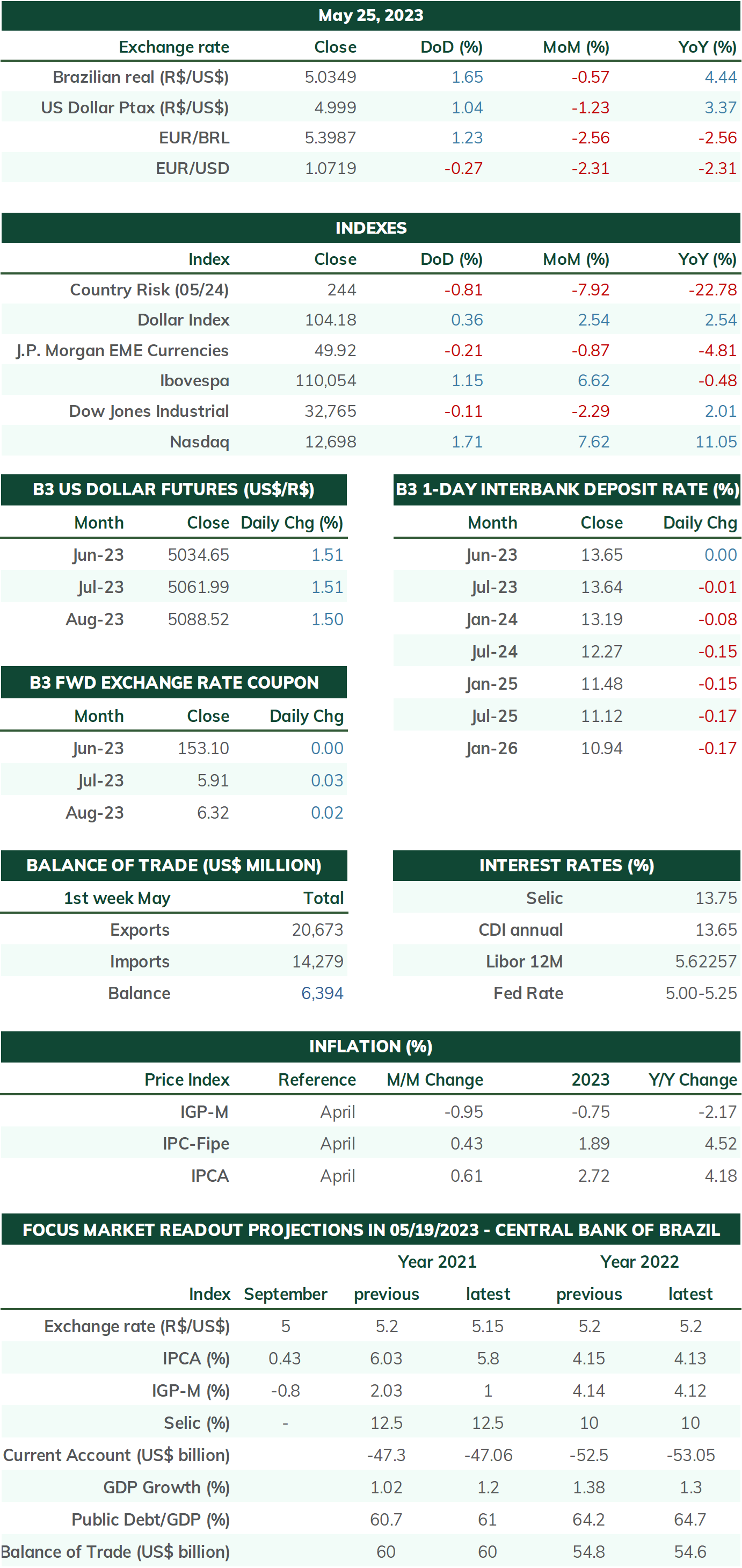
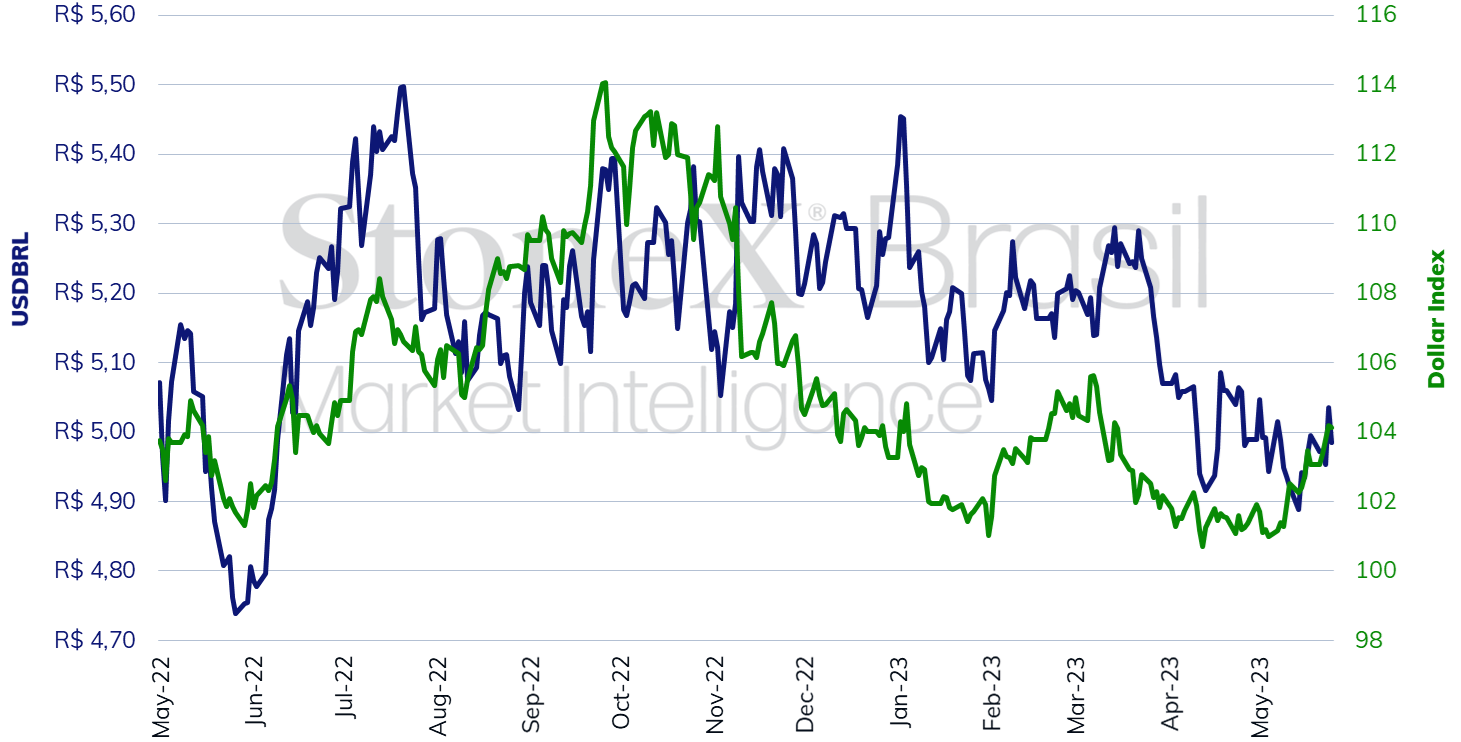
The USDBRL ended this Friday's session (26) quoted at BRL 4.985, a weekly retreat of 0.2%, monthly of 0.1%, and annual of 5.6%. The dollar index, meanwhile, closed Friday's trading session quoted at 104.1 points, a variation of +1.0% in the week, +2.7% in the month, and +0.8% in the year. The foreign exchange market reacted to the strong risk aversion and global strengthening of the US currency amid prolonged negotiations for extending the US debt limit and the possibility of an unprecedented default in the country. In Brazil, the final approval of the new fiscal framework by the Chamber of Deputies allowed the value of the national currency to be supported even in an adverse external scenario.
Expected impact on USDBRL: Bullish
The focus of investors' attention this week should be on the negotiations regarding raising the ceiling of public debt in the United States as the American Treasury may run out of funds to honor its commitments – and default for the first time in its history. While it is unknown when that date would be, U.S. Treasury Secretary Janet Yellen has repeatedly warned that it could occur as soon as June 1, next Thursday, due to heavy payments piling up at the beginning of the month. The procedure for voting on an eventual budget agreement by the US Congress can take several days as internal bureaucratic impediments require a certain period of up to 72 hours between the presentation of a legislative proposal and its vote.
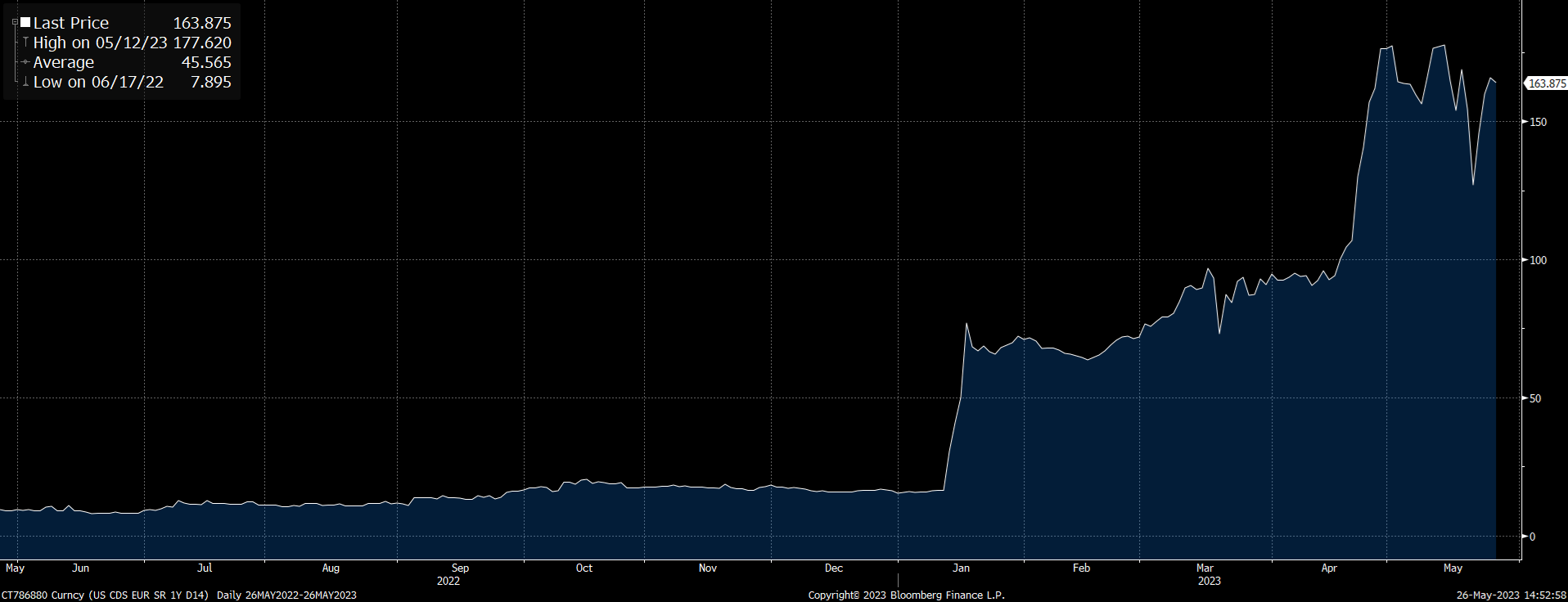
By getting so dangerously close to such a catastrophic default, negative effects ripple through the asset markets. Volatility and risk aversion have remained high in recent weeks, hurting various risky assets. For example, the spread of Credit Default Swap (CDS) contracts for US Treasury bonds (a thermometer for their risk) remained close to their highs, requiring payment of 1.63% of the bond value per year as a CDS premium last Friday (26). Additionally, the rating agency Fitch has placed the US debt credit rating – "AAA," the highest possible – on "negative watch" because of the inability of Democrats and Republicans to reach a new agreement on raising the debt limit. "The brinkmanship over the debt ceiling, failure of the US authorities to meaningfully tackle medium-term fiscal challenges that will lead to rising budget deficits and a growing debt burden signal downside risks to US creditworthiness," Fitch warned. The situation resembles August 2011, when a Republican-majority House of Representatives and a Democratic-led Executive and Senate also reached an impasse over the debt ceiling, approaching default, and the rating agency S&P Global permanently downgraded the US bond rating from AAA to AA+, the second highest.
Most analysts believe that the parties will reach a last-minute agreement and that a default will be avoided. However, suppose politicians do the unthinkable or get their estimates wrong about how much time they still have to negotiate and pass new budget legislation. In that case, the repercussions are likely to be profound and prolonged.
Expected impact on USDBRL: Bullish
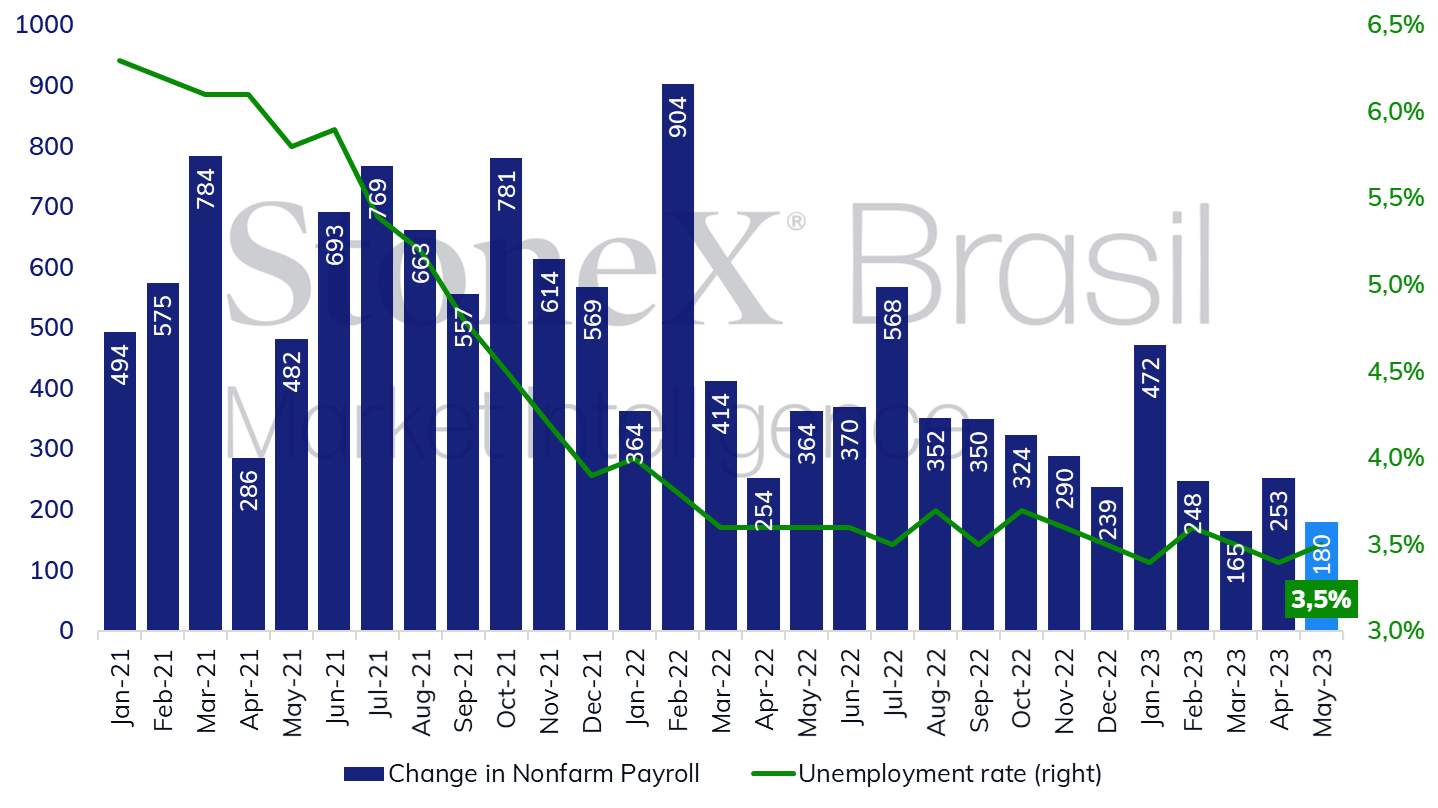
The week will bring important data for evaluating the American economic situation, such as the industrial Purchasing Managers' Indexes (PMI) for May, measured by the ISM Institute and data for the labor market, highlighting the Employment Situation Report for May. The latest projections point to another month of strengthening in the labor market and a balance of 180,000 new jobs in May, reinforcing interpretations that the Federal Reserve will need to keep its interest rates higher for longer. As for the manufacturing PMI, another reading below 50 points is expected (average estimates point to 47.0 points), indicating that the sector currently faces considerable challenges.
Expected impact on USDBRL: Bearish
This week, the Brazilian Institute of Geography and Statistics (IBGE) publishes the Gross Domestic Product for the first quarter of 2023, whose median estimates point to a growth of 1.3% compared to the fourth quarter of 2022, driven by the good performance of agribusiness and the resilience of consumption. Additionally, the IBGE should release data for the labor market in April, with expectations of stability for the unemployment rate, at 8.8%.
Expected impact on USDBRL: bearish
After being definitively approved by a large majority of votes in the Chamber of Deputies, the fiscal framework proceeds to the Federal Senate, where a rapporteur for the bill (PLP 93/2023) should be appointed and whether the matter will go directly to the Plenary (under urgency) or will pass through special committees. It took five weeks for it to be approved, but the president of the Senate, Senator Rodrigo Pacheco (PSD-MG), believes it should be approved as early as June. If the text approved in the Senate is identical to that of the Chamber, it goes on to presidential sanction; however, if there are any changes, it returns to the Chamber for final consideration by the deputies before going on to the Executive.