- Federal Reserve officials are expected to reaffirm the central bank's commitment to maintaining monetary tightening in the US, albeit at a more spaced-out pace, potentially strengthening the dollar.
- Copom's monetary policy decision should recognize the more favorable macroeconomic scenario and possibly signal the possibility of future reductions in the basic interest rate (Selic), contributing to strengthening the Brazilian real.
- Approval of the fiscal framework in the Brazilian Congress should reinforce the environment of optimism with the country's macroeconomic scenario, attracting investments and strengthening the Brazilian real.
In the previous week
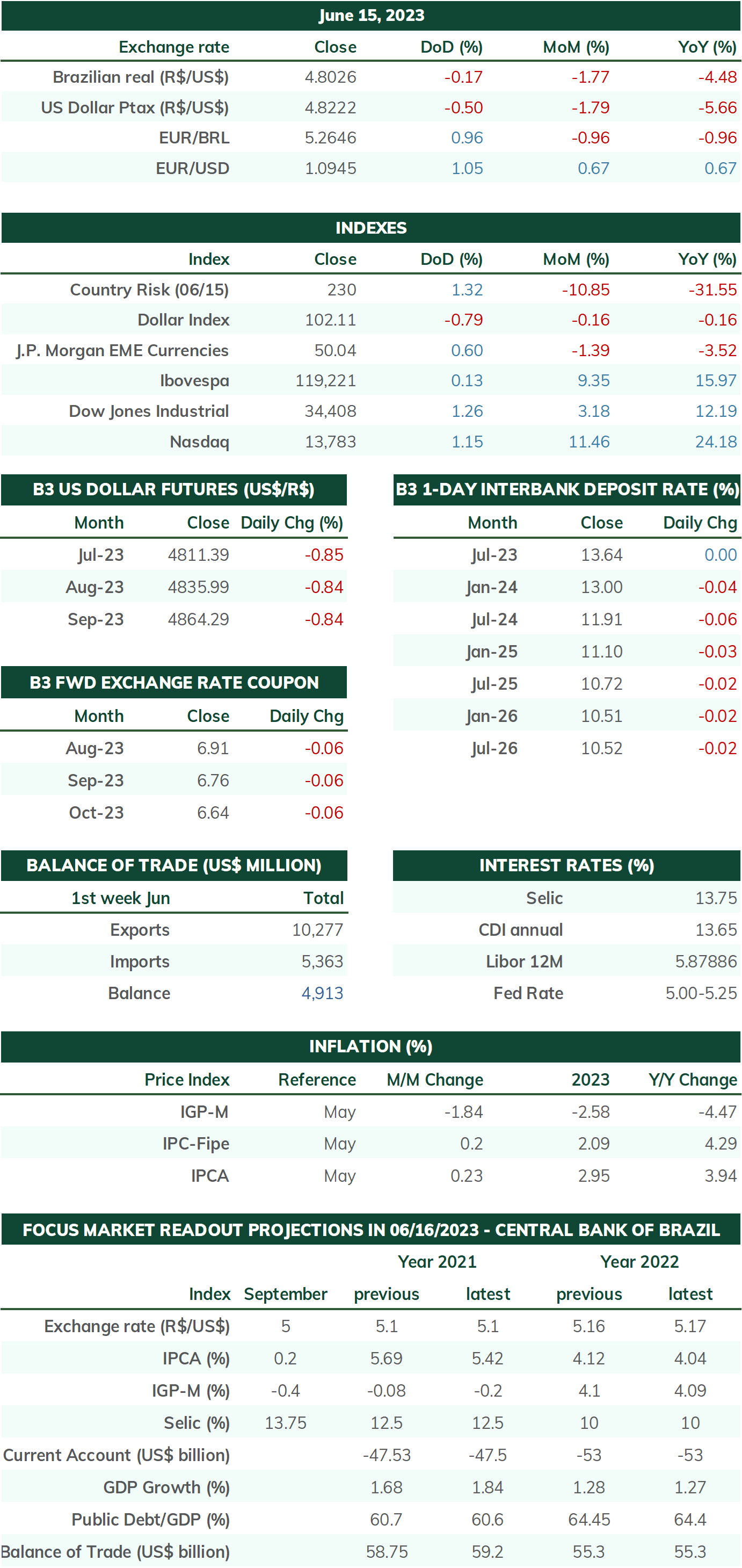
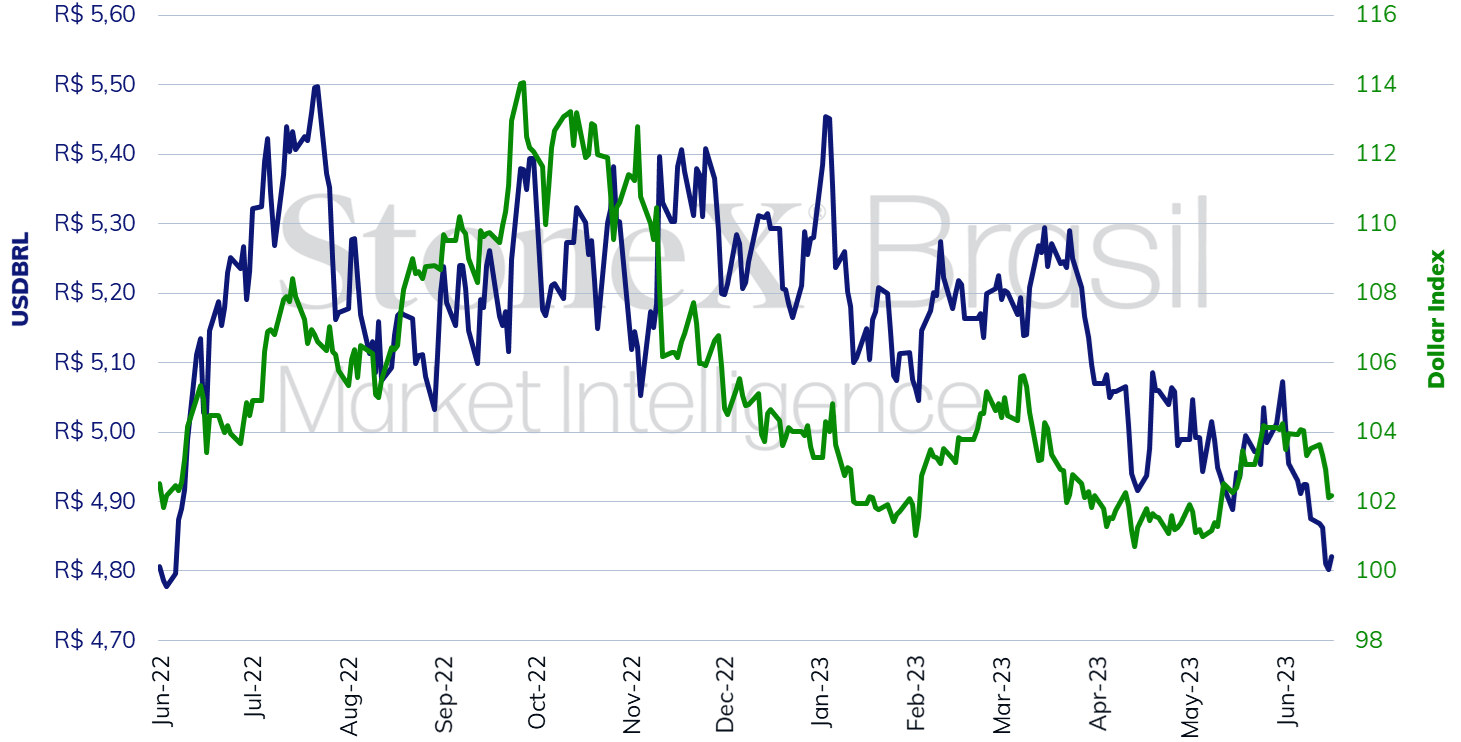
The USDBRL ended Friday's session (16) quoted at BRL 4.821, a weekly retreat of 1.1%, monthly of 4.9%, and annual of 8.7%. The dollar index closed Friday's session at 102.2 points, a variation of -1.3% weekly, -2.0% monthly, and -1.1% yearly. The foreign exchange market reflected the monetary policy decisions by the Central Banks of the United States, Europe and Japan, strengthening the European currency against the American and Japanese currencies. The elevated Brazilian sovereign credit outlook from "stable" to "positive" by the risk rating agency S&P reinforced the optimistic atmosphere in Brazil. It contributed to the strengthening of the real.
Expected impact on USDBRL: bearish
There is almost a consensus that the Central Bank of Brazil's Monetary Policy Committee (Copom) should keep the basic interest rate (Selic) stable at 13.75% p.a. for the 7th time in a row in its decision this Wednesday (21). However, there is great expectation for the monetary authority's communiqué, mainly for how the balance of risks will be addressed and if there will be any sign of a possibility of interest rate cuts in the short term. Until the last decision, in early May, Copom adopted a firm tone in its stance, stating that the core of prices in the country was too resilient and that inflationary expectations were too high to consider the possibility of reductions in the Selic rate. Instead, the communiqué "emphasize[d] that, although this is a less likely scenario, it will not hesitate to resume the adjustment cycle if the disinflation process does not go as expected" - a phrase that is not likely to appear in this week's communiqué.
However, over the last few weeks, the release of a lower-than-expected National Broad Consumer Price Index (IPCA) for May, a higher-than-expected Gross Domestic Product (GDP) for the first quarter of 2023 and the perspective of approval of the new fiscal framework in the National Congress have generated strong optimism among national investors regarding expectations for the main macroeconomic variables, such as inflation, growth, exchange rates and interest rates. This favorable environment allowed for an expressive strengthening of the BRL, among other Brazilian assets. In recent speeches, Central Bank officials have acknowledged the qualitative change in the environment but have been a bit more general in mentioning that interest rate cuts may occur soon if these conditions are maintained without committing to a timeframe.
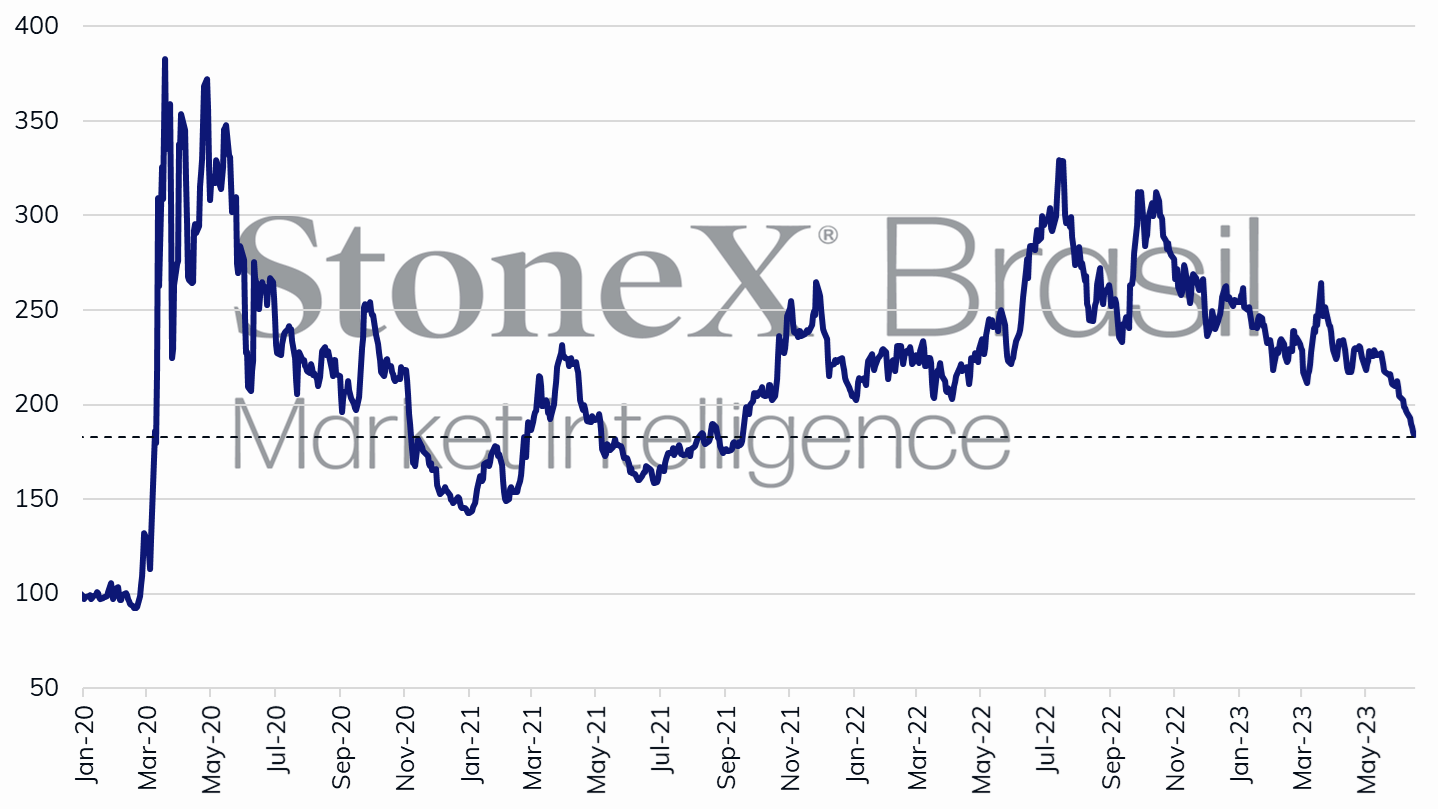
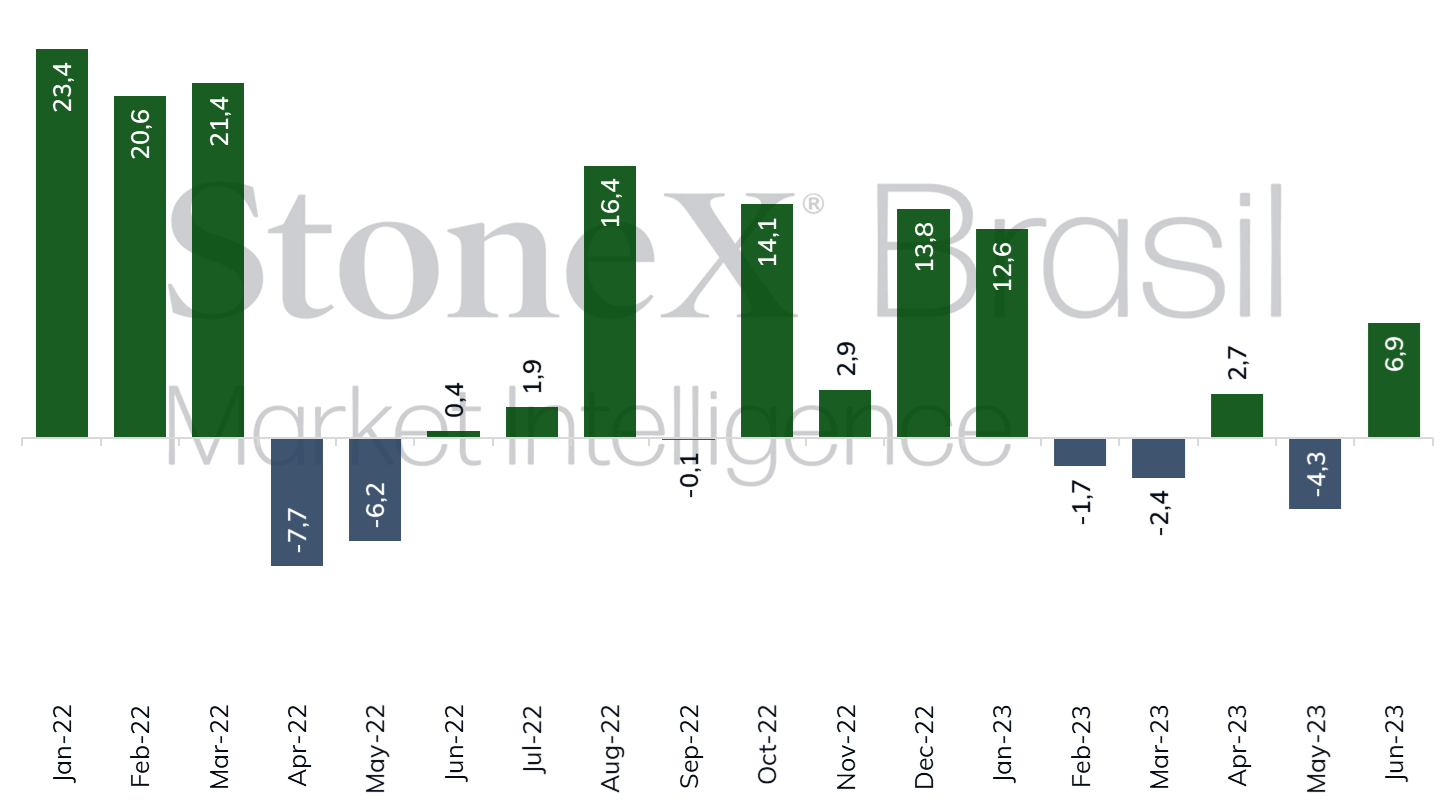
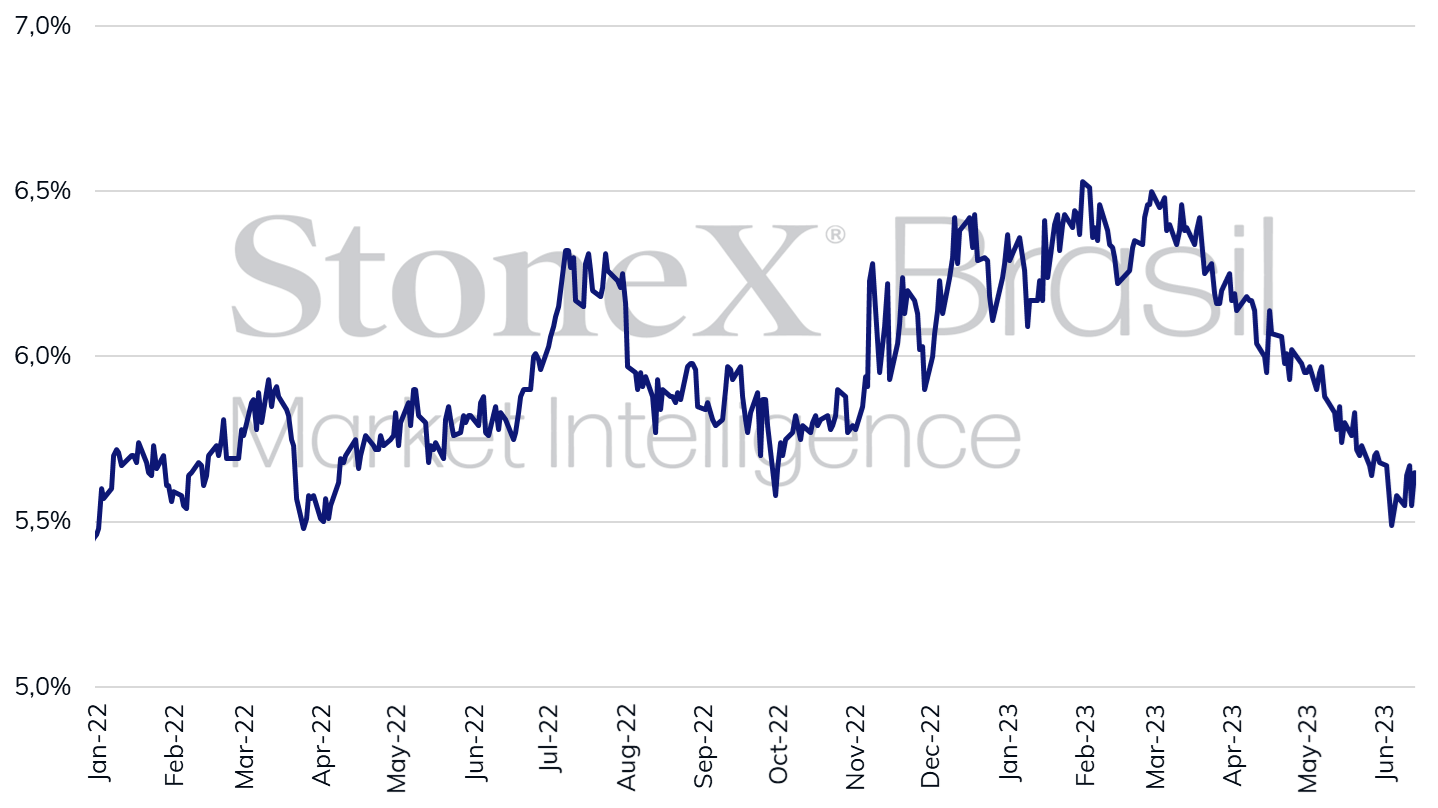
This atmosphere of investor enthusiasm can be seen in some risk appetite indicators. The spread on Brazil's 5-year Credit Default Swap contracts, a thermometer for a country's risk, is continuously declining and at its lowest level since September 2021, at 184 basis points. After four months of weak results, the balance of foreign capital flow on the B3 accumulates a surplus of BRL 6.9 billion up to mid-June. And the financing rates for National Treasury bonds, such as the NTN-B with maturity in 2045, are at their lowest level since April of last year.
Expected impact on USDBRL: Bullish
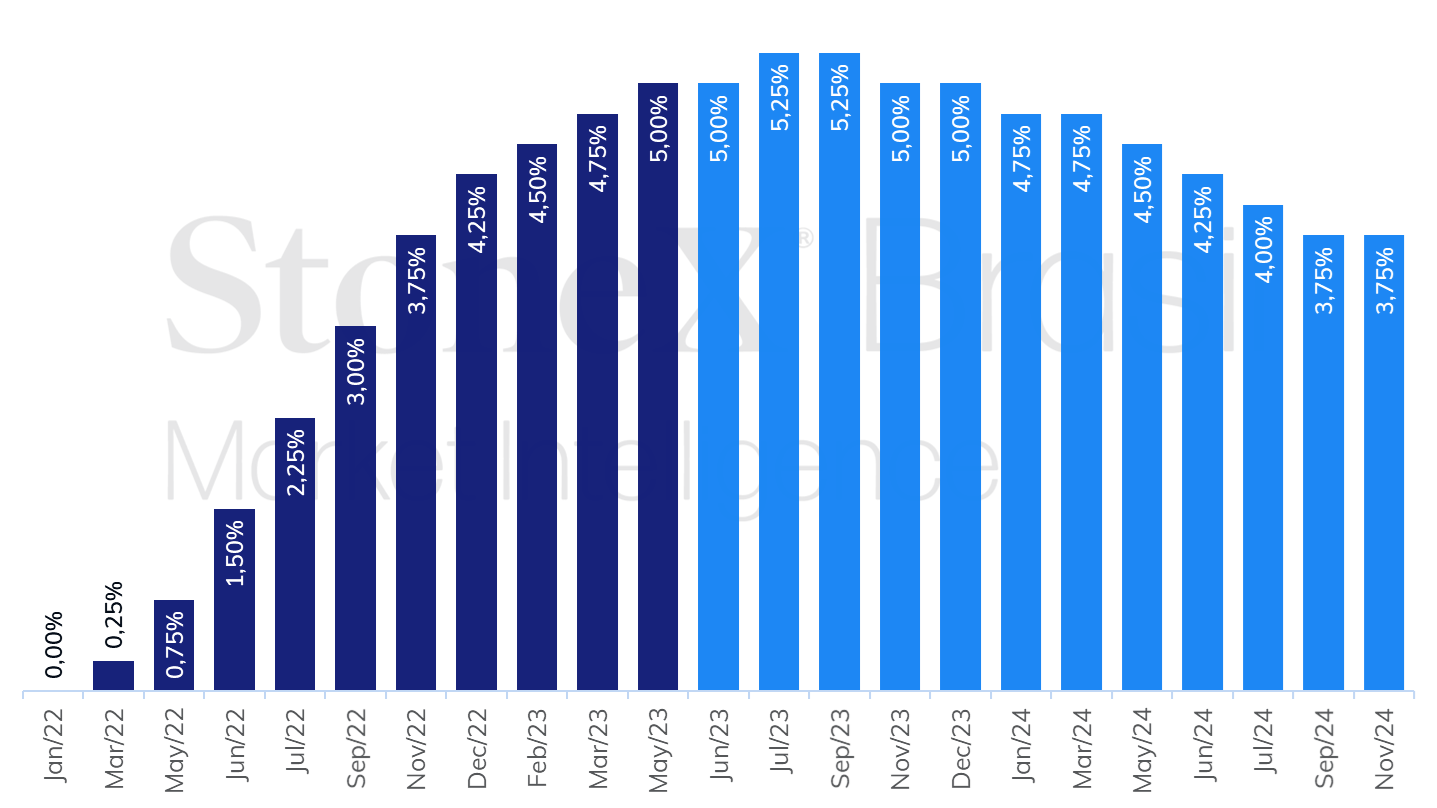
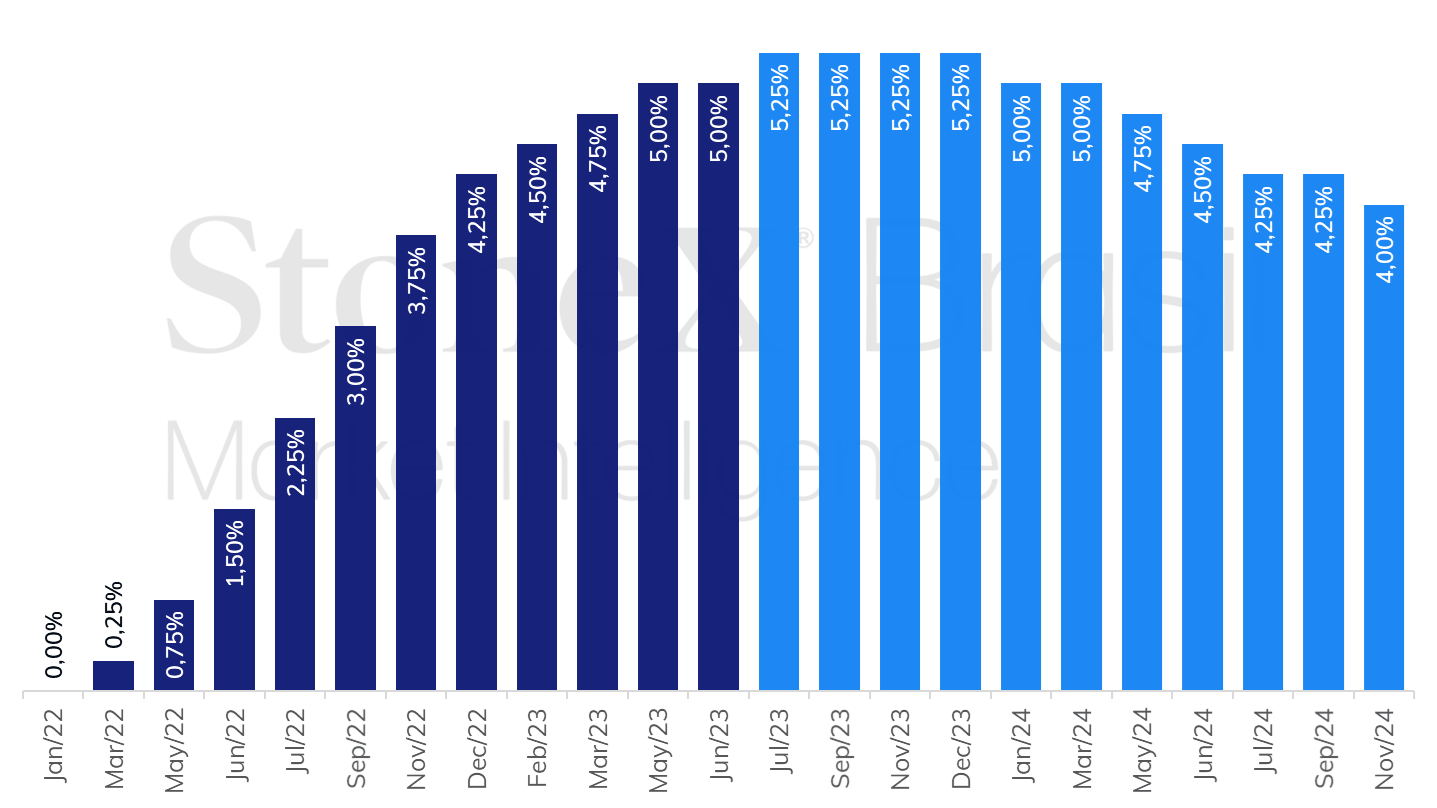
Last Wednesday's (14) decision by the Federal Open Market Committee (FOMC) of the Federal Reserve (Fed) was considered ambiguous by market players, although this was not the Committee's intention. The members of the FOMC unanimously decided to keep the basic interest rate (fed funds rate) stable between 5.00% and 5.25%, ending a sequence of ten straight adjustments. At the same time, the FOMC's summarized economic projections were updated, which foresee a more heated economy in 2023 - with higher projections for inflation, growth, and employment - and a higher final interest rate level. The projections' average is between 5.50% and 5.75%, and 16 out of 18 participants see at least one increase later this year.
What confuses analysts is why pause at this point; there is almost a consensus among FOMC members that the economy is heating up, and there is a need to raise interest rates further in 2023. During the press conference, Fed Chairman Jerome Powell sought to argue that while the Committee believes that the interest rate level will need to be higher, the balance of risks is more balanced (the comparison between the risks of inflationary overshooting and economic recession). There are benefits to gathering more information over a longer period before deciding on a further adjustment. Even so, Powell would not commit to an intention to raise interest rates in July, stating only that this decision would depend on the data collected by then. Thus, most bets on the interest rate futures market continued to point to one more 0.25 p.p. readjustment in 2023, and not 0.50 p.p. as the average projections of the Federal Reserve indicate.
This week, several Federal Reserve officials will be speaking to the public. They may seek to provide more context regarding the future path of interest rates and reaffirm the central bank's commitment that monetary tightening will continue at a more spaced-out pace, which could influence the currency’s value. Scheduled to speak this week are the Federal Reserve Chairman Jerome Powell, Federal Reserve Board Governor Lisa Cook, Federal Reserve Board Governor Philip Jefferson, St. Louis Fed President James Bullard, New York Fed President John Williams, Chicago Fed President Austan Goolsbee, Cleveland Fed President Loretta Mester, Federal Reserve Board Governor Christopher Waller, Federal Reserve Board Governor Michelle Bowman, Richmond Fed President Tom Barkin, and Atlanta Fed President Raphael Bostic.
Expected impact on USDBRL: bearish
The rapporteur of the bill for the new fiscal framework in the Federal Senate (PLP 93/2023), Senator Omar Aziz (PSD-AM), said last week that he believes the proposal should be definitively approved during this week in the National Congress. He said he wants to present his report, vote on it in the Senate Economic Affairs Committee on Tuesday (20), and take it to the Plenary on the same day. There is an agreement with the president of the Chamber of Deputies, Congressman Arthur Lira (PP-AL), for the text approved in the Senate to be voted in the Chamber the following day, Wednesday (21). Although the project has already been approved in the Chamber, Aziz should propose changes to the text, such as removing the Fundeb (Fund for Maintenance and Development of Basic Education) and the Constitutional Fund of the Federal District from the calculation of the spending limit and a change in the period used to correct public spending for inflation (December to November instead of July to June). The Legislative's approval of the fiscal framework should increase investors' optimism about Brazilian assets by stabilizing expenses and public debt, favoring the attraction of investments and thus strengthening the Brazilian real.