- The minutes from the Federal Open Market Committee (FOMC) decision should reinforce the view of the Federal Reserve members that more interest rate hikes will be necessary to combat inflation in the US, contributing to strengthening the dollar.
- Economic data in the United States should show a stable economy with a very heated job market, reinforcing the perception that the Federal Reserve will need to maintain monetary tightening for longer to restabilize prices.
- Approval of important economic agendas for the government in the Chamber of Deputies can reduce the perception of political risks of Brazilian assets and contribute to the attraction of investments, strengthening the real.
- The update of the Focus Bulletin should bring new favorable estimates for the main Brazilian macroeconomic variables and reinforce the optimistic perception of the country's business environment, strengthening the Brazilian real.
The week in review
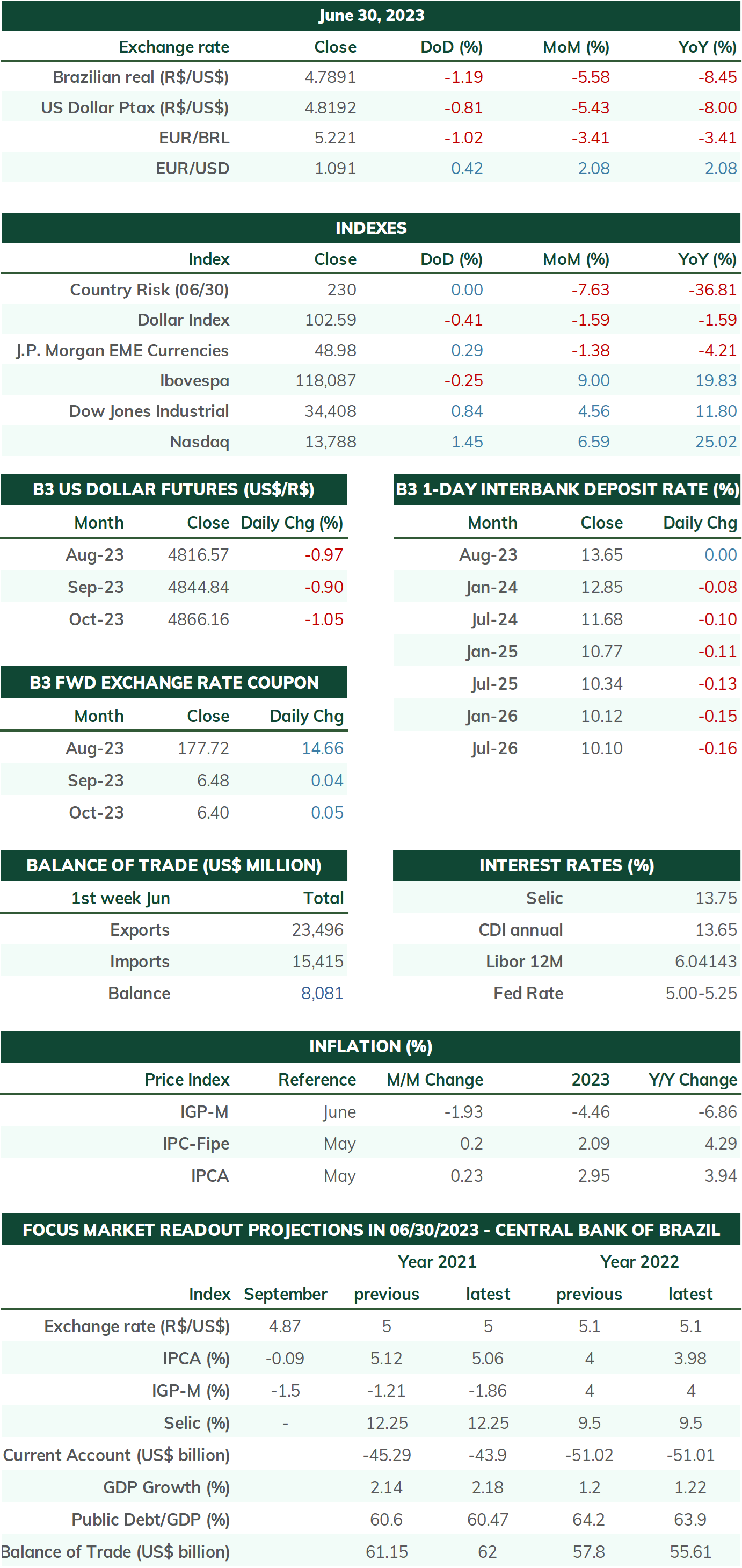
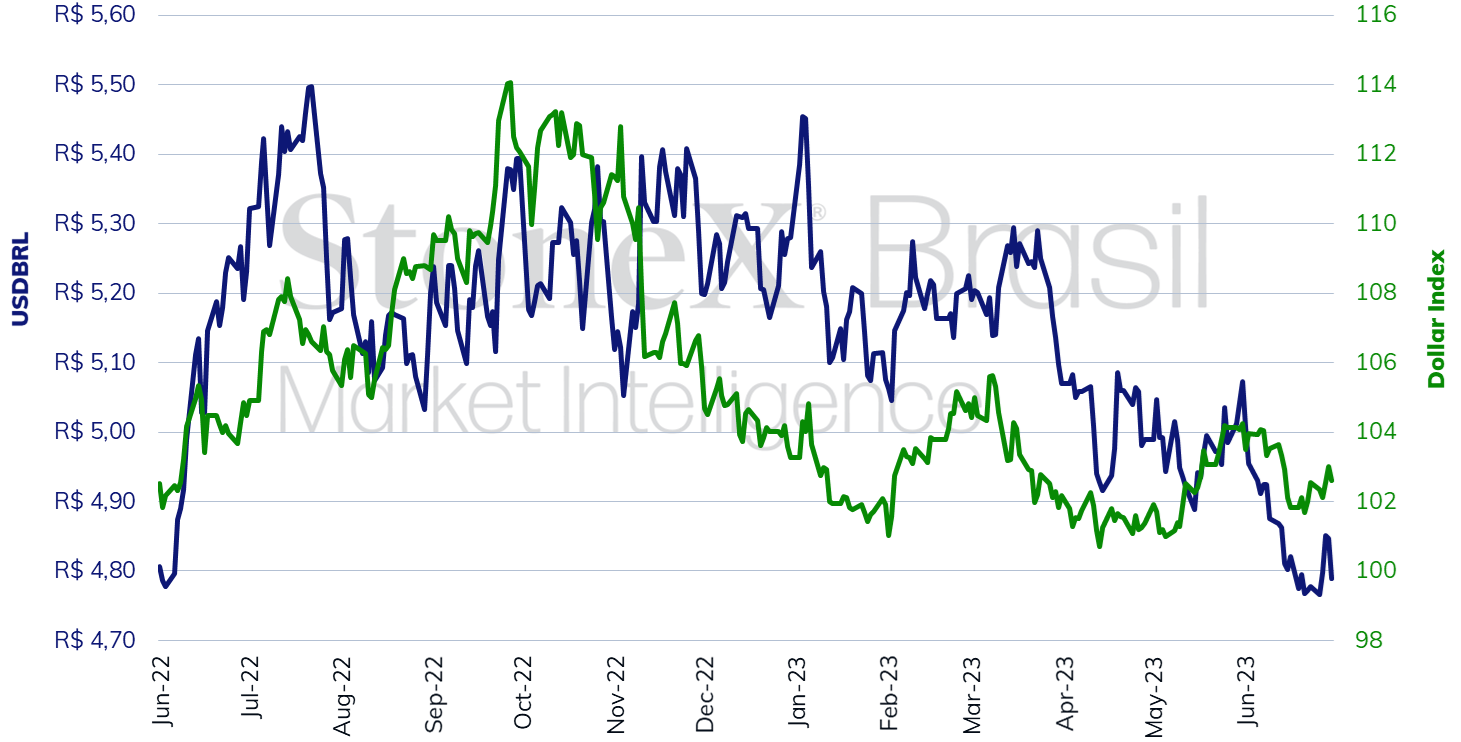
The USDBRL interrupted a five-week decline sequence to close this Friday's (30) session quoted at BRL 4.789, a weekly gain of 0.2% but a monthly drop of 5.6% and an annual of 9.3%. The dollar index closed Friday at 102.6 points, a variation of +0.1% for the week, -1.6% for the month and -0.6% for the year. The foreign exchange market reflected a strong movement of technical correction in Brazil, with reports of significant profit remittances abroad due to the accumulated gains in the month. Abroad, the American currency reflected the release of the American Gross Domestic Product (GDP) for the first quarter above the estimated and the Personal Consumption Expenditures (PCE) Price Index with mild values for May.
Expected impact on USDBRL: bearish
The week should hold a full legislative agenda for the Chamber of Deputies. Returning from an event in Portugal, the president of the Lower House, Deputy Arthur Lira (PP-AL), stated that he "arranged a concentrated effort" with the Minister of Finance, Fernando Haddad, and scheduled for consideration in Plenary the bill on the tie-breaking vote in the Administrative Council of Tax Appeals - Carf (PL 2.384/2023), the final analysis of the text of the complementary bill of the fiscal framework (PLP 93/2023) and the voting of the Constitutional Amendment Proposal that aims at tax reform in the country (PEC 45/2019).
The first bill recreates the so-called "quality vote" of the Carf. The Council is a parity administrative body that judges disputes between taxpayers (individuals and legal entities) and the federal government in relation to tax payments. With the reestablishment of the "quality vote,” in cases of tie votes, the decision would be broken by the National Treasury’s counselors - in favor of the Union.
The fiscal framework needs a final analysis by the Plenary of the Chamber of Deputies, as the text approved in the Federal Senate differed from the one approved by the Chamber. The procedural rite requires that the deputies analyze only the amendments to the project, that is, the points modified by the senators, accepting the suggestions or returning to the text initially approved in the Lower House.
Finally, the tax reform would go through a first review by the deputies. Since it is a constitutional amendment, it requires two favorable votes in the Chamber and two in the Senate to approve the PEC. Last week, the rapporteur of the proposal, Deputy Aguinaldo Ribeiro (PP-PB), presented his preliminary opinion on the project, which, among its main measures, includes the extinction of four taxes - IPI, PIS and Cofins (federal), ICMS (state) and ISS (municipal) - and their replacement by two new Value Added Taxes (VAT): the Tax on Goods and Services (IBS), unifying the ICMS and the ISS, and the Contribution on Goods and Services (CBS), in place of the IPI, PIS and Cofins. In addition to the simplification obtained with the reduction in the number of taxes, the change aims to neutralize the collection of taxes by avoiding their cascading throughout the production chain, which ends up placing too heavy a burden on more complex industrial activities. In the proposal, tax collection would no longer occur at the origin of the operation (production or sale), as it is currently, but at the destination, where the consumption of the good or service in question occurs. The report forecasts the transition to the new taxes over eight years between 2026 and 2033, with the gradual introduction of the CBS starting in 2027 and the IBS starting in 2029. The change of charging from origin to destination would occur over 50 years, defined by the governors, between 2029 and 2078.
Expected impact on USDBRL: Bullish
Last week, the disclosure of the Gross Domestic Product (GDP) for the first quarter of 2023 and the Personal Consumption Expenditure (PCE) Price Index for May boosted investors' risk appetite by suggesting that economic growth in the US remains resilient, yet inflationary pressures are losing pace. Thus, this week, investors should focus on the economic activity data and the labor market in the United States, with its implications for the monetary policy of the Federal Reserve.
Firstly, the Purchasing Managers' Index (PMI) for June manufacturing and services will bring an updated reading of the country's situation. The scenario for the industry is of contraction, both in the United States and the major global economies, while the prices of industrial goods are in decline. The service sector activity should grow moderately, just like in May, while the prices of services accelerate with greater vigor.
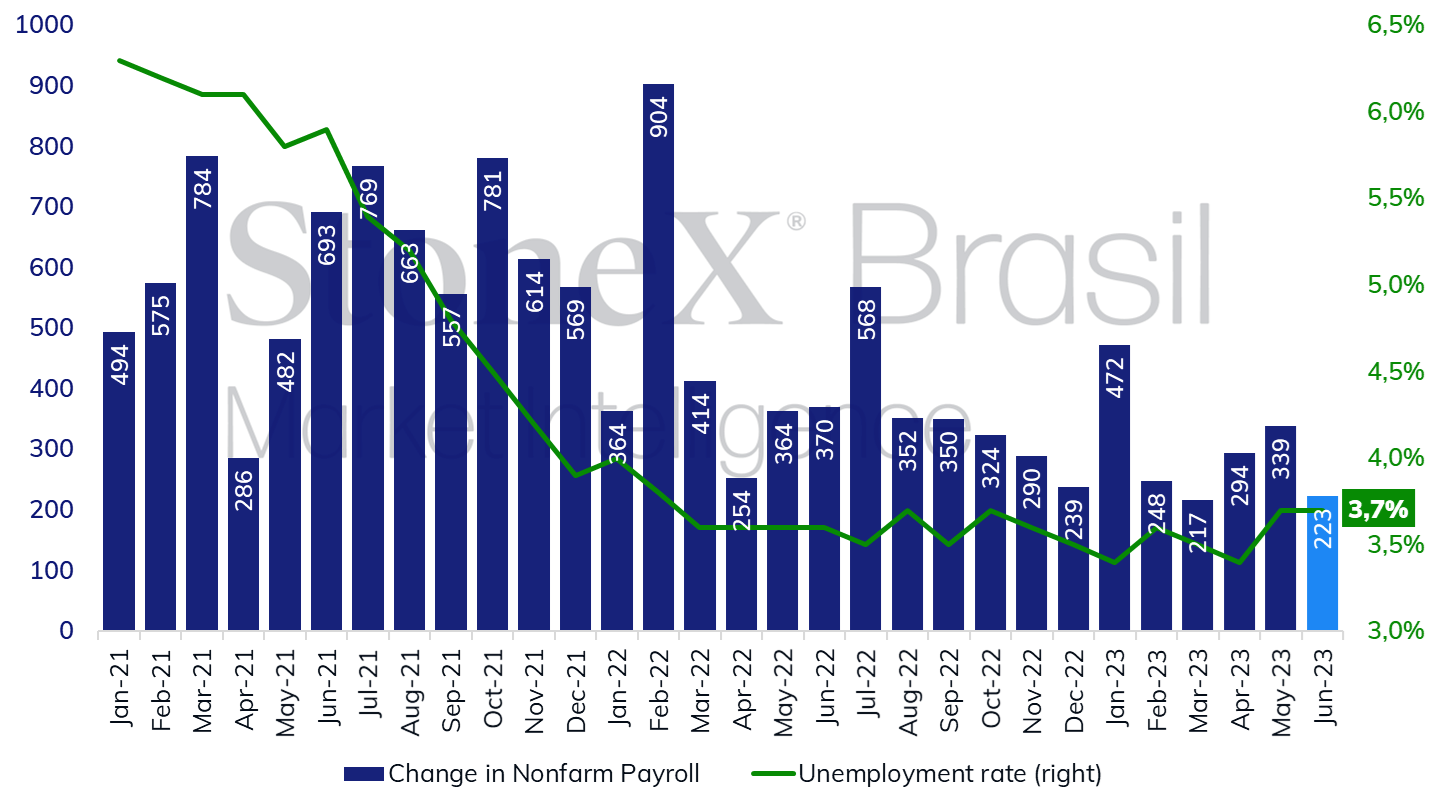
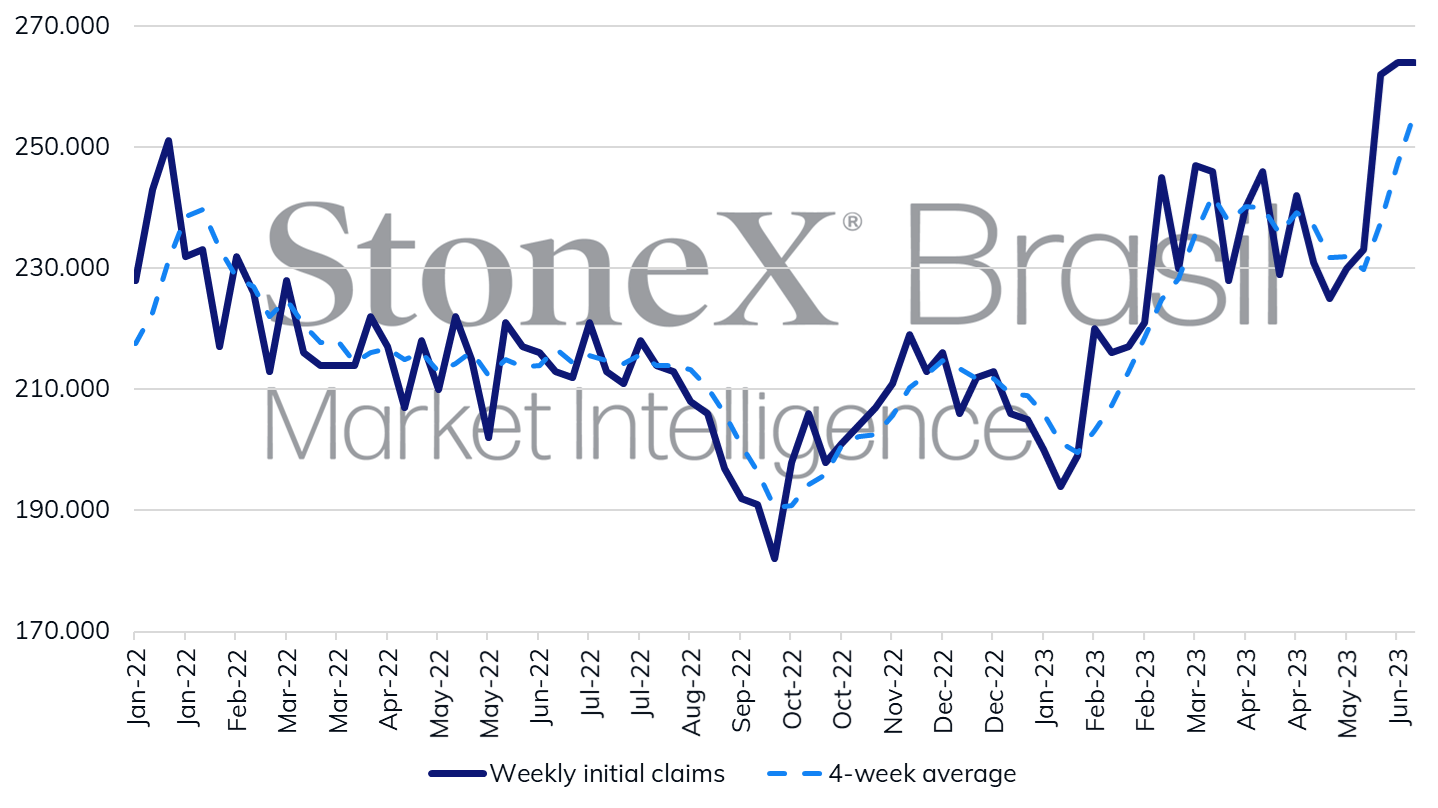
The reading for the job market in June should show another month of net job creation in the country, corroborating interpretations that the demand for labor continues to be high in organizations and that the availability of workers is still scarce. On the other hand, in the last few weeks, weekly unemployment benefit claims have seen a considerable increase, signaling what could be the start of a weakening process in the country's job market that could take some time to reflect in other indicators, such as the monthly job creation balance and unemployment rate.
Expected impact on USDBRL: Bullish
The Federal Open Market Committee (FOMC) adopted a dichotomous stance in its June monetary policy decision. On the one hand, its members decided to keep the basic interest rate unchanged, ending a cycle of ten consecutive increases after fifteen months and keeping it between 5.00% and 5.25% per annum. On the other hand, the Committee signaled its intention to make further adjustments throughout the year by revealing in its summarized economic projections that 16 of its 18 members foresee at least one more increase, with a median between 5.50% and 5.75% per year. Due to this contradiction, investors have not changed their bets on American interest rates. They continue to predict that the FOMC will adjust its rate one last time in July, raising it to a level between 5.25% and 5.50% per annum. Still, they have extended their forecasts on when a possible interest rate cut would begin to the first quarter of 2024. Given the high degree of dispersion for the American interest rates estimates among the members of the FOMC, the minutes of the meeting can provide greater context about the divergences within the Committee and clarify if there was any discussion about the July meeting.
Expected impact on USDBRL: Bearish
As widely expected, the National Monetary Council (CMN) changed the format of the inflation targets system in Brazil, ceasing to indicate targets for a calendar year and adopting a regime of a longer-term continuous target starting from 2025, keeping the target at 3.0% and the tolerance range at 1.5 percentage point. The new research from the Focus Bulletin on Monday should maintain its trajectory of favorable revisions for economic growth and inflation estimates, especially after the Central Bank improved its forecasts in its Quarterly Inflation Report in June.