- Economic data in China should reinforce the perception that demand in the country is slowing down, which could hurt the performance of risky assets such as commodities and currencies of commodity-exporting countries such as the Brazilian real.
- The approval of the tax reform and the Carf Law may improve the perception of tax risks of Brazilian assets and reinforce the optimistic perception about the business environment in the country, strengthening the real.
- Inflation data for June in Brazil should reinforce the perception that inflation is slowing down and that there is room for the Central Bank to start cutting the basic interest rate (Selic) in August, strengthening the real.
- Inflation data for June in the United States may help interpret that inflation in the country is slowing down, reinforcing bets that the Fed's cycle of interest rate hikes is nearing an end.
The week in review
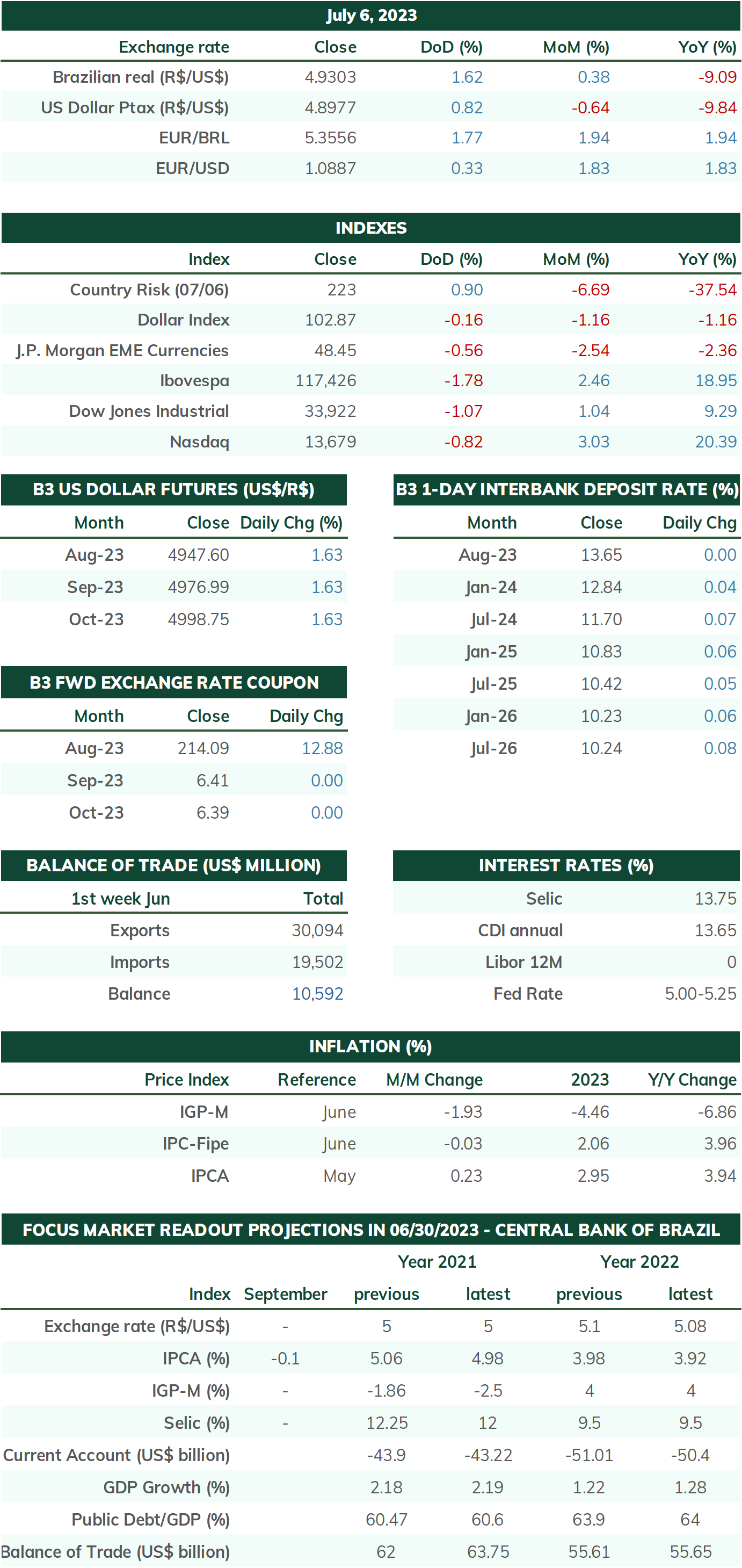
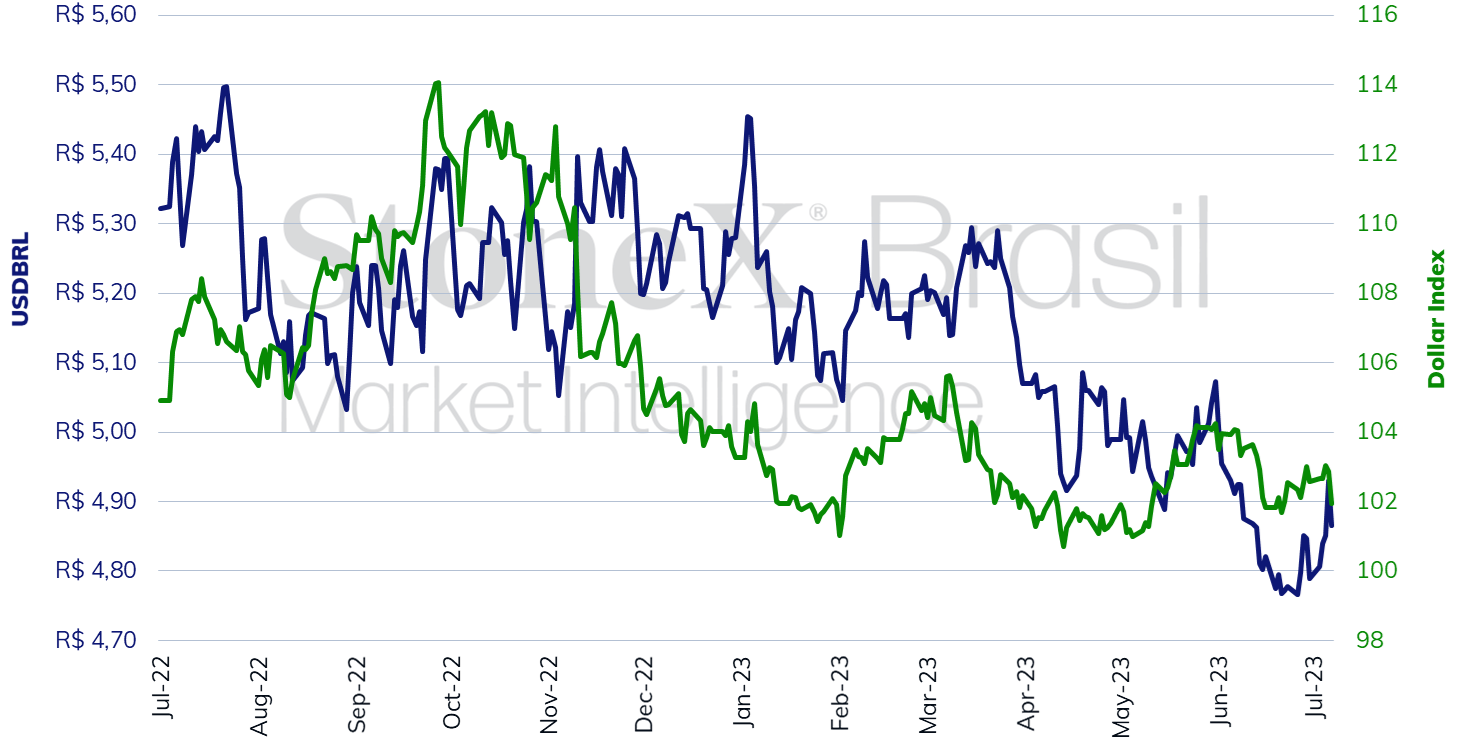
The USDBRL ended the week higher, ending Friday's session (07) quoted at BRL 4.865, a variation of +1.6% in the week, +1.6% in the month and -7.9% in the year. The dollar index, meanwhile, closed Friday's session quoted at 102.0 points, a weekly retreat of 0.6%, monthly of 0.6%, and annual of 1.3%. The foreign exchange market reflected the government's difficulty in advancing its economic agenda in Congress, exposing the Administration's difficulty articulating with the Chamber of Deputies. Abroad, the US currency weakened in a week of less liquidity due to a US holiday and lower than estimated labor market data for June.
Expected impact on USDBRL: bearish
Last week, Brazilian assets experienced strong volatility due to the Chamber of Deputies' difficulty moving forward with its planned "concentrated effort week" to consider economic issues. The president of the Chamber, Arthur Lira (PP-AL), had scheduled the analysis of the bill on tie-breaking vote in the Administrative Council of Tax Appeals - Carf (PL 2.384/2023) for Monday (03), the final analysis of the text of the bill to complement the tax framework (PLP 93/2023) for Tuesday (04) and the rest of the week for the vote in two rounds of the Proposed Amendment to the Constitution aimed at tax reform in the country (PEC 45/2019). However, due to disagreements among parliamentarians and difficulties in articulating with the federal government, no project was considered until Thursday. On Thursday night, deputies approved, in two rounds, the constitutional amendment of the tax reform, and the Carf law was expected to be approved on Friday. On the other hand, the fiscal framework's final approval will probably not occur until August.
The impasse exposed several problems in the way these projects were handled. The text of the Carf law was only made available hours before its vote and included points supposedly not agreed upon between the party leaders and the government's economic team. Since this bill was in a state of urgency, the Constitution states that no further votes could take place before its consideration in the Plenary. However, without making any progress in solving this impasse, Lira stated that constitutional matters could be voted on and proceeded to vote on the PEC, threatening a possible legal challenge to the session that approved the tax reform. The tax reform text was also presented on the eve of its vote without any analysis of its economic or fiscal impact. Finally, Congress will enter an "informal recess" starting next week, although the Constitution states that there can be no mid-year recess until the Budget Guidelines Law - which will not be voted on until August - has been voted on.
In any case, most analyses project that the approval of the tax reform and (possibly) the Carf Law should contribute to strengthening the BRL. The first is because it is a relevant victory for the federal government since the project intends to increase the country's fiscal competitiveness and has the potential to attract foreign investments. And the second is because it is an important tool to raise tax revenues (an estimated BRL 50 billion) and help achieve the primary surplus targets established in the new fiscal framework.
Expected impact on USDBRL: bearish
After surprising favorably in May, the National Broad Consumer Price Index (IPCA) is expected to decline in June, reinforcing the interpretation that inflationary pressures are reducing in the country. The median of the estimates points to a variation of -0.10% in the monthly value, accumulating a high of 3.15% in 12 months. The data should contribute to the bets that the Central Bank will start its cycle of cuts in the basic interest rate (Selic) in its next decision in August. Currently, the interest rate futures market is pricing a reduction of 0.50 p.p. in August.
Expected impact on USDBRL: bearish
The release of the Consumer Price Index (CPI) for June in the United States should reinforce the perception that the Federal Reserve's cycle of interest rate hikes is nearing an end (although it is almost consensus that the central bank will raise the rate by 0.25 p.p. at the end of July). The median of the estimates for the full index is for a 0.3% increase in the monthly figure and a 12-month accumulated high of 3.1%, while the core inflation figure (which excludes volatile components such as food and energy) is expected to increase by 0.3%, with a 12-month accumulated high of 5.0%. The inflationary problem in the United States is more related to the resilience in service prices and the growth in labor costs than to industrial goods, whose prices have been falling for some months now. Therefore, the fall of the full index has been faster than that of core inflation, as energy prices, in particular, are falling sharply.
Expected impact on USDBRL: Bullish
China's economic agenda this week may hurt the performance of risky assets such as commodities and currencies of emerging countries like Brazil. On Monday, the country's inflation figures are expected to remain extremely subdued, suggesting that the recovery in demand remains below projections. The trade balance data should also signal the deceleration of global demand (by the fall in Chinese exports) and domestic demand (by the fall in imports). There has long been speculation about the possibility of Chinese authorities enacting economic stimulus measures for the country, but they have been rare and unsatisfactory so far.