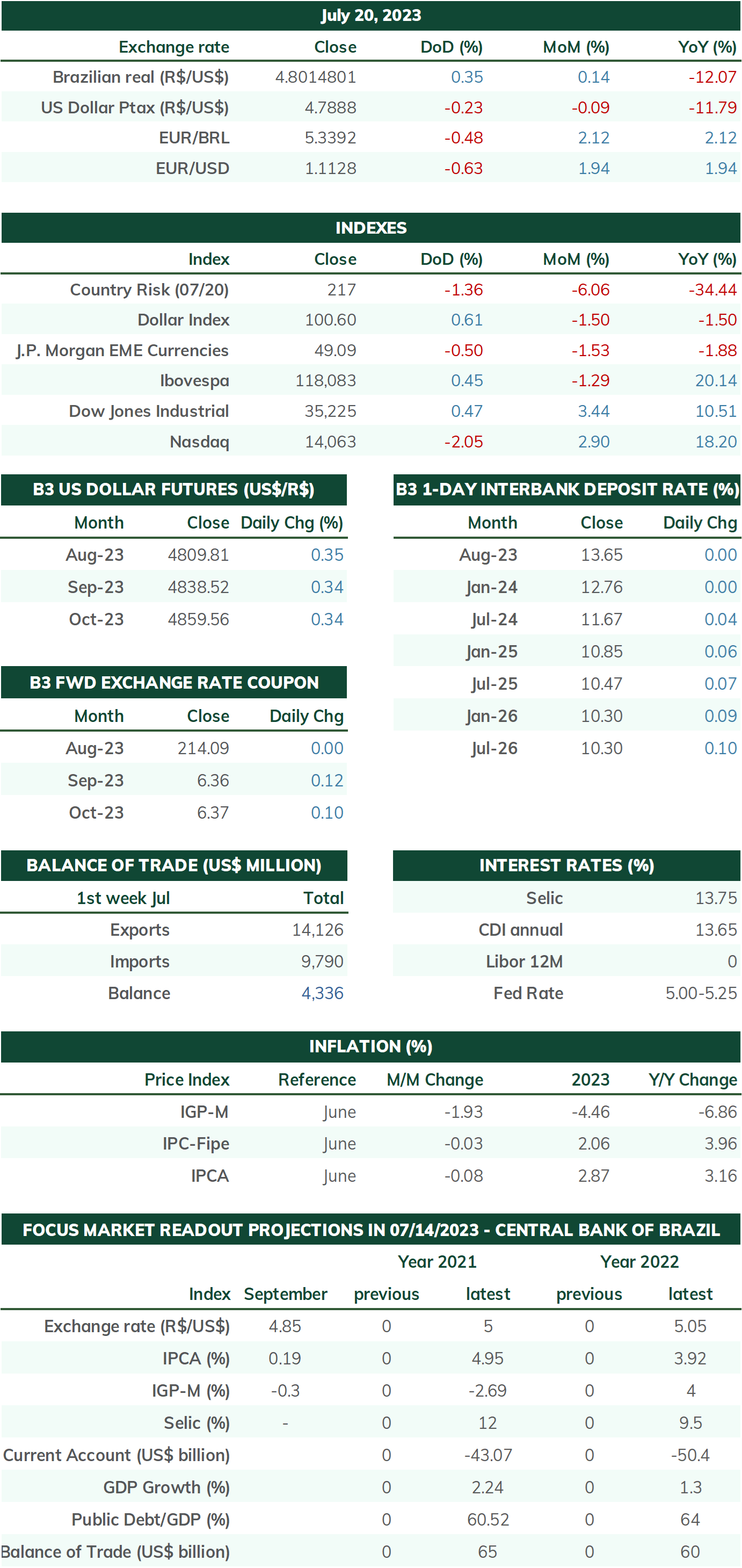
- Interest rate hikes by the Federal Reserve and Jerome Powell's speech relativizing recent moderations in inflation and advocating further readjustments may contribute to strengthening the dollar.
- Higher interest rates by the European Central Bank, and a possible indication of further increases, should strengthen the euro against other currencies and weaken the real.
- Economic data in the US could reinforce the perception that inflation in the country is moderating and consolidate expectations that the Fed's cycle of interest rate hikes will end, weakening the dollar.
- Economic data in Brazil may reinforce the perception that inflation in the country is moderating, and there is room for the Central Bank to initiate cuts to the basic interest rate (Selic) in August, strengthening the real.
The week in review
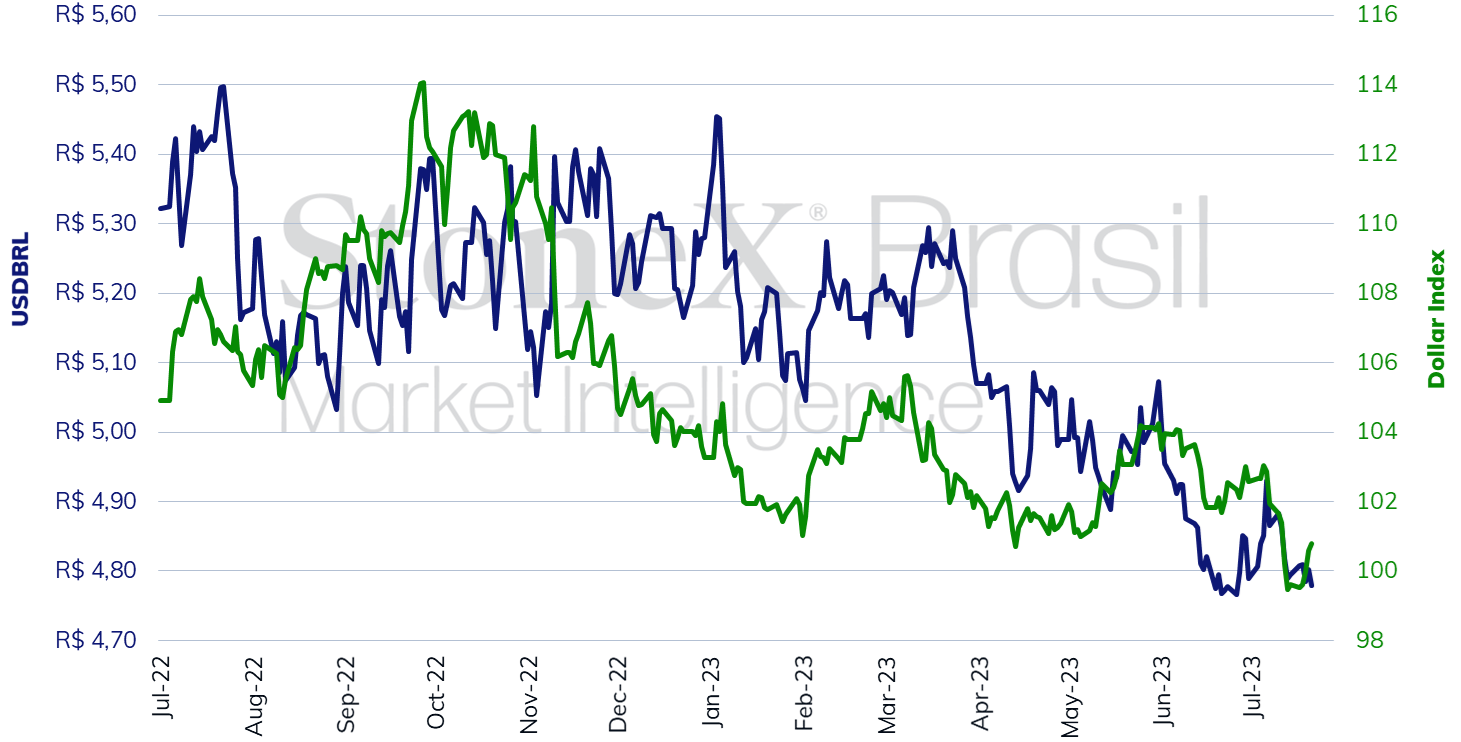
The USDBRL ended the week lower, ending Friday's session (21) quoted at BRL 4.780, a weekly decline of 0.3%, monthly of 0.2% and annual of 9,5%. The dollar index closed this Friday's session quoted at 100.8 points, a variation of +1.2% in the week, -1.7% in the month and -2.4% in the year. In a week of few items on the agenda, the foreign exchange market reflected the weak data for gross domestic product in China, the moderation of inflation in Europe and the United Kingdom and the improvement of economic projections for economic growth and inflation in Brazil.
Expected impact on USDBRL: bullish
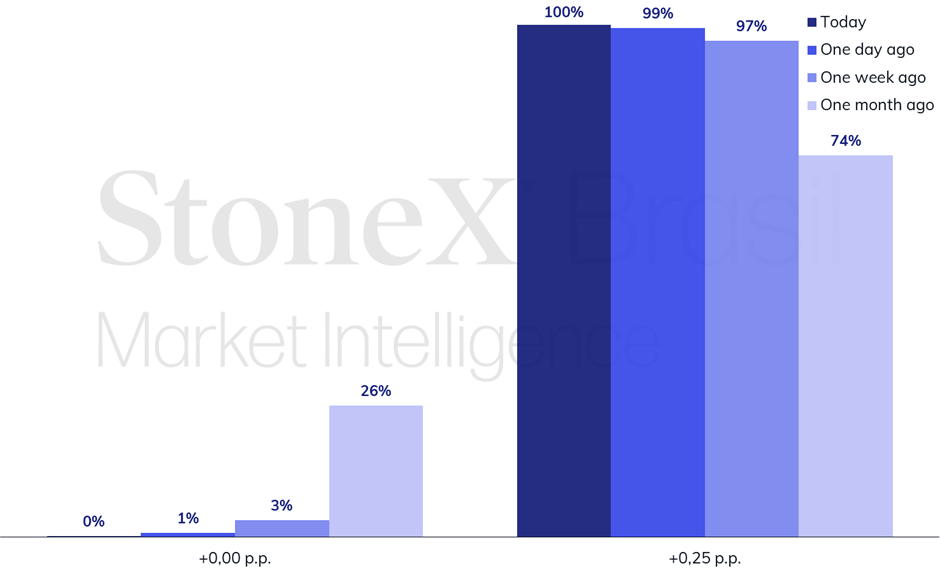
The investors' attention this week should be the monetary policy decision of the Federal Open Market Committee (FOMC) on Wednesday (26), whose bets on the interest futures market point almost unanimously to a readjustment of 0.25 p.p. to the US basic interest rate, raising it to the range between 5.25% and 5.50% p.a.
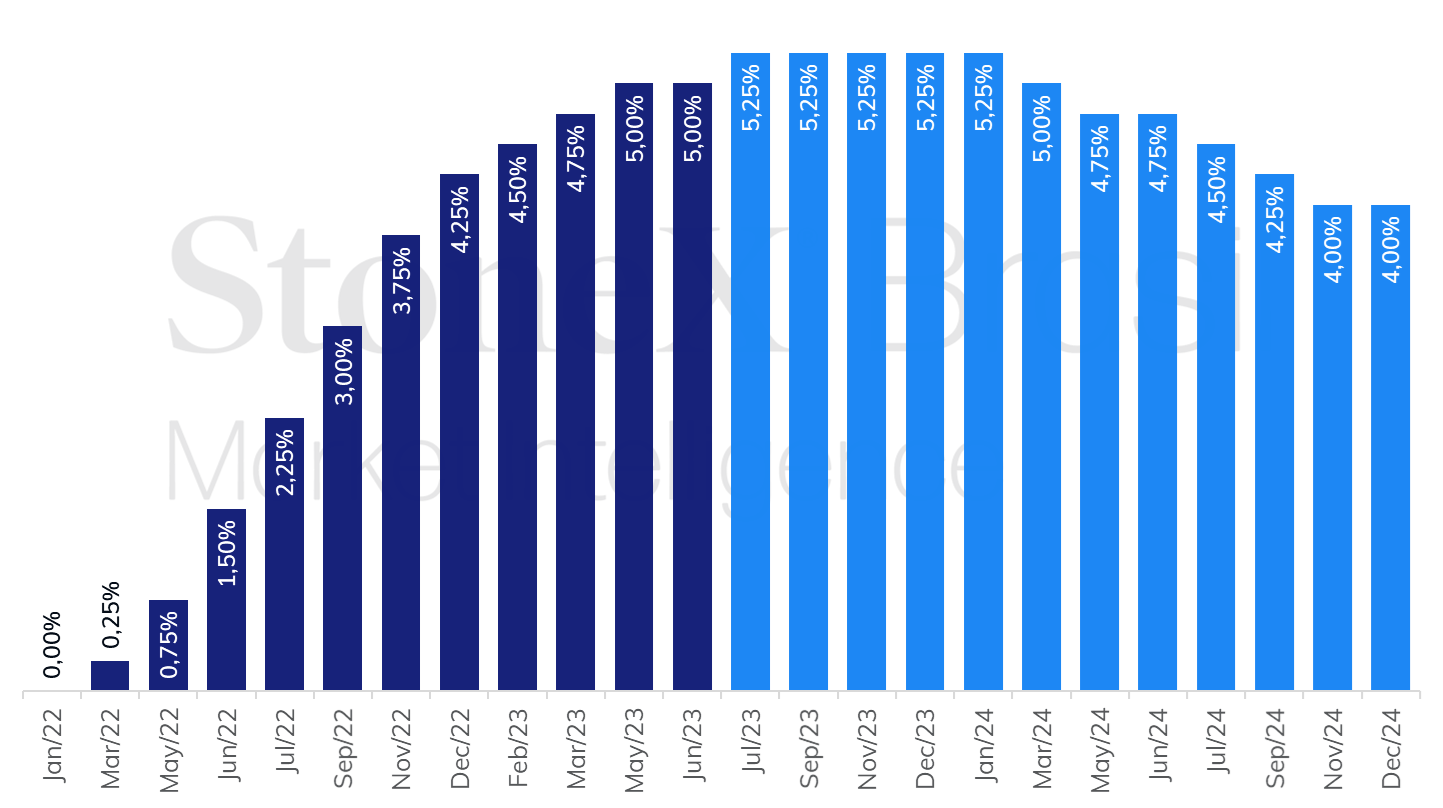
Fed Chairman Jerome Powell is expected to reaffirm, once again, that the committee is determined to recover price stability in the country and that the latest projections released in June point to another readjustment in the future. Powell should also relativize the recent inflationary moderation, mentioning the need for more data confirming a disinflation trend. However, after the release of softer data for the labor market and, especially for June inflation in the United States, analysts anticipate that this should be the last interest rate increase, ending the monetary tightening process after 16 months and 5.25 basis points. In addition, rather than believing that this will be the maximum point, bets on the future market anticipate aggressive cuts to US interest rates from the first quarter of 2024 because they anticipate a weakening of economic activity, the labor market and price pressures that would require an easing by the US central bank.
Expected impact on USDBRL: bearish
It is also worth noting the release of US economic data this week. On Thursday (27), the first preview of the Gross Domestic Product of the second quarter will be released, with an expected growth of 1.8%. And on Friday (28), the Personal Consumption Expenditures (PCE) price index will be published, with expectations of a slowdown for both the general index and its core, which excludes the volatile components of food and energy, as observed with the Consumer Price Index (CPI) two weeks ago, consolidating expectations of the end of the interest rate hike cycle in the US.
Expected impact on USDBRL: bearish
In a busy week, with fiscal, external sector, monetary and credit statistics and data for the labor market, it is worth highlighting the release of the National Broad Consumer Price Index 15 (IPCA-15) of July, the last inflationary reading before the decision of the Monetary Policy Committee (Copom) next week. Investors are waiting for a new slowdown in the data. They will pay special attention to the figures of the core index and service prices, which have shown a slower fall and have been the focus of the Central Bank's concern when considering the possibility of monetary easing.
Expected impact on USDBRL: bullish
This week, the European Central Bank (ECB) is expected to readjust its key interest rate by 0.25 p.p., raising it to 3.75% p.a. In recent monetary policy decisions, the ECB has signaled its intention to maintain the pace of interest rate hikes for the next decisions, citing the resilience of the core price indices as the main motivator of its monetary tightening. However, given the recent moderation in this metric in recent months, analysts wonder if the euro area central bank will maintain this signal of another interest rate hike for the subsequent decision or if, possibly, the monetary authority will indicate the possibility of a pause in readjustments.