- The possible shutdown of US government activities due to a lack of consensus among members of Congress for a new Budget may promote a cautious and risk-averse environment among investors, harming the performance of risky assets, such as the BRL.
- Data for the American economy should reinforce the perception that productive activity and the labor market remain strong, which, in turn, corroborates the interpretations that interest rates in the country will remain higher for longer and contribute to strengthening the USDBRL.
- Possible approval of government economic agendas by Congress can reduce the perception of political risks of Brazilian assets, contributing to the attraction of investments and thus strengthening the BRL.
The week in review
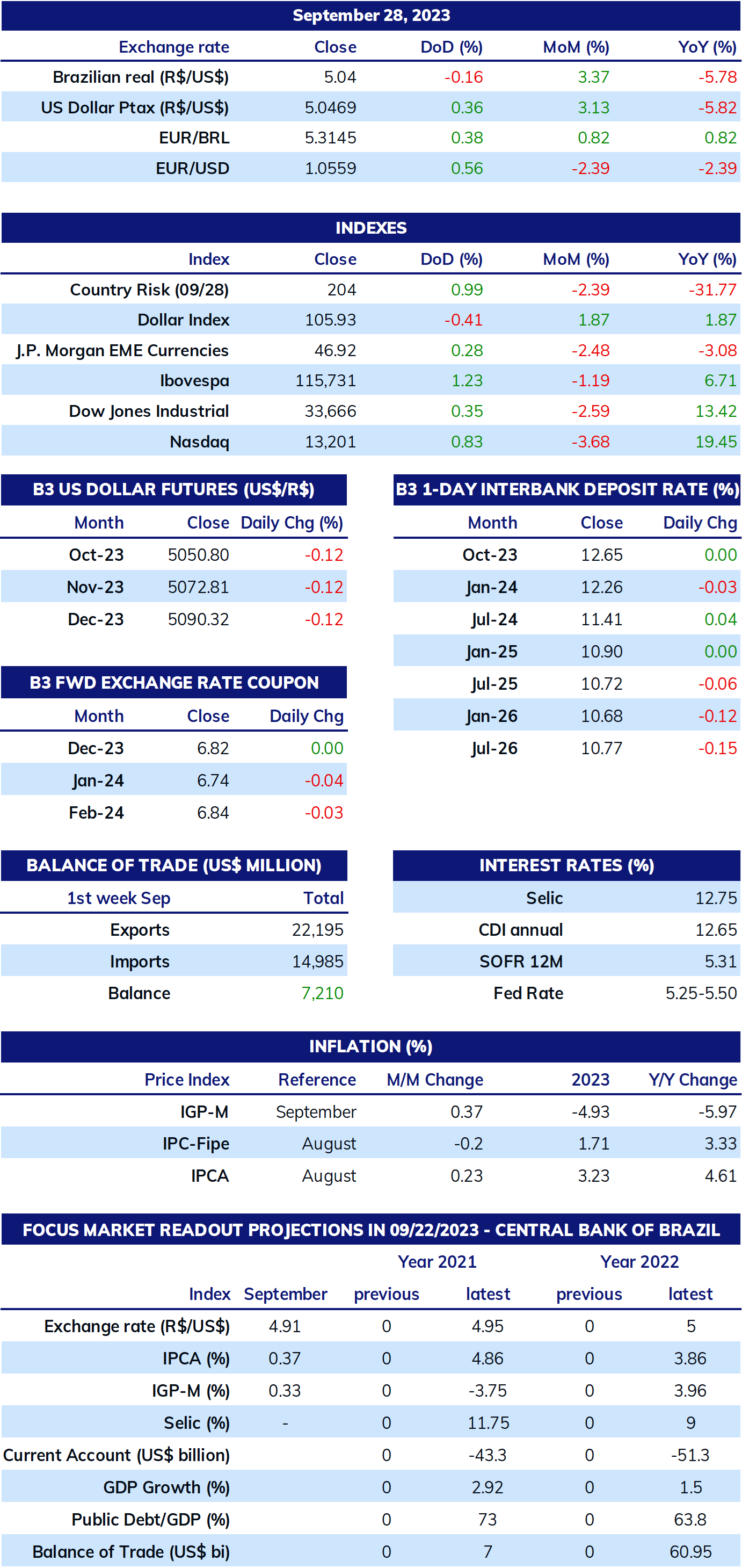
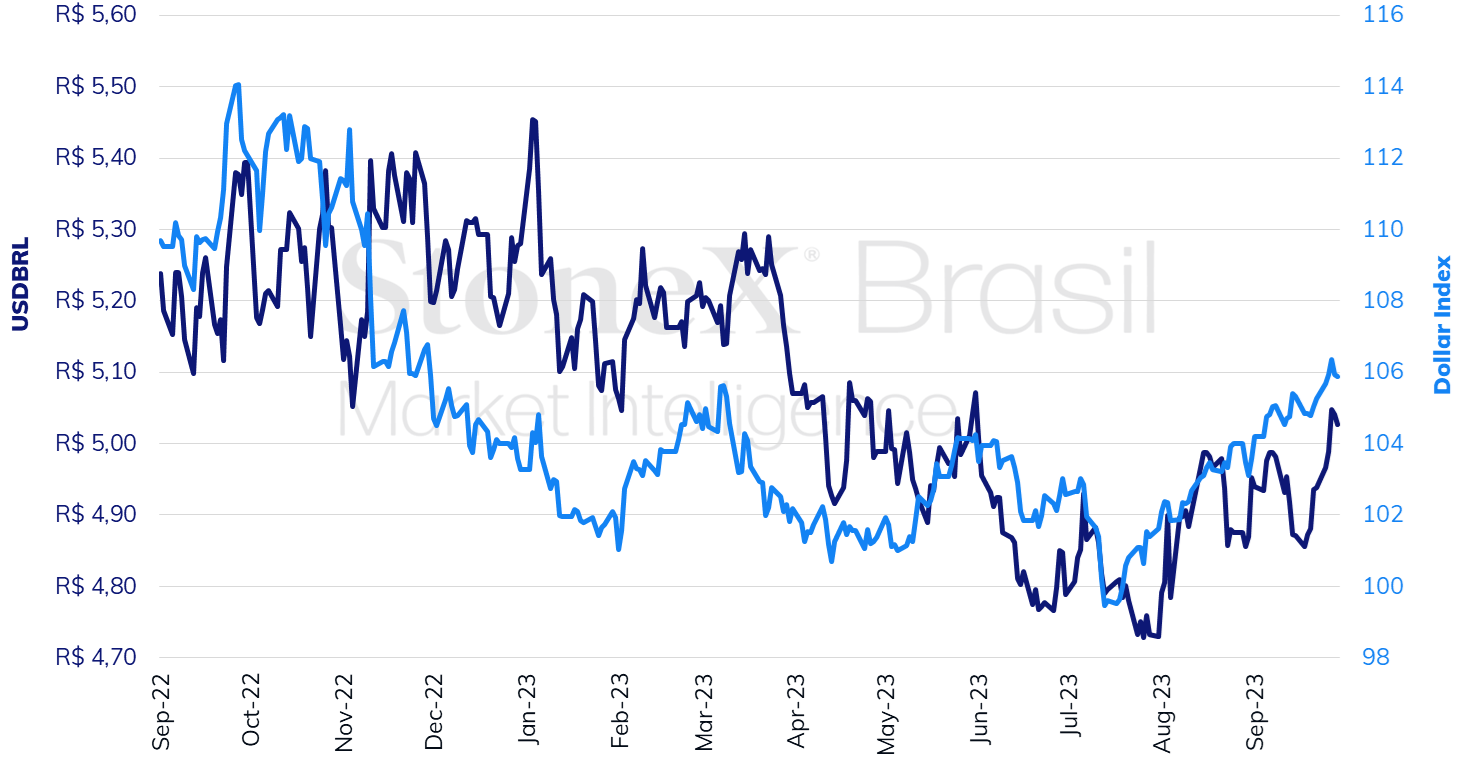
The USDBRL ended the week higher, closing Friday's session (29) at BRL 5.0273, a variation of +1.8% for the week, +1.5% for the month, and -4.8% for the year. The dollar index closed higher for the eleventh consecutive week on Friday's session, with a weekly gain of 0.6%, a monthly gain of 2.2%, and an annual gain of 2.5%. The foreign exchange market reacted to the continuous and sustained rise in US Treasury yields, the release of the minutes of the Monetary Policy Committee (Copom) decision, the release of inflation data for Brazil, the United States, and Europe, and the formation of the end-of-month Ptax rate.
Expected impact on USDBRL: bullish
Investors' attention this week should be the likely shutdown of the US government, the 22nd since 1976. The country's Congress had approved a Budget that funded the activities of the public sector until September 30 of this year, and the House and the Senate must approve new budget laws (called "appropriations bills") that fund the government after that date. Without the approval of a new Budget, all federal activities considered non-essential are halted, impacting the dynamics of the financial market by preventing government agencies' publication of important statistics. For example, the September Employment Situation Report and the August Job Openings and Labor Turnover Survey (JOLTS) may not be released next week.
It is difficult to try to predict how long this shutdown can last. The impasse lies mainly in the House of Representatives, where the Republicans have a small majority, and a group of ultraconservatives refuses to approve any new Budget that does not involve deep cuts in areas they consider less important. However, these areas are precisely the most strategic for the Democrats, who have a majority in the Senate and would refuse to approve this proposal. The Senate has already sent alternatives, approved in a bipartisan manner, to the House, but this group has refused to yield.
Additionally, the credit rating agency Moody's, the last of the three major agencies that still rates the US sovereign bond as "triple A" (highest possible rating), warned last week that a new shutdown would harm the country's credit rating, as it would highlight a weakening of fiscal policy in a time of rising public debt and pressures to address its sustainability. "Fiscal policymaking is less robust in the U.S. than in many Aaa-rated peers, and another shutdown would be further evidence of this weakness," wrote Moody's. A negative review by this agency could reinforce an external environment of risk aversion and search for safe assets, potentially weakening the Brazilian real.
Expected impact on USDBRL: bullish
Among the data that will certainly be released this week, it is worth highlighting the Purchasing Managers' Index (PMI) for September by the ISM institute, both for the industrial activity and the services sector. The September data should maintain the pattern of previous months, that is, show contraction (reading below 50 points) for industry and expansion (above 50 points) for services. In recent months, the growth of the American economy has exceeded analysts' estimates by remaining stable even in the face of a cycle of interest rate hikes by the Federal Reserve (Fed). Similarly, requests for unemployment assistance continue to suggest a labor market with high demand for labor and few signs of weakening. Both indicators can contribute to the perception that interest rates in the United States must remain high for a long period to ensure that inflation returns to the Fed's target, strengthening the dollar against other currencies.
Expected impact on USDBRL: bearish
Two weeks after the entry of the center-right party (Centrão) into the coalition supporting the government in Congress, conflicts in the relationship between the Executive and the Legislative branches continue to surface. Last week, the President of the Chamber of Deputies, Arthur Lira (PP-AL), publicly complained about the delay of the Administration in implementing the changes in the leadership of Caixa Econômica Federal and threatened to "block" the voting agenda until the agreement was fulfilled. Later, after a meeting between Lira and the Minister of Finance, Fernando Haddad, the parliamentarian committed to submit three important projects for voting next week, namely, the Provisional Measure proposing to tax exclusive investment funds, offshore funds, and the Legal Framework for Loan Guarantees. Already in the Federal Senate, there must be an extraordinary session to vote on the Desenrola bill, which limits credit card interest rates. After a better-than-expected start, the articulation of the federal government's priority projects with the National Congress has been slow and subject to criticism. Accordingly, the approval of these measures can be well evaluated by investors and reduce the perception of political risks of Brazilian assets, contributing to the attraction of investments and thus strengthening the BRL.