FX Overview: Key Events of the Week
- Bearish factors
- Slowing of the US labor market in March could increase fears of an economic slowdown in the country and boost bets on interest rate cuts by the Federal Reserve, weakening the dollar globally.
- Bullish factors
- Announcement of import tariffs by the Trump administration is expected to heighten fears of a global “tariff war” and increase investors’ risk aversion, boosting demand for “safe haven” assets and hurting the performance of the real.
The week in review
The week was marked by uncertainties and concerns regarding US import tariffs, with fears that the US could trigger a global “tariff war” and damage both its own economy and that of other countries.
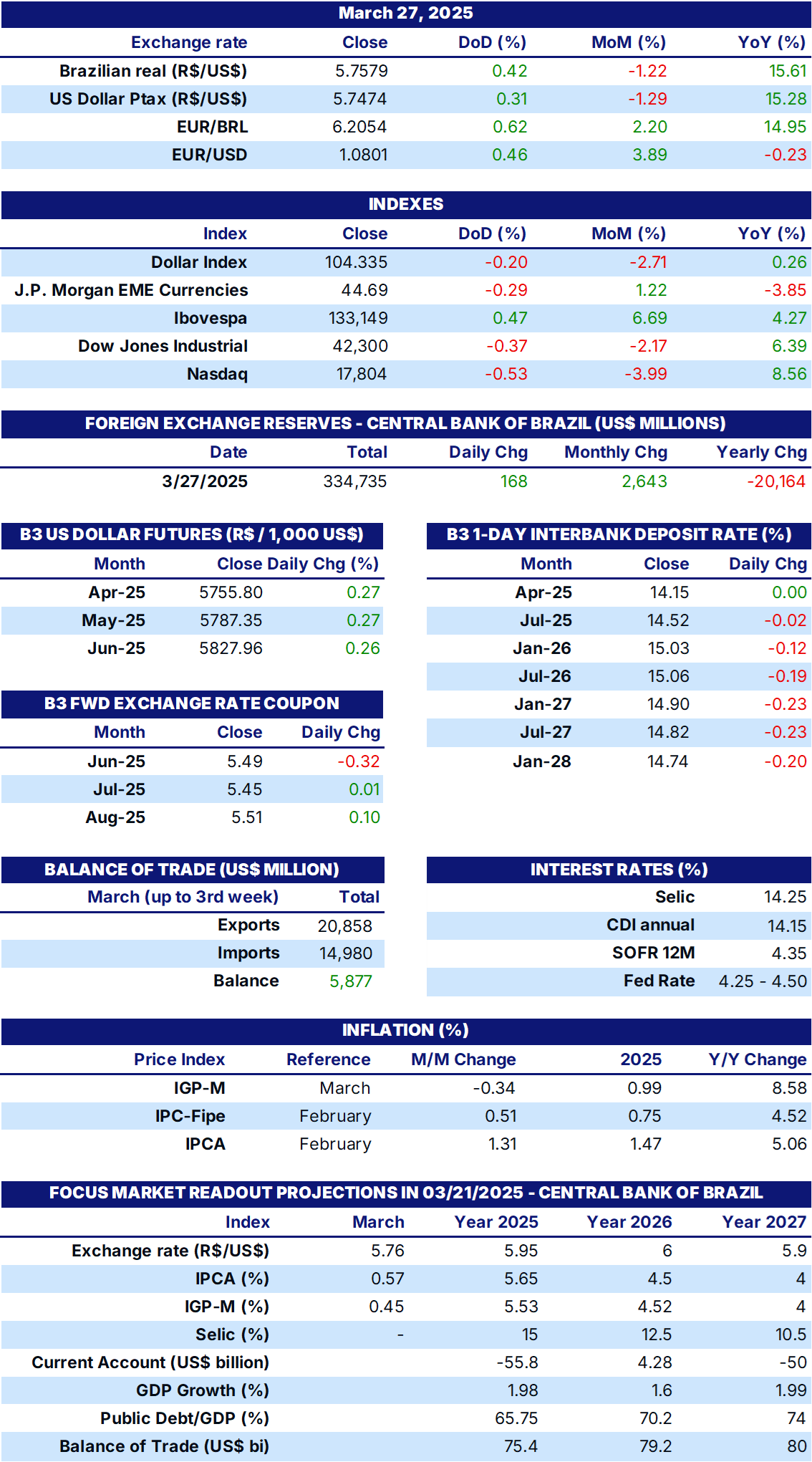
The USDBRL ended Friday’s session (28) quoted at BRL 5.7627, a change of +0.8% for the week, -2.6% for the month and -6.7% for the year. Meanwhile, the dollar index closed Friday’s session at 104.0 points, a weekly decline of 0.1%, monthly of 3.3% and annual of 3.8%.
USDBRL and Dollar Index (points)
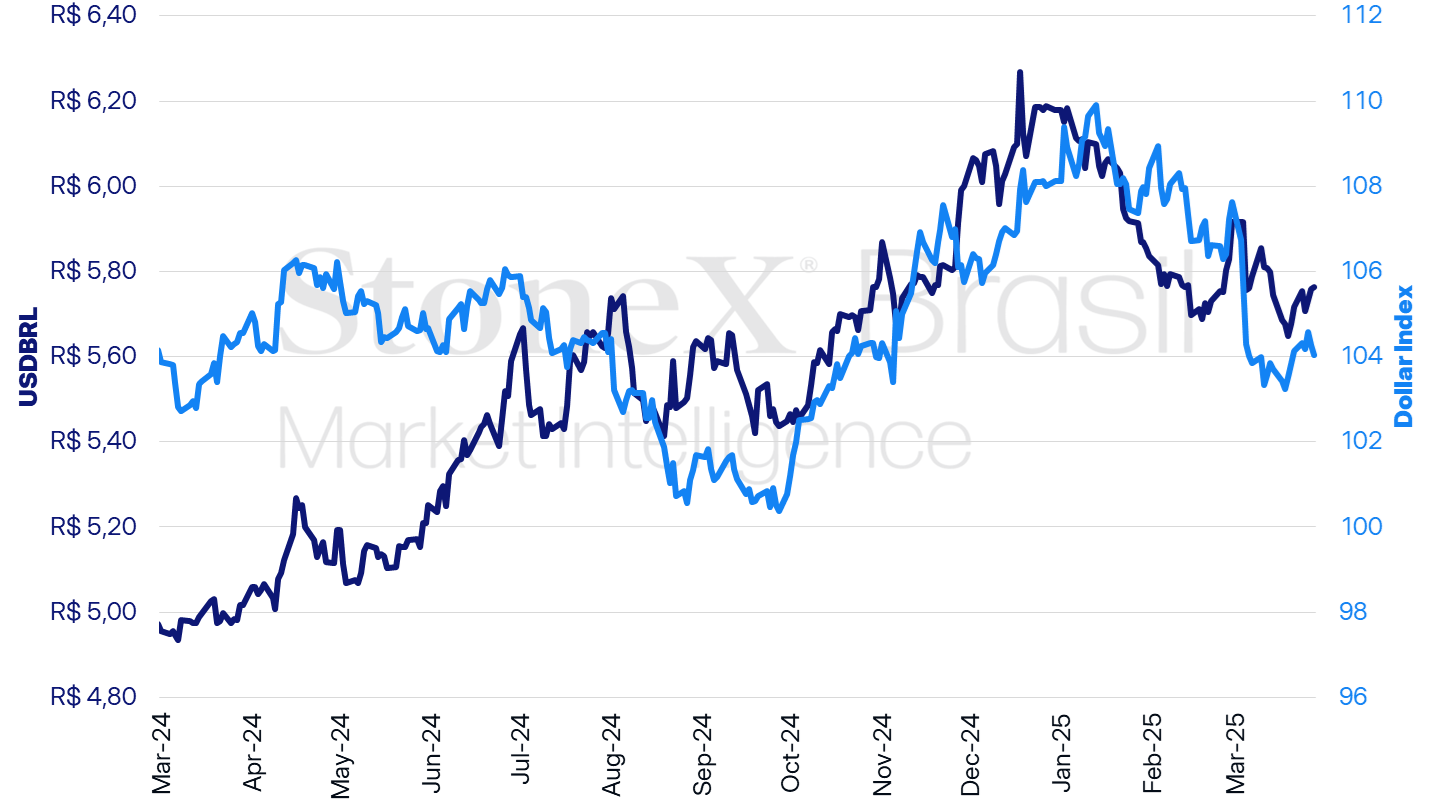
Source: StoneX cmdtyView. Preparation: StoneX.
KEY EVENT: US Import Tariffs
Expected Impact on USDBRL: Bullish
Global financial markets continue to experience significant volatility due to uncertainty over the conduct of US economic policies. Investors are awaiting announcements on US import tariffs on Wednesday (02), the day when the country’s president, Donald Trump, promised to increase taxes on all imports of copper, semiconductors, pharmaceuticals, wood and forest products, as well as adopt “reciprocity tariffs” on other countries and end the suspension of tariffs on products from Mexico and Canada.
However, there is still significant doubt about what will be announced on that day. Last week, press reports stated that Trump would announce only reciprocity tariffs on some specific economies this week, without applying any surcharge to specific sectors, suggesting that the White House might adopt a more targeted approach, thereby reducing concerns over negative impacts of tariffs on the US economy. However, these concerns were revived after Trump unexpectedly anticipated the announcement of import taxes on the automotive segment, initially scheduled for April 02, with a 25% surcharge on all vehicles imported into the US from April 03 and all auto parts and components from May 03, with the promise that these tariffs will be permanent and will be added to any other tariffs already in place.
Although it is impossible to state precisely at this moment, it seems more likely that the Trump administration will announce on the 02 only reciprocity tariffs against some countries. The US Treasury Secretary, Scott Bessent, stated that the focus will be on a set of 10 to 15 countries that have the largest trade surpluses with the US. Investors are expected to remain on standby for more details on which countries will be affected, what the tariff rates will be, how these tariffs relate to others already announced and when they might come into effect. It also seems likely that the US will continue to significantly and persistently intensify its trade barriers in the coming weeks, with more tariffs being announced and no clear view of a reversal of this trend.
Thus, the high degree of uncertainty and unpredictability regarding US policies and the expectation that import tariffs will be broad and high for a considerable period should result in increased global risk aversion, favoring the performance of assets considered “safe havens” during times of insecurity and stress, such as gold, the Swiss franc and the Japanese yen, thereby hurting the performance of the real.
US Employment Data
Expected Impact on USDBRL: Bearish
Next week also features several economic indicators for the US. Among them, the March Employment Situation Report (payroll) on Friday (04) stands out, whose median projections anticipate a slight decline in job creation, from a positive balance of 151,000 new jobs registered in February to 128,000 in March. If confirmed, this estimate could increase investors’ concern regarding the dynamism of the US labor market, especially if accompanied by other economic activity indicators below expectations throughout the week. In addition to the “payroll”, the week will also include the publication of the Job Openings and Turnover Survey (JOLTs) for February on Tuesday (01) and the ADP Private Sector Employment Report for March on Wednesday (02). Although recent data indicate a gradual weakening of the labor market, investors remain pessimistic for fear that some of the Trump administration’s economic policies could harm labor market conditions, such as the imposition of import tariffs, and large-scale hiring freezes and layoffs promoted by the US federal government. This, in turn, could increase bets on interest rate cuts by the Federal Reserve this year, which tends to reduce the attractiveness of US bonds and contribute to a scenario of global dollar depreciation.
US: History and Expectation for the Interest Rate – updated on March 28, 2025
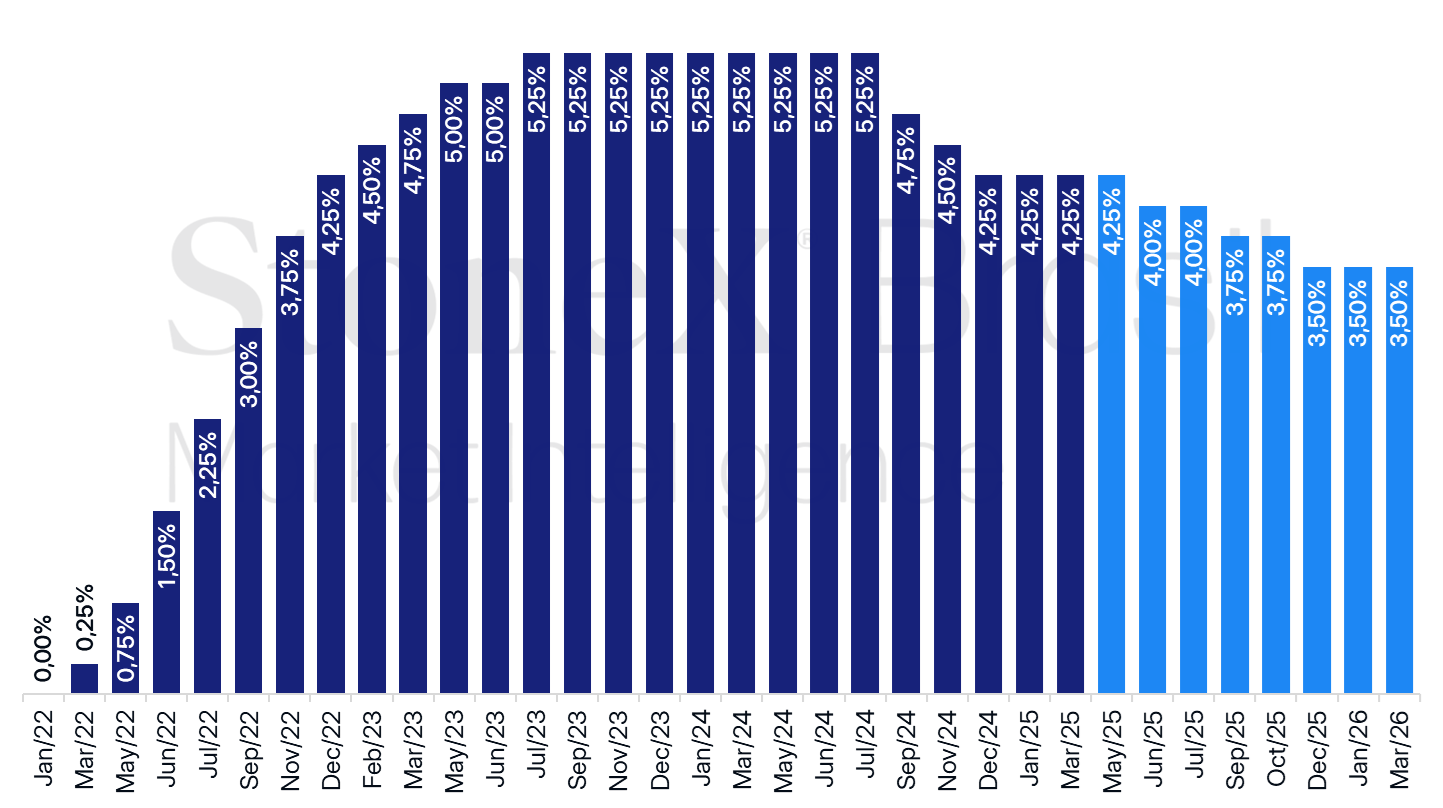
Source: CME FedWatch Tool. Preparation: StoneX. Refers to the highest probability bet in the interest rate futures market on the indicated date.
End-of-Month Ptax Rate
Expected Impact on USDBRL: Undefined
After a month of instability, oscillating between a high of R$ 5.88 and a low of R$ 5.63 in March, the real exchange rate is expected to experience higher trading volume and volatility next Monday (31), within the time windows used by the Central Bank for calculating the end-of-month Ptax rate, i.e., between 10:00 and 13:10. The Ptax is a reference published daily by the Central Bank and its end-of-month value is widely used in exchange and derivative contracts. Thus, market participants intensify their operations during these intervals, competing to determine its value.

INDICATORS