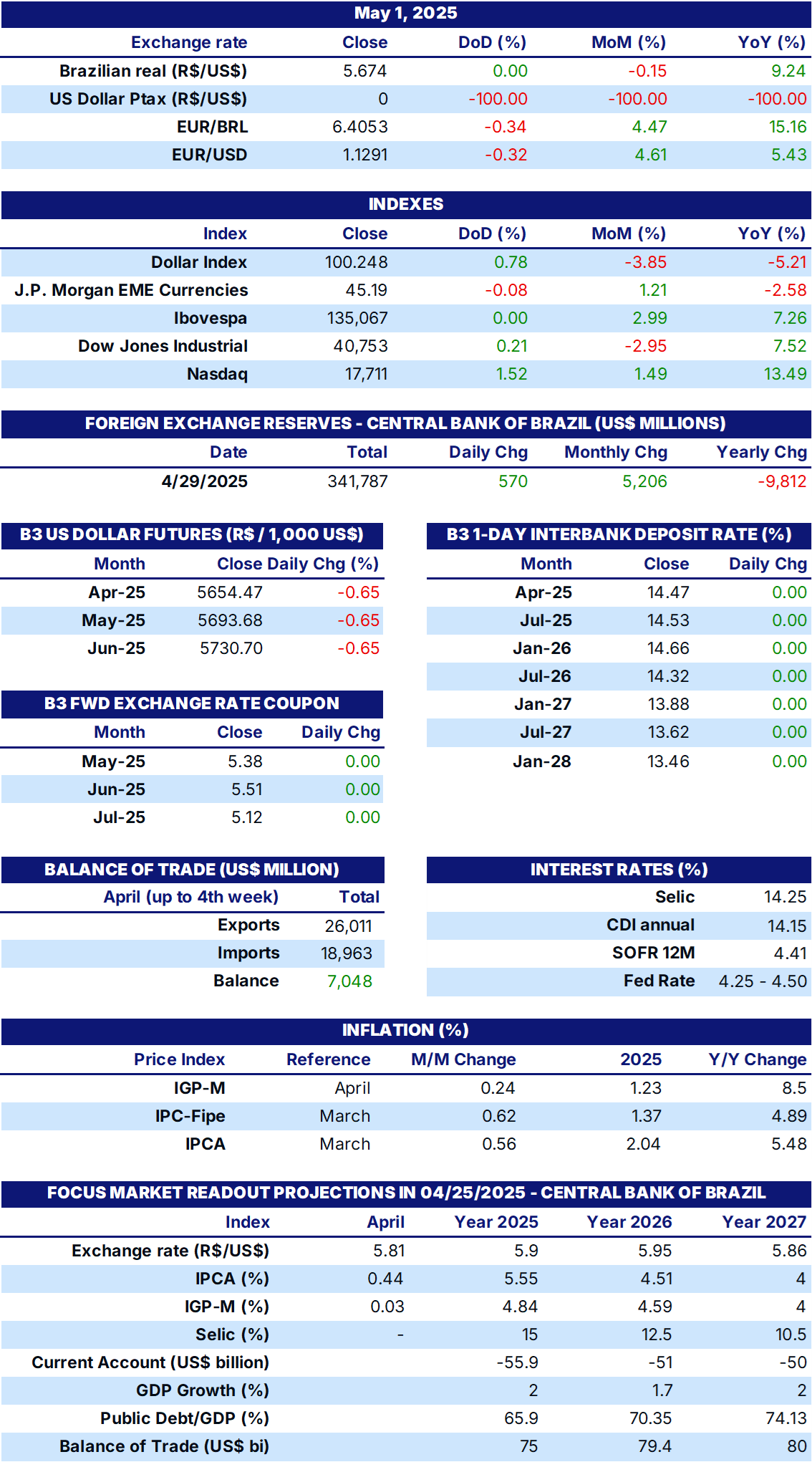
FX Overview: Key Events of the Week
- Bearish Factors
- Easing of trade tensions between the United States and China may stimulate demand for risk assets and support a strengthening of the real.
- Moderate rise in the April IPCA is likely to keep concerns about the Brazilian inflationary backdrop high and increase bets on further hikes to the benchmark interest rate (Selic), supporting the real’s performance.
- Bullish Factors
- The FOMC is expected to signal that U.S. interest rates will remain unchanged for longer, raising yield prospects on dollar-denominated securities and supporting a global strengthening of the U.S. dollar.
- Possible indication of a more cautious stance by Copom in the future due to signs of a slowdown in the Brazilian economy and global uncertainties may undermine prospects for the Brazilian interest rate differential, weakening the real.
The week in review
The week was characterized by an extension of relief in global trade tensions, with measures by the U.S. government to ease the impact of import tariffs on the automotive sector and an initial rapprochement between the United States and China raising optimism for an agreement between the two countries.
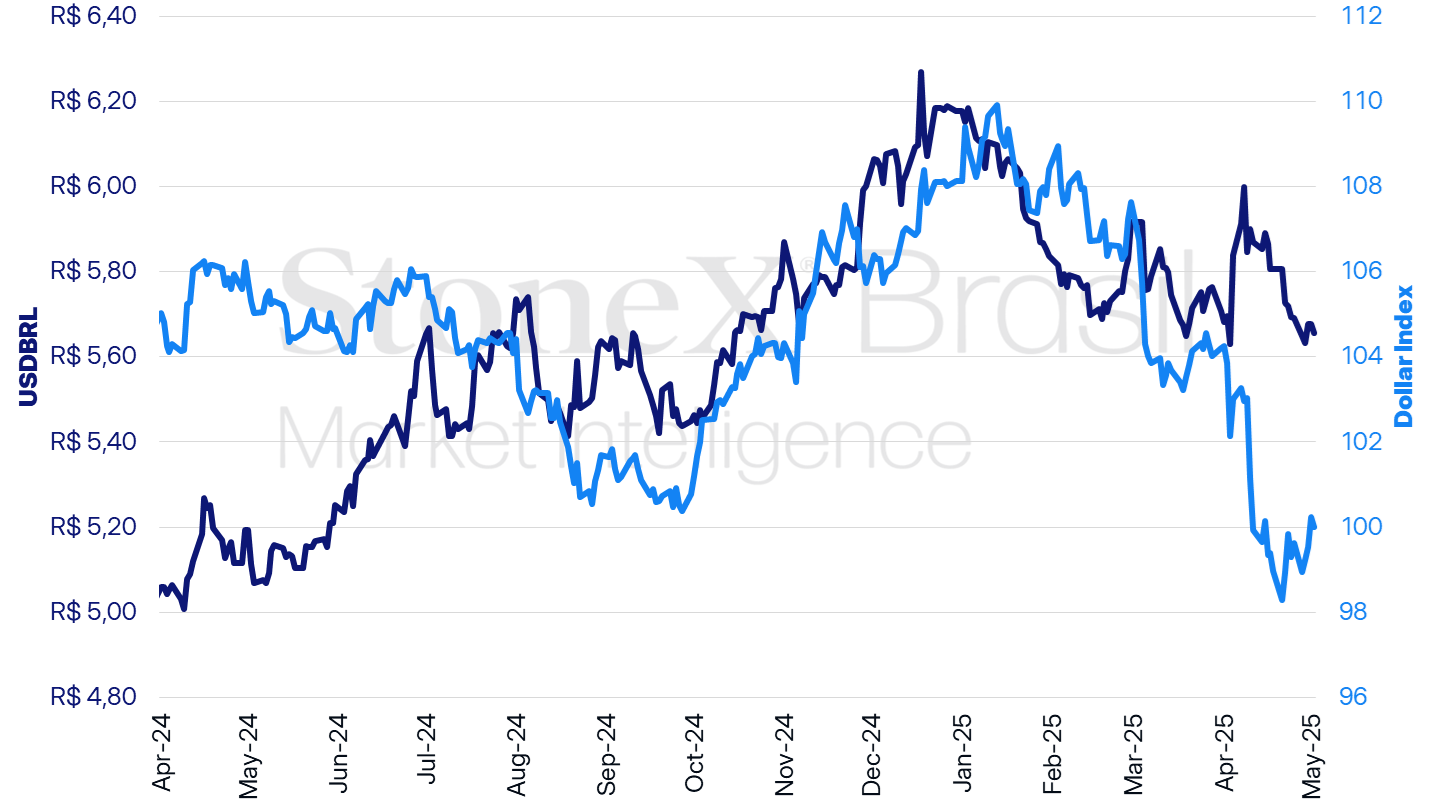
The USDBRL closed this Friday (02) at BRL 5.6556, a weekly decline of 0.6%, a monthly decline of 0.4%, and an annual decline of 8.5%. Meanwhile, the Dollar Index (DXY) ended the week at 100.0 points, up 0.4% on the week, up 0.5% on the month, and down 7.5% on the year.
USD/BRL and Dollar Index (points)
Source: StoneX cmdtyView. Compiled by StoneX.
KEY EVENT: FOMC Rate Decision
Expected Impact on USDBRL: Bullish
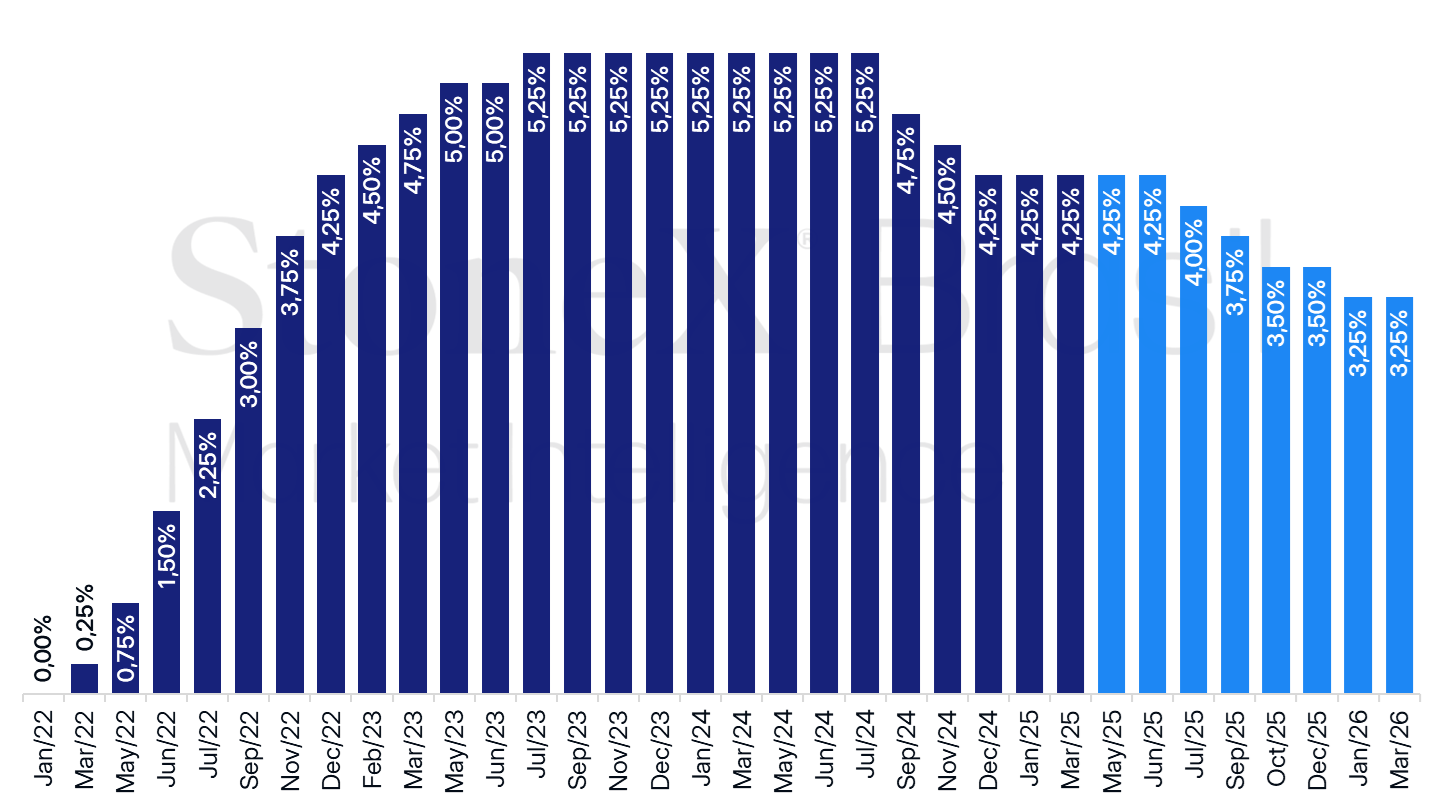
There is virtually a consensus among analysts that the Federal Open Market Committee (FOMC) of the Federal Reserve (Fed) will keep the U.S. policy rate unchanged, in the range of 4.25% to 4.50% per annum. In a widely anticipated decision without the release of economic projections, investors will focus on the Fed’s assessment of risks and possible clues about the future path of interest rates. In the last decision, FOMC Chair Jerome Powell noted that “Uncertainty is remarkably high" and that the risk balance was more adverse – in other words, both the risks of more persistent inflation and the risks of an economic slowdown appear to have risen. However, Committee members continue to emphasize the need for a cautious approach to monetary policy, aiming to dispel any sense of urgency for new rate cuts and signaling that U.S. rates will remain stable for some time. This signaling was further reinforced by recent remarks from Powell suggesting that the Fed should prioritize price stability even if it faces a slowdown in growth, as well as by stronger-than-expected readings for the U.S. labor market in March and April, reducing fears of an economic recession. Thus, the FOMC decision may reduce investor bets on rate cuts in the U.S., which tends to strengthen the dollar globally.
U.S.: Interest Rate History and Outlook – updated on May 2, 2025
Source: CME FedWatch Tool. Compiled by StoneX. Refers to the most probable outcome in the interest rate futures market as of the indicated date.
Trend of Easing Trade Tensions between the U.S. and China
Expected Impact on USDBRL: Bearish
In recent weeks, the White House’s gradual rollback of import tariffs has helped revive risk appetite in global financial markets, benefiting the performance of risk assets, with the U.S. government emphasizing progress in talks with other nations to reach new trade agreements. Obviously, these types of agreements are complex and usually take months, but investors are betting that the United States may reach initial understandings and sign “memoranda of understanding” more quickly, which would reinforce the trend of recovering risk appetite. Additionally, investors anticipate that trade tensions between the United States and China may ease after the Chinese government officially declared that talks between the two countries had begun. Thus, the possibility of further advances in negotiations between Washington and other countries, especially China, should bolster optimism among financial market participants and support the performance of risk assets such as equities, commodities, and currencies of emerging markets, like the real.
Copom Rate Decision
Expected Impact on USDBRL: Bullish
In Brazil, most analysts project that the Monetary Policy Committee (Copom) will raise the benchmark interest rate (Selic) by 50 basis points, from the current 14.25% to 14.75% per annum. In the last meeting, the Committee had signaled the likelihood of a new increase at the meeting scheduled for next Wednesday (7), albeit at a smaller magnitude than the previous three decisions, in which the Selic was raised by one percentage point. In this regard, given the broad consensus on the size of the next hike, investors’ attention is focused on any future forward guidance regarding the conduct of monetary policy. With respect to the risk balance, it is expected that the Committee will reinforce the perception of a deteriorating inflation scenario, in light of recent indicators, which tends to support a more restrictive stance by the monetary authority. Conversely, it is expected that they will once again highlight signs of an economic slowdown, a factor that could induce the Committee to act more cautiously in future decisions. Moreover, the statement may include references to the possible impacts of the recent tariff shock promoted by the United States, which should have negative repercussions on global growth and commodity prices, with potential disinflationary effects. Thus, even in the face of another rate hike, the possible signaling of a slower pace of Selic increases or even the end of the hike cycle may reduce expectations of an expansion of the Brazilian interest rate differential, which could make attracting external resources more difficult and thus contribute to the weakening of the real.
Inflation in Brazil
Expected Impact on USDBRL: Bearish
On the domestic front, investors are also focusing on the release of the Extended National Consumer Price Index (IPCA) for April. The median forecast indicates an easing of inflation on a monthly basis, with an estimated increase of 0.44%, below the 0.56% recorded in March and the 1.31% observed in February. On an annual basis, however, the expectation is that 12-month inflation will remain at 5.5%, above the ceiling of the inflation target set by the Central Bank, at 4.50% per annum. This outlook reinforces the probability of a continued monetary tightening cycle, with further hikes in the Selic rate. Higher interest rates, in turn, tend to increase the relative attractiveness of Brazilian assets, favoring the inflow of foreign capital and contributing to the appreciation of the real.

INDICATORS