FX Overview: Key Events of the Week
- Bearish Factors
- Expectations of eased trade tensions between the United States and China after the Geneva meeting may stimulate demand for risk assets and strengthen the real.
- Copom minutes are expected to reinforce the Committee’s more conservative stance and bolster the perception that Brazilian interest rates will remain higher for longer, contributing to the real’s appreciation.
- Bullish Factors
- Expectations of stronger inflation figures and weaker U.S. retail sales could heighten fears of “stagflation” in the U.S., leading to greater risk aversion and hurting the performance of risk assets such as the real.
The week in review
The week was marked by interest rate decisions from the central banks of Brazil and the United States, as well as increased relief in global trade tensions after the U.S. reached an agreement with the United Kingdom and scheduled a first meeting with Chinese economic authorities.
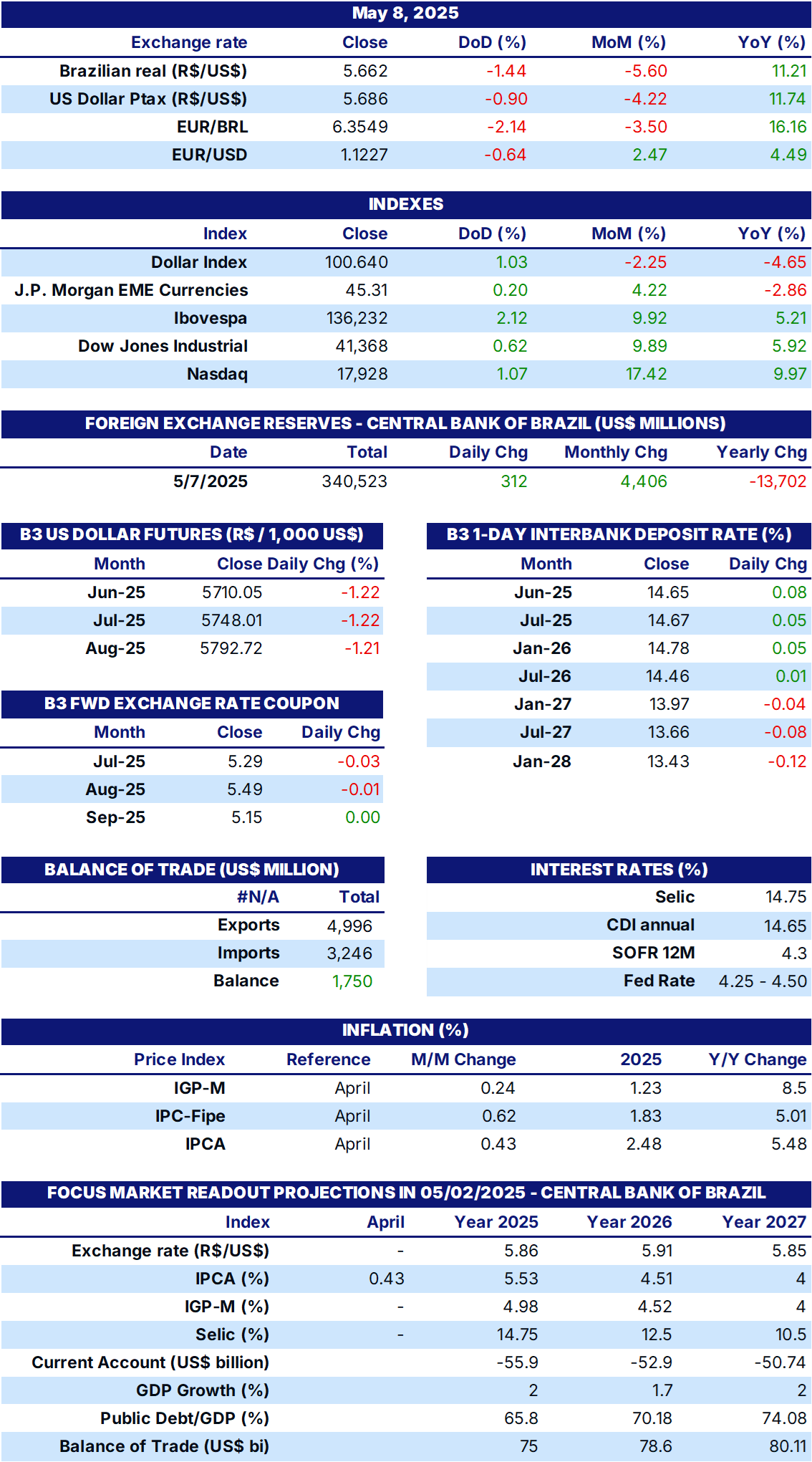
The USDBRL closed on Friday (09) at BRL 5.6544, with a 0.0% change for the week, −0.4% for the month, and −8.5% for the year. Meanwhile, the Dollar Index (DXY) closed the week at 100.4 points, up 0.4% weekly and 0.9% monthly, but down 7.1% year-to-date.
USDBRL and Dollar Index (points)

Source: StoneX cmdtyView. Prepared by: StoneX.
KEY TAKEAWAY: Trend of Easing U.S.–China Tariff Tensions
Expected Impact on USD/BRL: Bearish
Last Thursday (08), the announcement of a “trade agreement” between the United States and the United Kingdom generated strong optimism among market participants, the first since the White House’s “tariff shock” of April 2. In reality, the announcement merely outlined “general terms” for a future agreement: the U.K. committed to cut tariffs on 2,500 American products and facilitate agricultural exports, while the U.S. agreed to lower the tariff on British automobiles from 27.5% to 10% for the first 100,000 units (rising to 25% thereafter) and eliminate duties on U.K. steel and aluminum. However, this optimism is difficult to justify.
First, no formal document— not even a memorandum of understanding—has been signed, weakening the commitments. More importantly, import duties on other British goods will remain at 10%, compared with a 1.3% average in 2022. The U.K. is uniquely well positioned to negotiate with the U.S., given its historical alliance, strong diplomatic ties, trade deficit with the U.S. (justifying a lower 10% rate), and lack of retaliation. Moreover, less than 20% of U.K. car exports and under 10% of U.K. steel exports go to the U.S. If the U.S. did not reduce its generalized 10% rate even for its most favorable partner, it seems unlikely any other country will secure that concession. Thus, many analysts conclude that American tariffs will remain substantially high even if more trade deals are struck, potentially harming the U.S. economy in the coming months.
Still, the bilateral announcement sparked high optimism that trade tensions could be eased before July 9—the end of the White House’s announced “90-day pause” (during which all import duties remain at 10%). In particular, expectations rose for the first meeting between U.S. and Chinese economic authorities, scheduled for this Saturday (10) in Switzerland. Levies of 125% by China and 145% by the U.S. have effectively halted direct trade, prompting both to reroute goods through third countries to benefit from lower duties. It is impossible to predict the outcome of this inaugural discussion: while it demonstrates a willingness to negotiate, neither side has publicly adopted a conciliatory stance, and trade talks are typically prolonged and complex. Nonetheless, last week’s developments suggest investors are hopeful that any progress will ease tensions, reducing concerns about economic losses and supporting risk assets such as equities, commodities, and emerging market currencies like the real.
U.S. Economic Indicators
Expected Impact on USD/BRL: Bullish
Although the White House’s “tariff shock” of April 2 triggered intense volatility in financial markets, its effects on the U.S. economy are unlikely to show up in this month’s data. Leading indicators—such as consumer and business confidence surveys—deteriorated sharply in April, suggesting that economic readings may weaken in coming months. However, these distortions are not expected to appear in April’s figures. On the contrary, any sign that April data already reflects higher trade barriers—though unlikely—would significantly stoke stagflation concerns among investors.
After the Consumer Price Index (CPI) surprised in March with readings weaker than expected—down 0.1% headline and up 0.1% core (excluding volatile food and energy components)—inflation is forecast to accelerate in April, with a median estimate of 0.3% for both headline and core CPI. Additionally, April retail sales are expected to decelerate sharply, from 1.4% growth in March to a modest 0.1%. Strong March performance was driven by Americans front-loading purchases to avoid potential tariff effects; this behavior is unlikely to repeat in April, weighing on the indicator. Stronger inflation alongside weaker consumer demand—key pillars of last year’s growth—would heighten stagflation fears and increase risk aversion, undermining risk assets such as equities, commodities, and emerging market currencies like the real.
Copom Minutes
Expected Impact on USD/BRL: Bearish
In Brazil, investors will digest the publication of the minutes from the Central Bank’s Monetary Policy Committee (Copom) meeting on Tuesday (13), where the Committee raised the Selic rate from 14.25% to 14.75% per annum. With the rate hike already widely anticipated, attention focused on the accompanying statement. Although no explicit forward guidance was provided, the minutes emphasized the need for “additional caution in monetary policy operations and flexibility to incorporate data that affect inflation dynamics.” The Copom also indicated that “the calibration of appropriate monetary tightening will remain guided by the objective of bringing inflation to target over the relevant horizon.” Even without explicitly mentioning further hikes, these passages were interpreted as signaling a more conservative stance, reducing bets on a near-term rate cut. By reinforcing caution, the minutes should support higher real-denominated yields, favoring the Brazilian currency.
Investors will also look for cues in the minutes about how the Committee views its risk balance, especially given its intent to respond to “incipient moderation in economic growth.” Concerns over economic resilience amid higher rates have been reiterated in recent communications, adding further focus. In this context, the release of the Monthly Services Survey and Monthly Trade Survey during the week will be important for calibrating expectations around the Selic’s path.

INDICATORS