FX Outlook: Key Events of the Week
- Bearish Factors
- Fears that an acceleration of the pace of U.S. debt accumulation could contribute to an outflow from dollar-denominated assets and, by contrast, support the performance of other currencies, such as the real.
- Expectation of a soft reading for the April PCE index may increase bets on rate cuts by the Federal Reserve, which tends to weaken the dollar globally.
- Bullish Factors
- New U.S. import tariff threats increase the perception of uncertainty and unpredictability in the conduct of American economic policies, which could result in greater global risk aversion and impair the performance of the real.
- Concerns about the Brazilian fiscal outlook remain elevated after confusing communication regarding the IOF increase, which may heighten risk perceptions for national assets and impair the performance of the real.
- Hotter readings for GDP and inflation in Brazil may reinforce expectations that the Central Bank will keep the benchmark interest rate (Selic) higher for longer, which could attract foreign investment and strengthen the real.
The week in review
The week was marked by concerns about the fiscal outlook in Brazil and the US, after the risk agency Moody’s downgraded the US sovereign credit rating and the Brazilian government caused investor stress by unexpectedly raising IOF rates.
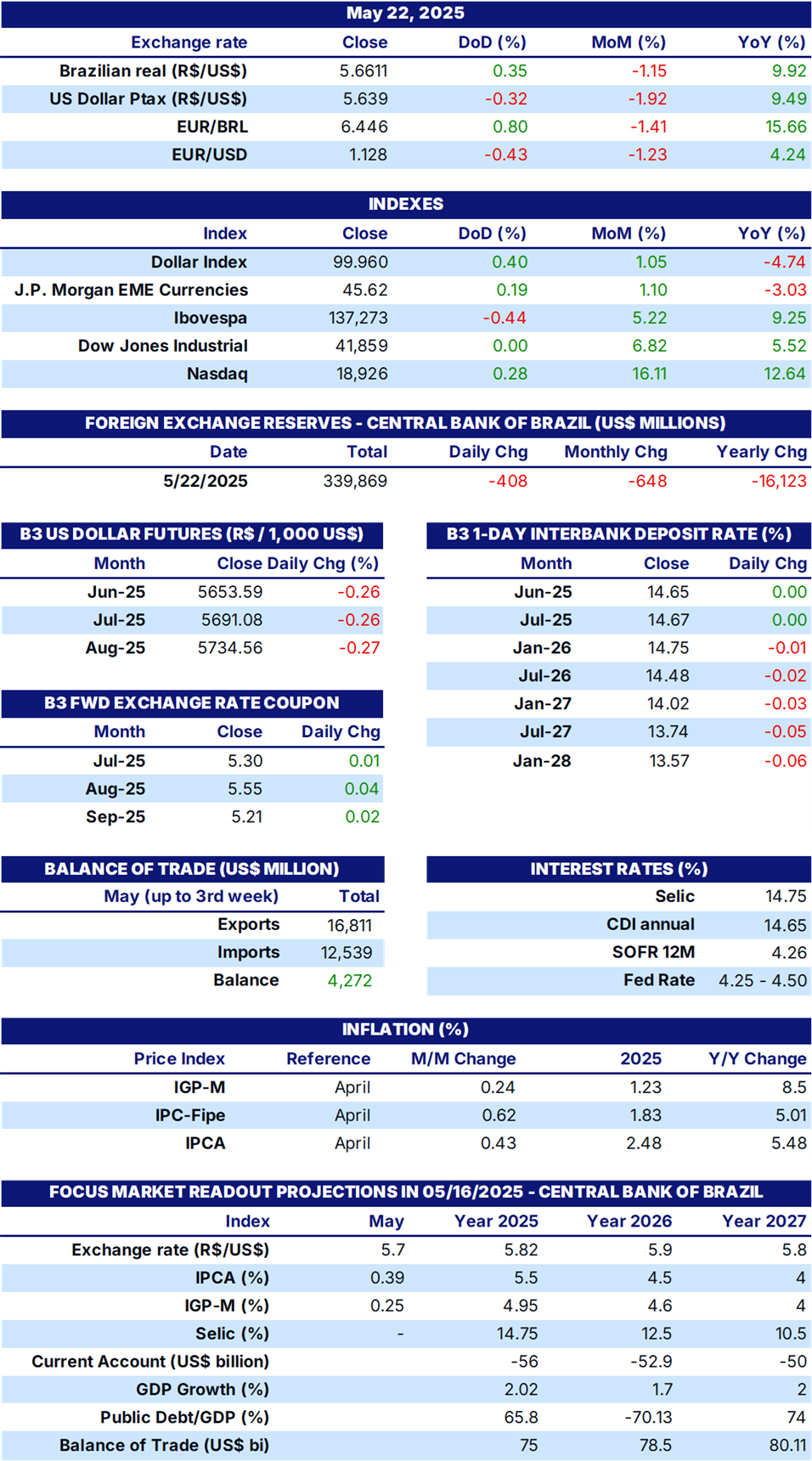
The real’s exchange rate closed this Friday (23) at R$ 5.6473, a weekly decline of 0.4%, a monthly decline of 0.5%, and an annual decline of 8.6%. The Dollar Index (DXY) closed the week at 99.1 points, with a -1.9% change on the week, 0.4% on the month, and 8.3% on the year.
USDBRL and Dollar Index (points)
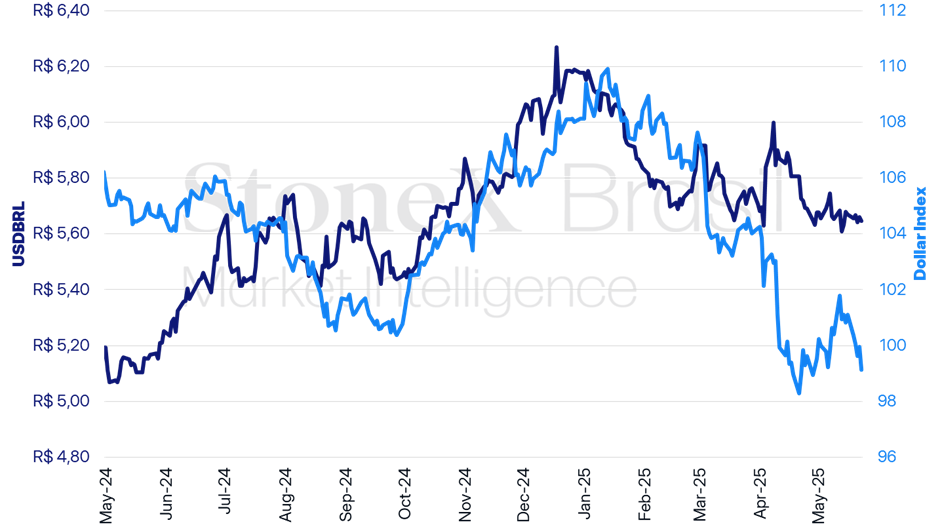
Source: StoneX cmdtyView. Prepared by: StoneX.
KEY EVENT: Volatility and Unpredictability of U.S. Economic Policies
Expected Impact on USDBRL: Bullish
Since Donald Trump assumed the presidency of the United States, global financial markets have experienced significant volatility due to the high degree of uncertainty, unpredictability, and inconsistency in the conduct of American economic policies. The new administration has implemented a rapid pace of changes in various areas, such as foreign trade, immigration, fiscal policy, energy policy, business regulation, federal administration structure, and diplomacy. This accelerated pace of change, by itself, already results in high uncertainty and unpredictability regarding the direction of the business environment, which is enough to lead to a cautious stance by businesses and investors, discouraging major decision-making.
However, the White House intensifies this uncertainty and unpredictability by introducing these changes through Executive Branch actions, practically without accompanying legislative changes, using eight declarations of a State of Emergency to legally support these acts. This, in turn, creates greater insecurity about the stability of these changes, since it opens the possibility of judicial challenges to the measures, or that the White House may simply change its mind and cancel or modify its actions. No area better exemplifies this insecurity than the government’s inconsistent stance on imposing import tariffs on other economies, with successive announcements, postponements, cancellations, modifications, and unfulfilled threats on this topic.
Number of executive orders, memoranda, and substantive proclamations in the first 100 days of the administration
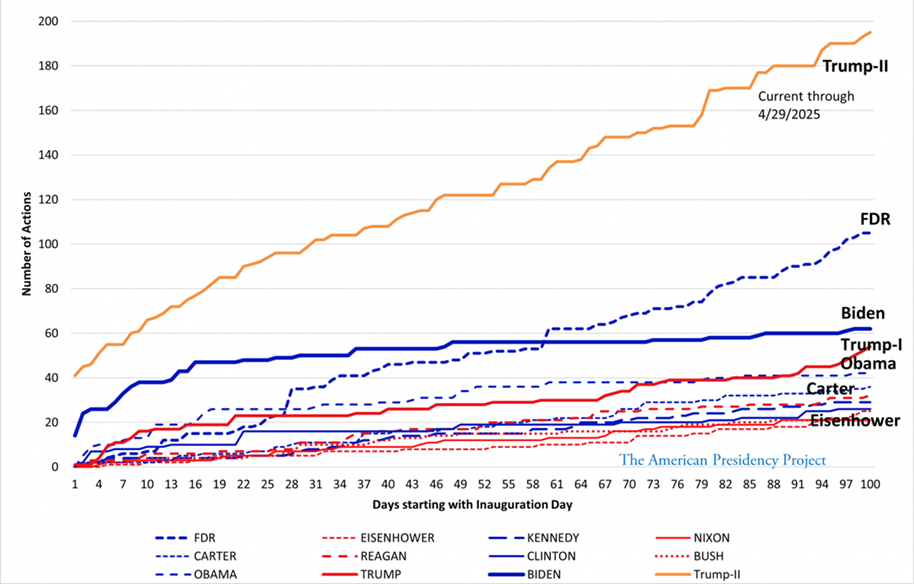
Source: The American Presidency Project / University of California, Santa Barbara
This contradictory behavior in the application of import tariffs caused abrupt fluctuations in financial markets, first with a deep global risk aversion following the imposition of the “tariff shock” in the first half of April, followed by a strong recovery in risk appetite as it sought to reverse or mitigate several of these measures. As a result, the Dollar Index fell 4.8% in the first three weeks of April, followed by a 2.2% gain in the subsequent four weeks.
However, this trend of easing trade tensions ended abruptly last Friday (23), when Trump unexpectedly stated that he would raise import tariffs on the European Union to 50% starting June 1 due to frustration over the progress of negotiations with the bloc, and also threatened a 25% tariff on Apple products if the company does not localize production of those goods. These messages differ drastically from White House communications in recent weeks, when it ceased to extol the purported benefits of trade barriers and made efforts to shift the focus to the possibility of new trade agreements and to the intention of reducing taxes through a new budget proposal. As a result, Trump reactivated a sense of insecurity and unpredictability among investors by showing that uncertainty about trade policy remains high, given that the recent retreats by the White House were announced as temporary, no trade agreements have been formalized, and, most importantly, there is no clarity about the objectives pursued by the government or how the tariffs will evolve over time.
Thus, although the environment remains uncertain and volatile, it seems more likely that the government’s recent threats will raise investor concerns about the possibility of stagflation in the US, causing risk aversion and boosting the performance of “safe haven” assets during times of stress and uncertainty, such as the euro, the Japanese yen, and the Swiss franc. Likewise, this scenario tends to impair the performance of risky assets, such as equities, commodities, and currencies of emerging economies, like the real.
Fiscal Concerns in the US
Expected Impact on USDBRL: Bearish
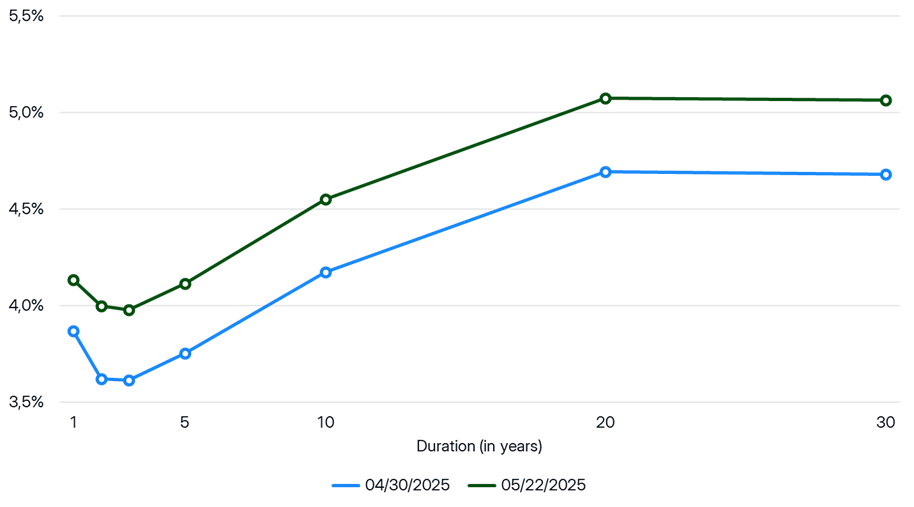
Last week, a rapid rise in concern about the US fiscal outlook contributed to a broad dollar retreat and an outflow from the country’s public debt securities, raising their interest rates on both near-term and long-term maturities. The movement began after the risk rating agency Moody’s downgraded the United States sovereign credit rating, expressing apprehension about rising US public debt and a growing fiscal imbalance, projecting a deficit of nearly 9% of GDP by 2035, compared to a previous estimate of 6.4% for 2024. These fiscal concerns intensified after the US House of Representatives approved the Trump administration’s budget proposal. The proposal, now moving to the Senate for review, includes, among other items, extending tax cuts implemented during Trump’s first term, exempting certain sources of income from income tax (such as tips and overtime), and raising the cap on state tax deductions. While the government argues that such measures will stimulate economic growth and consequently revenue, independent estimates indicate that the fiscal deficit is likely to worsen, resulting in an acceleration of public debt accumulation. Additionally, there remains concern that, to mitigate the projected fiscal imbalance, the government may resort to cutting social spending, which could have adverse effects on more vulnerable segments of the population. It is worth noting that the proposal faces considerable resistance, having been approved in the House by a margin of only one vote and subject to changes by the Senate. This context of fiscal and political uncertainty may continue to contribute to heightening the perceived risk associated with the US economy, which could result in further dollar weakness and, in turn, tend to favor the real.
US Treasury Yield Curve (% p.a.)
Source: U.S. Department of the Treasury. Prepared by: StoneX.
Fiscal Concerns in Brazil
Expected Impact on USDBRL: Bullish
In Brazil, investors must continue monitoring news about the balance of the country’s public accounts after the real’s exchange rate fluctuated sharply last week due to incomplete and conflicting information about fiscal measures by the government. Initially, news that the Administration would institute a larger spending freeze than previously estimated generated optimism and drove the exchange rate down. However, the leak that the government would raise the Financial Operations Tax (IOF), without further details, caused significant stress among financial market operators. This stress intensified after the economic team held a hastily organized press conference without coordinating the changes with other government ministries, causing negative repercussions and forcing the government to abandon the change for Brazilian investments abroad. As a result, investors remain cautious about the possibility of new news that could reinforce pessimism regarding fiscal matters in Brazil, which would increase risk premiums and tend to weaken the real against the dollar.
Economic Activity and Inflation in Brazil
Expected Impact on USDBRL: Bearish
Also noteworthy is the series of Brazilian economic indicators to be released over the week, with the potential to influence investor expectations regarding the trajectory of interest rates in Brazil. The focus should be on Q1 2025 GDP, for which the median estimate points to a 1.5% increase compared to the previous quarter. If confirmed, this variation would indicate a growth in economic activity, driven mainly by a strong performance in the agricultural sector, the primary driver of investment during the quarter, and still-heated household consumption. In addition to GDP, the release of the Broad Consumer Price Index-15 (IPCA-15) for May will also be relevant, with an expected 0.45% increase month-over-month and 5.50% year-over-year, a level still above the Central Bank’s inflation target ceiling of 4.50%, reinforcing the view of resilient inflation. If projections are confirmed, the indicators should support recent statements by the Central Bank President, Gabriel Galípolo, who argued for keeping the Selic rate at a restrictive level for a more extended period than observed in previous cycles. This context broadens the perspective of a favorable interest rate differential for Brazil compared to other economies, which tends to attract foreign investments and to value the real.
FOMC Minutes and PCE in the US
Expected Impact on USDBRL: Bearish
Finally, investors should pay attention to the release of the minutes from the latest Federal Open Market Committee (FOMC) meeting and the April Personal Consumption Expenditures (PCE) Price Index. Considering that the minutes refer to a decision made three weeks ago and that the main components of the PCE have already been previewed by the Consumer Price Index (CPI) and Producer Price Index (PPI) for April, it is likely that the impact of these releases on the currency market will be limited. However, any surprises or additional relevant information could alter expectations regarding future decisions.
Regarding the minutes, the prevailing expectation is that the content will reiterate the tone of the statement released after the decision, reinforcing the view that the Fed will maintain a cautious stance, opting to “wait and see” how upcoming economic data evolves, as well as the measures of the Trump administration’s economic team. As for the PCE, expectations are that the indicator will show a moderation of inflation in April. Given its relevance as the primary metric monitored by the Fed, its release should have a more significant impact than the minutes, potentially reinforcing bets on future rate cuts in case of a slowdown, which tends to weaken the dollar globally and favor the real.

INDICATORS