FX Outlook: Key Events of the Week
- Bearish factors
- Recent trend of dollar-denominated asset outflows weakens the U.S. currency and favors the performance of other currencies, such as the real.
- Bullish factors
- Legal challenge to import tariffs by the U.S. and proposal to tax foreign capital increase uncertainty and unpredictability in the conduct of U.S. economic policies and heighten risk aversion, which tends to hurt the real.
- Slower-than-expected indicators for the U.S. labor market may raise concerns about the country’s economy, increasing global risk aversion and weakening the real.
- Concern about the Brazilian fiscal outlook remains high amid resistance to the IOF increase, which may raise perceived risk for national assets and hurt the performance of the real.
- Rate cut by the European Central Bank is likely to weaken the euro and, indirectly, strengthen the U.S. currency.
The week in review
The week was marked by the resurgence of U.S. trade tensions after a judicial challenge to the legality of the import tariffs imposed by the country and new threats from Trump to the European Union and China. In Brazil, a challenge to the IOF tax increase also worsened the perception of fiscal risks in the country.
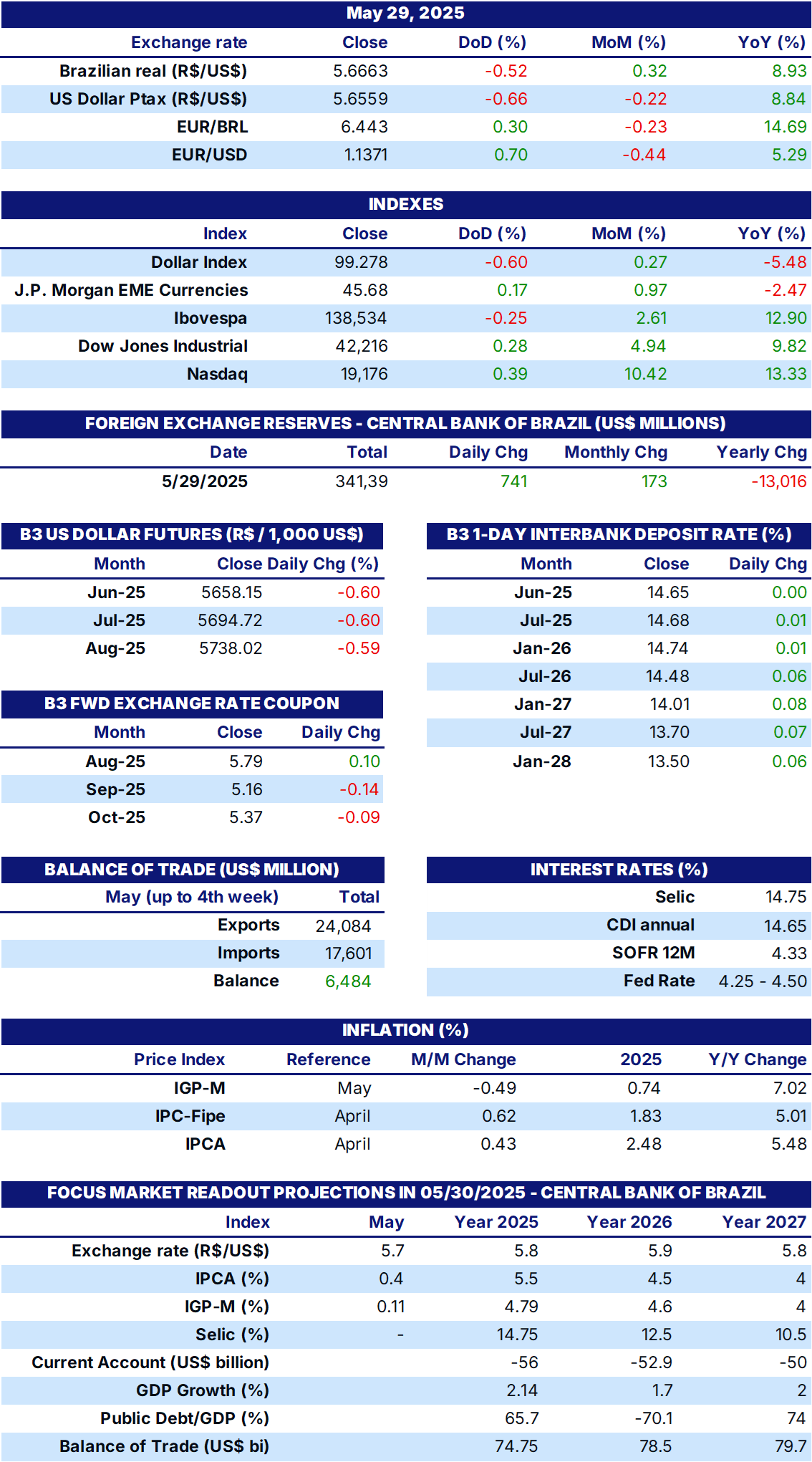
The USDBRL ended this Friday’s session (30) quoted at R$ 5.7205, a weekly gain of 1.3% and a monthly gain of 0.8%, but an annual decline of 7.4%. Meanwhile, the Dollar Index (DXY) closed the week at 99.4 points, a change of +0.3% on the week, -0.2% on the month, and -8.1% on the year.
USDBRL and Dollar Index (points)
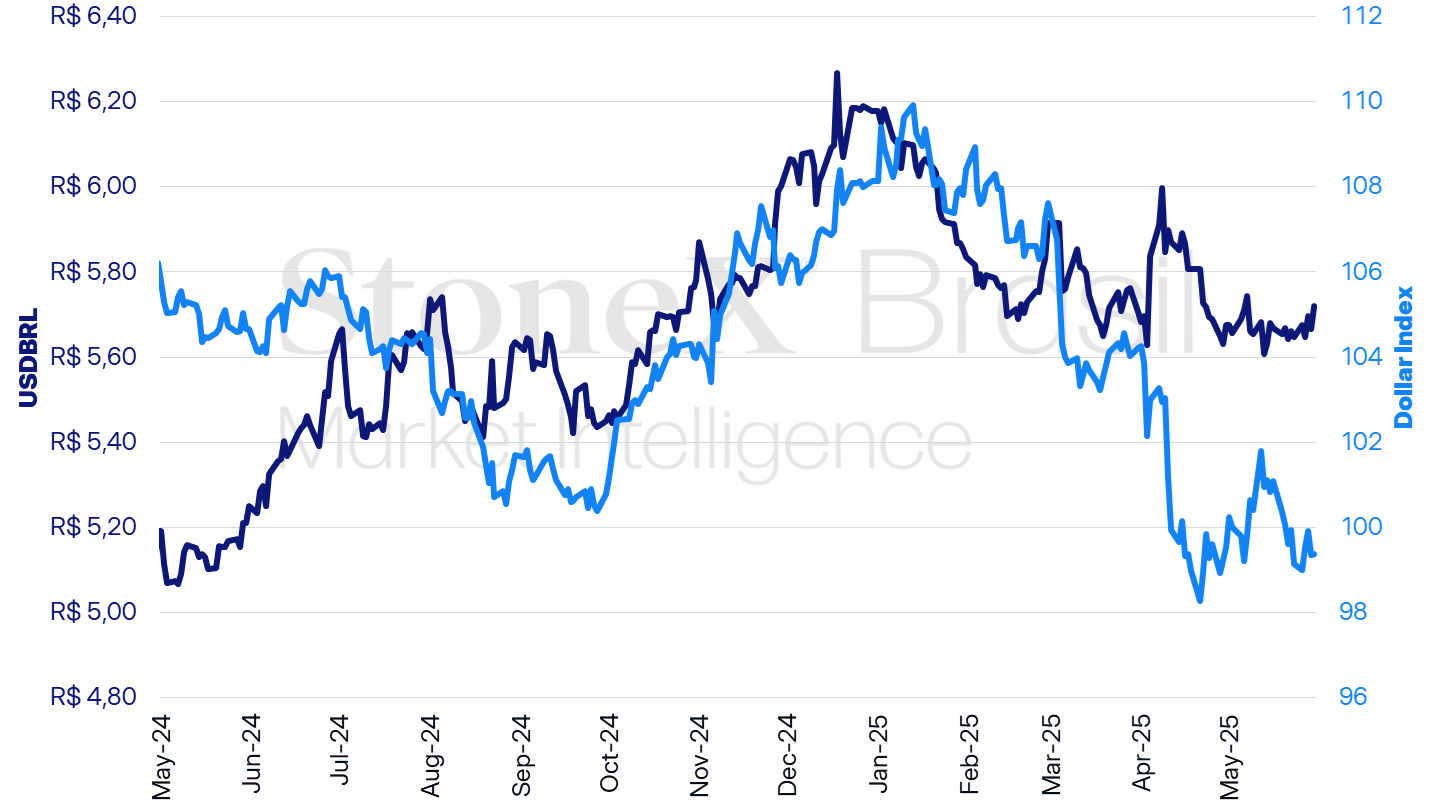
Source: StoneX cmdtyView. Prepared by: StoneX.
THE MOST IMPORTANT: Volatility and unpredictability of U.S. economic policies
Expected impact on USDBRL: bullish
Possible legal alternatives for implementing tariffs in the U.S.
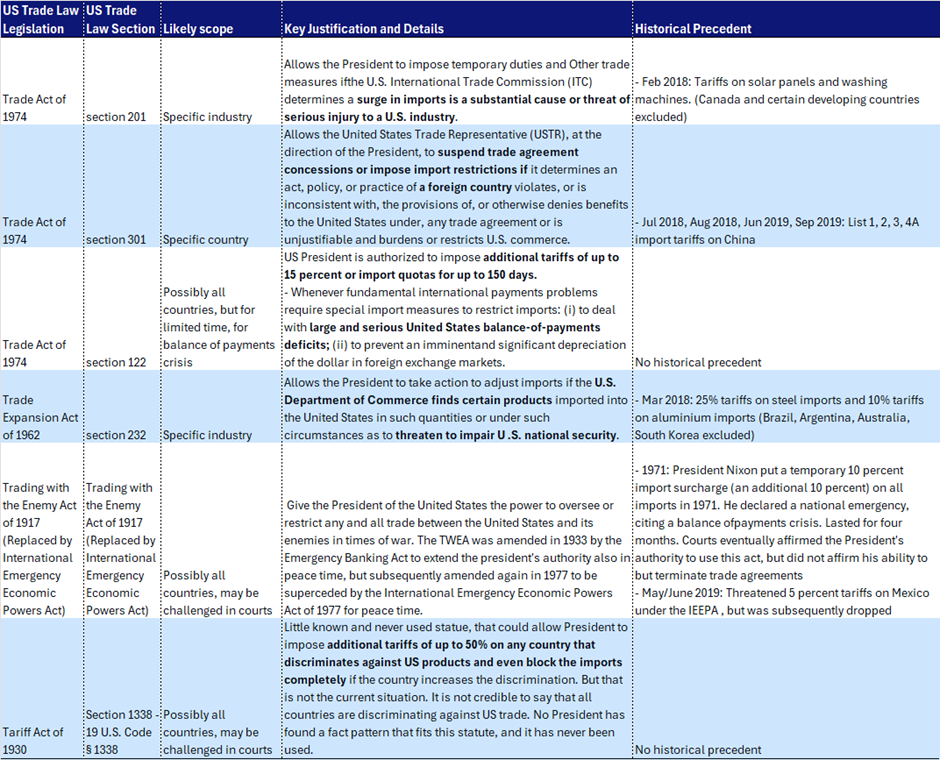
Source: MUFG. Prepared by: StoneX.
This week, although the business environment remains quite uncertain and volatile, it seems likely that the sense of unpredictability and insecurity among investors will remain high and impair the dollar’s overall performance, which has entered its fifth consecutive month of depreciation against currencies of other advanced economies. In particular, the legal challenge to the legality of the import tariffs imposed by the White House has simultaneously reinforced uncertainty about the permanence of these tariffs in the long term and the determination of the U.S. government to use this economic instrument regardless of any judicial challenges.
In summary, on Wednesday, a panel of three judges of the U.S. International Trade Court ruled that the President of the United States, Donald Trump, exceeded the legal limits of his authority by imposing import tariffs through a declaration of a State of Emergency under the IEEPA (International Emergency Economic Powers Act), a 1977 law. However, on Thursday, an appeal to the U.S. Court of Appeals for the Federal Circuit determined that the court order should be suspended while the court does not rule on the merits of the case.
Initially, the court order increased uncertainty about the conduct of U.S. trade policies, since it raised concerns that the measures imposed by the White House could be prohibited by the country’s judiciary. It is worth remembering that last week’s FX Overview had already warned that “the White House intensifies this uncertainty and unpredictability [in the conduct of U.S. economic policies] by implementing (...) changes through executive actions, practically without accompanying legislative changes, using eight declarations of a State of Emergency to legally support these actions. This, in turn, generates greater insecurity about the stability of these changes, since it opens up the possibility of judicial challenges to the measures, or that the White House simply changes its mind and cancels or modifies its actions.” Subsequently, however, members of the Trump administration warned that they had legal alternatives to keep the tariffs in effect. These two conclusions—the greater uncertainty about the permanence of these tariffs in the long term and the determination of the U.S. government to use this economic instrument—reinforced a movement to diversify investors’ portfolios, reducing exposure to U.S. assets and weakening the dollar.
This trend of the dollar weakening due to a reduction in capital flows to the United States is also reinforced by recent remarks from Trump, who last week threatened to impose a 50% surcharge on the European Union starting on June 1 (in less than 48 hours, he extended this deadline to July 9) and, last Friday (30), complained that China was violating the terms of the recent agreement between the two countries, which had agreed to a temporary 90-day reduction in mutually imposed import tariffs. These threats raised fears that the trade tensions provoked by the White House could rise abruptly again, fears that had never disappeared, since the White House’s recent retreats were announced as temporary, there has been no formalization of trade agreements, and, most importantly, there is no clarity about the government’s objectives or how the tariffs will evolve over time.
(Update: on Saturday, 05/31, Trump announced that the import tariffs on steel and aluminum, which began at 25% and were reduced to 10% on April 9, will increase to 50% starting this Wednesday, 06/04)
In this sense, investors also fear that a proposal within the Budget pending in Congress could further reduce capital flows to the U.S. In the text of the budget law approved by the House of Representatives is a provision (Section 899 – Enforcement of Remedies Against Unfair Foreign Taxes) that proposes to tax foreign capital of any person or entity domiciled in “discriminatory foreign nations,” that is, countries whose taxes the U.S. government considers abusive or unfavorable to American companies. In these cases, the section allows rates on income, profits, and interest earned by foreign investments in the U.S. to be increased by five percentage points each year up to a maximum of 20 points above the legal rate. As the definition of “unfair taxes” is vague and imprecise, if the proposal is also approved by the U.S. Senate, the White House would have broad freedom to tax capital of countries with taxation different from that of the U.S., such as digital services taxes of the European Union, Canada, the U.K., and Australia, for example. The measure should decrease the attractiveness of American assets precisely at a time when the country’s currency is harmed by external capital outflows.
Although the global weakening of the dollar seems quite likely within the analyzed context, the trend for the real is less clear. On one hand, the real tends to strengthen when the dollar depreciates, and the recent losses of the American currency have contributed to a reduction in the national exchange rate. On the other hand, the scenario of uncertainties, insecurities, and unpredictabilities in the conduct of U.S. economic policies encourages cautious behavior by investors, which can result in greater risk aversion, boost the performance of assets considered “safe havens,” and, consequently, weaken the real.
U.S. Employment Data
Expected impact on USDBRL: bullish
This week, the main indicators for the U.S. labor market will be released. The highlight will be the May Employment Situation Report on Friday (07), whose median projection points to a net creation of about 130,000 jobs, a slowdown compared to the 177,000 recorded in April. In addition, the April Job Openings and Labor Turnover Survey (JOLTs) will be released on Tuesday (03), and the May ADP Private Sector Employment Report on Wednesday (04). If the data suggest signs of weakening in the labor market, concerns among investors about the pace of growth of the U.S. economy may increase, especially in light of the uncertainties generated by the recent economic measures of the Trump administration. So far, the direct effects of the new government’s economic conduct on employment are not yet clear, but fears persist related to the imposition of import tariffs, hiring freezes, and large-scale layoffs recently promoted in federal agencies. Last Thursday (29), moreover, weekly initial jobless claims showed levels above expectations, totaling 240,000 claims versus a median estimate of 229,000. Although this isolated data point does not constitute a trend, the repetition of negative surprises in upcoming indicators may increase fears of economic slowdown in the country, which tends to broaden global risk aversion and depreciate the real.
IOF tax and fiscal fears in Brazil
Expected impact on USDBRL: bullish
In Brazil, the clash between the Ministry of Finance and the National Congress over the increase in IOF (Tax on Financial Operations) may continue to resonate among investors throughout the week. The tax increase, unexpectedly announced two weeks ago, generated strong resistance among productive sectors and political leaders. In response, legislators have been trying in recent days to draft a Legislative Decree (PDL) to annul the decision, a move with a strong possibility of materializing after the Speaker of the Chamber, Hugo Motta, stated that the political environment is favorable to overturn the decree. Motta also said that Congress would give the Ministry of Finance ten days to present a “durable and consistent” alternative source of revenue. Over the past week, however, the Minister of Finance, Fernando Haddad, reiterated that there is no viable revenue source to replace the resources expected from the IOF increase, warning that its annulment would raise the spending block in 2025 from R$ 31.3 billion to more than R$ 50 billion. The lack of an immediate solution was confirmed by the Secretary of the Treasury, Rogério Ceron, who admitted that the government's economic team still has no alternative to the decree but said they will work to present a proposal within the ten-day deadline given by Congress. In this context, fiscal uncertainty generated by the institutional impasse should continue to elevate the risk premiums demanded by investors for Brazilian assets, which tends to weaken the real.
European Central Bank Interest Rate Decision (ECB)
Expected impact on USDBRL: bullish
There is consensus among analysts that the European Central Bank (ECB) should cut its key interest rate for the eighth consecutive meeting next Thursday (05), from 2.25% to 2.00% per year. The expectation is supported by the combination of improved inflation projections for the European Union, the slowdown in economic activity, and the worsening of risks associated with the tariff escalation by the United States. As for price behavior, the perception of inflation relief has been reinforced in recent weeks, driven both by the appreciation of the euro, which makes imported products cheaper, and by the sharp decline in international commodity prices, especially energy. From a geopolitical standpoint, it is worth recalling that the recent statement by President Donald Trump, announcing his intention to raise import tariffs on EU products to 50% from July 9, in response to his frustration with the pace of bilateral negotiations between the economic bloc and the U.S., contributes to increased uncertainty. In this context, investors continue to bet on further rate cuts by the ECB, which, in turn, tends to weaken the euro and indirectly strengthen the dollar.

INDICATORS