FX Overview: Key events of the week
- Bearish factors
- Expectation of the announcement of proposals to replace the increase in the IOF tax may improve the perception of fiscal risks of Brazilian assets and contribute to strengthening the real.
- Greater optimism regarding the economic outlook for the US fosters investors' appetite for risk and tends to foster the performance of risky assets, such as the real.
- Moderate increase in the May IPCA is expected to raise bets on a new increase in the basic interest rate (Selic) by the Copom, which favors the attraction of foreign investment and contributes to the strengthening of the real.
- Bullish factors
- Hotter reading for inflation in the US should strengthen bets that the Federal Reserve will keep interest rates steady for longer, which increases the yield outlook for US bonds and tends to strengthen the dollar globally.
The week in review
The week was marked by greater risk appetite and investor optimism after progress in talks between the US and China for a trade agreement and better-than-expected data for the US labor market in May. In Brazil, the apparent consensus between Congress and the Executive for alternatives to replace the recent increase in the IOF contributed to the strengthening of the real.
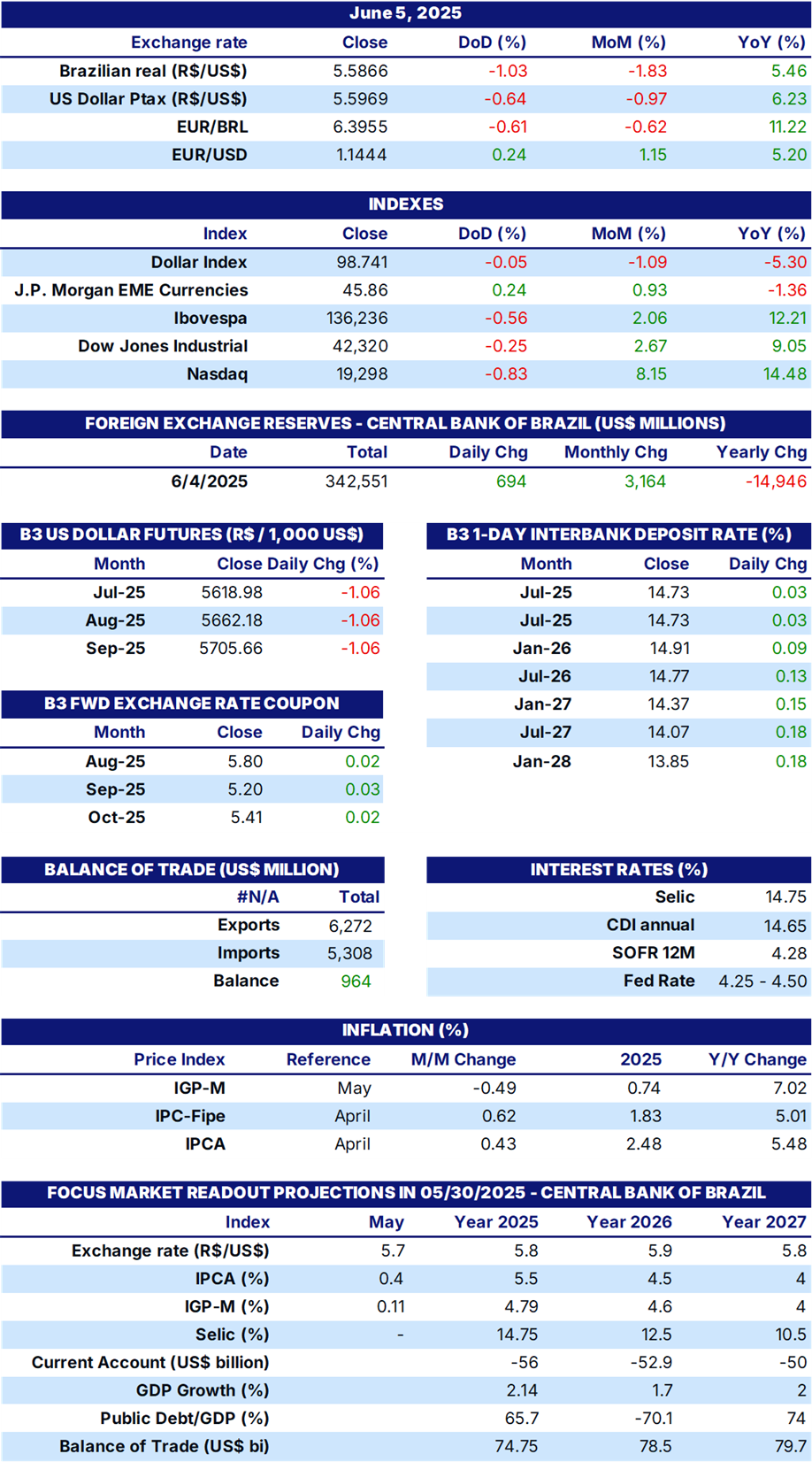
The USDBRL closed this Friday's session (06) at BRL 5.5701, a weekly decrease of 2.6%, a monthly decrease of 2.6%, and an annual decrease of 9.8%. The Dollar Index (DXY) closed the week at 99.2 points, a change of -0.2% for the week, -0.2% for the month, and -8.3% for the year.
USDBRL and Dollar Index (points)
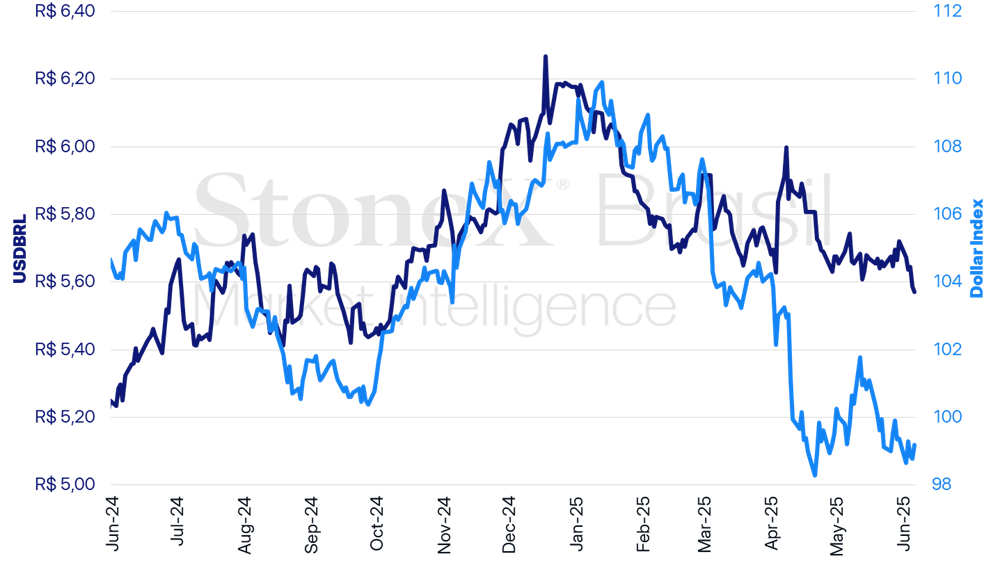
Source: StoneX cmdtyView. Design: StoneX.
KEY EVENT: Alternatives to increasing the IOF
Expected impact on USDBRL: bearish
In Brazil, investors must reflect on the impasse between the Ministry of Finance and the National Congress regarding the recent increase in IOF tax. Last Tuesday (03), the Minister of Finance, Fernando Haddad, declared that the alternatives to the tax increase are already practically defined, having been presented to President Luiz Inácio Lula da Silva and later discussed at lunch with the presidents of the Senate, Davi Alcolumbre (União-AP), and the Chamber of Deputies, Hugo Motta (Republicanos-PB). According to the minister, however, the proposals will still be detailed in a meeting with the leaders of Congress, scheduled for this Sunday (08), when they may finally be announced. Although it is impossible to anticipate which measures will be announced, press reports say that the majority bet among parliamentarians is that a linear cut of 10% in tax benefits (credit and financial subsidies paid by the federal government) will be proposed.
The increase in the IOF, announced unexpectedly two weeks ago, provoked strong resistance among productive sectors and political leaders. In response, lawmakers had been mobilizing to articulate a Legislative Decree Project (PDL) to nullify the decision, giving a ten-day deadline for the government to find a “lasting and consistent” revenue alternative. In this context, the controversy surrounding the IOF remains a relevant factor of fiscal uncertainty, contributing to the volatility of Brazilian assets, especially if the solution presented by the government is perceived as insufficient to prevent the revocation of the proposal, which anticipated an increase in federal revenue of R$ 20.5 billion in 2025. It should also be remembered that fiscal fears in Brazil intensified after the rating agency Moody's downgraded the outlook for Brazil's sovereign credit grade from "positive" to "stable", keeping the grade at "Ba1". Thus, if the measures announced are considered by investors as favorable to the government's budgetary balance, they should boost the performance of the real and other domestic assets.
Greater optimism for the American economy
Expected impact on USDBRL: bearish
Last week, the American currency partially recovered from its recent depreciation after better-than-expected employment data in the country and progress in trade negotiations between the United States and China improved the outlook for the American economy. In particular, investors became more optimistic after a nearly 90-minute call between the presidents of the two countries to align points of disagreement while negotiating a trade agreement, and, subsequently, by the issuance of a temporary import license for Chinese rare earth metals by the three largest American automakers.
In addition, although there is almost consensus among analysts that the inconsistency and unpredictability in the conduct of American economic policies should result in greater inflationary pressure and slow down the country's growth, so far most indicators have been more resilient than anticipated. As a result, the most pessimistic scenarios for the American economy are more unlikely.
Despite these caveats, the business environment remains very vulnerable to sudden and abrupt changes due to the high degree of uncertainty and unpredictability about the conduct of American economic policies. The White House frequently changes strategies and priorities, all recent retreats on the application of import tariffs were announced as temporary and there has not yet been any formalization of trade agreements, which usually take years to be formalized. In addition, the U.S. government amplifies this uncertainty and unpredictability by promoting an accelerated pace of change through executive actions, without accompanying permanent changes in legislation.
Such inconsistency leads many investors to believe that most of the changes implemented are being used as diplomatic bargaining tactics and will not remain in effect for long, especially regarding the application of import tariffs. This, in turn, has favored investors' risk appetite and boosted the performance of risky assets, such as stocks, commodities, and currencies of emerging countries. So far, it seems more probable that this trend will continue to prevail this week – at least, until the next surprise from the White House.
Inflation in the U.S
Expected impact on USDBRL: bullish
It is also worth mentioning the release this week of data for inflation in the US during the month of May. The median of the projections points to a slight reacceleration of the Consumer Price Index (CPI), which would maintain its monthly increase at 0.2% while its core, which excludes the more volatile components of food and energy, would go from 0.2% in April to 0.3% in May. This slight increase should be the result of price hikes in certain categories of industrial goods that are more affected by the application of import tariffs, such as furniture, clothing, automobiles, and automotive parts, which must have passed on higher production costs to some extent.
The hotter reading for inflation in the US should reinforce investors' bets that the Federal Reserve will not be in a hurry to make new interest rate cuts, seeking to maintain a firmer monetary tightening to stabilize inflation while the economy remains resilient. Contributed to this interpretation was the release of the May U.S. Employment Situation Report, which surprised with a net job creation greater than expected and an increase in wage gains also above the estimated. Thus, the prospect that the yields on American bonds will remain higher for longer should help attract foreign capital to the United States and contribute to the global strengthening of the dollar, which, in turn, tends to harm the performance of the real.
IPCA in Brazil
Expected impact on USDBRL: bearish
The median of the projections for the Broad National Consumer Price Index (IPCA) for May indicates a slight slowdown in inflation, going from 0.41% in April to 0.39% in May. If this scenario is confirmed, the 12-month accumulated inflation would decrease from 5.53% to 5.40%, remaining, however, significantly above the Central Bank's inflation target ceiling, set at 4.50% per year. The result of the IPCA for May represents the last relevant inflation data before the Monetary Policy Committee (Copom) decision on June 17. The expectations regarding the decision remain divided among analysts. While the smaller portion of bets anticipates that the Copom will keep the basic interest rate flat, the larger portion projects a new increase of 0.25 percentage points, postponing the end of the current cycle of monetary tightening initiated in September. This expectation is especially based on the resilience observed in recent indicators of economic activity, such as the performance of the Gross Domestic Product (GDP) in the first quarter, which exceeded market projections. In this context, the release of the IPCA gains relevance, and if the data comes out in line with expectations, it should increase the perception of the persistence of inflationary pressures, sustaining the expectation of a new increase in the Selic rate. This, in turn, improves the outlook for Brazilian bond yields and favors the attraction of external capital flows, strengthening the real.

INDICATORS