Dollar should reflect expectations of higher interest rates in the US, White House pressure against Powell, IPCA-15 and ECB decision
- Bearish factors
- Pressure from the White House against the Federal Reserve chairman may reduce the credibility of American monetary policy, making it difficult to attract foreign capital and hurting the overall performance of the dollar.
- Bullish factors
- A decrease in bets on Federal Reserve interest rate cuts tends to foster the attraction of financial investment to the US, strengthening the dollar.
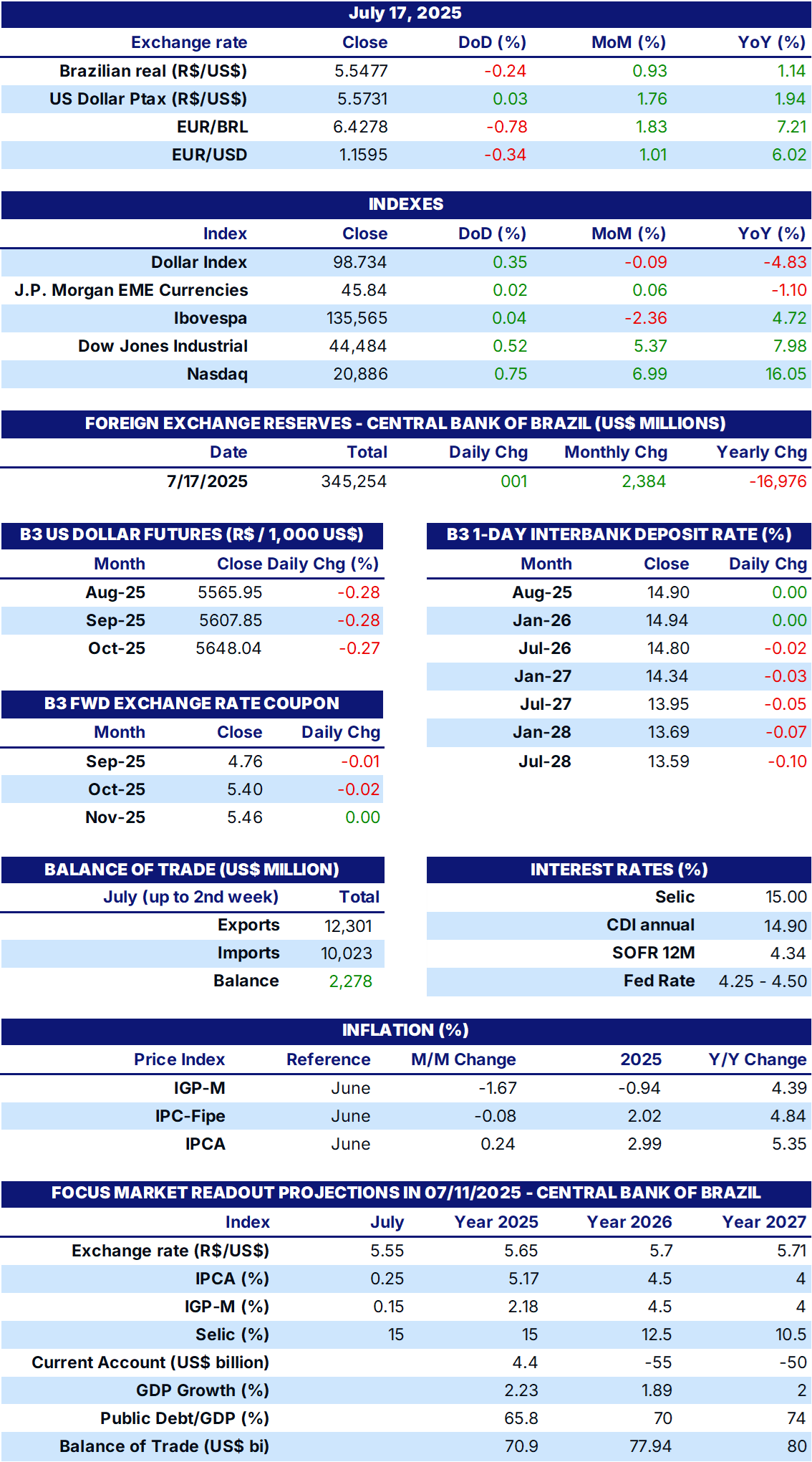
- Moderation of the July IPCA-15 may increase bets on a cut in the basic interest rate (Selic) still this year, which tends to harm the attraction of foreign investment and weaken the real.
- The European Central Bank's monetary policy decision may reinforce expectations for further interest rate cuts throughout the year, which, in turn, tends to strengthen the dollar against the euro and, indirectly, weaken the real.
The week in review
• The White House announced 30% import tariffs on products from Mexico and the European Union
• The U.S. Commerce Office announced an investigation into Brazil's unfair trade practices.
• American economic data suggest that the economy remains healthy and inflation remains contained, although the first effects of the tariffs on prices have emerged.
• STF validated most of the increase in the Tax on Financial Operations (IOF), in victory for the government.
USDBRL and Dollar Index (points)
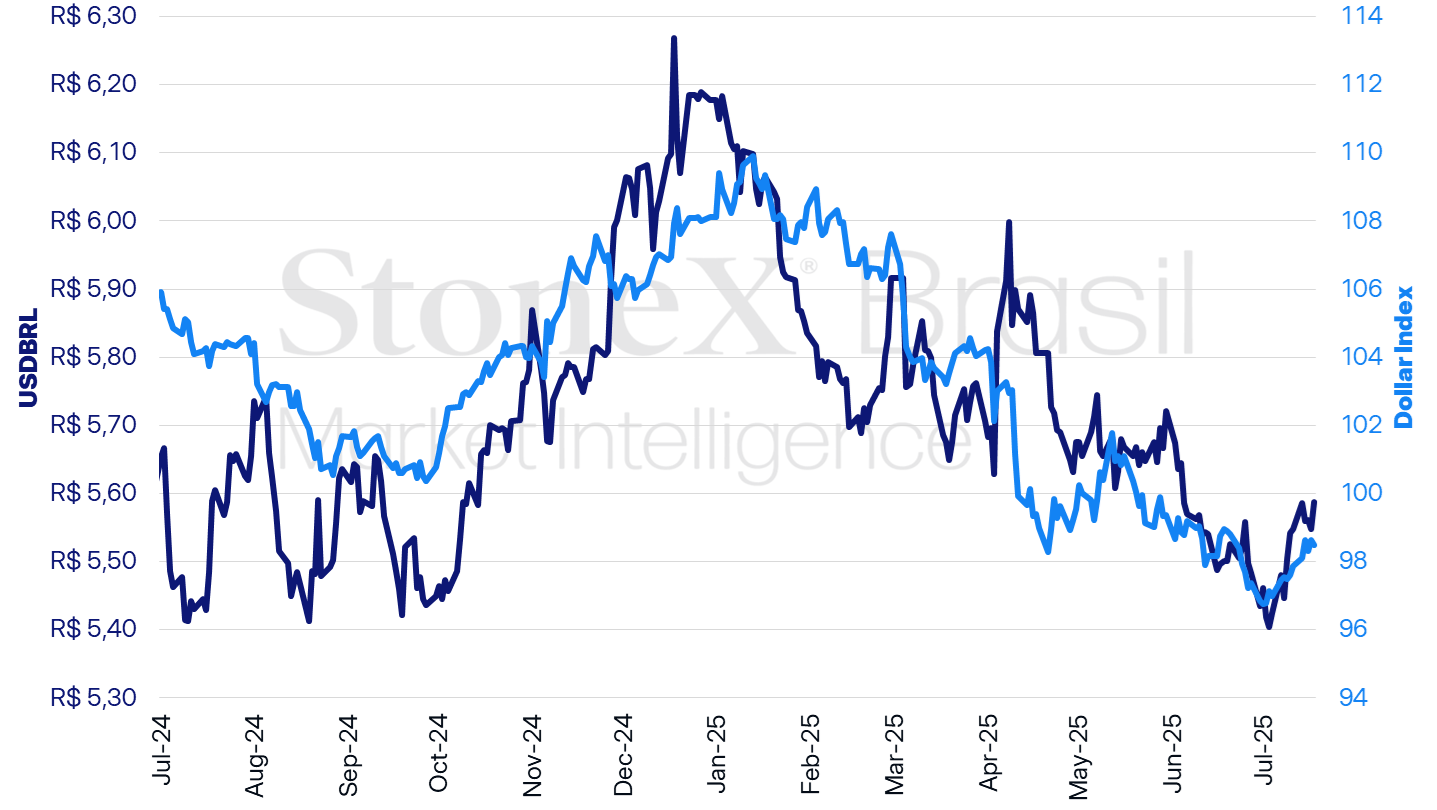
Source: StoneX cmdtyView. Design: StoneX.
Variations of USDBRL | Daily: +0.72% | Weekly: +0.72% | Monthly: +2.81% | YTD: -9.55% | In 12 months: -0.02% |
Dollar index variations | Daily: -0.14% | Weekly: +0.63% | Monthly: +1.69% | YTD: -8.91% | In 12 months: -5.45% |
KEY EVENT: Bets on interest rate cuts in the United States fall
Expected impact on USDBRL: bullish
USA: History and expectation for the interest rate - updated on July 18, 2025
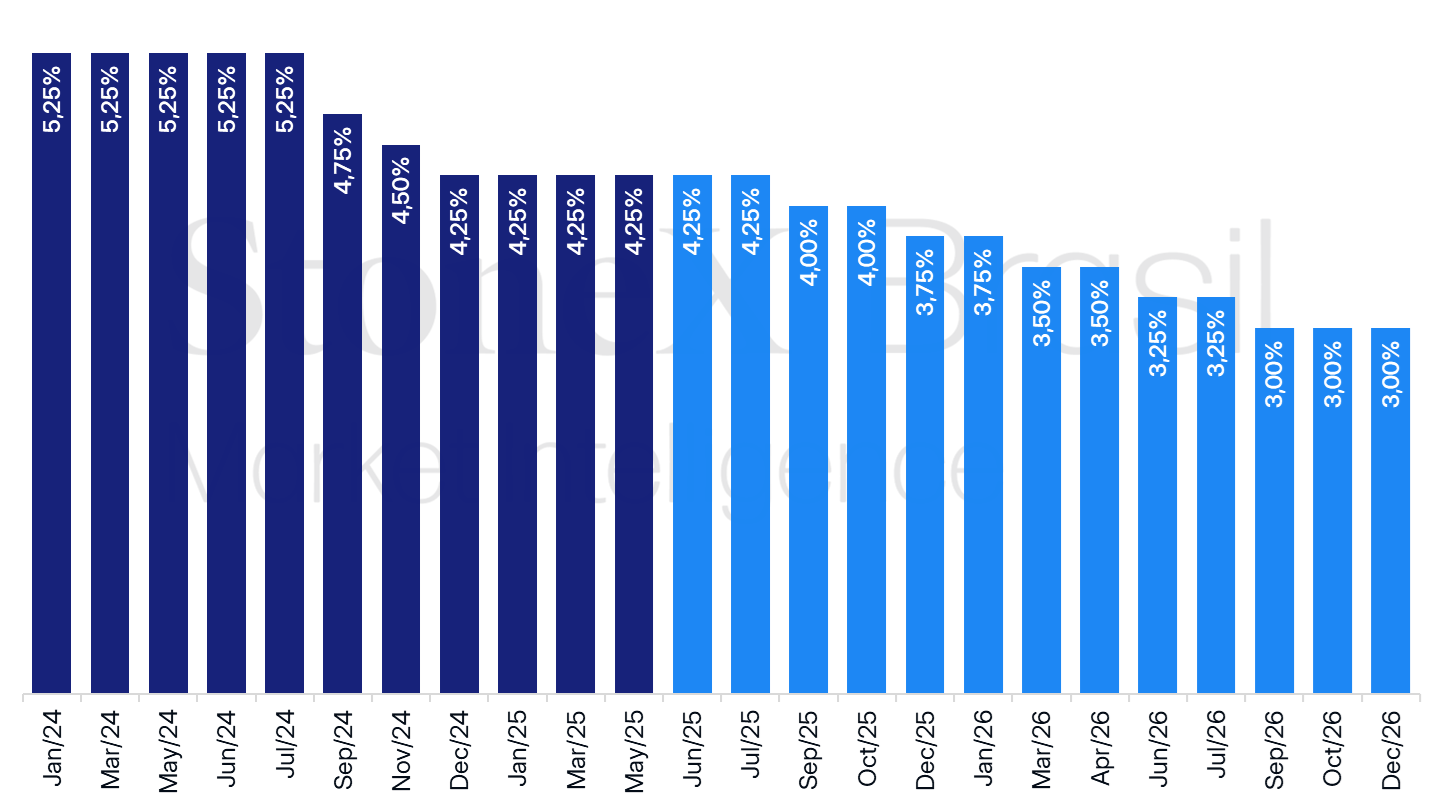
Source: CME FedWatch Tool. Design: StoneX. Refers to the bet with the highest probability in the future interest rate market on the indicated date.
Over the past two weeks, the decrease in investors' bets on interest rate cuts by the Federal Reserve has driven a rebound in the dollar's global value.
Why this is important: The expectation of higher interest rates in the US favors the inflow of foreign investment into the country and supports a strengthening of the dollar, which tends to harm the performance of the real.
Healthy economy: In the last two weeks, data for the American labor market and for consumer demand performed better than expected, reducing concerns about an economic slowdown in the country.
- This, in turn, reinforces the reading that the Federal Reserve does not need to be in a hurry to lower its interest rate, lowering investors' bets for cuts.
Impact of tariffs on inflation: Although US inflation in June rose less than estimated, the numbers also showed the first signs of inflationary pressures due to import tariffs, even if only for a limited group of products.
- Some sectors more exposed to international trade, indeed, showed a significant pick up in their prices in June, such as electronics, clothing, footwear, and furniture.
- As a result, the first signs of the effects of tariffs on prices have increased concerns about greater inflationary pressure in the coming months, which is also reducing bets on interest rate cuts by the Fed and contributing to a global strengthening of the dollar.
Risks of higher inflation: There is practically consensus among analysts that the impacts of tariffs on inflation should increase in the coming months, although there is debate about the magnitude and duration of these impacts.
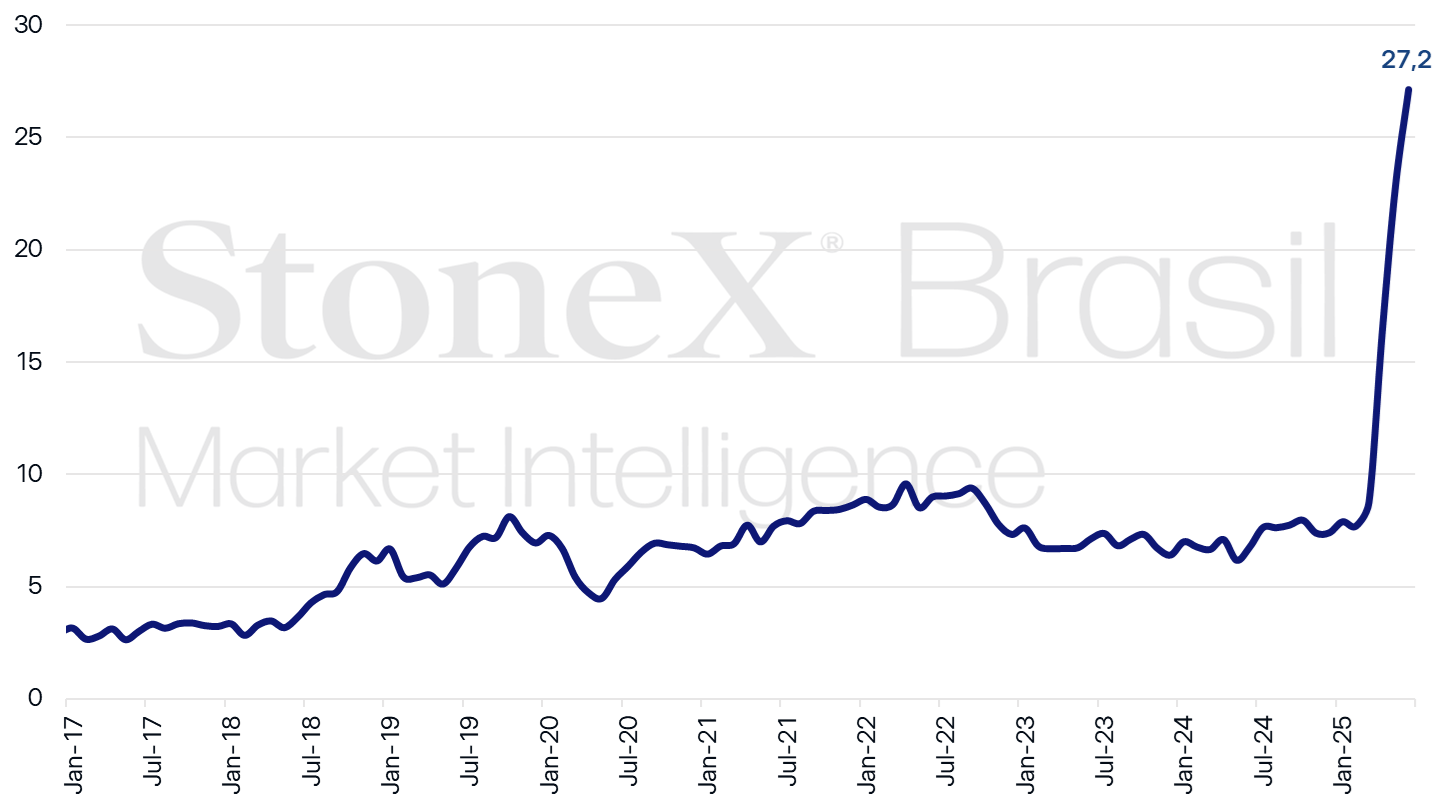
- The increase in import tariffs can be seen in customs revenues, which grew 231% in the second quarter of this year compared to the same period last year.
United States monthly customs revenue (US$ billion)
Source: U.S. Treasury Fiscal Data. Design: StoneX.
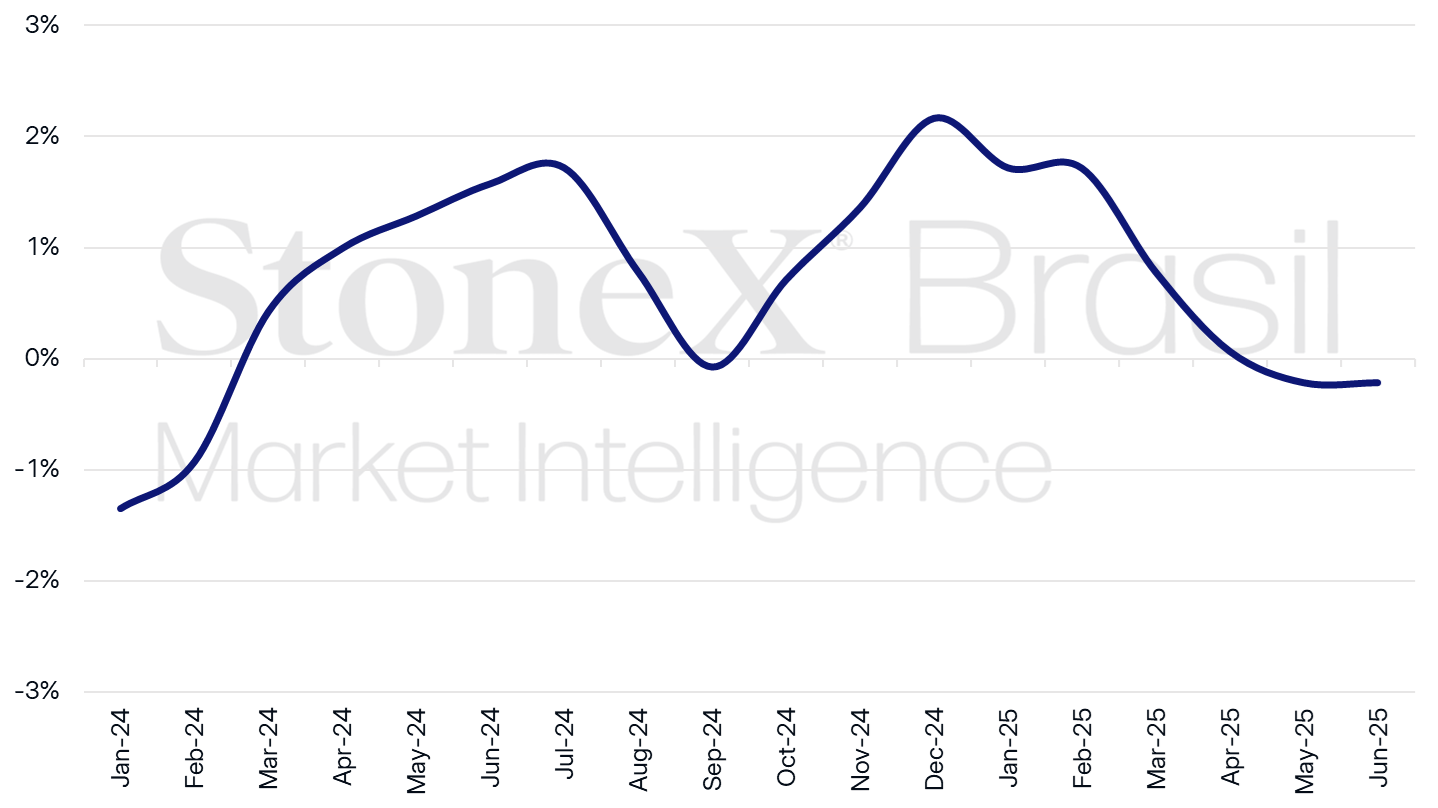
- This means that import costs are rising. On the other hand, import prices are practically stable, which shows that foreign companies are not reducing their prices for their American customers.
Cumulative change in 12 months of import prices in the United States (%)
Source: U.S. Bureau of Labor Statistics (BLS), Federal Reserve Bank of St. Louis. Design: StoneX.
- As both the Consumer Price Index (CPI) and the Producer Price Index (PPI) do not show widespread effects of tariffs on prices, it is reasonable to conclude that, at the moment, companies are keeping prices stable and reducing their profit margins.
- It is reasonable to imagine that at some point these companies may pass on the higher costs to consumers, which would generate inflationary pressures.
Toughening the threats: These risks may become even greater if the White House follows through on its threat to significantly increase the tariffs of the tariffs starting August 1.
Other inflationary risks: In addition to the risk of tariff impacts, two other factors may result in higher inflationary pressures in the second half.
- First of all, the depreciation of the American currency in the first half of the year also tends to increase the import costs for the country's companies.
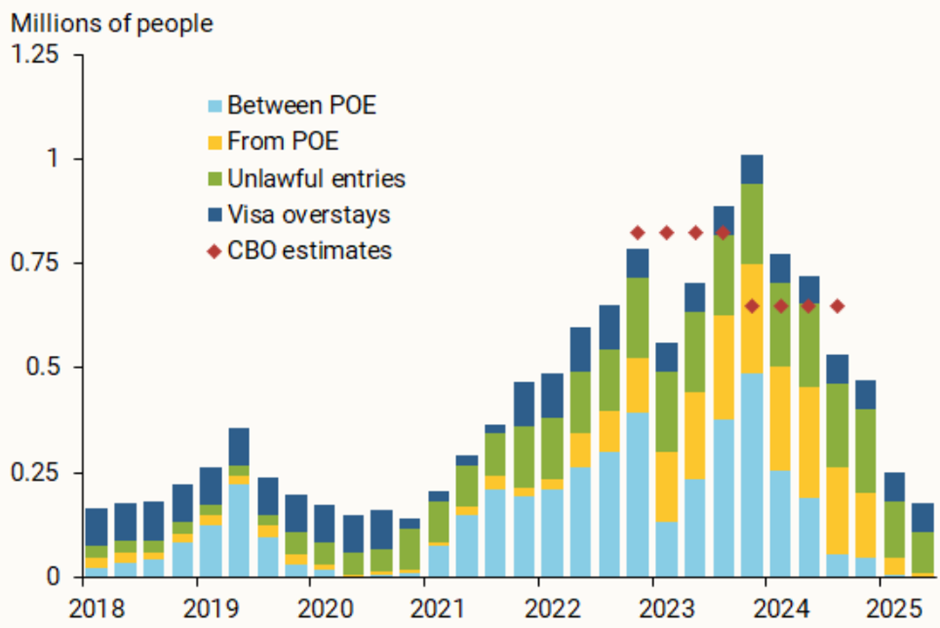
- Additionally, the significant reduction in the inflow of undocumented immigrants to the United States may contribute to maintaining a lower unemployment rate in the country, which, in turn, may foster wage gains and drive inflation by keeping demand higher.
Inflow of undocumented immigrants to the United States per quarter (millions of people)
Source: Federal Reserve of San Francisco.
White House increases pressures on the Federal Reserve
Expected impact on USDBRL: bearish
The White House has ramped up its pressure campaign on Federal Reserve (Fed) Chairman Jerome Powell, seeking to influence the agency's monetary policy decisions.
Why this is important: Pressure from Executive and Legislative authorities on the Fed can seriously undermine the credibility of American monetary policy, which tends to drive foreign investors away from American assets and harm the overall performance of the dollar.
Overview: U.S. President Donald Trump has been critical of Jerome Powell almost daily, frustrated by the Federal Open Market Committee's decisions not to cut U.S. interest rates.
- In April, Trump said on social media that "Powell's resignation can't come any faster."
- That same month, the Wall Street Journal reported that White House lawyers explored legal options to try to remove Powell from the Federal Reserve, including whether they could do so under "due cause."
- In May, Trump confirmed press reports that he was considering announcing Powell's successor early in order to influence expectations for American monetary policy.
- In June, Trump again stated on social media that he could fire Powell.
- In July, the White House ramped up pressure on Powell, alleging that he lied or was grossly negligent in his testimony to Congress regarding the renovations of the Fed's headquarters, seeking a legal alternative to his firing.
- Last Tuesday (15), Treasury Secretary Scott Bessent stated that the “formal process” to find Powell’s successor had already begun.
- And on Wednesday (16), Trump confirmed news reports that he had discussed Powell's dismissal with Republican Party lawmakers the night before, but that it was "highly unlikely" he would do so.
Questionable legality: There are important legal challenges to this dismissal. The U.S. Supreme Court ruled in 1935 that members of independent bodies, such as the Fed, cannot be fired without cause.
- Additionally, in a decision on May 22 of this year, the Supreme Court stated that "we disagree that [the dismissals of members of independent agencies] necessarily imply the constitutionality of removing members of the Federal Reserve without cause."
Alternatives: Even if Trump does not fire Powell, he can still influence expectations for American monetary policy in other ways.
- Powell has only ten months left in office, and it may not be worth the risk of causing turmoil in financial markets with his resignation.
- In addition, Trump needs to nominate a successor to Adriana Kugler, a member of the Federal Reserve Board of Governors whose term ends on January 31.
- Bessent indicated in an interview that the White House is probable to use the nomination for Kugler's seat to insert its candidate for Fed chair into the Federal Open Market Committee (FOMC) before Powell's term ends.
What about the FOMC? It is worth remembering, finally, that the FOMC is composed of 12 members – the seven members of the Fed's Board of Governors and five presidents of regional Federal Reserves.
- Therefore, even if Powell's successor shares Trump's view that US interest rates need to be reduced quickly, this does not automatically mean that the other members of the Committee will follow his view.
July IPCA-15
Expected impact on USDBRL: bullish
This week, the Broad National Consumer Price Index 15 (IPCA-15) should once again show a moderate increase in July.
- This will be the last inflation reading before the decision of the Monetary Policy Committee (Copom) on July 30.
Why this is important: If confirmed, the moderation of inflation data may reinforce the expectation of interest rate cuts earlier than expected by the Central Bank, while a gradual convergence of inflation to the agency's target is observed.
- This, in turn, may reduce the outlook for domestic bond yields and hinder the attraction of foreign investment, which tends to harm the performance of the real.
Expectation: The median estimate for the July IPCA-15 is for a slight pick up in the monthly index, to 0.29%, after posting an increase of 0.26% in June.
- This would keep the cumulative index in 12 months at 5.3%, substantially above the ceiling of the inflation target stipulated by the Central Bank (BC), of 4.5%.
Overview: The most recent inflation data, the Broad National Consumer Price Index (IPCA) for June, recorded an increase of 0.24%, marking the fourth consecutive monthly slowdown of its headline index.
- Despite the retreat, the cumulative in 12 months reached 5.35%.
- With this, the president of the Central Bank, Gabriel Galípolo, sent a letter explaining the reasons for not meeting the target, according to the new methodology adopted this year, which requires such justification whenever the index outstrips the tolerance range for six consecutive months.
Interest rate decision of the European Central Bank (ECB)
Expected impact on USDBRL: bullish
There is consensus among analysts that the European Central Bank (ECB) should keep its key interest rate unchanged next Thursday (17), at 2.25% p.a.
- If confirmed, the decision ends the cycle of seven consecutive decreases carried out by the agency since September last year.
Why this is important: More than the decision itself, investors should look for clues about the next steps of the entity, which should act with caution in the face of uncertainties regarding the real impacts of the new American tariff barriers on the European economy.
- If the communication reinforces pessimism regarding the bloc's economy, it may foster expectations for new interest rate cuts in the near future, which, in turn, tends to strengthen the dollar against the euro and, indirectly, weaken the real.
Overview: The prolonged cycle of cuts promoted by the ECB was based on the improvement in inflation projections for the European Union, the slowdown in economic activity, and the recent intensification of risks associated with the escalation of trade barriers imposed by the United States.
- Last week, the American president, Donald Trump, announced the implementation of 30% tariffs on the import of products coming from the European Union starting August 1.
- However, especially in the face of the strong unpredictability regarding the American trade policy promoted by the White House, it is difficult to foresee whether this rate will indeed remain or the real impacts of this tariff on the European economy.
- In this sense, the probable lull promoted by the ECB should be justified as a necessary time for the institution to assess the scenario of uncertainties, possibly resuming rate cuts in the October decision.

INDICATORS