Dollar is expected to reflect anticipation of interest rate cuts in the US and the IPCA-15 in Brazil
- Bullish
- Possible deflation of the IPCA-15 may reinforce the perception of a faster stabilization of prices in Brazil and increase bets on cuts to the basic interest rate (Selic), which tends to hinder the attraction of foreign investment to Brazil and would harm the performance of the real.
- Bearish
- Jerome Powell's speech at Jackson Hole raises the odds of Federal Reserve interest rate cuts in September, which tends to hinder the attraction of foreign investment to the US and would depreciate the dollar globally.
The week in review
- Jerome Powell signals the possibility of rate cuts by the Federal Reserve, weakening the dollar globally.
- Donald Trump met with Volodymyr Zelensky and other European leaders to discuss the conflict between Russia and Ukraine.
- Minutes of the Federal Reserve's latest interest rate decision showed that its members were more concerned about inflationary risks than about unemployment risks in the US.
- Flávio Dino, from the Supreme Federal Court, decided that foreign laws and court orders do not automatically apply in Brazil, which would nullify the effects of the American sanctions on Minister Alexandre de Moraes.
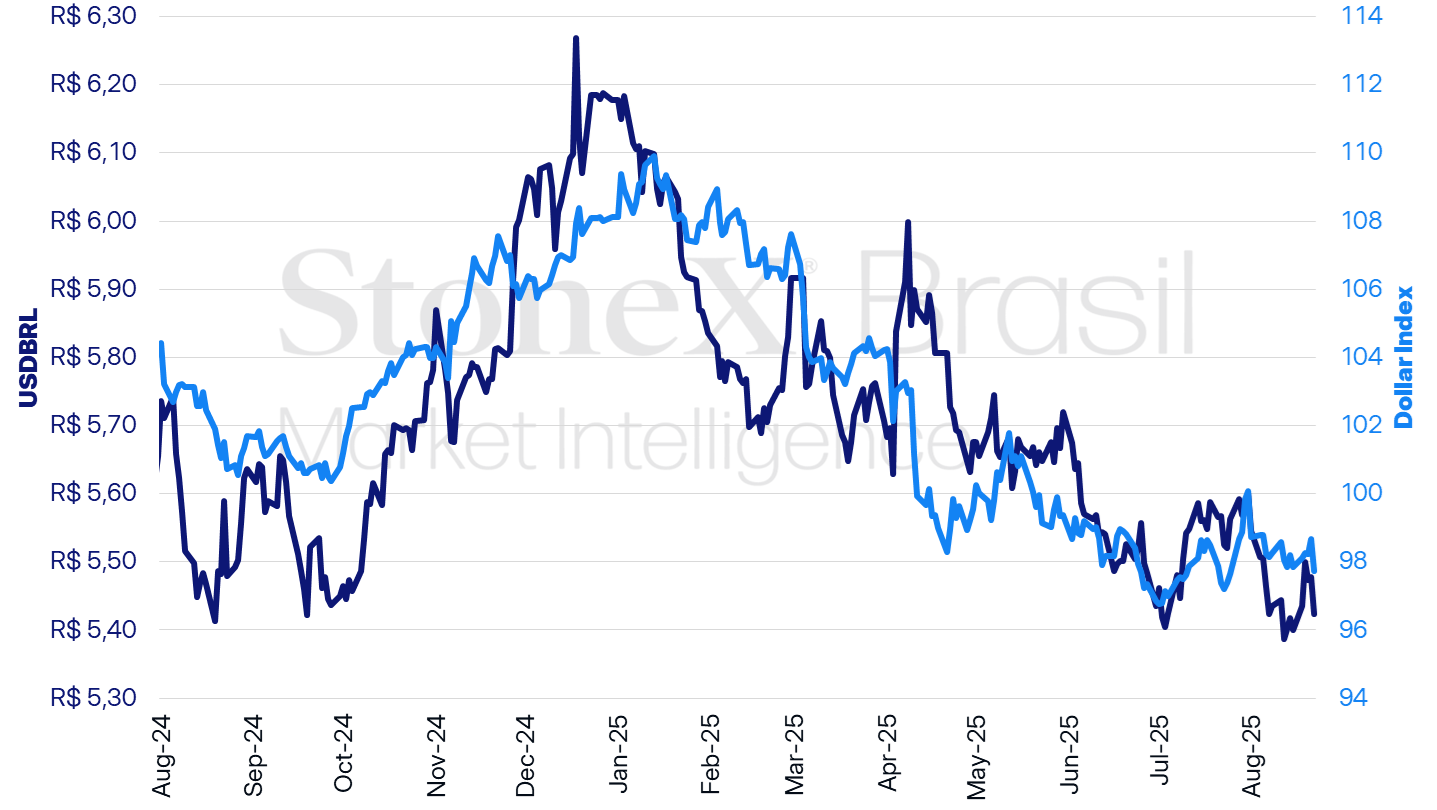
USDBRL and Dollar Index (points)
Source: StoneX cmdtyView. Design: StoneX.
Variations of the USDBRL | Daily: -1.00% | Weekly: +0.43% | Monthly: -3.18% | YTD: -12.22% | In 12 months: -2.99% |
Dollar index variations | Daily: -0.93% | Weekly: -0.11% | Monthly: -2.33% | YTD: -9.61% | In 12 months: -3.71% |
KEY EVENT: Powell's speech at Jackson Hole
Expected impact on USDBRL: bearish
USA: History and expectation for the interest rate - updated on August 22, 2025
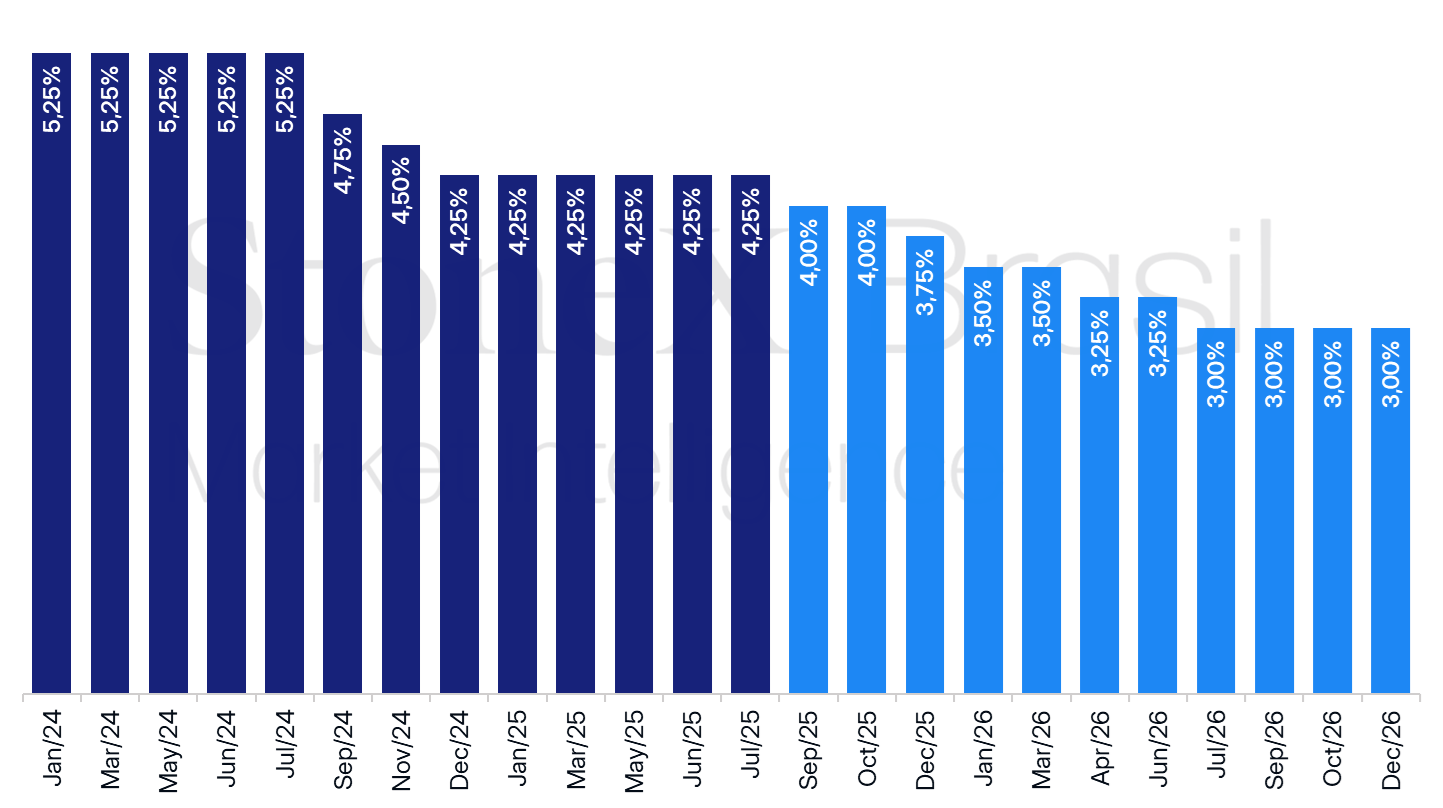
Source: CME FedWatch Tool. Design: StoneX. Refers to the bet with the highest probability in the future interest rate market on the indicated date.
In his speech at the Annual Jackson Hole Monetary Policy Symposium, Jerome Powell, chairman of the Federal Reserve, indicated the possibility of interest rate cuts by the Fed in the short term.
- However, Powell defended that this adjustment should occur cautiously, gradually and only if the data support this decision.
- Powell's speech came at a time of heightened uncertainty about the evolution of the U.S. economy in the second half of the year and constant attacks by the White House against the Federal Reserve's conduct of monetary policy.
Why this is important: The increase in bets on interest rate cuts by the institution reduces the expected returns on US bonds, makes it harder to attract foreign investment to the country, and contributes to a global weakening of the dollar.
Changes in the balance of risks: In his remarks, the Fed chairman suggested that a reduction in the level of interest rates may be appropriate from now on because of "the base case for the economic outlook and the change in the balance of risks" for the Fed's dual mandate of price stability and maximum employment.
- “In the short term, inflation risks are tilted to the upside, while employment risks are tilted to the downside—a challenging situation.”
Risks of slowdown: On one hand, Powell acknowledged that there are significant risks of a worsening in labor market conditions, which is in “a curious kind of balance” due to both a smaller number of available workers and a slowdown in the pace of hiring.
- “This unusual situation suggests that downside risks to employment are increasing. And if these risks materialize, they could do so rapidly in the form of sharply higher layoffs and rising unemployment.”
- He also noted that U.S. Gross Domestic Product (GDP) growth slowed significantly in the first half of the year
Inflationary risks: On the other hand, Powell also acknowledged that there are significant risks of an inflationary pick up, both due to import tariffs and economic activity.
- He emphasized that “the effects of tariffs on consumer prices are clearly visible now. We expect these effects to accumulate over the coming months, with great uncertainty regarding their speed and magnitude.”
- The Fed Chair also stated that “a reasonable baseline scenario is that the effects will be relatively short-lived,” meaning a one-off price adjustment that would not necessarily influence monetary policy.
- “Of course, a one-off price adjustment doesn’t mean everything happens at once. It will still take time for the effects of tariffs to manifest across supply chains.”
- “However, it’s also possible that inflationary pressures caused by tariffs could result in a more persistent inflation dynamic, and that is a risk to be assessed and managed.”
- “We cannot take the stability of inflation expectations for granted. We will not allow a one-off increase in price levels to turn into a persistent inflation problem,” Powell affirmed
Independence and impartiality: In a subtle message, Powell reiterated that monetary policy does not follow a predefined course and that Fed members will make their decisions based on the evaluation of the data.
- “FOMC members will decide solely based on their evaluation of the data and its implications for the economic outlook and the balance of risks. We will never deviate from this approach.”
- His remarks subtly respond to criticism and threats from U.S. President Donald Trump and Republican Party leaders regarding the country’s interest rate levels.
- Trump has threatened to sue or dismiss Powell over renovation costs at the Fed that exceeded projections, and this week also threatened to sue or dismiss Fed Board Governor Lisa Cook over alleged mortgage fraud.
Data on the American economy: Additionally, the last week of August will bring some important indicators to help investors calibrate their expectations for the evolution of the American economy in the coming months.
- PCE: The median of the estimates for the Personal Consumption Expenditures (PCE) Price Index in July shows an increase of 0.3% for both the headline indicator and its core, which excludes the more volatile food and energy components, the same value recorded by both in June. As with the consumer price index, there should not be widespread effects of import tariffs on the prices of items more sensitive to international trade.
- Income and expense: Both Personal Income and Personal Consumption Expenses should have accelerated, with income rising from 0.3% in June to 0.4% in July, and consumption increasing from 0.3% to 0.5% over the same period. The moderate expansion imply a gradual slowdown in demand in the country, without implying risks of an abrupt downturn in the economy.
- GDP: The second preview of the US Gross Domestic Product in the second quarter should maintain the annualized growth of 3% recorded in the first preview.
- Consumer Confidence: The projections point to a slight improvement in the Consumer Confidence Index measured by the Conference Board, from 97.2 points in July to 98.0 points in August, while they point to a slight worsening of the Consumer Confidence Index measured by the University of Michigan, from 61.7 points to 58.6 points in the same period.
July IPCA-15
Expected impact on USDBRL: bullish
The National Broad Consumer Price Index 15 (IPCA-15) is expected to show deflation in its headline index, according to the median estimate.
Why this is important: If confirmed, the greater moderation of the data may reinforce expectations of cuts to the benchmark interest rate (Selic) earlier than initially anticipated, amid the perception of greater price stabilization.
- This scenario tends to reduce the attractiveness of Brazilian treasuries by lowering their yield prospects and hinder the inflow of foreign capital, negatively affecting the performance of the real.
Expectation: The median forecast for the IPCA-15 in August indicates a decrease of 0.2%, after a 0.33% increase in July.
- The result should be mainly influenced by the drop in food and transportation prices, favored by seasonality and the appreciation of the real in the first half of the year.
- Despite the retraction, the cumulative index over 12 months should remain slightly below 5%, still above the ceiling of the Central Bank's inflation target, set at 4.5%.
Overview: As recorded in the minutes of the last Monetary Policy Committee (Copom) meeting, the Central Bank continues to assess the “accumulated impacts of the monetary adjustment already carried out, still to be observed, (...) [and whether they are] sufficient to ensure inflation converges to the target.”
- If the IPCA-15 indeed comes in more moderate, the result may reinforce bets on the weakening of monetary policy rigidity, especially after expectations for the annual increase of the IPCA in 2025 fell below 5% for the first time since February this year.
- Even so, a possible reduction of the Selic in the second half of the year would still depend on new evidence of inflation stabilization in the coming months.
PTAX rate at the end of the month
Expected impact on USDBRL: undefined
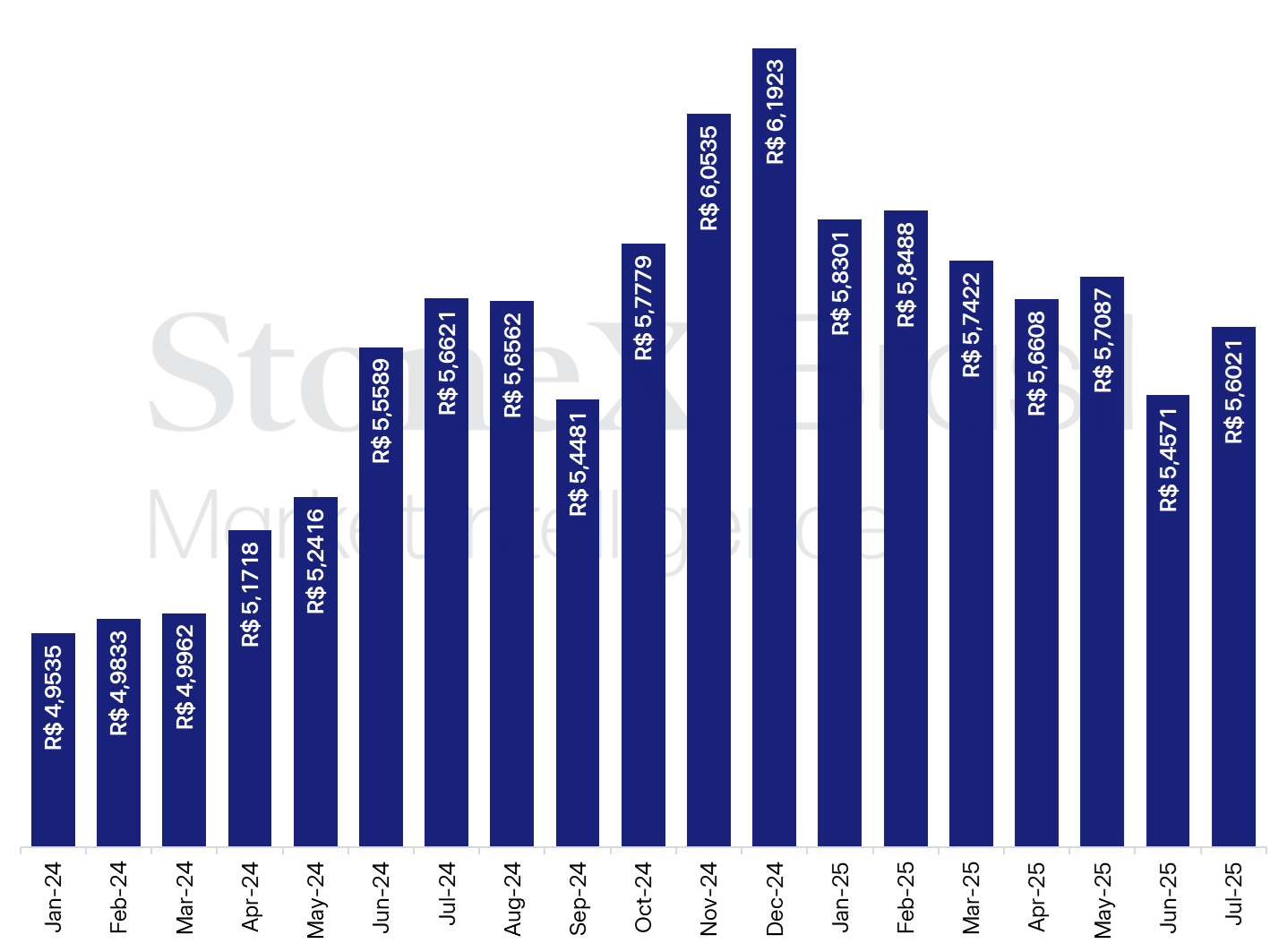
End-of-month PTAX rate – (USDBRL)
Source: Central Bank of Brazil. Design: StoneX.
The PTAX rate is a reference published daily by the Central Bank, and its end-of-month value is widely used in foreign exchange and derivatives contracts.
Why is this important: Financial market operators intensify their operations during the periods when the last PTAX rate of the month is set, which makes it harder to interpret the real’s movements on the day.
- The volume of trades and volatility usually increase during the time windows used by the Central Bank of Brazil to calculate the end-of-month PTAX rate, between 10:00 AM and 1:10 PM.

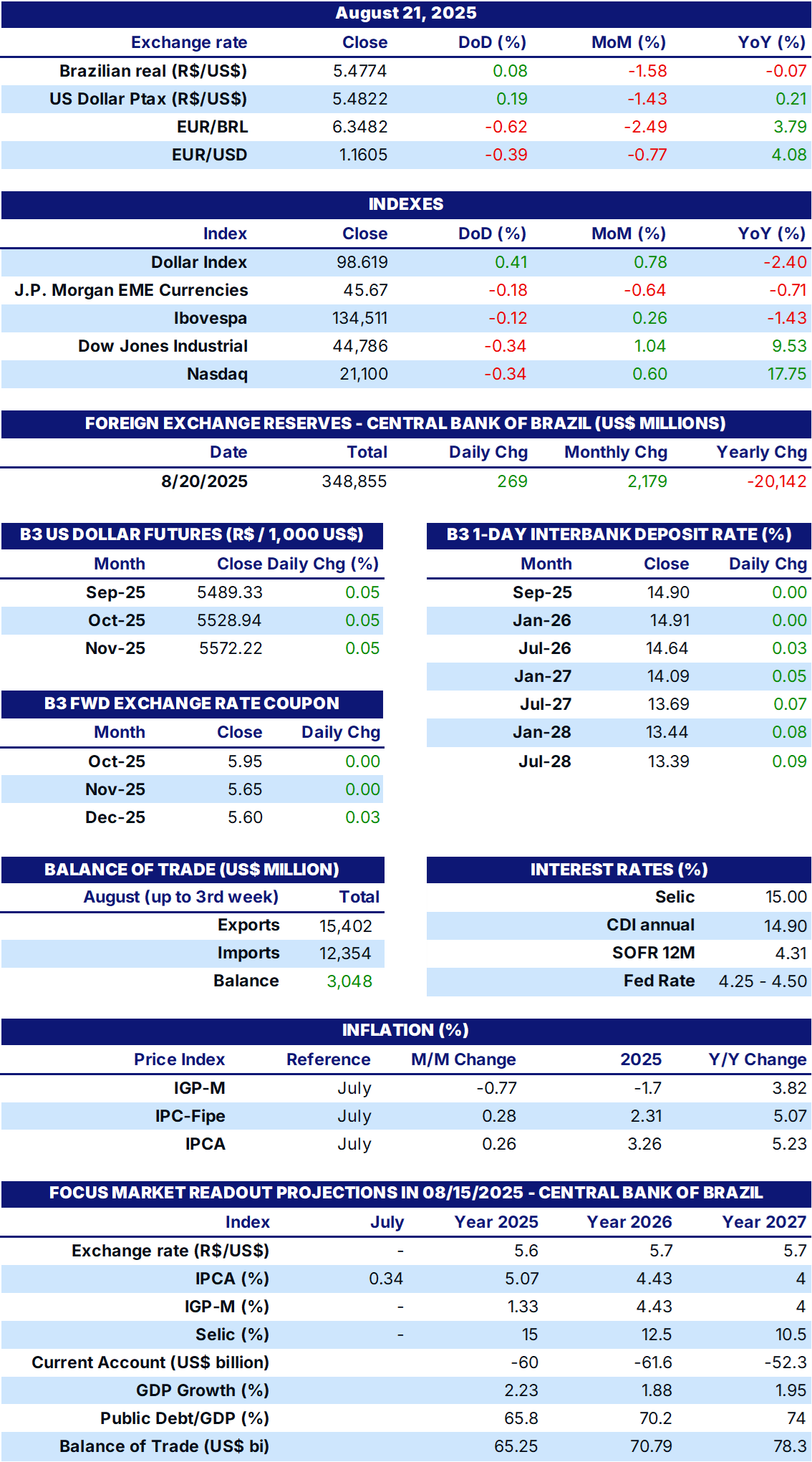
INDICATORS
Sources: Central Bank of Brazil; B3; IBGE; Fipe; FGV; MDIC; IPEA and StoneX cmdtyView.