USDBRL Expected to Reflect Copom Minutes, IPCA, and Negotiations to Fund the U.S. Government
- Bullish
- A moderate October IPCA reading and Copom minutes are expected to reinforce the perception of slowing inflation in Brazil, potentially increasing bets on interest rate cuts starting next year.
- Bearish
- A potential funding of the U.S. government would allow the gradual publication of suspended economic statistics since October 1, which may boost risk appetite among investors and favor the Brazilian real.
The week in review
- Brazil’s Central Bank kept the benchmark interest rate (Selic) steady at 15% per year, reinforcing a conservative tone in its statement.
- Private U.S. economic data showed mixed readings, with higher-than-expected private job creation and accelerated PMI indices, alongside greater-than-anticipated job cuts and an unexpected drop in consumer confidence.
USDBRL and Dollar Index (points)
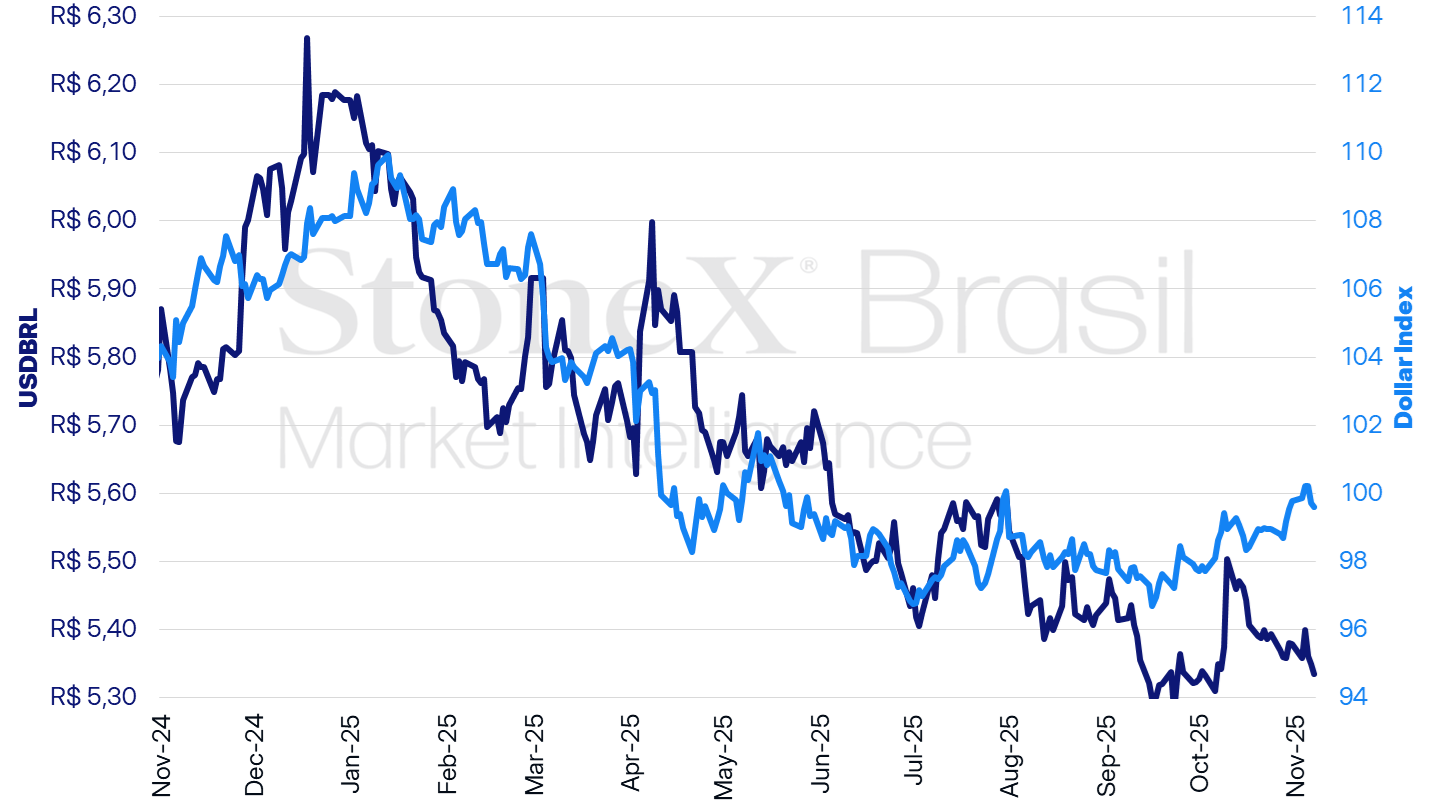
Source: StoneX cmdtyView. Prepared by: StoneX.
USDBRL Variations | Daily: -0.27% | Weekly: -0.84% | Monthly: -0.84% | Year-to-Date: -13.65% | 12-month: -6.01% |
Dollar Index Variations | Daily: -0.14% | Weekly: -0.20% | Monthly: -0.20% | Year-to-Date: -7.90% | 12-month: -4.64% |
Key Focus: IPCA and Copom Minutes
Expected Impact on USDBRL: Bullish
Brazil: Historical and Median Interest Rate Forecast – Focus Report as of October 31, 2025
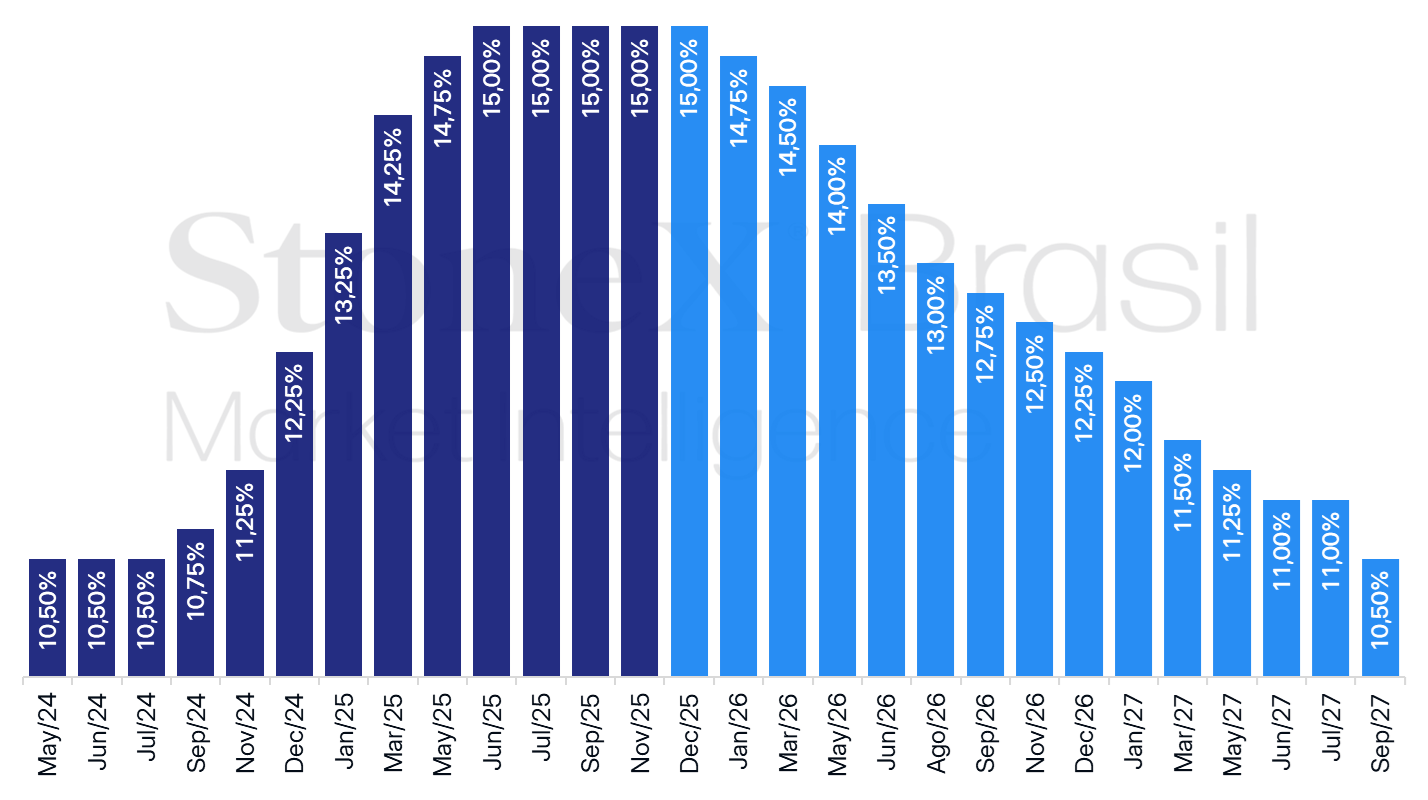
Source: Central Bank of Brazil. Prepared by: StoneX.
Domestically, investors are likely to react to the release of October’s Broad Consumer Price Index (IPCA), with the median estimate forecasting a 0.16% increase following a 0.48% rise in September.
- If confirmed, this result would slow the 12-month cumulative increase from 5.17% to 4.75%, reinforcing the perception that inflation is losing momentum.
- This trend was acknowledged by the Central Bank in last Wednesday’s Copom decision, where the statement highlighted signs of “easing inflation.”
- As such, the release of the meeting minutes this week will be closely monitored, as market participants seek further insights into the committee’s assessment and potential clues about future monetary policy steps.
Why This Matters: While the minutes are expected to reiterate maintaining the Selic at elevated levels for a “prolonged period,” any indication that the committee recognizes signs of slowing inflation could fuel expectations of rate cuts as early as 2026.
- Even if inflation remains above target, confirmation of a stabilization trend could help reduce inflationary risk perceptions.
- Such adjustments in expectations, though limited in impact, may lower projections for domestic bond yields and contribute to a depreciation of the Brazilian real.
Copom Minutes: The document is expected to maintain the tone of the statement issued after the decision, prompting investors to look for details on subtle changes presented by the Committee.
- The most significant change in the statement relates to the acknowledgment of early signs of slowing inflation, as noted: “headline inflation and underlying measures showed some easing but remained above the inflation target.”
- This acknowledgment indicates a perception of easing, albeit insufficient for convergence to the target or to establish a consolidated trend.
- The recognition was further reinforced by another excerpt, highlighting that “the Committee assesses that the strategy of maintaining the current level of interest rates for a very prolonged period is sufficient to ensure inflation converges to the target.”
- This formulation demonstrates that Copom views the current interest rate level as adequate to curb inflationary pressures, eliminating the need for further hikes while comfortably maintaining the Selic steady as it awaits clearer disinflation signals.
IPCA: If the median forecast of a 0.16% rise in October’s IPCA is confirmed, the index should reach 4.75% for the 12-month cumulative, still above the 3% target but closer to the 4.5% ceiling set by the Central Bank.
- This result would represent a significant slowdown compared to the recent peak of 5.53% recorded in April 2025, highlighting progress in the disinflation process.
- Beyond the headline index, investors will closely monitor the behavior of service prices and core inflation, which exclude volatile items such as food and energy. In September, core inflation fell from 0.34% (August) to 0.03%, while services, which are more demand-sensitive, dropped from 0.41% to 0.09% in the same period.
Potential U.S. Government Reopening
Expected Impact on USDBRL: Bearish
Duration of U.S. Government Shutdowns Since 1980 (days)
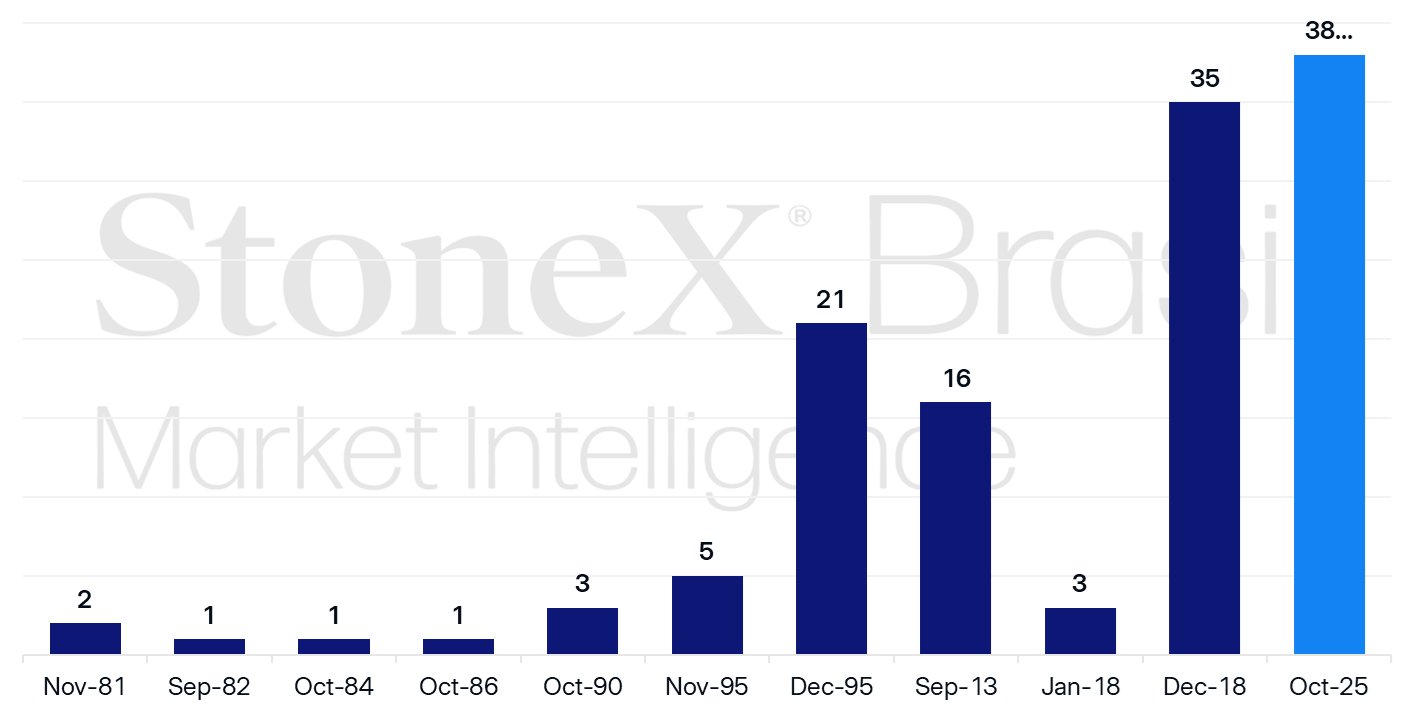
Source: U.S. House of Representatives Office of Art and Archives. Note: Includes shutdowns exceeding 24 hours.
Last week, Congressional leaders from both the Republican and Democratic parties signaled initial progress toward an agreement to reopen the U.S. government.
- This marks the longest government shutdown in U.S. history.
Why This Matters: Reopening the U.S. public sector would enable the resumption of economic data collection and publication, suspended since October 1.
- This would provide a gradual understanding of the country’s economic developments, boosting risk appetite among investors and benefiting riskier assets like the Brazilian real.
Overview: To approve a new budget or extend the existing one, 60 Senate votes are required, but the Senate is split between 53 Republicans and 47 Democrats.
- However, party leaders remain at an impasse, with Democrats demanding guarantees that public healthcare subsidies will be extended and properly allocated.
- This year, the White House rescinded various expenditures approved by Congress with Republican consent, which holds the majority in both chambers and voted against challenges from lawmakers to these rescissions.
- Last week, though, some lawmakers from both parties indicated initial progress toward reaching a new consensus.
- Some Democrats question their party’s demand for healthcare subsidy guarantees before voting to extend the previous budget.
- Meanwhile, some Republicans question their party’s insistence on reopening the government prior to negotiating healthcare subsidies.
An Alternative: A proposed solution to break the deadlock includes three key elements:
- Approval of a short-term extension of the current budget until September 30;
- Scheduling healthcare subsidies for debate in legislative chambers; and
- Passing a separate long-term budget to fund military, legislative, and agricultural sectors.
- However, debates continue over the duration of the potential budget extension.
Growing Pressure: The prolonged shutdown’s challenges are increasingly pressuring the U.S. executive and Congress to find a solution to reopen the government.
- Although the White House managed to reallocate funds to pay October salaries for military personnel, most public servants are approaching a second month without wages.
- Additionally, the end of subsidies for public healthcare programs has led to a sharp increase in costs since November 1, while a food assistance program for 42 million Americans was suspended this month.
- The country’s civil aviation regulator ordered a 10% reduction in the number of flights at 40 airports due to a widespread shortage of air traffic controllers.
- Pressure on Republicans also mounted after Democrats’ victories in key elections last Tuesday (November 4), including mayoral races in New York City, the governorship in Virginia, and a proposal for redistricting reforms in California.
- On Friday (November 7), White House economic adviser Kevin Hassett stated that the economic impacts of the shutdown are “much worse” than anticipated, particularly in the travel and leisure sectors.
Data Delays: With a government reopening, economic indicators suspended since October 1 would gradually be released, starting with older data and moving to the most recent.
- These figures will be essential for assessing the economic outlook and adjusting investor expectations for the trajectory of U.S. interest rates.

INDICATORS
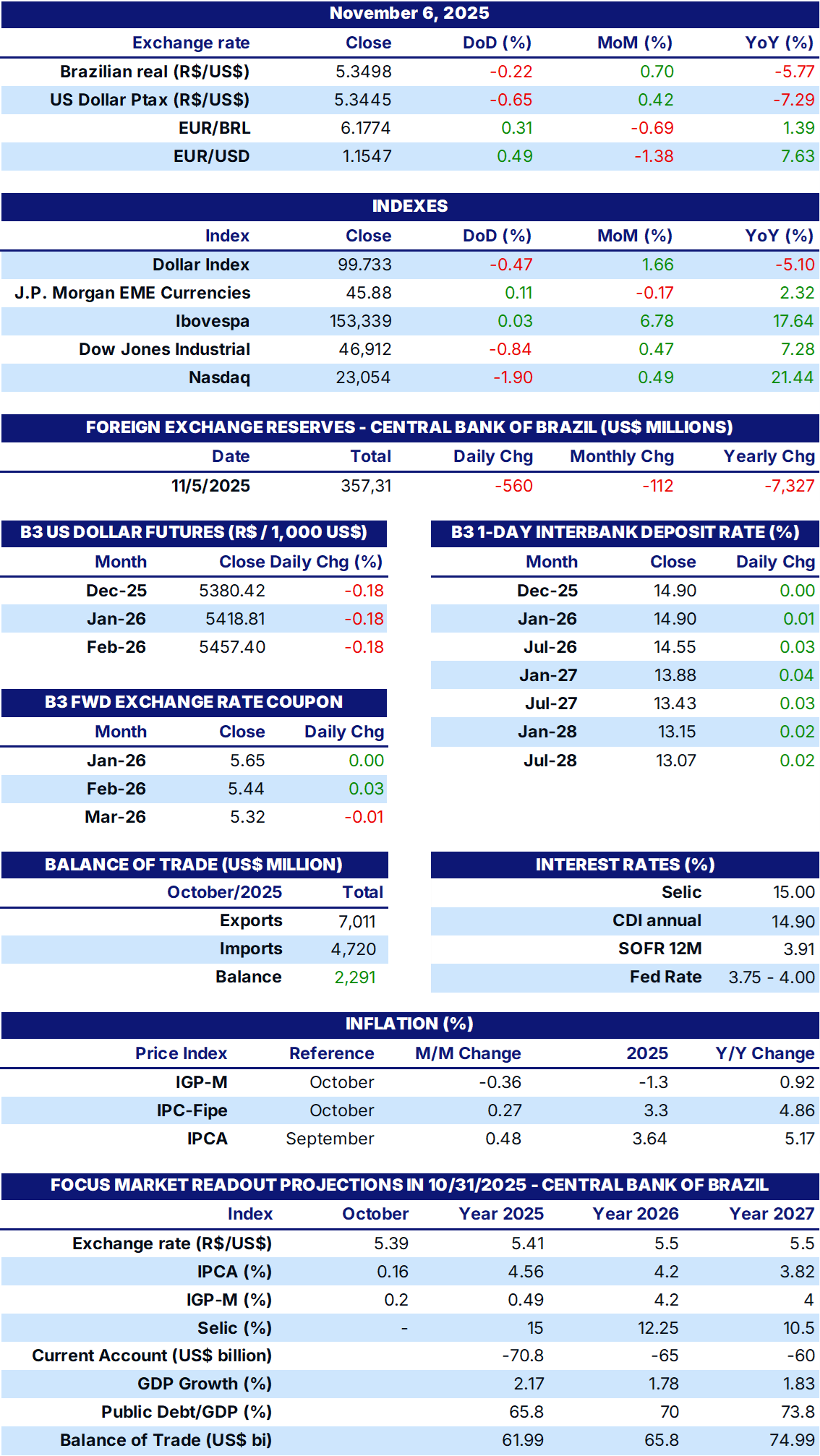
Sources: Central Bank of Brazil; B3; IBGE; Fipe; FGV; MDIC; IPEA; and StoneX cmdtyView.
The StoneX Group Inc. group of companies provides financial services worldwide through its subsidiaries, including physical commodities, securities, exchange-traded and over-the-counter derivatives, risk management, global payments and foreign exchange products in accordance with applicable law in the jurisdictions where services are provided. References to over-the-counter (“OTC”) products or swaps are made on behalf of StoneX Markets LLC (“SXM”), a member of the National Futures Association (“NFA”) and provisionally registered with the U.S. Commodity Futures Trading Commission (“CFTC”) as a swap dealer. SXM’s products are designed only for individuals or firms who qualify under CFTC rules as an ‘Eligible Contract Participant’ (“ECP”) and who have been accepted as customers of SXM. StoneX Financial Inc. (“SFI”) is a member of FINRA/NFA/SIPC and registered with the MSRB. SFI is registered with the U.S. Securities and Exchange Commission (“SEC”) as a Broker-Dealer and with the CFTC as a Futures Commission Merchant and Commodity Trading Adviser. References to securities trading are made on behalf of the BD Division of SFI and are intended only for an audience of institutional clients as defined by FINRA Rule 4512(c). References to exchange-traded futures and options are made on behalf of the FCM Division of SFI . StoneX is a trading name of StoneX Financial Ltd (“SFL”). SFL is registered in England and Wales, Company No. 5616586. SFL is authorized and regulated by the Financial Conduct Authority [FRN 446717] to provide to professional and eligible customers including: arrangement, execution and, where required, clearing derivative transactions in exchange traded futures and options. SFL is also authorised to engage in the arrangement and execution of transactions in certain OTC products, certain securities trading, precious metals trading and payment services to eligible customers. SFL is authorised & regulated by the Financial Conduct Authority under the Payment Services Regulations 2017 for the provision of payment services. SFL is a category 1 ring-dealing member of the London Metal Exchange. In addition SFL also engages in other physically delivered commodities business and other general business activities which are unregulated and not required to be authorised by the Financial Conduct Authority. StoneX Group Inc. acts as agent for SFL in New York with respect to its payments services business. StoneX APAC Pte. Ltd. acts as agent for SFL in Singapore with respect to its payments services business. ‘StoneX’ is the trade name used by StoneX Group Inc. and all its associated entities and subsidiaries.
Trading swaps and over-the-counter derivatives, exchange-traded derivatives and options and securities involves substantial risk and is not suitable for all investors. Past performance of any futures or option is not indicative of future success. Indicators are not a trading system and are not published as a specific trade recommendation. The information herein is not a recommendation to trade nor investment research or an offer to buy or sell any derivative or security. It does not take into account your particular investment objectives, financial situation or needs and does not create a binding obligation on any of the StoneX group of companies to enter into any transaction with you. You are advised to perform an independent investigation of any transaction to determine whether any transaction is suitable for you. No part of this material may be copied, photocopied or duplicated in any form by any means or redistributed without the prior written consent of StoneX Group Inc.
© 2026 StoneX Group Inc. All Rights Reserved.