Dollar likely to reflect FOMC and Copom interest rate decisions, as well as the 2026 electoral scenario
- Bullish
- Central Bank may signal the proximity of a cutting cycle for the benchmark interest rate (Selic), which would hinder the attraction of foreign investments and weaken the real.
- News regarding the 2026 electoral scenario may amplify the perception of fiscal risks for domestic assets, which would weaken the real.
- Bearish
- The Federal Open Market Committee (FOMC) may decide on an interest rate cut by the Fed, which would hinder the attraction of foreign capital and weaken the dollar globally.
The week in review
- Data from the ADP institute showed a contraction in the level of American private employment, increasing bets on interest rate cuts by the Fed.
- Brazilian GDP moderated its quarterly rise from 0.4% to 0.1% in the third quarter, evidencing that high interest rates are slowing down the economy and domestic demand.
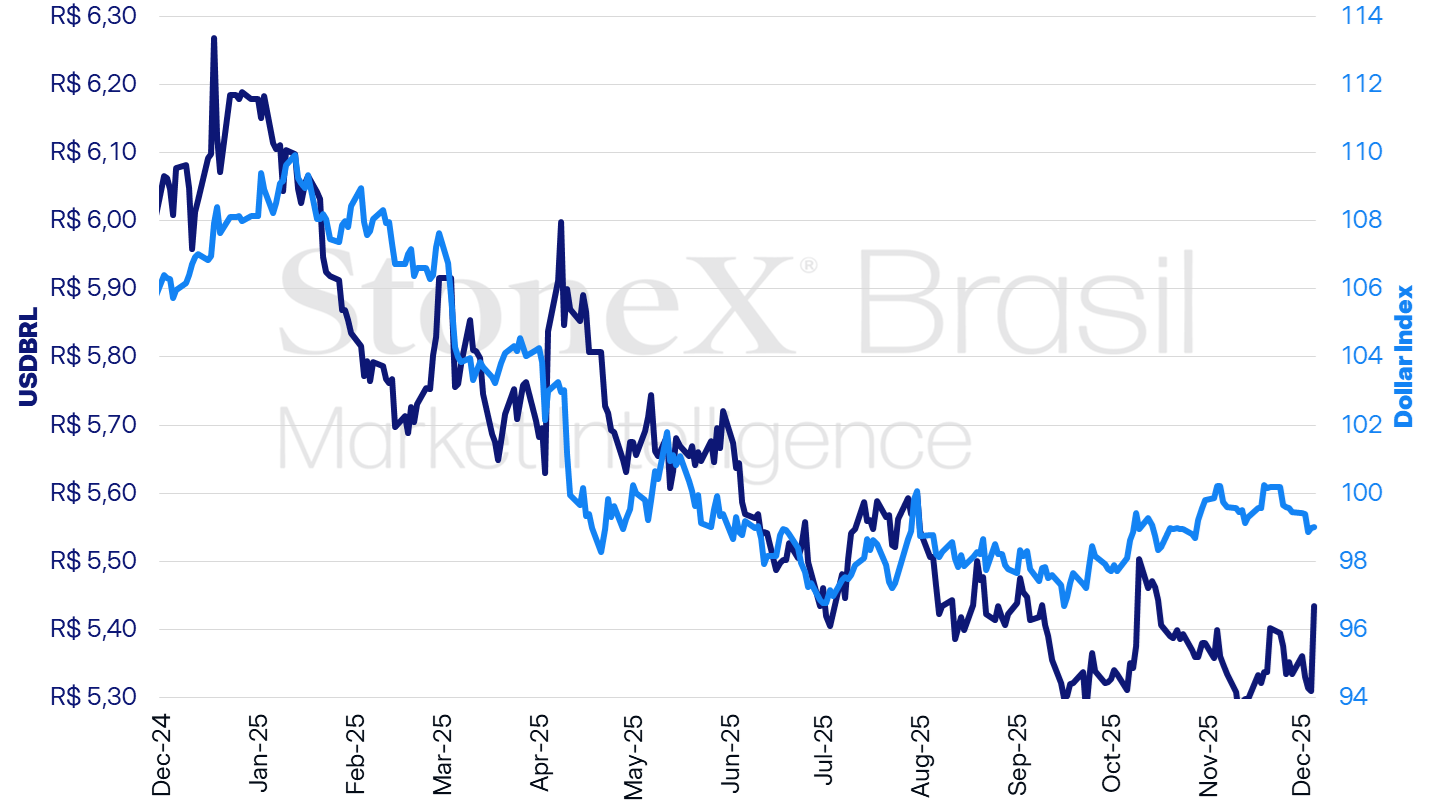
- On Friday, the news that former president Jair Bolsonaro chose his son, Flávio, to be a candidate for the 2026 presidential elections sharply raised the perception of risks for domestic assets and intensely devalued the real.
USDBRL and Dollar Index (points)
Source: StoneX cmdtyView. Design: StoneX.
USDBRL variations | Daily: +2.35% | Weekly: +1.88% | Monthly: +1.88% | Annual: -12.03% | In 12 months: -9.55% |
Dollar Index variations | Daily: +0.02% | Weekly: -0.44% | Monthly: -0.44% | Annual: -8.44% | In 12 months: -6.36% |
THE MOST IMPORTANT: FOMC Interest Rate Decision
Expected impact on USDBRL: bearish
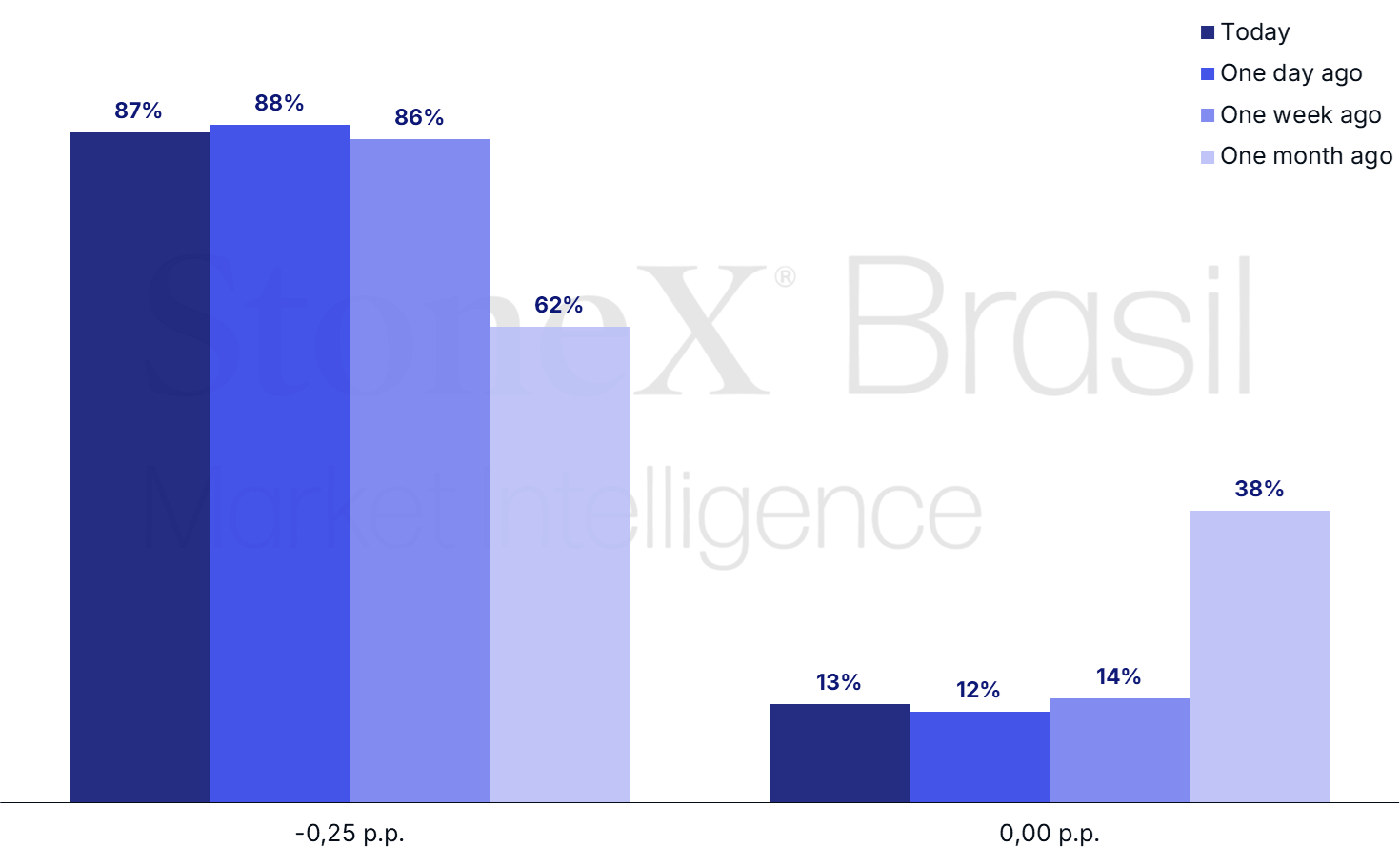
Bets for the Federal Reserve interest rate decision of December 10
Source: CME FedWatch Tool. Design: StoneX. Probabilities in the interest rate futures market with reference to December 05, 2025.
Global financial markets are expected to react to the Federal Open Market Committee (FOMC) interest rate decision of the Federal Reserve (Fed) this Wednesday (10), where there is a majority expectation for an interest rate reduction from the 3.75% to 3.50% range to the 3.50% to 3.75% per annum range.
Why this is important: The reduction in American interest rates should harm the profitability of US Treasuries and make it difficult to attract foreign capital, weakening the dollar globally.
Contradictory scenario: Although investors are betting mostly on an interest rate cut, this decision still seems undefined and difficult to anticipate.
- Statistics for the American economy continue to present a contradictory scenario, with some indicators suggesting a more vigorous performance and others suggesting a weaker performance than expected.
- In fact, it is possible to justify both a reduction and a maintenance of the interest rate level, depending on which indicators are attributed greater importance.
- Additionally, there is a high degree of divergence among Committee members regarding the most appropriate conduct for monetary policy, with some advocating for a higher interest rate level to help stabilize inflation and others advocating for interest rate reduction to stimulate the sustenance of the labor market.
- In recent weeks, bets in the futures market for an interest rate cut in the December decision have fluctuated widely, falling from over 90% before the October 29 decision to less than 30% on November 19 and, subsequently, rising again to nearly 90% in the last two weeks.
Majority bets: Even though the economic scenario, the balance of risks, and the opinions of FOMC members are divergent, investors are betting mostly on a rate drop in this decision.
- These bets rely on some data suggesting greater weakness in the labor market and the absence of speeches by Powell in recent weeks.
- According to this interpretation, it is believed that Powell would seek to modify investor expectations if the FOMC were inclined to keep its interest rates stable in this decision.
- It is important to highlight, however, that this interpretation does not present solid foundations.
Projections: In addition to the Committee's decision, investors are expected to react to the release of the Summary of Economic Projections that accompany this decision.
- Released every quarter, these projections bring estimates from all FOMC members for economic growth, unemployment, inflation, and interest rates in the US for the coming years.
- In the Projections released in September, there was a high degree of dispersion in expectations for interest rates in 2026 and 2027, evidencing the low degree of confidence among members regarding the evolution of the economy in the coming years.
Anticipating changes at the Fed: Additionally, contributing to expectations for a faster cycle of interest rate cuts is the prospect of replacing the Federal Reserve chairmanship.
- Powell's term as Fed Chair ends on May 15, although he may wish to continue as a member of the Board of Governors until January 2028.
- Press reports point out that the director of the White House National Economic Council, Kevin Hassett, is the favorite to be nominated as the next chairman of the Federal Reserve.
- Investors understand that Hassett is the candidate most aligned with the White House and would likely be the most cooperative in advancing Donald Trump's priorities.
- Trump argues that American interest rates can fall substantially without accelerating inflation. Therefore, it is believed that Hassett would strive to reduce interest rates more quickly, perhaps even more than would be prudent.
Copom Interest Rate Decision
Expected impact on USDBRL: bullish
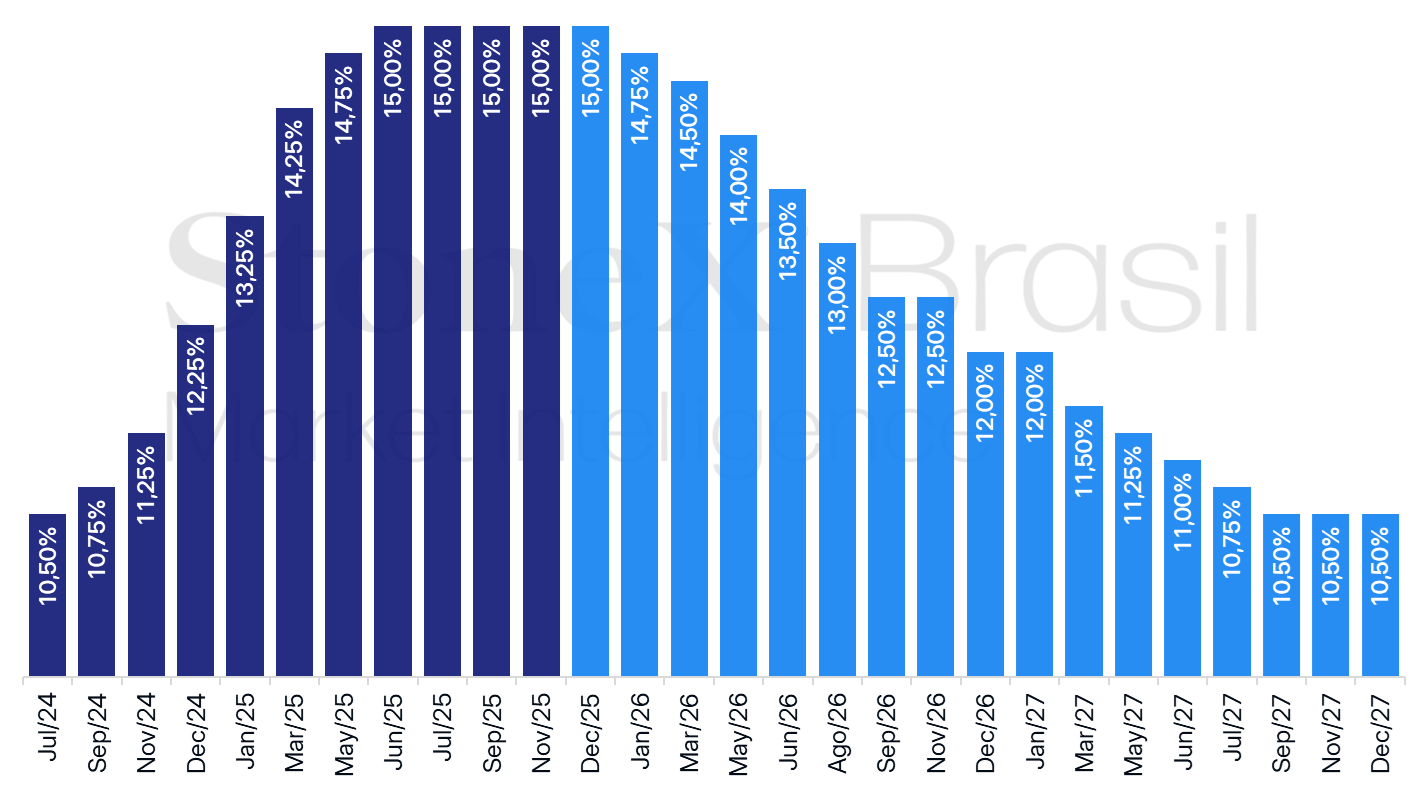
Brazil: History and expectation for the interest rate – Focus bulletin of November 28, 2025
Source: Central Bank of Brazil. Design: StoneX.
The Monetary Policy Committee (Copom) of the Central Bank of Brazil (BC) is expected to keep the benchmark interest rate (Selic) unchanged in this Wednesday's (10) decision, at 15.00% p.a., and signal the possibility of interest rate cuts in the coming months.
Why this is important: The possible signaling of the beginning of interest rate cuts in Brazil may reduce the yield on domestic bonds, making it difficult to attract foreign capital and devaluing the real against the dollar.
Overview: There is practically a consensus that Copom will keep the Selic rate unchanged at 15.00% p.a. for the fourth consecutive decision this Wednesday (10), reflecting a cautious strategy by the BC to stabilize prices in a context of elevated inflationary expectations, a heated labor market, and resilient economic activity.
- Because there is practically a consensus regarding the decision, investors will be attentive to its statement, especially regarding the possible removal of the expression indicating maintenance of the Selic for a "quite prolonged period," which would be interpreted as a step towards interest rate cuts.
- With inflation gradually converging to the 3% annual target and the third-quarter GDP showing deceleration, Copom's balance of risks seems increasingly compatible with interest rate cuts in the short term.
- Majority bets by investors indicate that the first reduction should occur in the January meeting, although the tone of this week's statement should be important to calibrate these expectations.
Galípolo's Speeches: Last Monday (01), the president of the Central Bank, Gabriel Galípolo, drew attention by stating that the expression "quite prolonged period" is not reset at every meeting, suggesting that this period begins in June, when the Selic was raised to 15.00% p.a.
- Investors interpreted this speech as a signal of greater proximity to the beginning of the cutting cycle.
- On the other hand, Galípolo also reinforced that Copom will maintain a cautious stance dependent on the evolution of data.
2026 Elections in Focus
Expected impact on USDBRL: bullish
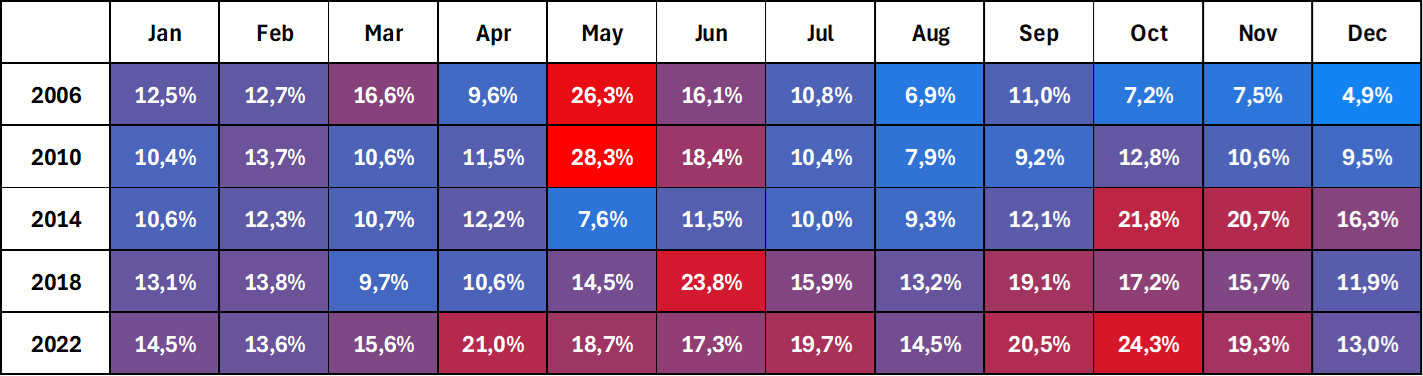
Monthly volatility of the real exchange rate (USDBRL) in presidential election years.
Source: StoneX cmdtyView. Elaboration: StoneX.
Investors should remain attentive to the news regarding the presidential elections of October 2026, amidst growing concerns about the fiscal scenario and the sustainability of Brazilian public debt.
Why this is important: Investors are increasingly sensitive to the approach of the presidential elections in October, reacting intensely to news about the election.
- In particular, investors fear that the current government will increase its level of public spending during 2026 and in subsequent years if re-elected, which raises the perception of fiscal risks for Brazilian assets and makes it difficult to attract foreign capital, devaluing the real.
Overview: On the afternoon of last Friday (05), the disclosure that Senator Flávio Bolsonaro (PL-RJ) was chosen by former president Jair Bolsonaro as a candidate for the Presidency in 2026 was poorly received by the financial market.
- The news caused a strong devaluation of domestic assets, with a significant rise in the dollar and a significant fall in the Brazilian stock exchange, interrupting the positive streak of recent days.
- Investors understand that the choice of Flávio as the PL candidate for the Presidency of the Republic would increase the chances of Lula's re-election, associated with more expansionary fiscal policies.
- This, in turn, stems both from the interpretation that Flávio would be less competitive than the governor of São Paulo, Tarcísio de Freitas (Republicanos), and from the understanding that his candidacy increases the possibility of there being more than one candidate in the election representing Bolsonaro's legacy, splitting the right-wing votes.
Fiscal fears: In recent months, investors had already reacted negatively to news related to the electoral cycle, such as the confirmation that the President of the Republic, Luiz Inácio Lula da Silva, would run for re-election and that the proposal for zero tariff on public transport would be part of his proposals.
- In practice, recent reactions by financial market agents reveal a preference for the election of a new president, who could be more conservative in their fiscal policy.

INDICATORS
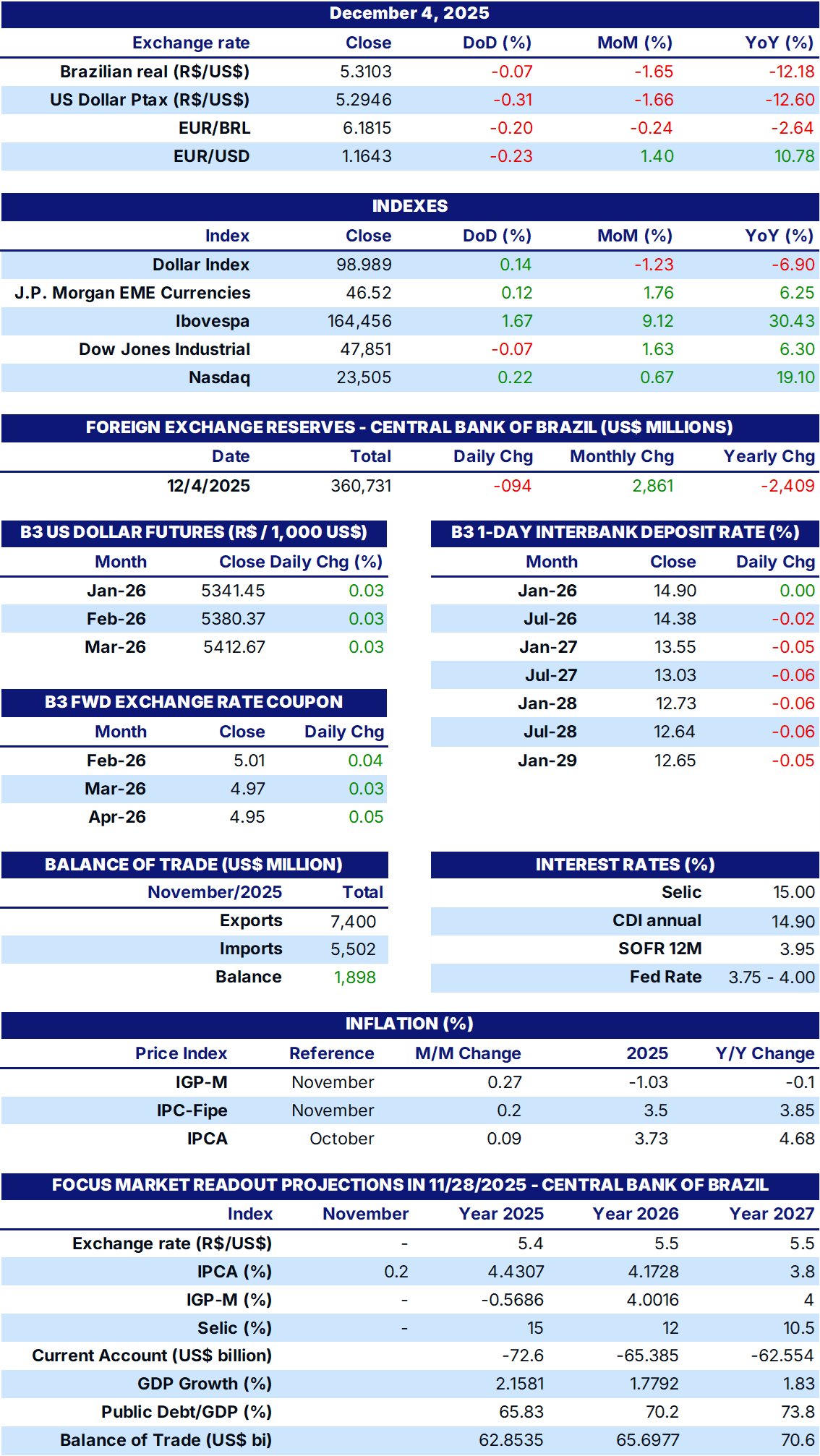
Sources: Central Bank of Brazil; B3; IBGE; Fipe; FGV; MDIC; IPEA and StoneX cmdtyView.