Fed Independence and U.S. GDP on the FX market’s radar
- Bullish
- Second reading of U.S. GDP for Q3 2025 is expected to confirm accelerated economic growth. Additionally, resilient inflation is likely to solidify the Fed’s cautious stance, with interest rates remaining unchanged at the January-end meeting.
- Potential signals of rate hikes from the central bank of Japan (BoJ) amid inflationary pressures and fiscal risks could strengthen the outlook for a narrower interest rate differential, discouraging “carry-trade” operations and long positions on the Brazilian real.
- Bearish
- Unfavorable Supreme Court decision against Lisa Cook may heighten concerns over Federal Reserve independence, exerting downward pressure on the dollar globally.
The week in review
- The week started with news of an investigation into Federal Reserve Chair Jerome Powell, which raised investor risk aversion due to fears of interference in U.S. monetary policy.
- On the geopolitical front, the week was marked by heightened tensions between Washington and Tehran, with Iran’s crackdown on protests in its capital drawing criticism from the White House. However, by week’s end, President Trump’s retreat from potential military action against Iran alleviated risk perceptions.
- In the U.S., the Consumer Price Index (CPI) for December remained at 2.7% year-over-year, above the 2% target, and industrial production rose by 0.4% in the same month, beating market expectations.
- In Brazil, the released indicators were broadly positive, showcasing economic resilience despite current interest rate levels. As a result, expectations for the start of an interest rate-cutting cycle may shift.
USDBRL and Dollar Index (points)
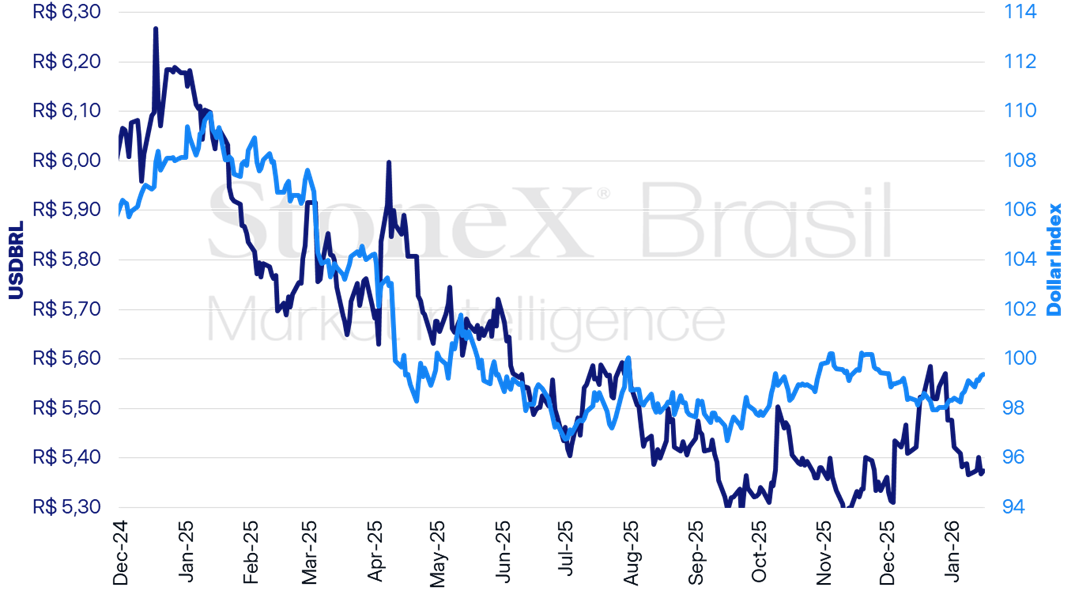
Source: StoneX cmdtyView. Design: StoneX.
USDBRL Variations
Daily: +0.09% | Weekly: +0.13% | Monthly: -1.89% | Annual: -13.02% | Last 12 months: -11.26%
Dollar Index Variations
Daily: +0.07% | Weekly: +0.27% | Monthly: +1.09% | Annual: -8.08% | Last 12 months: -8.77%
Key Event: U.S. Q3 GDP Preview
Expected Impact on USDBRL: Bullish
In the upcoming week, the market will closely monitor U.S. economic indicators, which are still normalizing after last year’s government shutdown.
- Focus will be on Q3 2025 Gross Domestic Product (GDP) and the Personal Consumption Expenditures (PCE) Price Index for November.
- The initial Q3 GDP reading revealed robust economic activity, with annualized growth of 4.3%, surpassing the 3.3% consensus forecast. The final figures are likely to confirm this significant expansion.
- For the PCE, expectations point to accelerating prices, with international travel—driven by airfare costs—being a standout category.
Why It Matters: A stronger economy coupled with elevated inflation signals to the Fed that interest rates could remain higher for longer despite Trump’s calls for rate cuts.
Interest Rate Outlook: Expectations for the Federal Open Market Committee (FOMC) meeting on January 27–28 are for rates to remain steady in the 3.5%–3.75% range, reflecting a more cautious Fed approach.
- At the December meeting, three committee members opposed a rate cut—an unusual move since September 2019—already hinting at this cautious stance.
- While recent data continues to indicate a robust economy and resilient inflation, projections for 2026 and 2027 are highly dispersed. Some indicators suggest stronger economic momentum, while others point in the opposite direction.
Brazil’s IPCA-15 Release
Expected Impact on USDBRL: Bullish
With a light domestic agenda, the National Consumer Price Index 15 (IPCA-15) will be Brazil’s most relevant indicator next week, helping investors refine expectations for the Central Bank’s interest rate-cutting cycle.
Why It Matters: Price indices are critical in determining interest rates. Persistent prices within tolerance bands strengthen bets on rate cuts by the Central Bank.
- Such movements could reduce the appeal of domestic bonds and hinder foreign capital inflows, negatively impacting the Brazilian real.
Outlook: December’s inflation data, the National Consumer Price Index (IPCA), showed a 0.33% monthly increase, closing 2025 with 4.26% cumulative inflation, within tolerance bands.
- This marks the third consecutive month of declining accumulated inflation and the second within tolerance levels.
- Additionally, the Producer Price Index for December fell by 0.37%, marking the tenth consecutive month of price declines, contributing to inflation control.
- Last week, the Central Bank’s Economic Activity Index (IBC-Br) and Monthly Retail Trade Survey (PMC) for November showed gains of 0.7% and 1.0%, respectively, exceeding median forecasts.
- As a result, despite inflation being under control, positive data reinforce perceptions of economic resilience, potentially influencing interest rate cut expectations.
Japan’s Interest Rate Decision
Expected Impact on USDBRL: Bullish
The market will also focus on the Bank of Japan’s (BoJ) interest rate decision on Friday (23). While the BoJ is expected to hold rates at 0.75%, investors will watch for signals regarding future policy shifts.
Why It Matters: Japan plays a key role in global “carry-trade” operations due to its historically low interest rates. Monetary policy decisions in Japan can reshape international “carry-trade” activity, impacting market liquidity.
- What is “carry-trade”: It involves borrowing in currencies from low-interest-rate countries and investing in assets denominated in high-interest-rate currencies to profit from the rate differential.
Outlook: Following its December rate hike to 0.75%, the BoJ is likely to hold rates steady next week. However, Japanese economic officials have advocated for more aggressive rate policies to curb yen depreciation. The BoJ may signal rate hikes for mid-2026, with investors anticipating changes by July–September.
- Since Prime Minister Sanae Takaichi’s election, the yen has underperformed, with analysts concerned about inflationary risks tied to active fiscal policies.
- Midweek rumors of potential parliamentary dissolution and new elections raised alarms in the market. A strengthened legislative majority for the prime minister could reduce resistance to fiscal expansion plans.
- In mid-2024, the BoJ adopted a more hawkish stance, raising rates from 0.1% to 0.25%, its first hike in 17 years. This partially unwound yen “carry-trade” operations, triggering bearish effects on global risk assets. At the time, Japan’s Nikkei index dropped 20% over three sessions; U.S. and European equity indices also fell, while the Brazilian real weakened against the dollar.
Resumption of Lisa Cook’s Trial
Expected Impact on USDBRL: Uncertain
The U.S. Supreme Court will resume hearings on Wednesday (21) regarding the attempt to dismiss Lisa Cook, a Federal Reserve Board member appointed by former President Joe Biden. This unprecedented move is part of broader Trump administration actions against Fed independence and other federal agencies.
- Created in 1913, the Federal Reserve Act safeguards the Fed from political interference. Under this law, Board members can only be removed for cause. Lisa Cook is accused of mortgage fraud, allegedly misrepresenting multiple properties as her primary residence to secure subsidized financing.
- The Supreme Court will hear arguments next week to decide whether to overturn a federal judge’s ruling that kept Cook on the Fed. A ruling favoring the White House could heighten fears over Fed independence and reduce global capital exposure to U.S. assets.
- On Monday (12), news of an investigation into Fed Chair Jerome Powell triggered strong market reactions and dollar depreciation. More details are available in the Currency Opening.
- Why It Matters: The Federal Reserve’s independence is a cornerstone of U.S. economic policy, underpinning trust in the country’s financial system. Challenges to the Fed increase uncertainty and push investors toward safe-haven assets like precious metals and other major currencies.

INDICATORS
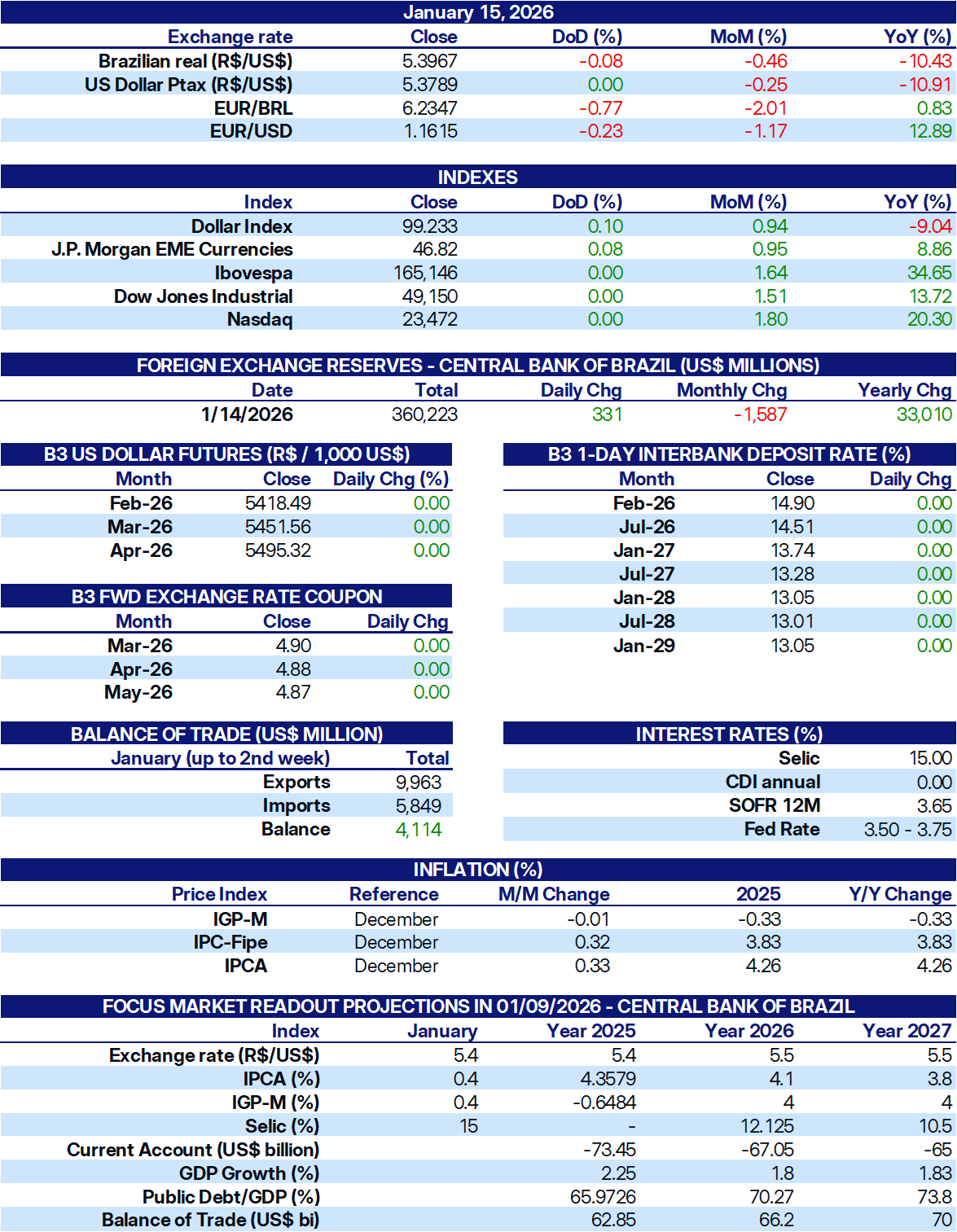
Sources: Central Bank of Brazil; B3; IBGE; Fipe; FGV; MDIC; IPEA; and StoneX cmdtyView.