USDBRL Reflect Trump's Deadline on Iran, Inflation Data, FOMC Minutes, and U.S. Indicators
-
Notice 1: The Market Intelligence reports scheduled for Friday, April 3, are suspended due to the Good Friday holiday.
-
Notice 2: The Economic Calendar is now available in an interactive report format.
-
With this new model, users can dynamically track both past release dates and scheduled announcements through the end of the year.
-
To access, click on the link.
- Bullish
- The approaching deadline for reopening the Strait of Hormuz, combined with stalled diplomatic progress and heightened risk of military escalation, is likely to sustain global risk aversion and bolster the dollar.
- U.S. inflation data is expected to reinforce the perception of persistent inflation, supporting expectations for higher interest rates for an extended period and strengthening the dollar globally.
- The FOMC minutes are likely to underscore the Fed's cautious stance on further rate cuts, which should increase the dollar's attractiveness.
- Bearish
- Signs of inflationary acceleration in Brazil could reduce expectations for deeper interest rate cuts by the Central Bank, potentially boosting returns on government bonds and strengthening the real.
The week in review
- The surge of optimism early in the week, driven by expectations of U.S. withdrawal from the Middle Eastern conflict, lost momentum after President Donald Trump's speech on Wednesday, April 1.
- In his remarks, Trump suggested the conflict could continue for two to three more weeks and hinted at a potential U.S. withdrawal even if the Strait of Hormuz remains blocked. This raised investor risk perceptions, reversing the trend seen in prior sessions.
- On the economic calendar, February's Job Openings and Labor Turnover Survey (JOLTS) showed a decline in the ratio of open positions to unemployed individuals, reflecting reduced job openings alongside rising unemployment, underscoring a loss of steam in the U.S. labor market.
USDBRL and Dollar Index (points)
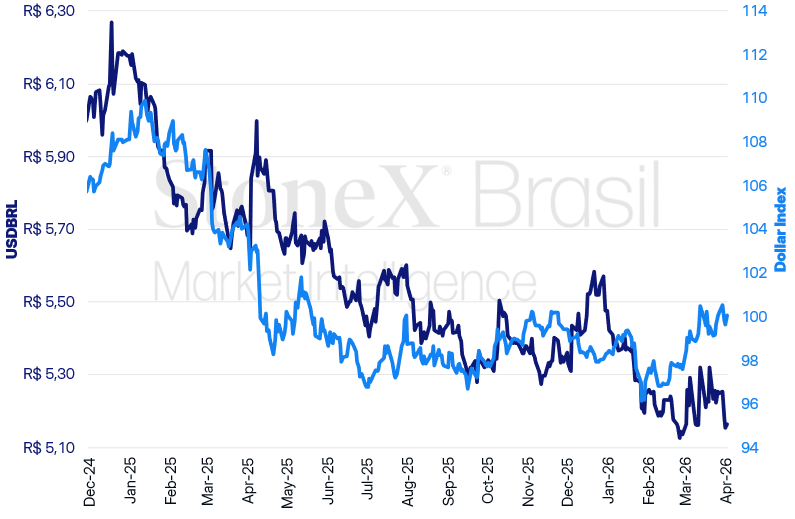
Source: StoneX cmdtyView. Prepared by: StoneX.
USDBRL Variations
Daily: +0.17% | Weekly: -1.59% | Monthly: -0.33% | Annual: -5.72% | 12-Month: -9.35%
Dollar Index Variations
Daily: +0.41% | Weekly: -0.10% | Monthly: +0.22% | Annual: +1.75% | 12-Month: -3.67%
KEY EVENT: Trump's Deadline for Strait of Hormuz Reopening Ends Next Week
Expected Impact on USDBRL: Bullish
For the sixth consecutive week, investors remain focused on the Middle Eastern conflict, as the deadline imposed by U.S. President Donald Trump approaches.
- The deadline, set for April 6, requires Iran to fully reopen the Strait of Hormuz, with failure to comply raising the likelihood of additional U.S. military actions.
- However, the deadline has been repeatedly extended in recent weeks. Initially a 48-hour ultimatum, it was extended by five days on March 23 and then another ten days on March 26.
- Moreover, recent statements from the U.S. president have been met with skepticism due to conflicting rhetoric, alternating between escalation and indications of conflict resolution.
Why This Matters: Depending on upcoming developments, next week's financial market reactions could unfold in two possible directions:
- A resolution of the conflict, either through a ceasefire or reopening of the Strait of Hormuz, would likely lead to a swift reversal of geopolitical risk premiums, significantly impacting oil and the dollar globally.
- Conversely, a military escalation targeting energy infrastructure could exacerbate supply disruptions, amplify risk aversion, and negatively affect riskier assets such as emerging market currencies, including the Brazilian real.
Trump's Speech and Market Reactions: On Thursday, April 2, financial markets reversed the risk appetite trend observed earlier in the week, directly reacting to the ambiguity of Donald Trump's statements the previous evening.
- On one hand, the speech emphasized the possibility of a “short-term” exit from the conflict.
- Despite the victorious tone, the president did not detail practical terms for demobilization or conditions for effectively ending hostilities.
- On the other hand, he paradoxically stated that the U.S. would intensify military actions over the next two to three weeks before potentially exiting the conflict.
- This mixed messaging, signaling both military escalation and imminent withdrawal, heightened ambiguity and complicated investors' interpretations of future geopolitical risk trajectories.
Delegating Responsibility for Strait of Hormuz Reopening: Another key aspect of the speech was the indication that the U.S. is not directly reliant on the Strait of Hormuz reopening due to its energy self-sufficiency. Trump suggested other nations should take responsibility for resolving the blockade.
- Though NATO was not explicitly mentioned, the remarks were interpreted as an indirect message to its members to take greater initiative, either by purchasing American oil or pursuing diplomatic or military solutions to reopen the strait.
- This raises concerns about the prolonged blockade and potential inflationary pressures, particularly in regions heavily reliant on imported oil and gas, such as the European Union and Japan.
- Additionally, the possibility of a U.S. withdrawal while the Strait remains blocked may strengthen Iran's control over the region, prolonging elevated risk premiums for regional oil markets.
U.S. Inflation and GDP Data
Expected Impact on USDBRL: Bullish
Next week, investors will analyze key economic indicators from the U.S., including inflation metrics like the Consumer Price Index (CPI) and Personal Consumption Expenditures (PCE) Index, as well as the third reading of Q4 2025 GDP.
Why This Matters: In the current environment, inflation data takes center stage as it remains the Federal Reserve's top concern, constraining short-term rate cut expectations.
- Meanwhile, GDP data, though reflecting the third estimate for the quarter, has limited informational value. Nonetheless, unexpected results could influence market sentiment regarding the pace of U.S. economic growth.
Personal Consumption Expenditures (PCE): February's PCE data precedes the recent Middle Eastern conflict that drove up energy and industrial input prices. Nevertheless, it remains closely watched as the Fed's preferred inflation metric.
- Analysts anticipate a firm PCE reading for February, aligning with the Fed's "higher for longer" stance.
- While February's CPI showed seemingly moderate results, its composition suggests stronger underlying pressures on PCE core inflation.
- Recent assessments indicate persistent inflation, particularly in services, with consecutive core increases incompatible with a sustained return to the 2% target.
- This scenario could reinforce the Fed's cautious approach, delaying rate cut expectations further. Lower readings may provide some relief but could be overshadowed by recent energy price shocks.
Consumer Price Index (CPI): March's CPI is expected to reveal a rebound in headline inflation, driven by energy shocks tied to the Middle Eastern conflict and recent fuel and commodity price spikes.
- Median estimates suggest a headline inflation rate near 3.25% annually, up from February's 2.4%.
- Core inflation, however, is likely to remain stable around 2.5% year-over-year, indicating that March's pressures are concentrated in energy components rather than widespread price increases.
- Geopolitical events typically elevate inflation via energy and supply chain disruptions while constraining growth.
Gross Domestic Product (GDP): On Friday, investors will monitor the release of the third estimate for U.S. Q4 2025 GDP.
- Expectations suggest annualized growth will hold at 0.7%, unchanged from the second estimate.
- Initial projections indicated 2.8% growth, later revised to 1.4% and subsequently to 0.7%.
- If maintained or downgraded, this may reinforce perceptions of slowing U.S. economic momentum, particularly alongside weakening labor market signals.
FOMC Minutes
Expected Impact on USDBRL: Bullish
Next week will also feature the release of minutes from the Federal Open Market Committee's (FOMC) March meeting, during which interest rates were maintained between 3.5% and 3.75% annually.
- The decision was not unanimous, with Stephen Miran voting for a 0.25 percentage point rate cut.
Why This Matters: In light of the Middle Eastern conflict and risk of additional inflationary pressures, the minutes are especially relevant as they may offer insights into the Committee's economic outlook and risk assessment.
- Signals of sustained policy restraint and caution could diminish near-term rate cut expectations, potentially boosting Treasury yields and strengthening the dollar globally.
Federal Reserve Projections: Alongside the decision, the FOMC released its Summary of Economic Projections (SEP), which provide key inputs for investor expectations.
- Compared to December 2025 forecasts, the Committee made limited changes to 2026 GDP and unemployment projections, indicating stability in these sectors.
- However, the PCE inflation forecast increased from 2.4% to 2.7%, remaining above the 2% target.
- The Fed's focus remains on price stability, reflected in its interest rate projections, which suggest only one rate cut in 2026 and another in 2027, maintaining a hawkish stance.
Brazil Inflation Data
Expected Impact: Bearish
Domestically, next week's most relevant data will be the Consumer Price Index (IPCA), potentially reflecting inflationary impacts following a month of Middle Eastern conflict.
- Despite recent signs of slowing inflation, levels remain above the Central Bank's target, demanding caution, especially in the current global context.
Why This Matters: Signs of inflationary acceleration could reduce expectations for deeper interest rate cuts, potentially boosting government bond yields and strengthening the real globally.
IPCA‑15: The most recent inflation indicator, the IPCA-15, measures price variations from the 16th of one month to the 15th of the following month.
- The latest IPCA-15 reading, covering mid-March to mid-April, showed a 0.44% price increase versus expectations of 0.29%. Despite the monthly rise, the 12-month rate fell from 4.10% to 3.90%.
- Although the headline index rose, the core – excluding volatile items like food and energy – decelerated from 0.91% to 0.37%, while fuel prices dropped by 0.03%.
Focus on Interest Rate Cuts: During an event on Monday, March 30, Central Bank President Gabriel Galípolo advocated for initiating a monetary easing cycle, emphasizing that the decision was supported by accumulated policy tightening.
- Despite uncertainties tied to oil supply shocks, monetary policy transmission has proceeded as expected, enabling the Committee to begin adjusting rates. Galípolo stressed gradual action to avoid abrupt moves.
- While international comparisons suggest sharper impacts from Brazil's restrictive stance, Galípolo sees the adjustment manifesting as an orderly activity slowdown, particularly in segments sensitive to economic cycles, as reflected in 2025 GDP data.

INDICATORS
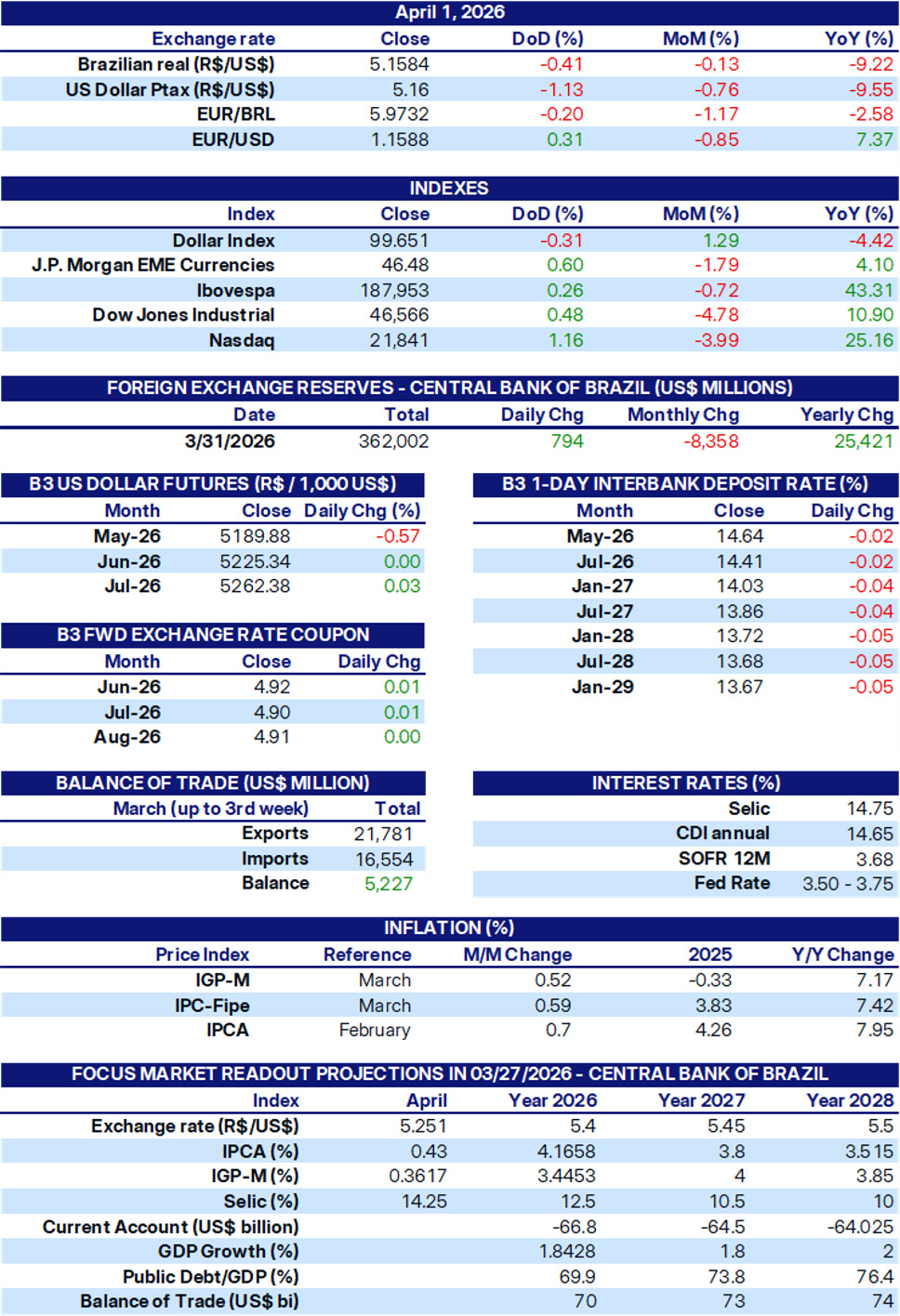
Sources: Central Bank of Brazil; B3; IBGE; Fipe; FGV; MDIC; IPEA; and StoneX cmdtyView.