USDBRL likely to be influenced by US-Iran negotiations and data releases in Brazil, the United States, and China
-
Notice: The Economic Calendar is now available in an interactive report format.
-
In this new format, it will be possible to dynamically track both past release dates and scheduled releases through the end of the year.
-
To access it, click the link.
- Bullish
- Signs of economic slowdown in Brazil through the release of activity indexes may indicate the possibility of faster interest rate cuts by the Central Bank.
- Stronger producer price inflation data in the US may reduce expectations of a rate-cutting cycle by the Federal Reserve.
- Potentially weaker-than-expected data from China may heighten risk aversion and negatively impact the currencies of trading partner economies, such as the Brazilian real.
- Bearish
- The possibility of progress in a US-Iran ceasefire agreement may boost risk appetite throughout the week, which could continue to be positive for the real.
The week in review
- The announcement of a two-week ceasefire in the Middle East rekindled investor risk appetite. Even so, the truce remains fragile, with the Strait of Hormuz still closed and the US and Iran showing little flexibility toward reaching a lasting agreement.
- On the domestic agenda, Brazil's Broad Consumer Price Index (IPCA) for March indicated an inflationary re-acceleration beyond expectations, despite a deceleration in the core reading, suggesting a strong correlation between the result and the Middle East conflict, given the rise in fuel prices.
- In the US, on the other hand, the Consumer Price Index (CPI) for March and its core measure came in below expectations, bringing some relief to investors. However, the Personal Consumption Expenditures (PCE) index accumulated through February — the Federal Reserve's preferred inflation gauge — remained resilient at 2.8%, above target.
- Finally, the final reading of US Gross Domestic Product (GDP) indicated annualized growth of 0.5%. The figure came in below expectations after successive downward revisions from an initial reading of 1.4%, reinforcing the thesis of fading momentum in the country's economic activity.
Commercial dollar (USD/BRL) and Dollar Index (points)
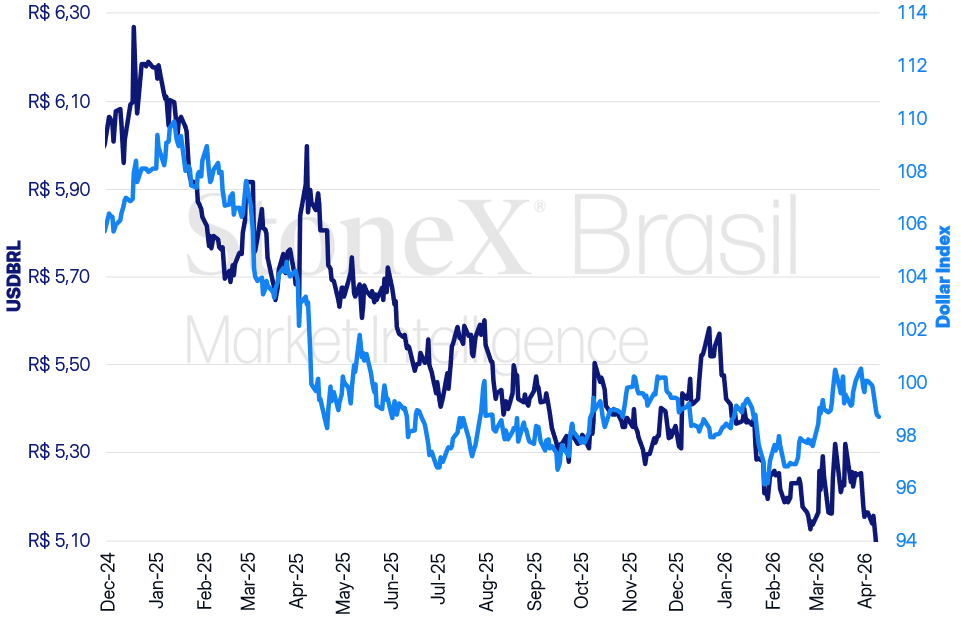
Source: StoneX cmdtyView. Design: StoneX.
Commercial dollar variations
Daily: -1.10% | Weekly: -3.01% | Monthly: -3.33% | Year-to-date: -8.55% | 12-month: -15.10%
Dollar Index variations
Daily: -0.12% | Weekly: -1.36% | Monthly: -1.14% | Year-to-date: +0.36% | 12-month: -2.45%
MOST IMPORTANT: US-Iran Negotiations
Expected impact on USDBRL: bearish
Investor attention is focused on the meeting scheduled for this Saturday (11th) between US and Iranian officials, to be held in Pakistan.
- The meeting aims to advance toward a definitive peace agreement, following the two-week ceasefire currently in effect.
- The negotiations involve sensitive issues for both sides. On the American side, the main demands include stricter limits on Iran's nuclear program, an end to support for armed groups in the region, and the reopening of the Strait of Hormuz.
- Iran, in turn, conditions any progress on formal security guarantees, recognition of its right to uranium enrichment, an end to attacks on Lebanon, and the maintenance of some degree of control over the Strait of Hormuz.
- Given the rigidity of positions and the asymmetry of demands, the risk of significant deadlock remains elevated. This risk is compounded by the continuation of Israeli military operations in Lebanon, which introduces additional uncertainty regarding the scope and sustainability of a potential broader agreement between Washington and Tehran.
- Updates related to this first meeting are likely to play a central role in shaping investor sentiment at the opening of markets next week.
Why this matters: The current ceasefire, though temporary in nature, has contributed to a reduction in geopolitical risk perception in global financial markets, supporting a recovery in investor risk appetite. This environment has sustained flows toward assets considered more sensitive to risk, such as currencies and equities of emerging economies, including the Brazilian real.
- In this context, concrete signs of progress in the negotiations tend to reinforce the continuation of this more positive backdrop for emerging market currencies, with the potential to attract additional external flows into Brazil.
- On the other hand, any signs of deterioration in the talks or a resumption of armed conflict could quickly reverse this movement, prompting a defensive repositioning of global portfolios toward safe-haven and higher-liquidity assets such as the dollar.
More details: Less than 24 hours after the ceasefire announcement, new Israeli strikes on Lebanon were reported, generating disagreements between the parties over whether or not Lebanese territory was covered by the terms of the agreement.
- Iran classified the strikes as a violation of the ceasefire and responded by reinstating the blockade of the Strait of Hormuz, reimposing restrictions on one of the world's main oil and natural gas shipping routes.
- While US and Israeli leaders stated that Lebanon was not part of the original agreement, representatives from Iran and Pakistan maintained that its inclusion had been explicitly stipulated.
- Additionally, on Friday (10th), the Speaker of the Iranian Parliament, Mohammad Baqer Qalibaf, declared that the holding of Saturday's talks is contingent on the prior fulfillment of two conditions: the implementation of a ceasefire in Lebanon and the release of Iranian assets currently frozen abroad.
Weekly performance of selected assets and currencies – April 3 to 10
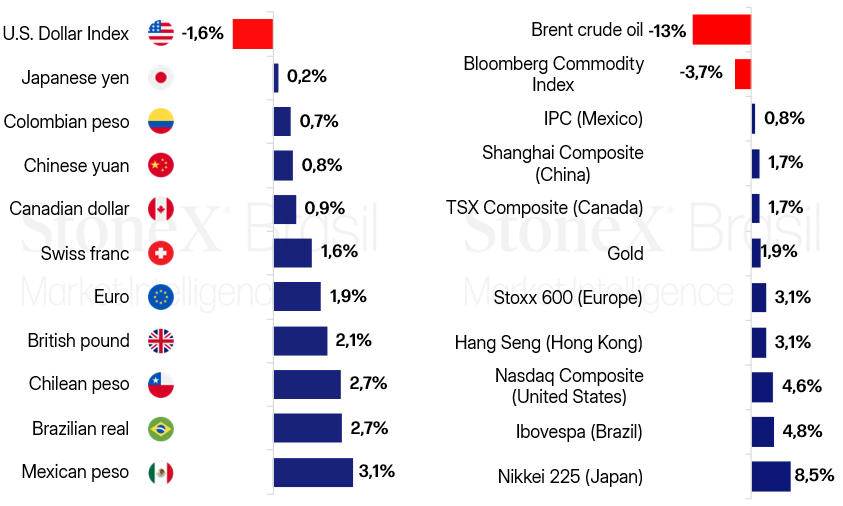
Source: StoneX cmdtyView. Design: StoneX.
Economic Activity in Brazil
Expected impact on USDBRL: bullish
Next week, the Central Bank's Economic Activity Index (IBC-Br), often regarded as a GDP preview, will be released.
- The indicator should help investors assess the outlook for the pace of growth in the Brazilian economy, which may have implications for the interest rate path conducted by the Central Bank.
Why this matters: Signs of fading momentum in domestic economic activity may reinforce expectations of monetary easing by the Monetary Policy Committee (Copom).
- Should this trend consolidate, it may exert depreciatory pressure on the real, particularly in a global context of heightened sensitivity to interest rate differentials.
Previous data: The most recent GDP release, referring to the fourth quarter, corroborated the slowdown suggested by earlier IBC-Br readings.
- In January, the IBC-Br advanced 0.8%, a result slightly below market expectations, but still consistent with a brief recovery in activity at the start of the year.
Central Bank Economic Activity Index (IBC-Br)
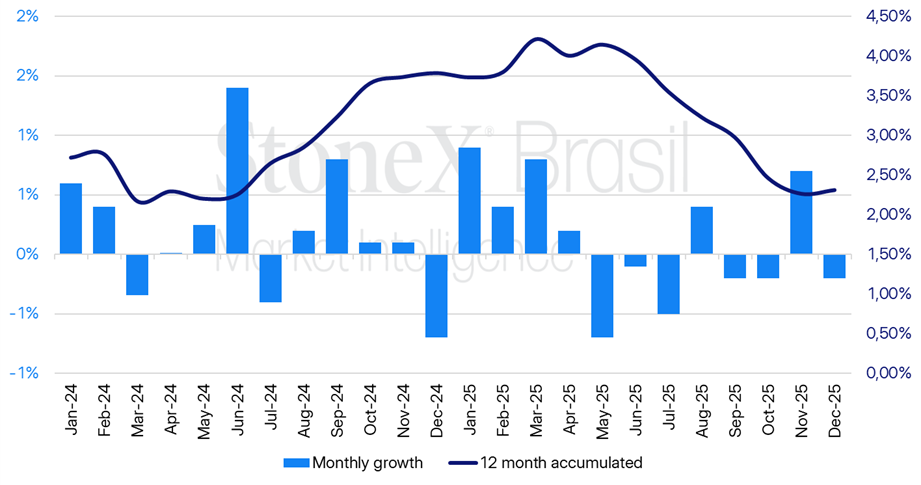
Source: Central Bank of Brazil. Design: StoneX.
US Producer Price Index
Expected impact on USDBRL: bullish
In the United States, the Producer Price Index (PPI) for March will be released, which should capture the first impacts of the Middle East conflict on producer costs and signal potential future inflationary pressures at the consumer level.
- In addition to the rise in energy commodity prices observed in recent weeks, the indicator should also reflect recent changes in US tariff policy.
- It is worth recalling that, in late February, the US Supreme Court ruled the broad tariffs previously imposed by Donald Trump to be unlawful. In response, the administration implemented a new global tariff of 10% on imports.
Why this matters: Signals of accelerating producer prices heighten market attention to the possibility of cost pass-throughs to end consumers, which could hinder the disinflation process, dampen expectations of interest rate cuts, and sustain the dollar's trajectory in the coming months.
Previous data: In February, the final demand PPI, which measures price changes at the final stage of the production chain, rose 0.7% month-over-month, above estimates, bringing the 12-month accumulated inflation to 3.9%.
- The core reading, which excludes more volatile items such as food and energy, posted gains of 0.5% month-over-month and 3.9% year-over-year, reinforcing the perception of relatively broad-based inflationary pressures.
United States Producer Price Index (PPI) – 12-month change (%)
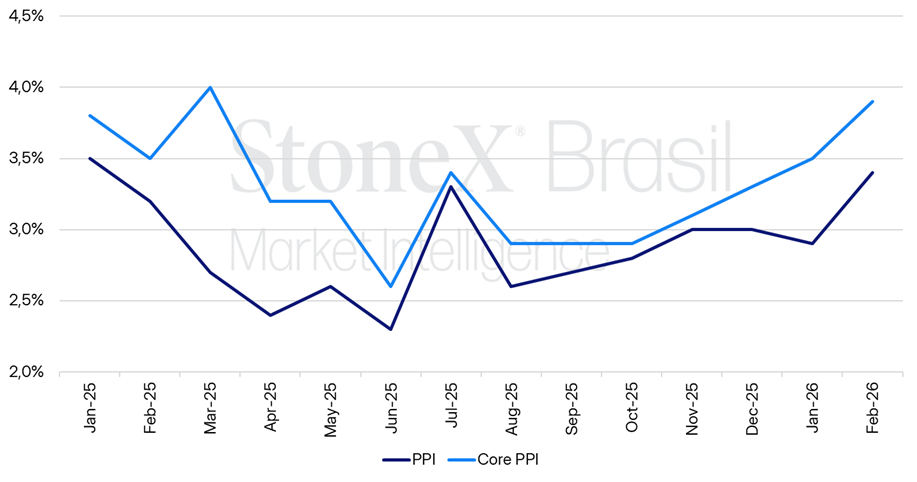
Source: Census. Design: StoneX.
Chinese Economic Data
Expected impact: bullish
Next week, global markets will also be watching the release of key Chinese economic indicators, with highlights being the trade balance for March on Tuesday (9th), and first-quarter 2026 GDP on Thursday (11th).
Why this matters: Weaker-than-expected indicators for the Chinese economy could heighten risk aversion globally, given the country's relevance as the world's second-largest economy and as a central hub of international supply chains.
- A softer reading tends to trigger a negative repricing of risk assets, particularly those linked to the global growth cycle.
- This effect is typically especially adverse for the currencies and assets of countries deeply integrated into trade with China, such as Brazil, and could act as a bullish factor for the dollar next week.
Chinese trade balance: Market consensus points to a meaningful moderation in the surplus relative to the exceptional level observed in the January–February cumulative figure. Estimates indicate a balance of around USD 110 billion, compared to USD 213.6 billion in the prior period.
- Exports are expected to remain the primary driver, though the annual growth rate is likely to ease after the strong advance recorded at the start of the year. Imports, in turn, should remain relatively sustained, reflecting government efforts to stimulate domestic demand and rebalance the growth structure.
- Several factors are expected to influence the March reading. Geopolitical tensions in the Middle East, particularly risks associated with global logistics chains and the Strait of Hormuz, may have increased volatility in international trade. Additionally, the temporary suspension of some US tariffs may have incentivized the front-loading of shipments. On the other hand, the continued strong performance of electric vehicle exports is likely to support the external result. The appreciation of oil prices in March, in turn, probably raised the value of imports, contributing to a narrowing of the trade surplus.
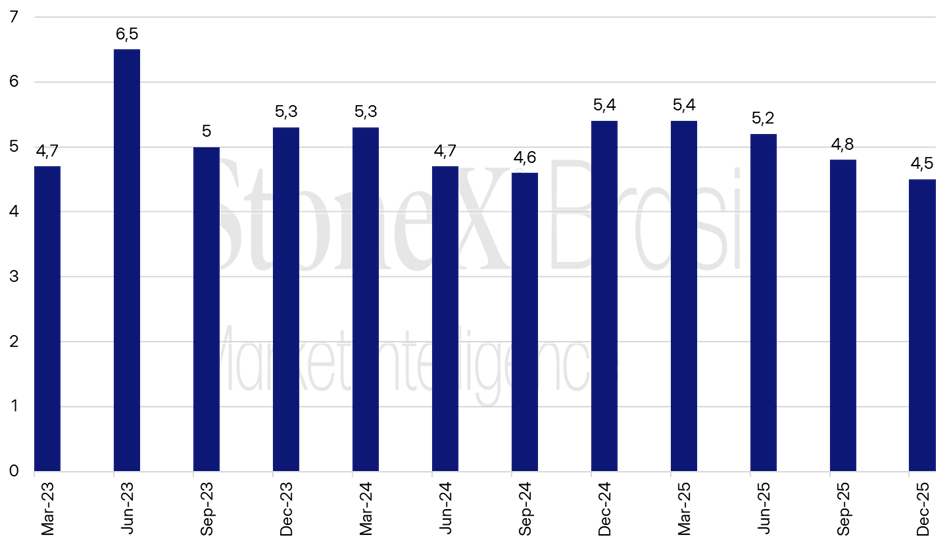
China's GDP: Regarding GDP, consensus points to growth of approximately 4.8% year-over-year in the first quarter. Some leading indicators, however, suggest upside risk, with projections reaching the 5.0%–5.5% range, following a relatively robust start to the year.
- Industrial production is expected to remain resilient, following the growth observed at the start of the year, while the unemployment rate should stay near 5.3%, within the implicit ceiling set by the government. The release will be particularly relevant for assessing whether the momentum observed at the beginning of 2026 is sustained beyond the seasonal effects associated with the Lunar New Year.
- The manufacturing sector and exports continue to serve as the main pillars supporting activity. By contrast, the real estate sector remains a structural weak point, with investment in property development posting sharp declines, limiting the recovery of fixed asset investment.
China Gross Domestic Product (GDP) – annualized (%)
Source: NBS. Design: StoneX.
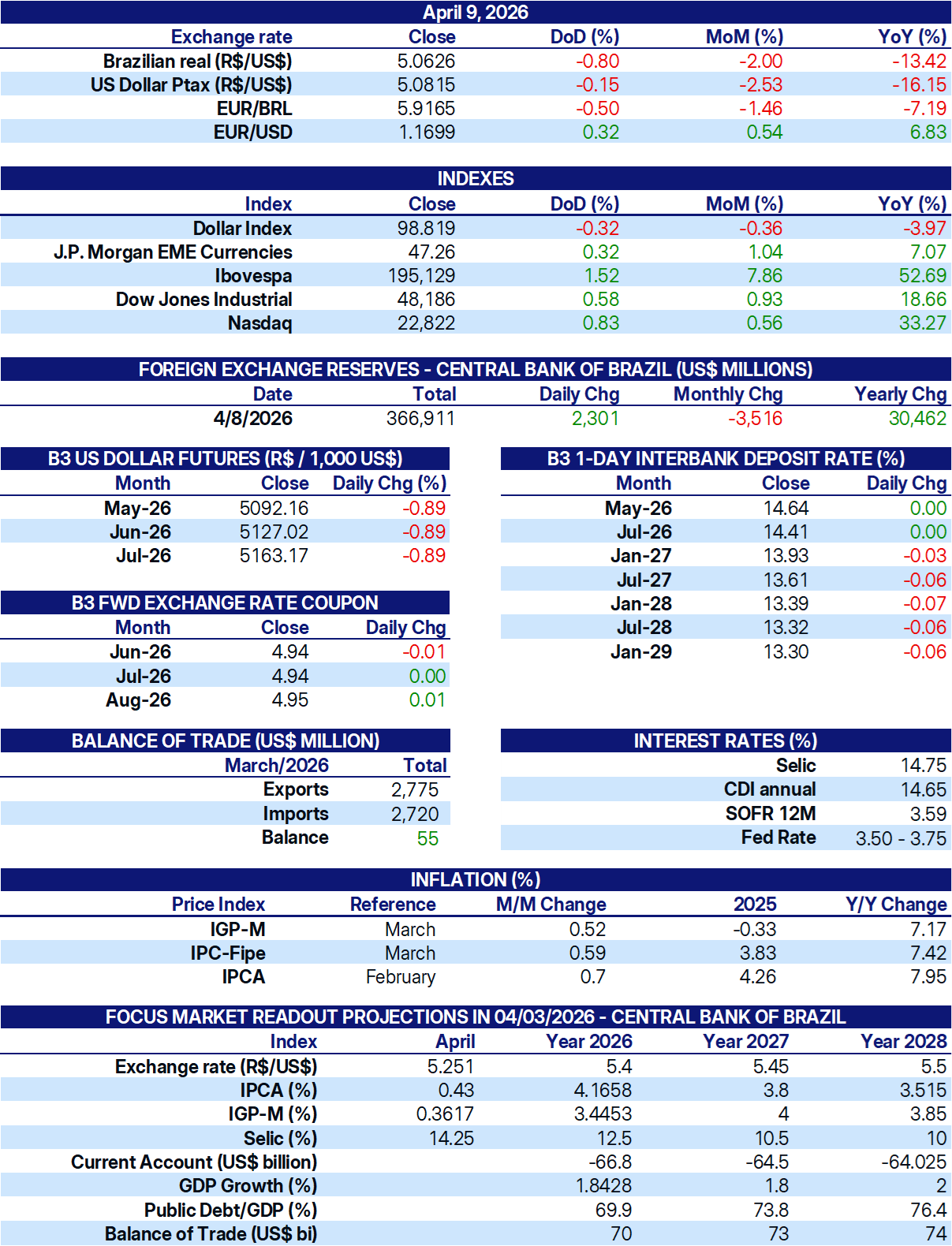
ECONOMIC INDICATORS
Sources: Central Bank of Brazil; B3; IBGE; Fipe; FGV; MDIC; IPEA and StoneX cmdtyView.