Dollar Expected to Reflect Geopolitical Tensions in the Middle East and Data on US Labor Market and Economic Activity
- Bullish
- The release of US indicators is expected to reinforce the perception of a more resilient and robust economy, increasing expectations of higher interest rates for longer in the country and favoring a global strengthening of the dollar.
- Bearish
- Expectations for a diplomatic agreement between the US and Iran that allows the reopening of the Strait of Hormuz may increase investors' risk appetite, which tends to devalue the dollar globally.
The Week in Reviee
- Conflicting news about the progress of diplomatic negotiations between the US and Iran caused significant volatility in global financial markets, although investors remain optimistic about the possibility of an end to the conflict.
- In the United States, the Personal Consumption Expenditures (PCE) Price Index, the inflation metric most utilized by the Federal Reserve, rose to 3.3% over the past 12 months, well above the US target of 2%.
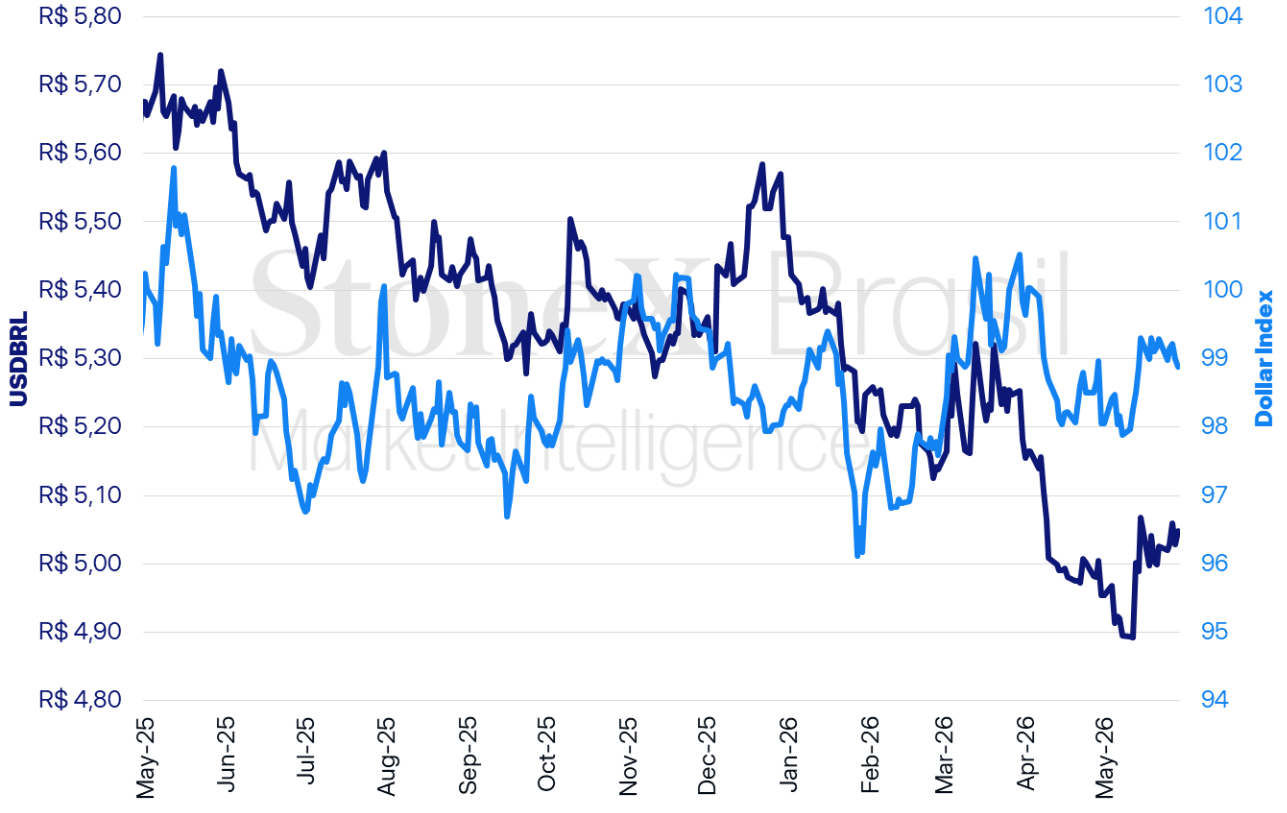
USDBRL and Dollar Index (points)
Source: StoneX cmdtyView. Design: StoneX.
USDBRL Variations | Daily: +0.38% | Weekly: +0.45% | Monthly: +1.89% | Annual: -7.83% | Over 12 months: -10.91%
Dollar Index Variations | Daily: -0.11% | Weekly: -0.41% | Monthly: +0.85% | Annual: +0.57% | Over 12 months: -0.46%
KEY EVENT: Expectations for an agreement in the Middle East
Expected impact on the BRL exchange rate: bearish
Variation in Crude Oil Production by Selected Countries between February and April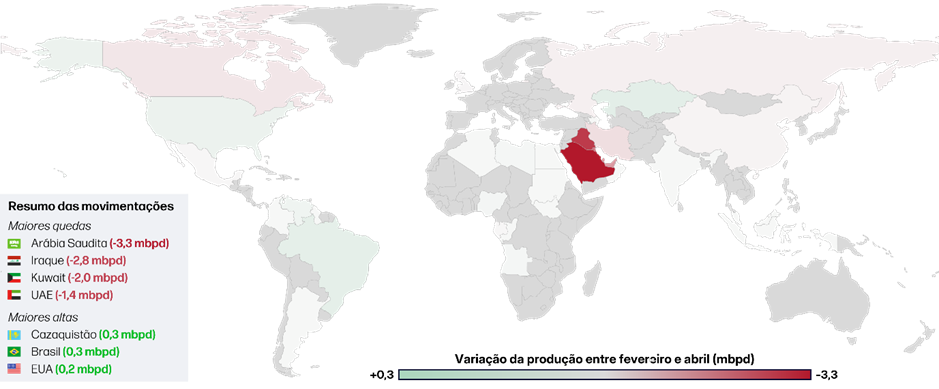
Source: EIA, OPEC, and DOE. Design: StoneX.
The foreign exchange market is expected to reflect greater investor expectations for a diplomatic agreement between the United States and Iran that could end the conflict between them and allow the reopening of the Strait of Hormuz.
Why This Matters: Clearer signs of progress in diplomatic negotiations should elevate investors' risk appetite, favoring the performance of riskier assets, such as the BRL.
- On the other hand, news signaling persistent disagreements between the countries tends to worsen investor sentiment, negatively impacting the real's performance.
Advances and Setbacks: On the afternoon of last Thursday (27), Axios reported that Washington and Tehran had reached a preliminary agreement to establish a Memorandum of Understanding, but the formalization of the agreement still required the approval of US President Donald Trump.
- According to the website, Iran's supreme leader had already agreed to the negotiated terms, but Trump had requested "a few days" to reflect.
- On Friday (29), the US president hinted that this agreement was real, stating he would meet at the White House to make a "final decision" on the matter.
- He listed that the agreement would include, among other topics, the removal and destruction of Iran's enriched uranium.
- However, Iran's Foreign Ministry spokesperson, Esmail Baqai, stated that "at the moment, we are focused on ending the war; we are not negotiating Iran's nuclear program."
- It is also worth noting that it was previously reported that Washington and Tehran had reached agreements on both May 6 and May 23, but no formalization occurred in either case.
Unwavering Faith: Even though the situation remains fragile and uncertain, investors remain optimistic about the prospect of the conflict's end being near.
- This optimism led to a decline of over 9% in international oil prices over the week.
Agreement details: According to the reports, the alleged agreement would extend the ceasefire for 60 days for hostilities against both Iran and Lebanon.
- Additionally, navigation in the Strait of Hormuz would be unrestricted and toll-free, and Tehran would have 30 days to remove the mines deployed in the area.
- During the ceasefire, both sides would continue discussing Iran's nuclear issue and the reduction of US sanctions against the Persian country.
Delay in Normalization: Even if the countries resolve the dispute quickly, it is necessary to consider that there will be a delay in normalizing flows through the Strait of Hormuz.
- The first obstacle would be the time required to clear the mines deployed in the region so that ships can navigate the area safely.
- Additionally, due to restrictions on oil exports, oil companies are operating at reduced capacity, requiring weeks to return operations to pre-war levels.
- Finally, there would still be the transportation time for the energy commodity from the Middle East to its destination country, as oil tankers move slowly.
- In this context, even with an immediate resolution, the time required to normalize the entire supply chain should keep oil prices at high levels, sustaining global inflation concerns.
US Economic Data
Expected impact on the BRL exchange rate: bullish
US: Historical and Expected Interest Rate Trajectory – Updated May 29, 2026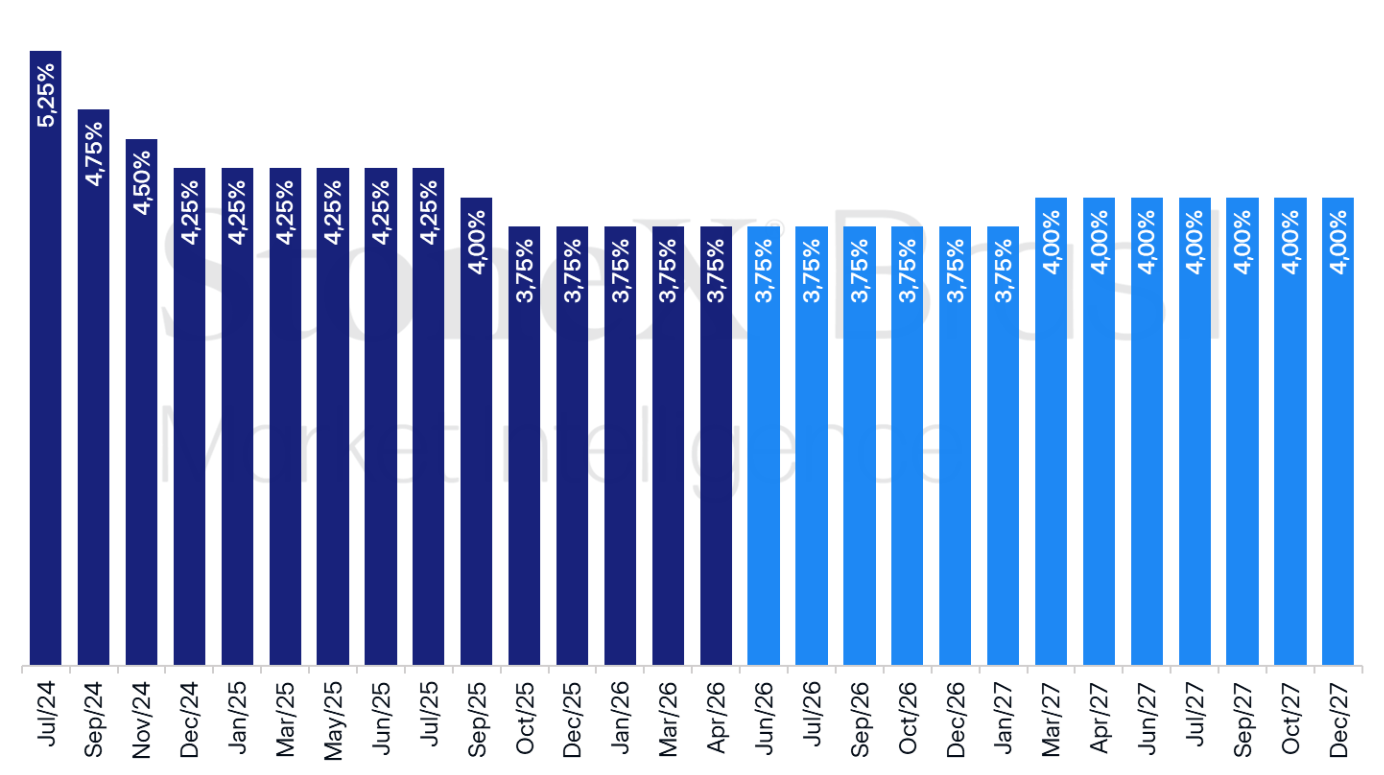
Source: CME FedWatch Tool. Design: StoneX. Refers to the market's highest probability bet for future interest rates on the indicated date.
Investors are expected to react to the release of indicators for US economic activity and labor market, aiming to calibrate expectations for the country's interest rate trajectory.
Why This Matters: The data is expected to reinforce the perception of a more resilient and robust US economy, increasing expectations for higher interest rates for longer in the country.
- This, in turn, tends to raise yields on US Treasuries and attract foreign capital, strengthening the dollar globally.
Estimates: The median estimates for the Employment Situation Report point to a net creation of 96,000 jobs in the US in May, as well as stable unemployment rates at 4.3%.
- Additionally, the median estimate for the Purchasing Managers' Index (PMI) measured by the ISM points to further expansion in May, remaining at 53.6 points in the services PMI and shifting from 52.7 points to 52.6 points in the manufacturing PMI.
Inflationary Challenges: The data is expected to suggest that the US economy remains strong, indicating no need for Federal Reserve rate cuts in the short term.
- On the other hand, inflation indices point to more persistent and widespread inflation in the country, necessitating higher interest rates to curb these price pressures.
- The core Consumer Price Index (CPI), excluding volatile food and energy components, accelerated by 0.4% in April, above the median estimate of 0.3%.
- The core Personal Consumption Expenditures (PCE) Price Index, used by the Fed to track inflation, grew by 0.2%, driven by industrial goods and business services.
- The core Producer Price Index (PPI) accelerated by 1.0% in the same month, far exceeding the median estimate of 0.3%.
- These figures indicate that inflationary pressure caused by the closure of the Strait of Hormuz and fears of a global oil supply shortage spread more rapidly beyond energy prices.
Inflation Measures for the United States (%)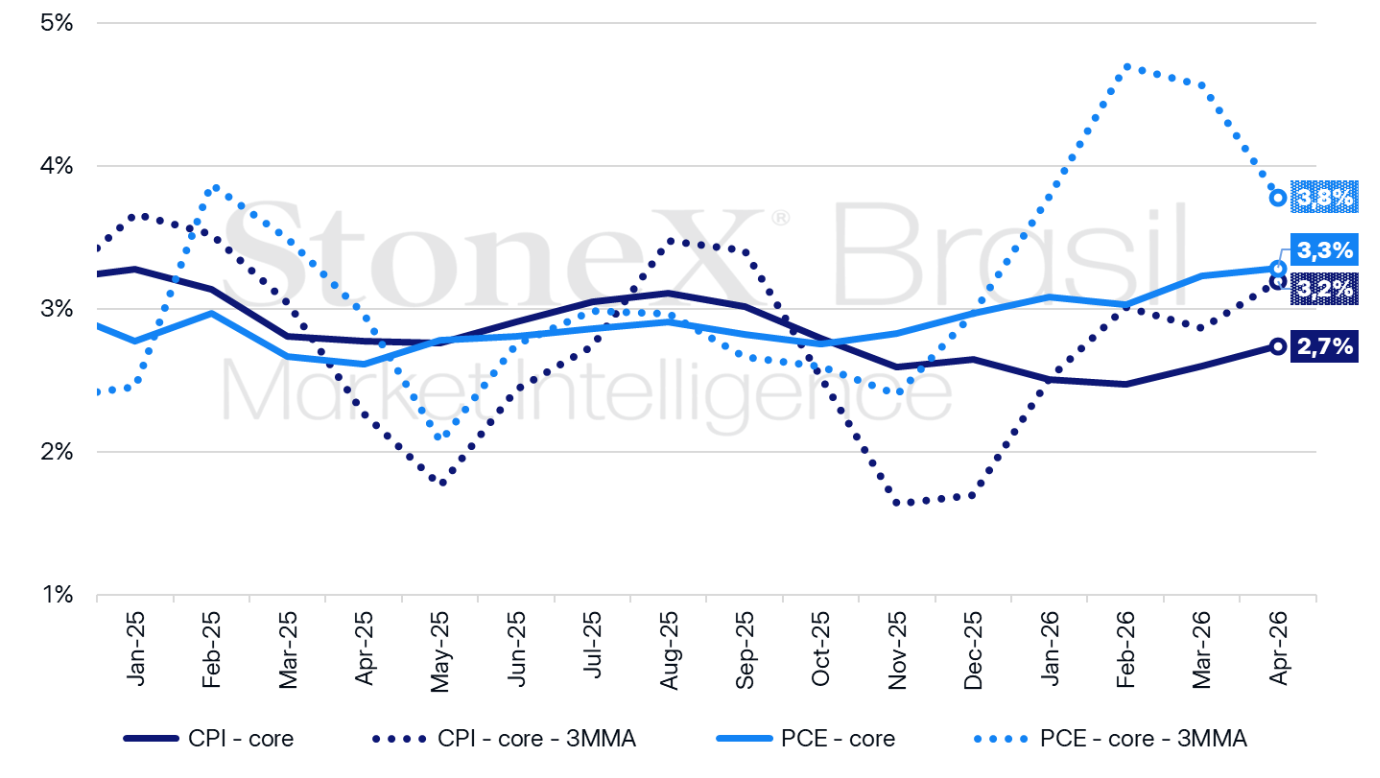
Source: US Bureau of Economic Analysis (BEA), US Bureau of Labor Statistics (BLS), Federal Reserve Bank of St. Louis. Design: StoneX.
No Room for Rate Cuts: Amid these inflationary challenges, investors have reversed their bets on the Federal Reserve's next interest rate move, shifting from anticipating a cut to expecting a hike.
- Additionally, various Fed members have warned about inflation risks facing the US and the possibility of future rate hikes by the Fed.
- For example, Federal Reserve Board Governor Christopher Waller stated that the Fed should remove the dovish (rate cut) bias from its communications and that advocating rate cuts now would be "madness."
- Kansas City Federal Reserve President Jeffrey Schmid stated that "the main concern is inflation, which is very heated and has remained above the inflation target for a long time."
- St. Louis Federal Reserve President Alberto Musalem said that "at this moment, the balance of risks is more tilted toward inflation than the labor market."

ECONOMIC INDICATORS
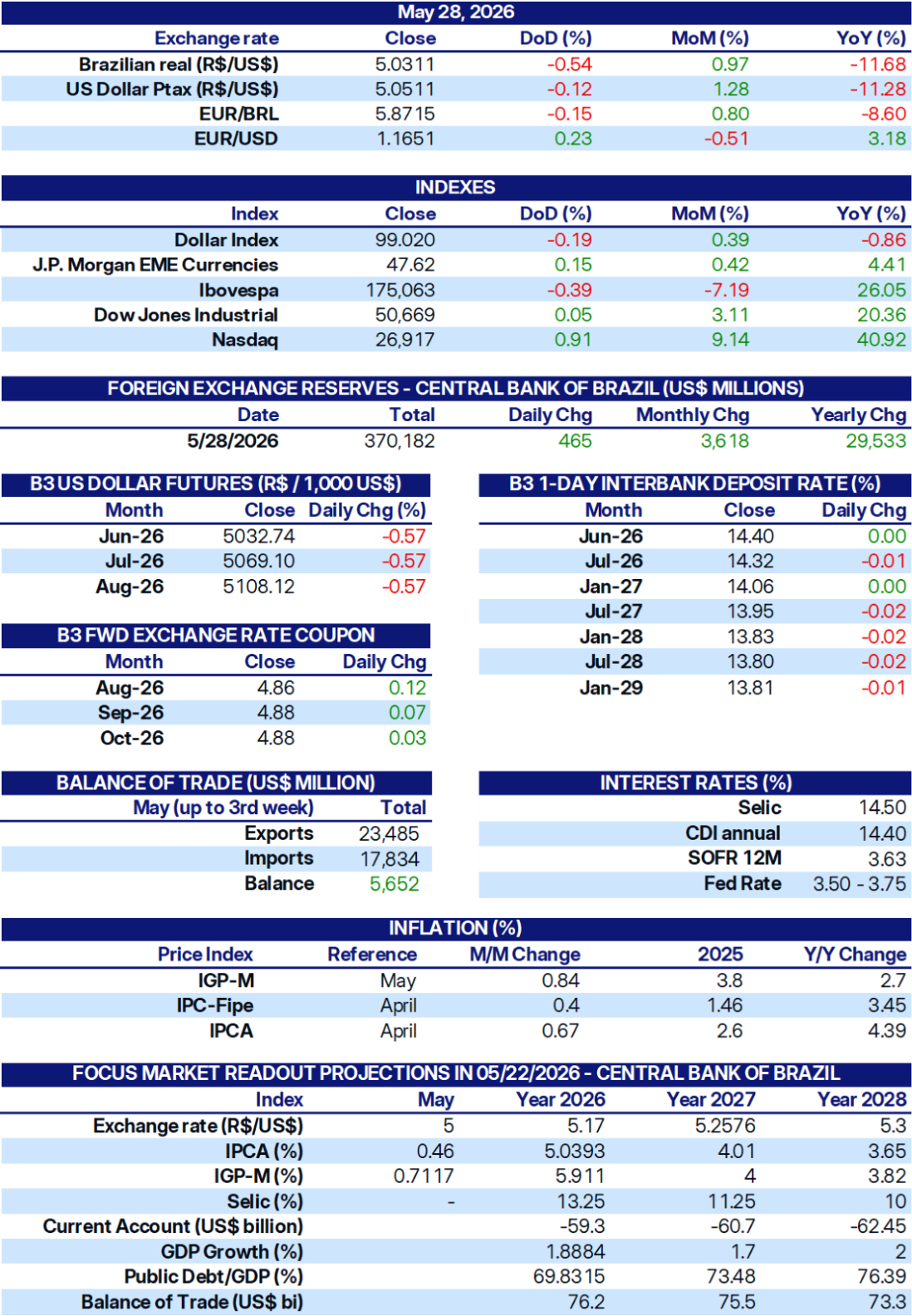
Sources: Central Bank of Brazil; B3; IBGE; Fipe; FGV; MDIC; IPEA and StoneX cmdtyView.