Dollar to reflect Jackson Hole Symposium, inflation data in the US and Brazil, and Brazil's electoral race
- Bullish
- Kevin Warsh's speech at Jackson Hole is expected to detail how the Federal Reserve intends to restore price stability in the US, increasing investor bets on new interest rate hikes in the short term and strengthening the USD globally.
- A benign reading of inflation in Brazil tends to reinforce bets on the continuation of the basic interest rate (Selic) cut cycle, reducing the attraction of external capital and weakening the Brazilian real.
- Bearish
- Moderate numbers for inflation and GDP in the US should reinforce the perception of a less heated economy, reducing bets on new interest rate hikes in the short term and weakening the dollar globally.
- Reports of investigations involving President Lula's son increase expectations of a victory for Flávio Bolsonaro in the presidential election, decreasing the perception of political risks in national assets and favoring the performance of the BRL.
The week in review
- In a week with few indicators, news of an expansion of long-term Treasury bond repurchase operations by the United States Treasury Department was the main driver of global financial markets.
- The measure means that the government will buy more Treasuries and signaled a greater supply of dollars in the market, devaluing the greenback. Additionally, it indicated that the government is not interested in reducing the public deficit, increasing the perception of inflationary risks.
USDBRL and Dollar Index (points)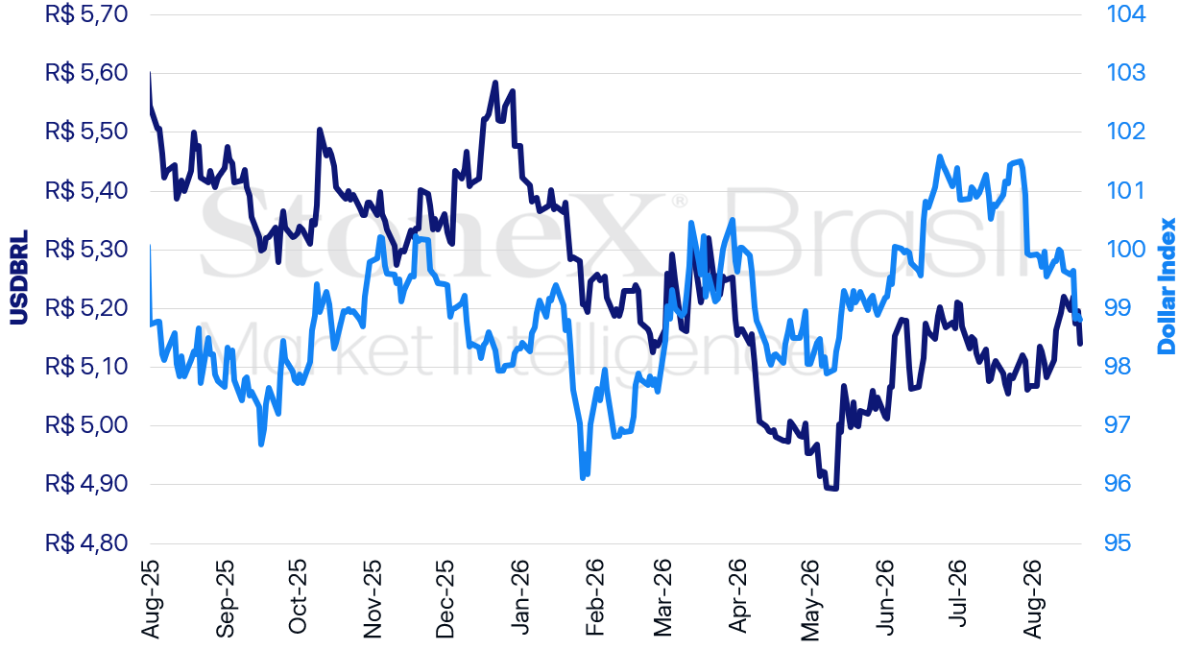
Source: StoneX cmdtyView. Design: StoneX.
USDBRL variations | Daily: -1.05% | Weekly: -1.52% | Monthly: +1.43% | Annual: -6.15% | Over 12 months: -6.15%
Dollar index variations | Daily: -0.07% | Weekly: -0.84% | Monthly: -1.09% | Annual: +0.49% | Over 12 months: +0.15%
KEY EVENT: Warsh's Speech at Jackson Hole
Expected impact on the USDBRL: bullish
US: Historical and expected interest rate – updated on August 21, 2026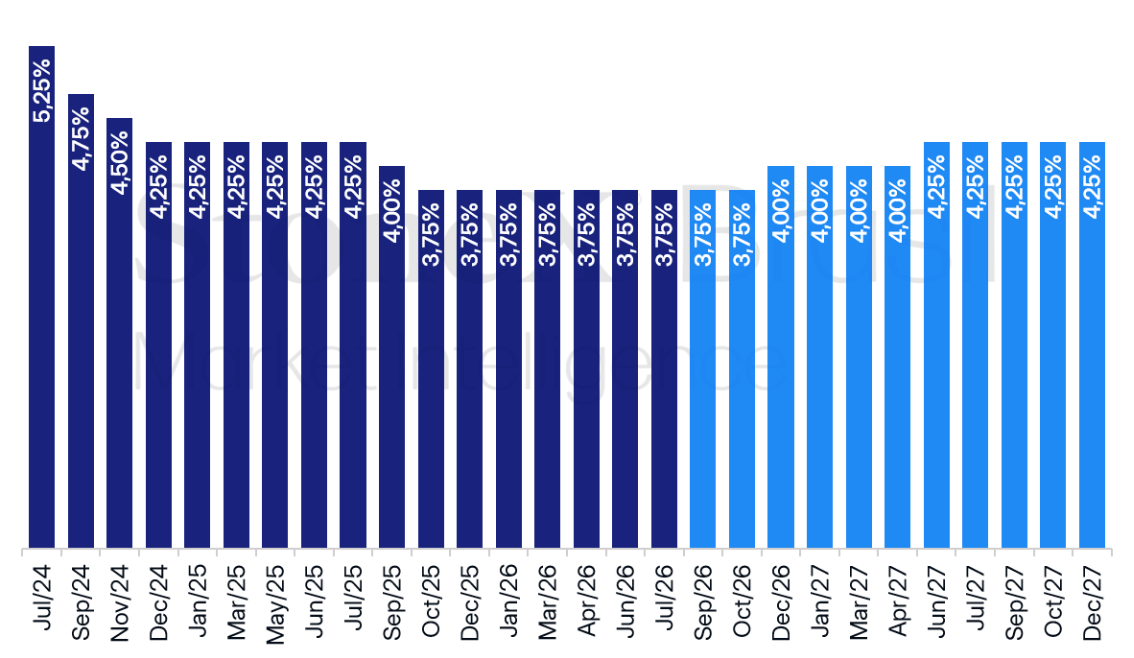
Source: CME FedWatch Tool. Design: StoneX. Refers to the most probable bet in the interest rate futures market on the indicated date.
The currency market is expected to react to the upcoming Friday (28) speech by Federal Reserve (Fed) President Kevin Warsh at the important Annual Monetary Policy Symposium in Jackson Hole, aiming to calibrate expectations for the trajectory of US interest rates.
Why this matters: It is likely that Warsh's speech will seek to be more specific about how the Federal Reserve intends to restore price stability in the US, increasing investor bets on new interest rate hikes in the short term.
- This, in turn, would raise the yield on US Treasuries and encourage the attraction of foreign capital to the country, strengthening the dollar globally.
Overview: This week marks the important Annual Monetary Policy Symposium in Jackson Hole, hosted by the Kansas City Federal Reserve, from Thursday (27) to Saturday (29).
- The event will feature speeches from various central bank authorities worldwide, and investors should pay special attention to Warsh's first speech at the event as the Federal Reserve president on Friday (28).
What to expect: In previous years, the Fed president's speech at Jackson Hole provided important insights into the direction of US monetary policy in the following months, influencing investor expectations about interest rate trajectories in the United States.
- Warsh will likely address planned reforms to the intellectual framework underlying the Federal Reserve's monetary policy through the five task forces announced in June.
- For example, he is expected to discuss the role of the Fed's balance sheet in monetary policy, how this aligns with interest rate setting, the potential deflationary effects of new artificial intelligence technologies, and how the central bank should communicate.
- However, as the new Fed president refuses to provide any forward guidance to investors, doubts remain as to whether he will continue the tradition of detailing the balance of risks for the American economy and short-term interest rate prospects.
Correcting the record? From investors' perspective, there is strong demand for a better understanding of how the Federal Reserve will operate under Warsh's leadership.
- The July 29 interest rate decision press conference hurt the Fed's credibility with financial market operators, who negatively received Warsh's vague and evasive answers about how the central bank would act if inflation remained high.
- Additionally, suggestions that the Fed could combat inflation without raising interest rates and potential changes to the metrics used as references for the central bank's target were also poorly received.
- Therefore, there is a possibility that Warsh will be more specific and detailed in his speech, seeking to "correct the record" and alleviate the discomfort caused by the press conference.
Interest rate hikes in doubt: Since the July 29 interest rate decision, investors have increasingly bet against the possibility of short-term interest rate hikes by the Federal Reserve.
- The main factor driving this trend was the perception of a Fed less inclined to raise interest rates after Warsh's press conference.
- However, recent economic data also suggest a less strong US economy than anticipated, indicating that there may not be urgency for higher interest rates.
- Both inflation indexes and labor market data showed moderate readings for two consecutive months.
- Additionally, although the Fed is independent, the November legislative elections reduce the likelihood of interest rate hikes in September and October decisions, as there is a risk of being interpreted as political interference without clear justification.
- However, counteracting this, the resurgence of geopolitical tensions in the Middle East in July has pushed global oil prices higher, raising fears of inflationary pressures in the second half of the year.
US Economic Data
Expected impact on the USDBRL: bearish
US inflation measures (%)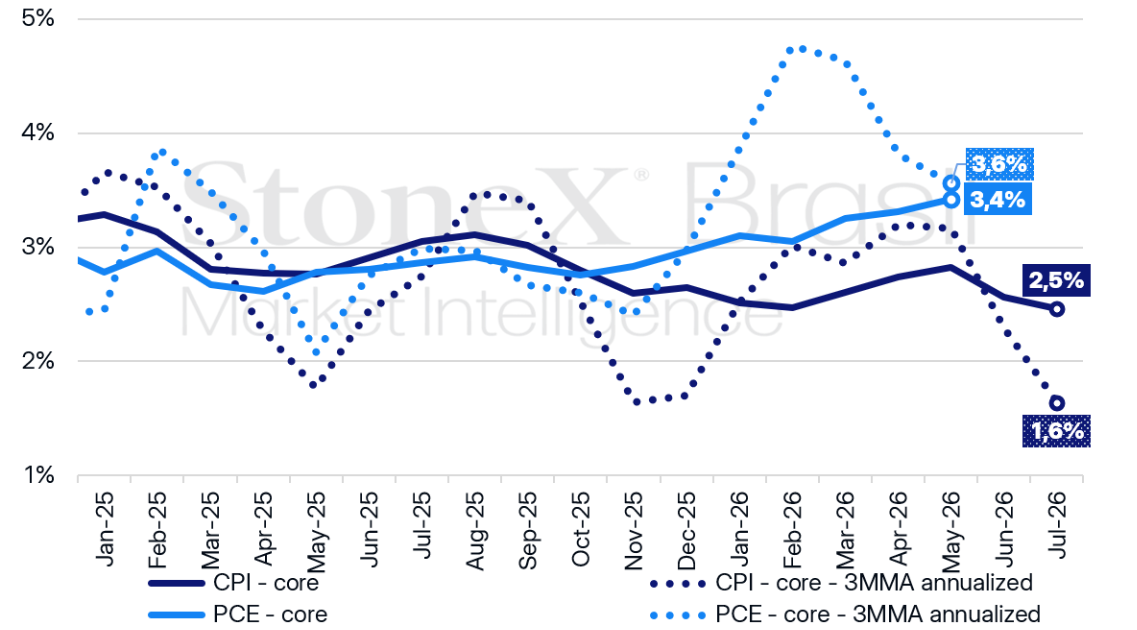
Source: U.S. Bureau of Economic Analysis (BEA), U.S. Bureau of Labor Statistics (BLS), Federal Reserve Bank of St. Louis. Design: StoneX.
In addition to the Jackson Hole speech, investors should react to the release of several important indicators to assess the evolution of the US economy, influencing expectations for monetary policy decisions.
Why this matters: Moderate numbers for inflation and GDP in the US should reinforce the perception of a less heated economy, reducing bets on new interest rate hikes by the Fed in the short term.
- This, in turn, would lower yields on US Treasuries and hinder the attraction of foreign capital to the country, weakening the USD globally.
Estimates: The median estimates for the Personal Consumption Expenditures (PCE) Price Index, the metric used by the Fed to monitor consumer inflation, indicate its monthly variation will shift from -0.1% in June to 0.1% in July.
- The indicator's core, which excludes volatile food and energy components, is expected to rise from 0.1% to 0.2% during the same period.
- Meanwhile, the median estimate for the second reading of the Gross Domestic Product (GDP) in the second quarter suggests its annualized growth rate will remain at 1.5%.
- If confirmed, these numbers reinforce the perception of a less heated US economy than anticipated, reducing the urgency for further interest rate hikes by the Fed.
Domestic Electoral Scenario
Expected impact on the USDBRL: bearish
With the official start of the electoral period, financial markets remain focused on updates to the domestic electoral scenario, seeking to calibrate their expectations for Brazil's economic policies over the next four years.
- In particular, investors should react to news about investigations involving the son of President Luiz Inácio Lula da Silva, which could harm his re-election campaign's viability.
Why this matters? Investors believe the news increases the chances of Flávio Bolsonaro winning the presidential election, reducing political risk perceptions for national assets and favoring the Brazilian real's performance.
- In practice, recent reactions from financial market agents reveal a preference for the election of a new president, potentially more conservative in fiscal policy.
Lulinha Case: Last Thursday (20), documents related to the investigation of Fábio Luís Lula da Silva, nicknamed Lulinha, were leaked to journalists.
- According to reports, the Federal Police (PF) indicated that Lulinha acted in "economic communion of interests" with lobbyist Roberta Luchsinger, negotiating contracts with the federal government.
- Besides this case, Lulinha is the target of two other PF investigations.
Poll publication: On Monday (24), another poll measuring voter intentions for the presidency will be released, potentially highlighting impacts from leaked investigations related to Lulinha.
- Last Monday (17), a BTG/Nexus poll showed Lula maintaining his lead in the first round with 41% of voter intentions, compared to 40% in the previous poll, while Flávio Bolsonaro also increased his share from 35% to 36%.
- In a potential runoff between Lula and Flávio, the results showed stability from the previous week's poll, with both candidates maintaining 47% and 44% of voter intentions, respectively, indicating a technical tie.
Inflation in Brazil
Expected impact on the USDBRL: bullish
IPCA-15 accumulated over 12 months (%) 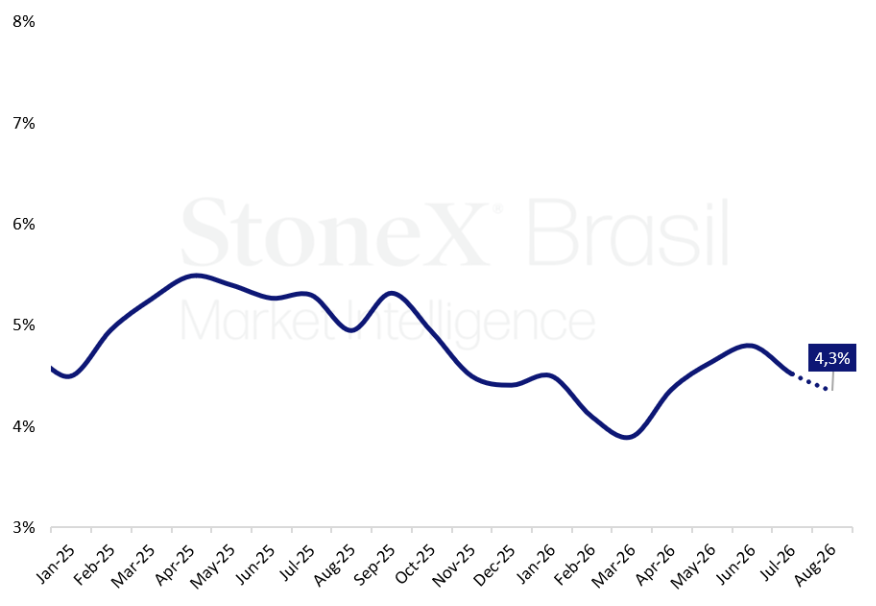
Source: Central Bank of Brazil. Design: StoneX.
Investors should also react to the August reading of the National Consumer Price Index 15 (IPCA-15), recalibrating expectations for inflationary trajectory and national monetary policy decisions.
Why this matters: The IPCA-15's deceleration should increase investor bets on the continuation of basic interest rate (Selic) cuts, lowering returns on national government bonds and hindering the attraction of external capital, thereby weakening the BRL.
Estimates: Median estimates suggest the monthly variation of the IPCA-15 will shift from 0.06% in July to -0.3% in August.
- This figure will likely be influenced by falling prices for food, transportation, and clothing, as well as temporary relief in electricity bills due to an extraordinary credit this month.
- The indicator's core, excluding volatile food and energy components, is expected to remain around 0.25%, reinforcing the perception of inflation moderation in the country.
Copom adopts a more neutral tone: Since its last Monetary Policy Committee (Copom) meeting, Central Bank authorities have adopted a more neutral tone regarding monetary policy decisions.
- In its post-meeting statement, Copom reiterated that "the total magnitude of the calibration cycle will be determined based on new information," but described an inflationary scenario still concerning, noting that upcoming decisions will aim to maintain "adequate restraint to ensure inflation convergence to the target."
Outlook: Given the lack of clear signals regarding the next steps, monitoring the country's inflationary trajectory will be crucial for investors to adjust their expectations.
- Until Copom's next interest rate decision in mid-September, August's IPCA reading will be released.
- It is worth noting that Copom's latest meeting minutes highlighted an upward asymmetry in inflationary risks (i.e., greater risk of accelerated inflation than moderated inflation) and a divergence between investor inflation expectations and the 2027–2028 targets, which should heighten monetary authorities' caution.

ECONOMIC INDICATORS
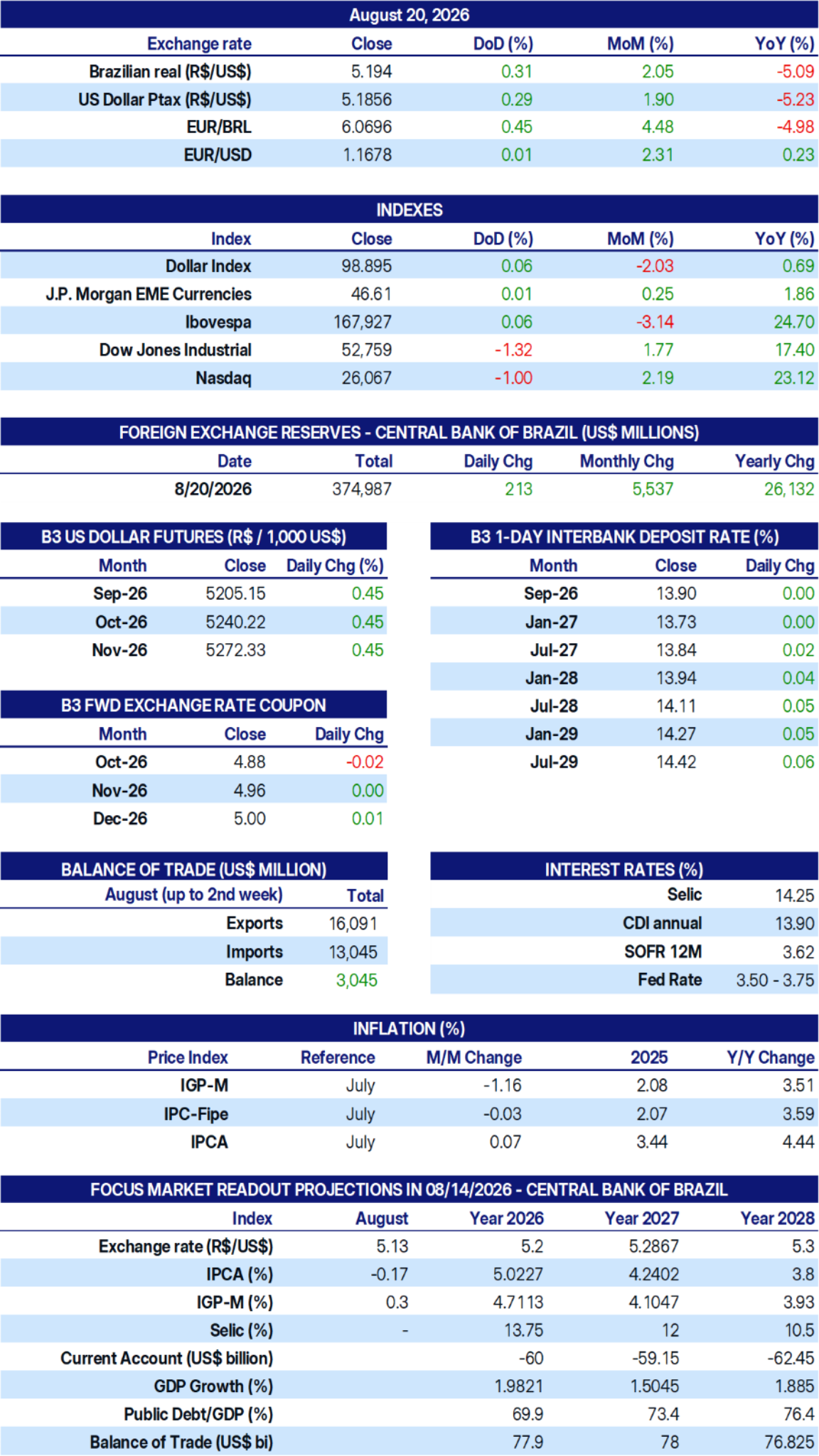
Sources: Central Bank of Brazil; B3; IBGE; Fipe; FGV; MDIC; IPEA; and StoneX cmdtyView.