Dollar expected to reflect US economic data, Brazilian GDP, Brazil's electoral scenario, and PTAX
- Bullish
- Recovery in the US labor market is expected to increase bets on a short-term interest rate hike by the Federal Reserve, raising yields on US Treasury bonds and strengthening the USD globally.
- Slowdown in Brazilian GDP during the second quarter is likely to strengthen expectations of further cuts to the benchmark interest rate (Selic), which tends to reduce the attractiveness of Brazilian government bonds and negatively impact the performance of the BRL.
- The proximity of the electoral period in Brazil tends to heighten uncertainty and perceptions of political risk regarding national assets, potentially deterring foreign capital and weakening the BRL.
- Bearish
- No predominantly bearish factors for the exchange rate have been identified this week. However, it should be noted that exchange rates are historically volatile, and a decline remains possible either due to frustration with bullish expectations or unexpected events.
The week in review
- The key event of the week was the speech by Federal Reserve (Fed) Chairman Kevin Warsh at the Annual Monetary Policy Symposium in Jackson Hole.
- During his remarks, Warsh reiterated his dissatisfaction with the trajectory of inflation in the US and suggested that the Fed could raise interest rates if inflation does not decelerate “clearly and at a sufficient pace,” which investors interpreted as a “hawkish” signal.
- In terms of indicators, figures for the Personal Consumption Expenditure (PCE) Index and the Gross Domestic Product (GDP) in the US slightly exceeded expectations, suggesting an economy that is a bit more robust than anticipated.
USD/BRL and Dollar Index (points)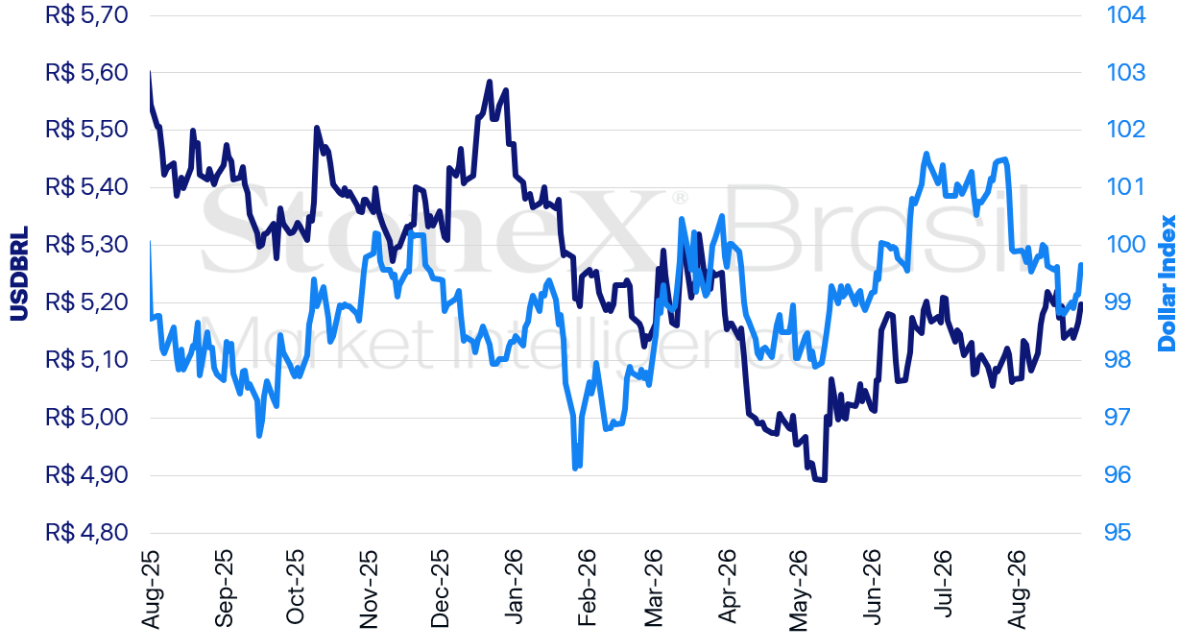
Source: StoneX cmdtyView. Design: StoneX.
USDBRL variations | Daily: +0.63% | Weekly: +1.13% | Monthly: +2.58% | Year-to-date: -5.09% | Last 12 months: -3.85%
Dollar index variations | Daily: +0.51% | Weekly: +0.86% | Monthly: -0.24% | Year-to-date: +1.36% | Last 12 months: +1.81%
KEY EVENT: US economic data
Expected impact on the USDBRL: bullish
Bets for the Federal Reserve’s interest rate decision on September 16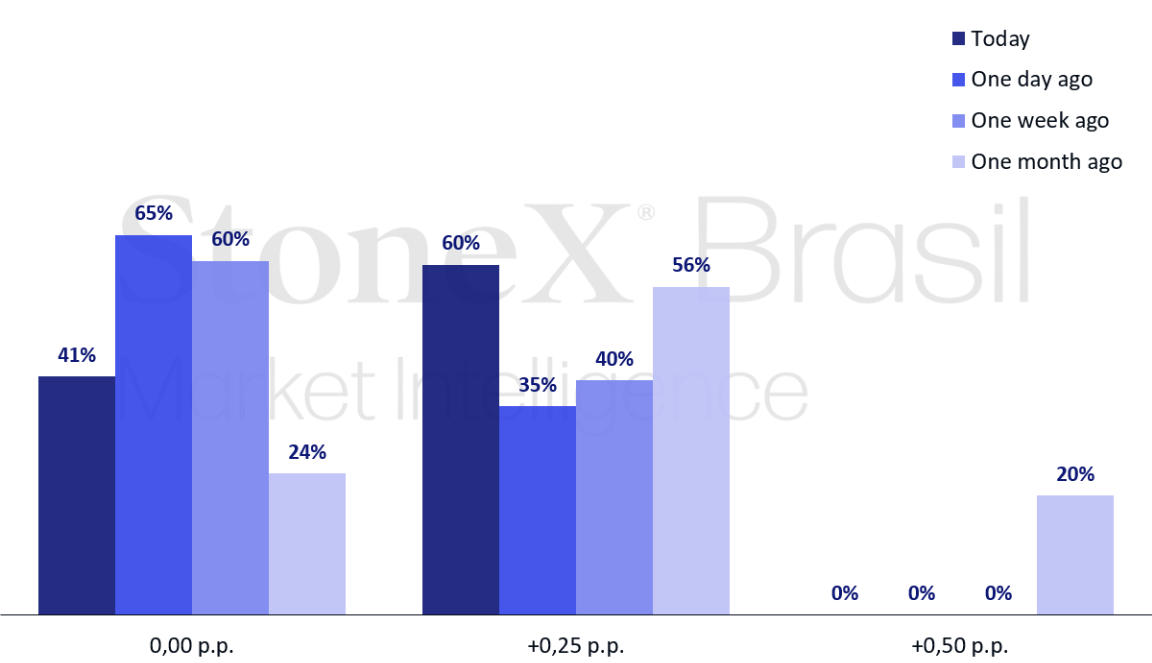
Source: CME FedWatch Tool. Design: StoneX. Futures market probabilities as of August 28, 2026.
The forex market is expected to reflect the release of US economic indicators, especially labor market data, while calibrating expectations for the country’s interest rate trajectory.
Why this matters: A recovery in US job creation could increase investors’ bets on further short-term interest rate hikes, boosting yields on US Treasuries and attracting foreign capital to the country, thereby strengthening the USD globally.
Estimates: After two months of weaker-than-expected US labor market data, analysts anticipate a recovery in the August Employment Situation Report.
- The median projection indicates that net job creation in the United States increased from -23,000 in July to 45,000 in August.
- The unemployment rate is expected to return to 4.2% after dropping to 4.1% the previous month due to an unexpected and likely temporary reduction in the labor force.
- Meanwhile, the ISM Purchasing Managers' Index is expected to decline from 53.9 points to 53.2 points for the manufacturing index and from 54.1 points to 53.8 points for the services index.
Potential interest rate hike: Last week, investors resumed betting on an interest rate hike by the Federal Reserve at the September 16 meeting following Kevin Warsh’s speech at the Annual Monetary Policy Symposium in Jackson Hole.
- Warsh suggested that the US central bank might raise interest rates if inflation does not return to the 2% annual target “clearly and at a sufficient pace.”
- He also stated that the US labor market remains robust, while the inflationary scenario presents higher risks and that US financial conditions can hardly be considered restrictive.
- Both statements suggest that further interest rate hikes may be necessary in the near future.
Yes, but: Although Warsh’s statements triggered a notable increase in bets for an interest rate hike, recent data points in the opposite direction, suggesting a less strong US economy than anticipated.
- Furthermore, there is uncertainty about what exactly constitutes a decline in inflation “clearly and at a sufficient pace,” the criterion specified by Warsh for another rate hike.
- This underscores the importance of this week’s labor market data release and next week’s inflation figures, as they may influence the Federal Reserve’s macroeconomic assessment for its September rate decision.
Economic activity in Brazil
Expected impact on the USDBRL: bullish
Brazil’s quarterly GDP growth (%)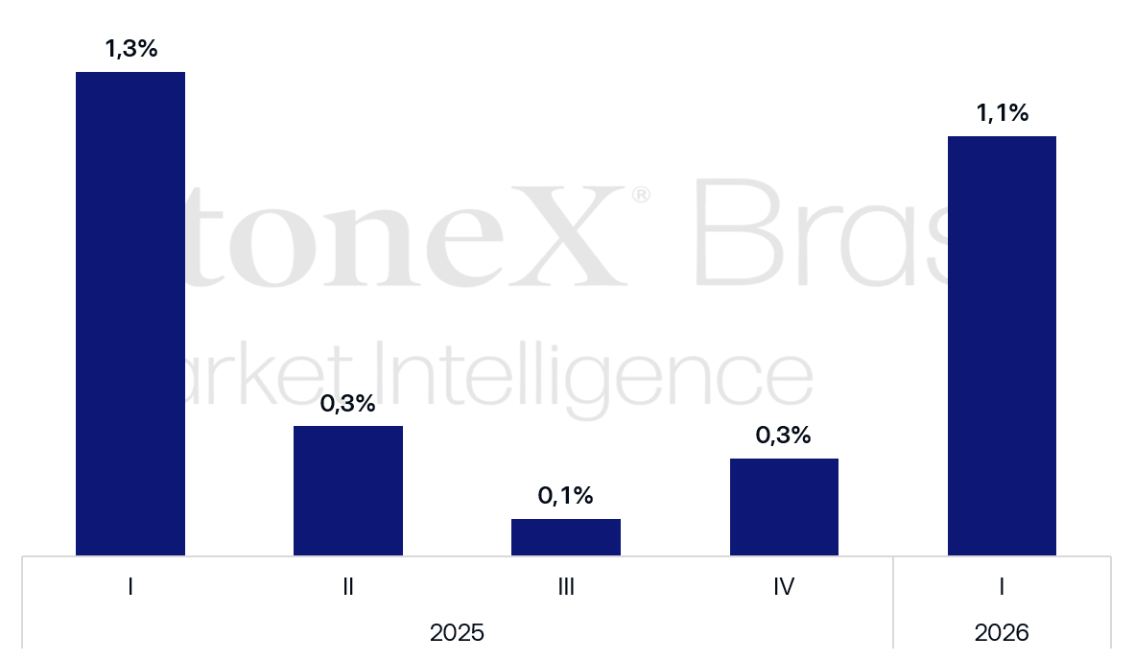
Source: IBGE. Design: StoneX.
Domestically, investors are expected to react to the release of second-quarter Gross Domestic Product (GDP) figures.
Why this matters? Signs of slowing economic activity tend to strengthen investors’ expectations for further cuts to the benchmark interest rate (Selic).
- This, in turn, tends to reduce the attractiveness of Brazilian government bonds and negatively impact the performance of the real.
Estimates and recent data: In the latest Focus Bulletin, the median estimate points to accumulated growth over four quarters slowing from 2.00% to 1.93% in the second quarter.
- For the end of the year, the projection is for growth of 1.95%, representing a slowdown compared to the 2.30% recorded the previous year.
- According to the Central Bank’s Economic Activity Index (IBC-Br), which calculates monthly economic activity variations, the accumulated result in the second quarter of the year was 0.2% growth.
- Meanwhile, FGV’s GDP Monitor indicates 0.3% growth in the second quarter.
Overview: Recent readings of economic activity indices have suggested a slight economic contraction in recent months, although the accumulated balance over the past 12 months remains positive.
- This, along with the gradual return of inflation within the tolerance margins of the target, tends to support the reading of room for further Selic cuts by the Monetary Policy Committee (Copom).
- On the other hand, the unemployment rate recorded at 5.3% in July, close to the historical series’ minimum, along with high earnings per worker, suggests a heated labor market that counters the case for interest rate cuts.
- Moreover, potential inflationary pressures stemming from the global strengthening of the dollar, rising oil prices due to the ongoing Middle East conflict, and potential impacts of El Niño on agricultural production at the end of the year remain risk factors, possibly increasing the central bank’s caution.
Brazilian political and electoral scenario
Expected impact on the USDBRL: bullish
On the domestic political front, investors are closely monitoring developments in the presidential race for October’s elections.
- Three presidential polls will be released this week, two on Monday (31) and one on Wednesday (02).
- Additionally, in the National Congress, two government-backed constitutional amendment proposals (PECs), one on ending the 6x1 work schedule and another on public security, have been forwarded to the Constitution and Justice Commission (CCJ).
Why this matters? A tight electoral race may reduce predictability regarding Brazil’s economic policies for the next four years, increasing the perceived risks of national assets, amplifying volatility, and negatively impacting the Brazilian real’s performance.
- Moreover, investors believe that progress on legislative agendas may increase the likelihood of Lula winning the presidential election, raising political risk perceptions of national assets and negatively impacting the BRL.
- In practice, recent reactions from financial market players reveal a preference for the election of a new president, who may be more fiscally conservative.
Electoral polls: In the most recent voting intention poll released by PoderData on Thursday (27), candidates Luiz Inácio Lula da Silva and Flávio Bolsonaro show 38% and 35% of first-round voting intentions, respectively.
- In a potential second-round contest between the candidates, Lula holds 45% while Flávio has 44% of voting intentions, indicating a technical tie.
PECs in Congress: Last Thursday (27), Senator Omar Aziz (PSD-AM), rapporteur for the PEC ending the 6x1 schedule, returned a favorable opinion supporting the text approved by the House of Representatives to expedite its Senate approval.
- The proposal will be reviewed by the CCJ on Wednesday (02), with expectations for same-day voting, though it may be postponed if any parliamentarian requests a review.
- Regarding the public security PEC, President Lula promised on Thursday to create a Ministry of Public Security if the PEC passes, aiming to coordinate efforts with states and municipalities on safety initiatives.
Month-end PTAX rate
Expected impact on the USDBRL: undefined
Month-end PTAX rate – selling (BRL/USD)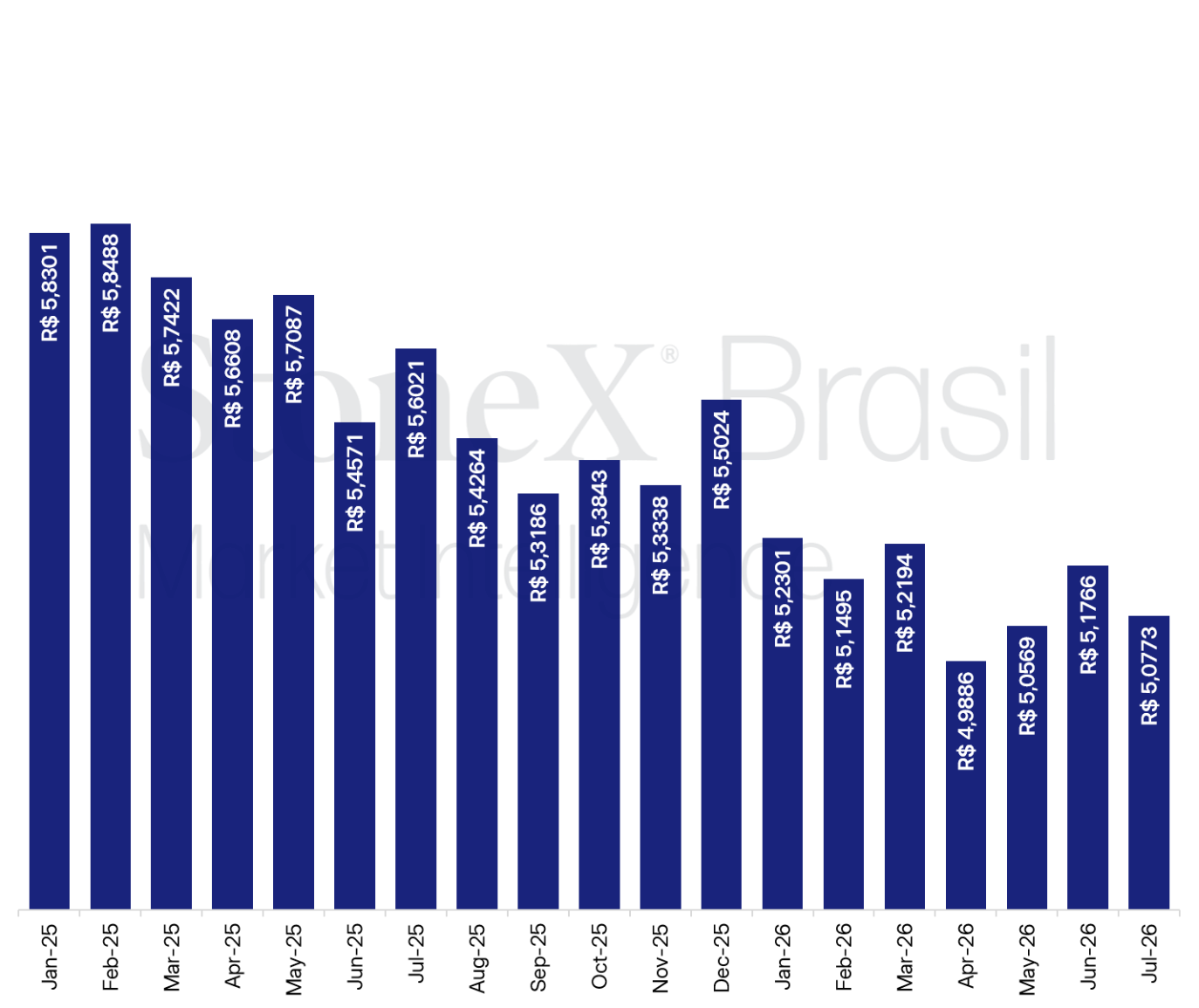
Source: Central Bank of Brazil. Design: StoneX.
Trading volume and exchange rate volatility are expected to rise during today’s session due to the month-end PTAX rate formation.
- The PTAX rate is a daily reference published by the Central Bank, with its month-end value widely used in currency and derivative contracts.
- The Central Bank calculates its value by averaging quotes obtained during four consultation windows between 10:00 a.m. and 1:10 p.m.
Why this matters: Financial market operators intensify their transactions during the intervals of the month’s final PTAX rate formation to attempt to influence its value in a direction favorable to their positions, increasing volatility and complicating the interpretation of real movements during the day.

INDICATORS
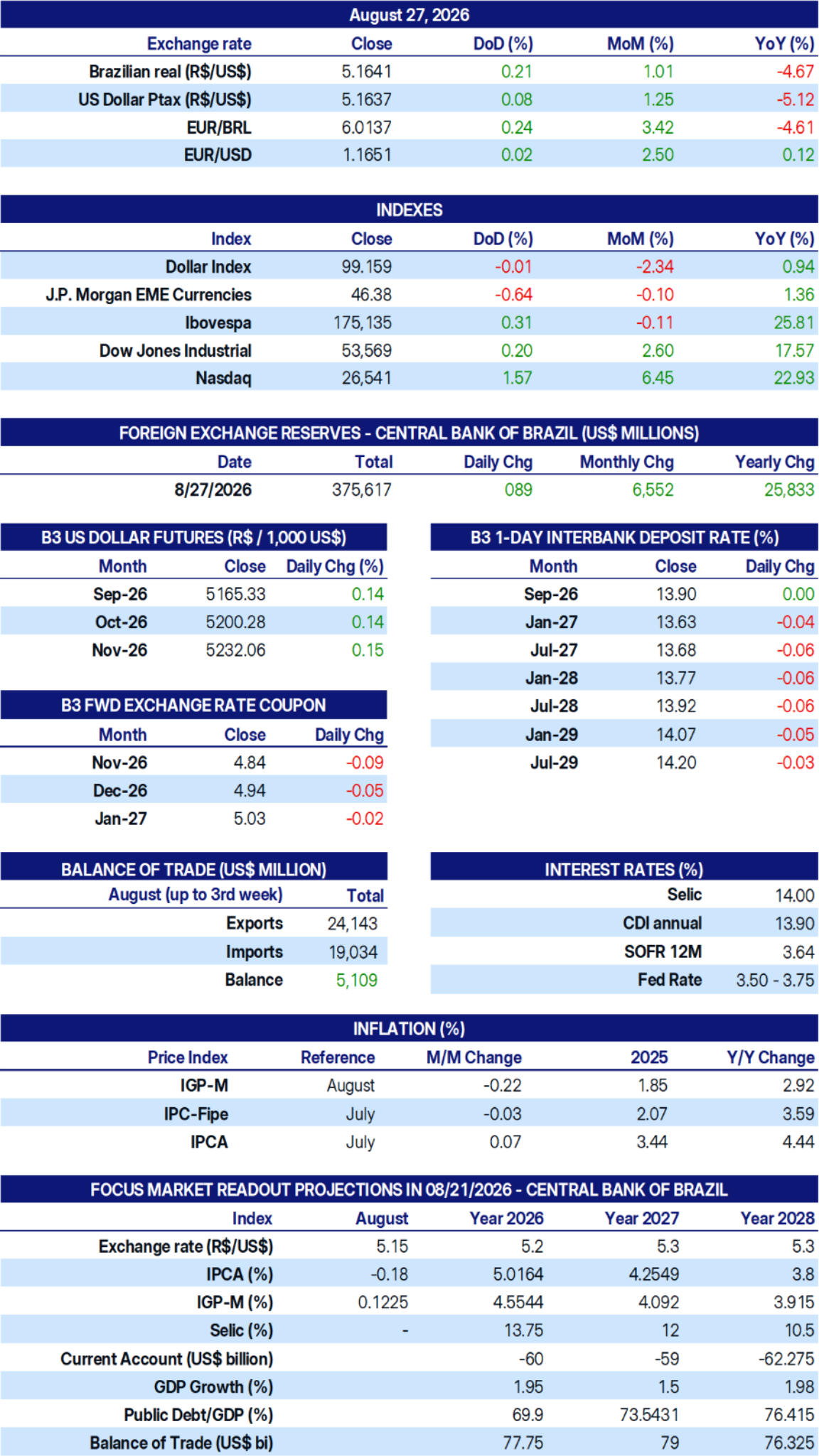
Sources: Central Bank of Brazil; B3; IBGE; Fipe; FGV; MDIC; IPEA and StoneX cmdtyView.