Dollar expected to reflect the first round of elections, FOMC minutes, and IPCA
- Bullish
- The FOMC minutes are expected to reinforce the expectation of higher interest rates for longer in the United States, which tends to increase the yield on US Treasury bonds and attract foreign capital to the country, strengthening the dollar globally.
- Bearish
- Strengthening perceptions of a tight electoral race, increasing the likelihood of a government shift and a more conservative fiscal approach, may reduce the risk premium on national assets, favoring the Brazilian real.
- A stronger IPCA reading may heighten concerns about the domestic inflationary outlook, reducing expectations for further Selic rate cuts and strengthening the Brazilian real.
The week in review
- Throughout the week, the electoral race was the primary factor driving exchange rate volatility. Overall, Lula’s slight recovery in voter intention hurt perspectives of a government change and economic policy shift in the country.
- On the international stage, escalating geopolitical tensions in the Middle East, coupled with the prospect of prolonged high interest rates in the US, strengthened the dollar globally.
- Meanwhile, US economic data showed a mixed picture, with robust readings for production activity but more moderate results for inflation and the labor market.
USDBRL and Dollar Index (points)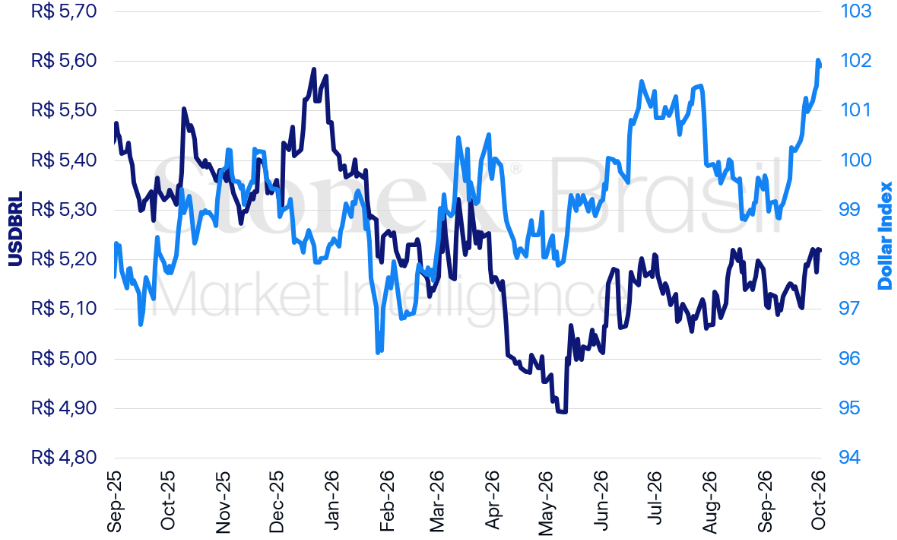
Source: StoneX cmdtyView. Design: StoneX.
USDBRL Variations | Daily: -0.03% | Weekly: +0.63% | Monthly: +0.86% | Annual: -4.70% | Over 12 months: -2.25%
Dollar Index Variations | Daily: -0.11% | Weekly: +0.91% | Monthly: +0.40% | Annual: +3.65% | Over 12 months: +4.12%
KEY EVENT: First round of elections
Expected impact on the USDBRL: bearish
Over the weekend, investors are expected to monitor the results of the first round of presidential elections, which should conclude by Sunday night (04).
- On Saturday (03), a series of voter intention polls will be released, helping calibrate expectations for the final stretch of voting.
- Assuming a first-round victory is unlikely for any candidate, investors will likely focus on the margin of difference between candidates, which could provide clues for the outcome of a potential second round.
Why this matters: A tight electoral race could reduce predictability regarding Brazil’s economic policies over the next four years, increasing the perception of risks for national assets, amplifying volatility, and weakening the BRL.
- In particular, recent reactions from financial market agents reveal a preference for the election of a new president who could adopt a more conservative fiscal policy.
- Therefore, a result that strengthens the prospect of a government change tends to reduce the perceived risk of national assets and favor the real’s performance.
Voter intention poll: On Thursday (01), Datafolha released its voter intention survey, showing Lula and Flavio Bolsonaro in a technical tie both in the first and second rounds, strengthening perceptions of tight elections.
- For the first round, projections show Lula with 42% of voter intentions and Flavio with 38%. In the previous week, the candidates were at 40% and 36%, respectively, maintaining the tie within the margin of error.
- In a potential second round, Lula’s voter intentions rose from 47% to 48%, while Flavio Bolsonaro’s remained at 45%, still indicating a technical tie.
First-round victory? Despite voter intentions being concentrated between Lula and Flavio, a first-round outcome seems unlikely.
- In this context, investors should monitor the first-round results to adjust their expectations for a potential second round, paying particular attention to the vote margin between the two leading candidates.
- Given that the other presidential candidates are aligned with the right, it seems more likely that most of their votes would shift to Flavio rather than Lula, favoring the senator’s campaign in a potential second-round race, especially in a scenario of tight margins.
- As such, a lead for Flavio or a narrow margin between the two candidates in the first round is likely to bolster investor optimism regarding a potential government change.
FOMC minutes
Expected impact on the USDBRL: bullish
US: Historical and expected interest rates – updated on October 2, 2026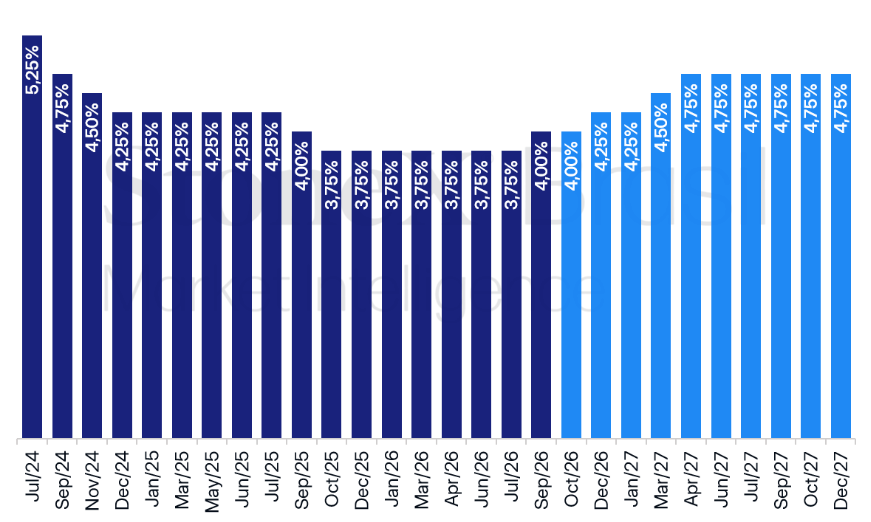
Source: CME FedWatch Tool. Design: StoneX. Refers to the market futures interest rate bet with the highest probability on the indicated date.
On the international stage, investors are expected to react to the release of minutes from the Federal Reserve’s Federal Open Market Committee (FOMC) last interest rate decision. The Fed raised US interest rates to the 3.75%-4.00% range and showed a firmer stance than expected in seeking price stability.
Why this matters: The document may reinforce the expectation of higher interest rates for longer in the United States, which tends to raise the yield on US Treasury bonds and attract foreign capital, strengthening the dollar globally.
Strong stance against inflation: Although the minutes are published just three weeks after the FOMC decision, the document gains greater importance due to Kevin Warsh’s enigmatic communication style as Fed Chairman since May.
- Although the interest rate hike was widely anticipated, the FOMC’s stance surprised by being firmer than expected, reinforcing expectations of higher interest rates for longer in the US.
- For instance, there was unanimity in the decision to raise interest rates, and 16 of the 18 members participating in the Summary of Economic Projections (Warsh refrains from participating) envisioned at least one more rate hike in 2026.
- As such, the document could offer new clues about the trajectory of US interest rates, influencing investor expectations.
Mixed data in the US: Last week, US economic indicators presented a mixed scenario, with some readings suggesting a robust economy and others a more stable outlook.
- The annualized growth rate of the second-quarter Gross Domestic Product was unexpectedly revised upward from 1.5% to 2.2%, driven by stronger personal consumption growth.
- Meanwhile, the Personal Consumption Expenditures (PCE) Price Index posted a milder-than-expected reading, influenced by a methodological revision that reduced the weight of certain components.
“Low fire, low hire”: Additionally, the September Employment Situation Report also presented a mixed picture for the country’s labor market.
- The US economy created a balance of only 29,000 jobs in September, well below the median estimate of 89,000 jobs.
- Furthermore, the July and August figures were revised downward by 60,000 jobs compared to the initial reports.
- However, the three-month average job creation remained virtually unchanged.
- The unemployment rate rose to 4.2%, driven by more people entering the labor force rather than an increase in layoffs.
Change in total US non-farm payroll – three-month average ('000 of people)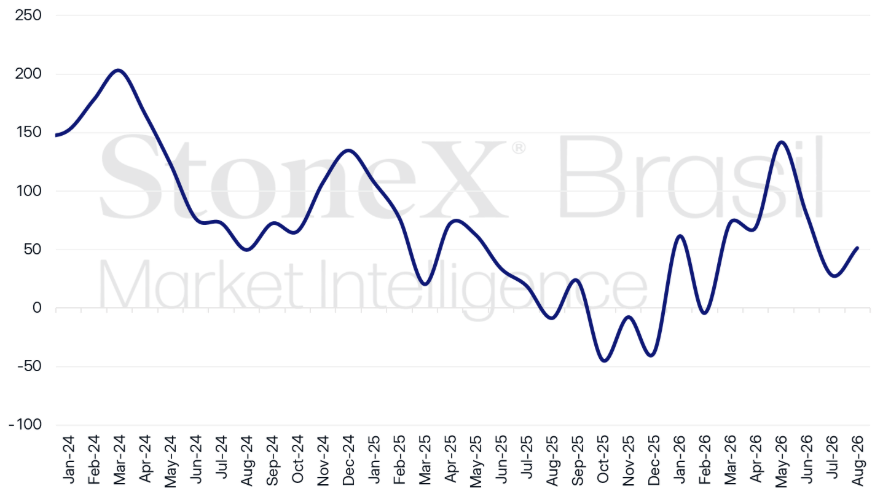
Source: U.S. Bureau of Labor Statistics (BLS), Federal Reserve Bank of St. Louis. Design: StoneX.
Slower rate hikes: In practice, these indicators do not fundamentally change the Federal Reserve’s risk balance, which includes a heated productive activity, a resilient and healthy labor market, and persistent inflation.
- However, by showing milder numbers for employment and inflation, these data suggest there is no urgency for the Fed to make financial conditions more restrictive.
- This impression was reinforced by statements from Federal Reserve members, such as Vice Chair Phillip Jefferson and New York Fed President John Williams, who advocated for a pause in October to gather more information about the economic context before deciding on future hikes.
- As such, investors still anticipate an interest rate hike cycle, but at a slower pace and with a slightly smaller magnitude.
Purchasing Managers’ Index (PMI): Additionally, investors are expected to monitor the services sector PMI, released by the ISM Institute, which should provide clues about the level of activity in the main sector of the U.S. economy.
- Projections point to a reading of 55.7, an increase from 55.4 recorded in the previous month.
- This, in turn, would represent an acceleration in the services sector, suggesting economic resilience and room for further rate hikes.
Inflation in Brazil
Expected impact on the USDBRL: bearish
Brazil: Historical and expected interest rates – Focus bulletin as of September 25, 2026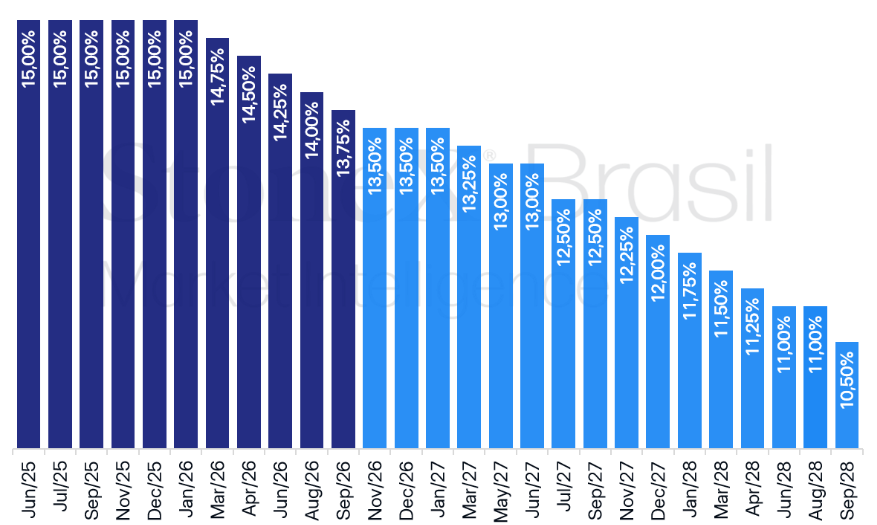
Source: Central Bank of Brazil. Design: StoneX.
On the domestic agenda, investors are expected to react to September’s reading of the Broad National Consumer Price Index (IPCA), which should influence investor expectations for the trajectory of Brazil’s basic interest rate (Selic).
- The median estimate from the latest Focus bulletin indicates that the IPCA will move from -0.32% in August to 0.52% in September, driven by rising food and electricity prices.
- If this projection is confirmed, the 12-month accumulated increase would rise from 4.22% to 4.26%, keeping the indicator within the target tolerance range.
Why is this important: A stronger IPCA reading is likely to heighten concerns about the domestic inflationary scenario, reducing the odds of further Selic rate cuts.
- This, in turn, tends to increase yields on national government bonds and the interest rate differential relative to abroad, strengthening the real.
Open next steps: In its latest interest rate decision, Brazil’s Monetary Policy Committee (Copom) acknowledged a scenario of high uncertainty, reinforcing a cautious tone for future steps without committing to any specific actions.
- The Copom maintained its assessment of an upward asymmetry for inflation risks (i.e., a greater risk of faster inflation rather than slower) and warned about the misalignment of investor inflation expectations relative to the target for 2027 and 2028.
- The Committee also raised its own inflation projections for 2026 and 2027, signaling that the inflationary scenario remains challenging, although it kept its inflation estimate for the first quarter of 2028 unchanged.
- On the other hand, the Copom highlighted a moderation in Brazil’s economy and included an analysis paragraph about the slowdown in bank credit, indicating that the current interest rate level is restricting economic activity and demand.
- This reinforces the Committee’s neutral tone – while a challenging inflation scenario would require higher interest rates to restore price stability, slower growth would require lower rates to stimulate economic activity.

ECONOMIC INDICATORS
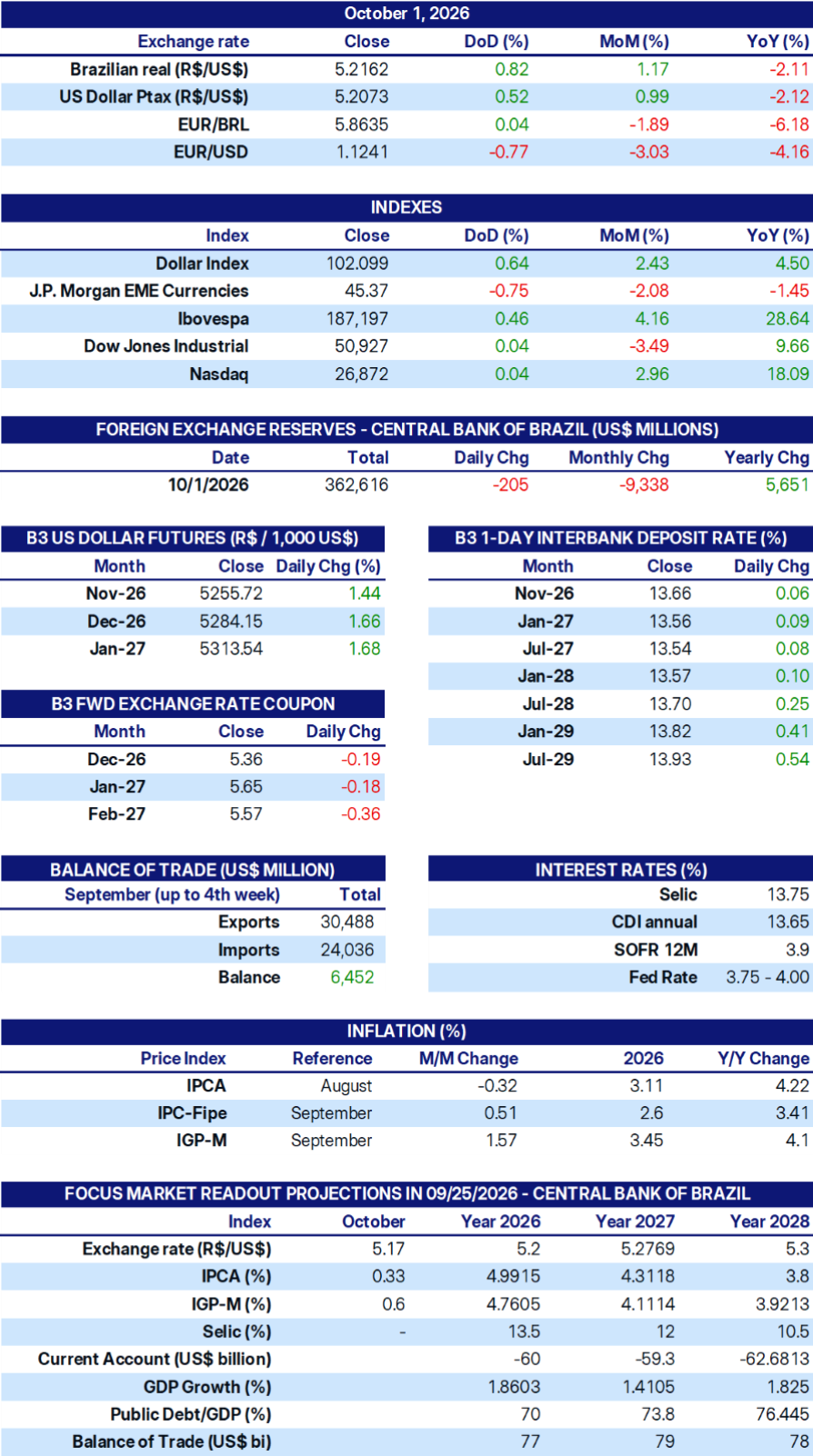
Sources: Central Bank of Brazil; B3; IBGE; Fipe; FGV; MDIC; IPEA and StoneX cmdtyView.