Foreign Scenario
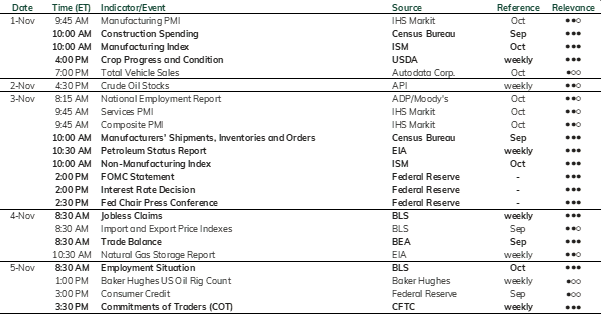
This week's focus will be the November meeting of the Fed’s Federal Open Market Committee (FOMC). Currently, the Central Bank buys monthly USD 120 billion securities from market agents, USD 80 billion in US Treasury and USD 40 billion in mortgage-backed securities. Although it has only indicated that a reduction will begin “soon”, many analysts believe that the Fed should start this cut from Wednesday’s monetary policy meeting, tapering Treasury purchases by USD 10 billion and mortgage-backed securities purchases by USD 5 billion. As such, the asset purchase program would be ended in June of next year. There is a heated debate about global inflationary acceleration, namely whether it is due to more temporary or longer-lasting factors. Last week, European Central Bank President Christine Lagarde argued that the rise of price levels in the European Union is due to transitional causes when justifying the decision not to change the bloc’s monetary policy. It will be interesting to observe how the Fed will address the issue, as well as whether it will mention the discussion among its members about when the Central Bank’s interest rates should be readjusted and at what rate. The outlined scenario is one of inflationary acceleration that persists for at least a few months in 2022, along with a sustained improvement in the labor market, which could underpin the decision to raise interest at the end of 2022.
One of the highlights of this week’s agenda will be the employment situation report in the United States. After the September report was a disappointment with only 194,000 jobs being created, the median expectations of analysts point to a net creation of 413,000 new jobs in October. Moreover, the publication of the PMI and ISM indices is expected to suggest that both industrial and services economic activity was strong for the month, despite restrictions in the supply chain. The meeting of oil exporting countries (OPEC) is also noteworthy, since international prices are at their highest level for the year. However, analysts point out that the OPEC should not change its production rate established in May, continuing to pressure the commodity’s price in the near future.
Domestic Scenario
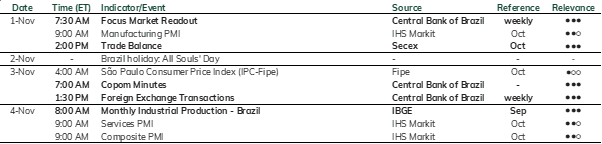
Tax risks remain a central theme of the domestic environment influencing the exchange rate. Last week, Chamber of Deputies Speaker Arthur Lira (PP-AL) faced resistance from other parties’ leaders and failed to get support for the Proposed Amendment to the Constitution of Precatories (PEC 23/21) to be voted on, at the risk of losing the vote. Precatories are Federal Government debts that the Federal Court has already recognized and for which there is no possibility of appeal. PEC 23/21 proposes extending the payment of a substantial portion of government debts and changing the calculation period of the constitutional spending limit correction, both raising the government’s spending capacity.
According to estimates released by the Ministry of Economy on Friday (29), PEC 23/21 adds BRL 91.6 billion to the 2022 budget, with BRL 47 billion coming from the change in the spending cap calculation and BRL 44.6 billion from postponed government debts. According to the Ministry, of the BRL 91.6 billion, the Executive intends to allocate: (i) R$ 50 billion to temporarily increase the average benefit of the Auxílio Brazil assistance program (which will replace the Bolsa Família) from BRL 191 to BRL 400 until December 2022, the year of election; (ii) BRL 24 billion to automatic readjustments of social security benefits by minimum wage inflation; (iii) BRL 10 billion for “compulsory spending and society demands”, according to the “Congress’ decision”; and (iv) BRL 6 billion to states and municipalities. Finally, the Ministry of Economics’ estimates show that PEC 23/21 would raise the primary deficit by 0.9 p.p. of GDP (from -0.5% to -1.4%) and raise general government gross debt by 1.0 p.p. of GDP (from 80% to 81%) in 2022.
The government’s panic to increase temporary social spending in the election year shows that it already seeks alternatives if the precatories PEC fails, even if it needs formally to disregard the constitutional spending cap. Minister of Citizenship João Roma said last Thursday (28) that the government will have operational difficulties to pay the Auxílio Brasil’s basic value of BRL 400 per month if the vote on the precatories PEC is not finalized by the second week of November. According to Roma, the Executive seeks “to raise Parliament awareness” of the need for a speedy proposal process. Chief of Staff Cyrus Nogueira told parliamentarians that the government could extend emergency aid to combat the pandemic if the precatories PEC is not quickly approved by the National Congress. According to Nogueira, the benefit’s value would be BRL 400 and its extension would be financed with extraordinary credit or with a decree of state of calamity. That is, its financing would be outside the spending cap. The government’s leader in the Chamber of Deputies, Ricardo Barros (PP-PR), confirmed that, if the PEC is not approved in time, the government intends to extend emergency aid outside the spending cap, i.e., without being calculated within the constitutional limit of public sector spending. “If there is no Auxílio Brasil, there will be emergency aid. The government will not fail to pay aid to the poor”, said Barros. “If it is not the BRL 30 billion [resources needed to afford the BRL 400 to current Bolsa Família beneficiaries in 2022], it will be BRL 80 billion of emergency assistance outside the cap,” said Barros. However, according to him, emergency aid would be extended in the same way as it is today: BRL 300 to 34.4 million people.
Roughly speaking, there are two principles that regulate public spending in the country, namely the Fiscal Responsibility Law (LRF) and the constitutional expenses limit (the spending cap). The LRF requires that any expense indicate a revenue that finances it (or an expense that will no longer be executed), except for temporary expenses. Since the government proposes a temporary increase until December 2022, there is no contest to the LRF. As for the spending cap, it imposes that all government expenditure should comply with a ceiling, which is corrected annually by inflation, that is, there is no real growth. In order for an expense to fall outside the constitutional expenses limit, there are two alternatives: (i) finance it by extraordinary credit; or (ii) use a Proposed Amendment to the Constitution (PEC), with which government leaders are experiencing difficulties. To use extraordinary credit, the government will need to argue that the current situation meets the requirements of relevance, urgency, and unpredictability. Therefore, there is a risk that this alternative would be taken into court, especially in relation to the question of unpredictability. Cyrus Nogueira’s alternative of decreeing a state of public calamity would also allow the government to finance spending beyond the constitutional expenses limit, but there is a risk of being questioned in court, depending on how such a calamity would be categorized.
Finally, it is important to point out that these improvised arrangements in defining the country’s fiscal policy create insecurity for market agents, who may require higher premium risks to invest in the country, which would negatively impact demand for the national currency. Due to the lower confidence in the government’s fiscal responsibility for 2022, the Monetary Policy Committee needed to speed up the pace of monetary tightening and last Wednesday (27) it adjusted the basic interest rate (Selic) by 1.5 p.p. from 6.25% to 7.75% per annum. This is the highest interest rate increase since December 2002, when the Selic was adjusted from 22% to 25% p.a. In its statement, the Central Bank also indicated that it foresees another increase of equal magnitude at the next Committee meeting on December 7 and 8, because, according to the members, the current scenario reflects a higher than usual balance of variance risks for inflation, which in turn requires more forceful readjustments in interest rates.