FX Weekly Overview : Key Events of the Week
- Bearish drivers
- Donald Trump's softer stance on the imposition of import tariffs should favor the performance of risky assets such as commodities and emerging market currencies including the BRL.
- Copom is expected to raise the benchmark Selic rate by 1.0 p.p., reinforcing the prospect of higher interest rates for longer in Brazil, which should help attract foreign investment and strengthen the BRL.
- Bullish drivers
- The FOMC's rate decision should reinforce the perception that the Federal Reserve will be cautious in its rate cutting cycle, which favors the profitability of dollar-denominated bonds and contributes to the global strengthening of the currency.
- The European Central Bank is expected to cut its interest rate by 0.25 percentage point, which will tend to weaken the euro and indirectly contribute to the global strengthening of the currency.
The week in review
The week was marked by a global weakening of the US currency after the new US president, Donald Trump, took a less aggressive stance than expected on the application of import tariffs against other countries, which favored the performance of risky assets such as commodities and currencies of emerging countries.
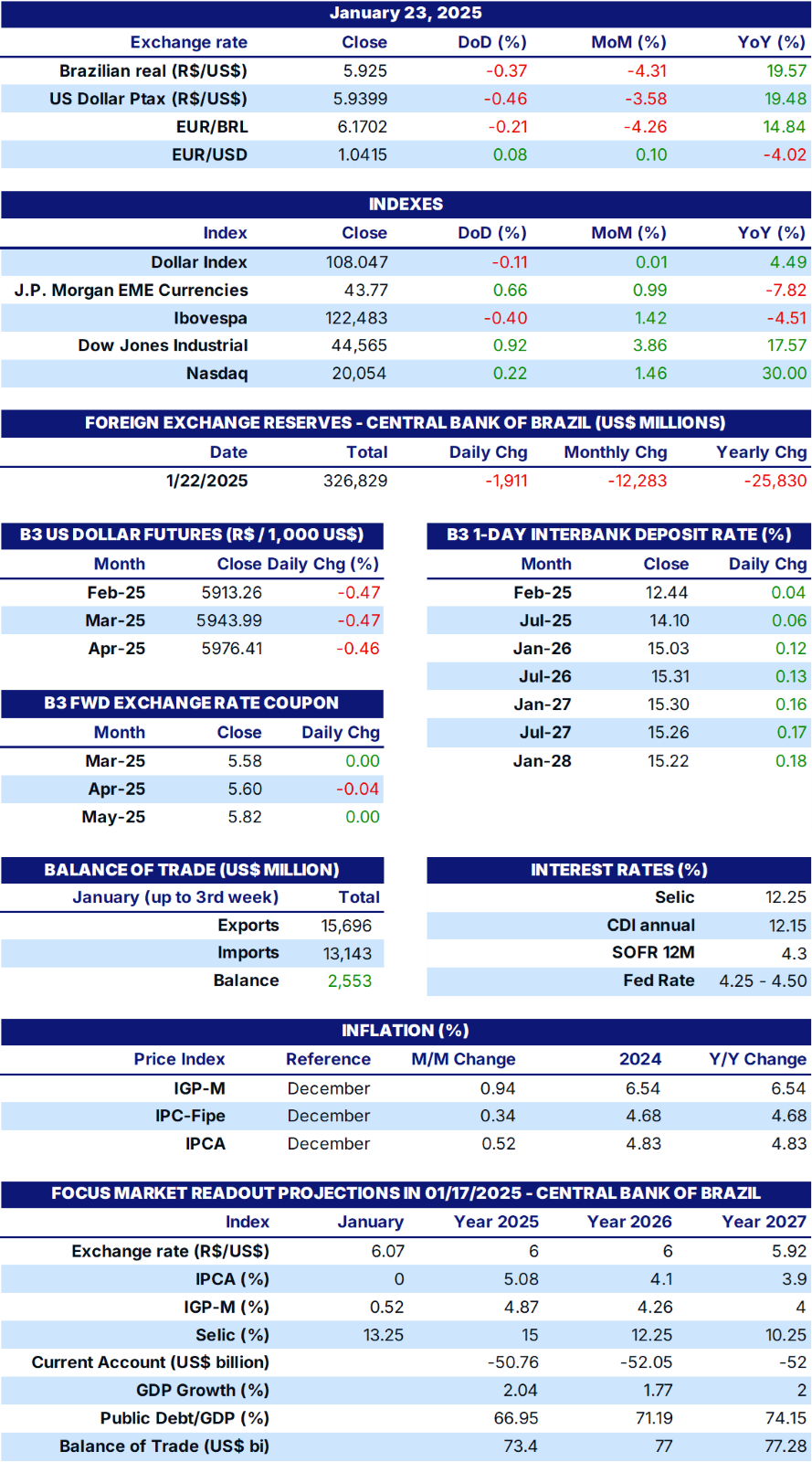
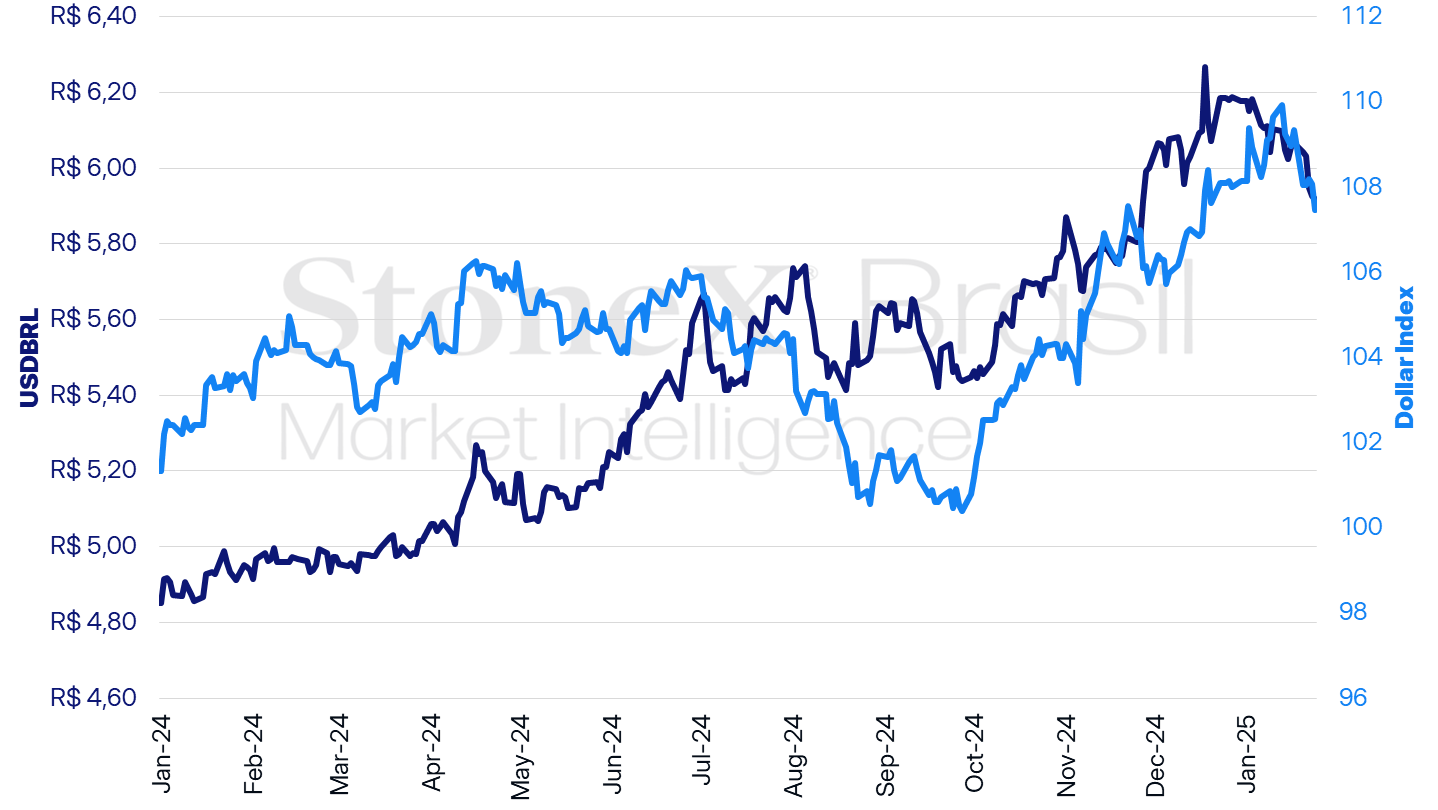
The dollar's interbank market value closed at BRL 5.9182 on Friday, marking a 2.4% decline for the week, 4.2% for the month, and 4.2% for the year. The dollar index closed Friday's trading session at 107.4 points, down 1.7% for the week, 0.6% for the month, and 0.6% for the year.
USDBRL and Dollar Index (points)
Source: StoneX cmdtyView. Design: StoneX.
KEY EVENT: FOMC monetary policy decision
Expected Impact on USDBRL: Bullish
On Wednesday (29), the Federal Open Market Committee (FOMC) of the Federal Reserve (Fed) is expected to maintain the current range of the basic interest rate, keeping it between 4.25% and 4.50% p.a., thus pausing the sequence of rate reductions that began with the September decision. This pause is indicative of a scenario where economic data has strengthened, there are lower risks of a sudden weakening of the job market, and inflation is stabilized at a level far from the Fed's target of 2% per year.Given the high probability of interest rates remaining unchanged, investors should focus their attention on the Committee's statement and the press conference by its chairman, Jerome Powell, for indications as to the future path of interest rates. The FOMC is expected to affirm its ability to adopt a patient and cautious approach in conducting monetary policy, given the slowing pace of inflation relative to target and the resilience of economic activity. The FOMC is expected to resume interest rate cuts only after gaining greater confidence that inflation continues to stabilize. It is noteworthy that the median of the projections for the core Personal Consumption Expenditure Price Index (PCE) for December, excluding the volatile food and energy components, is expected to show another moderate increase on Friday (31). As the PCE is used by the Fed to verify its inflation target, the December figures should help to partially reduce concerns that US inflation is resilient and persistent.
In addition, the expectation of an inflationary impact from the possible economic policies of Donald Trump's administration should also reinforce the FOMC's cautious stance, although the Committee should mention that these possible measures will not affect monetary policy decisions until there are more concrete details about their content and timing. At the press conference following the latest decision, Fed Chairman Jerome Powell noted that members of the Federal Reserve have already begun to assess the potential impact of these proposals, such as tariff increases, tax cuts and changes to immigration policy. Trump's recent statements regarding his desire to lower interest rates could also add to the scenario of uncertainty, although the president does not have the autonomy to interfere in the decision and Powell has already addressed the Federal Reserve's autonomy in similar situations in the past. In this way, the FOMC's decision is likely to reinforce investors' perception that the Federal Reserve should slowly reduce its interest rate, which could push up US Treasury yields and strengthen the dollar globally.
US: Interest Rate History and Expectations - January 24, 2025
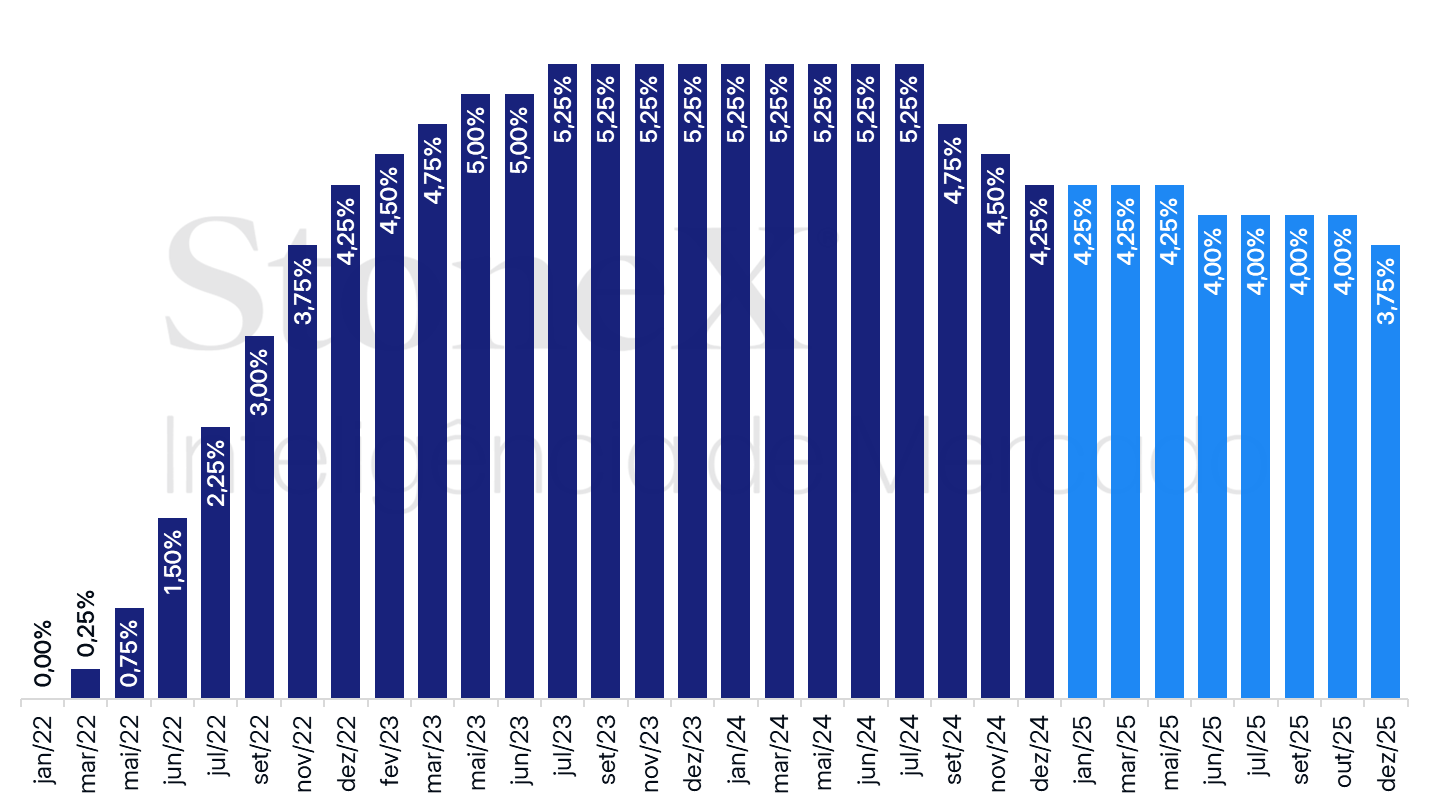
Source: CME FedWatch tool. Design: StoneX. Refers to the most likely bet in the interest rate futures market on the date indicated.
Reversal of the "Trump Trade"
Expected Impact on USDBRL: Bearish
The dollar weakened across the board last week, falling to its lowest level since December 18, after President-elect Donald Trump surprised most investors with a softer stance on US trade policy. As one of his key campaign promises, there were fears that Trump would raise import taxes on his first day in office. However, the president has chosen to threaten the imposition of these surcharges without ordering any immediate action, giving the impression that they are being used as a negotiating tactic with other global economies.
Trump's first week in office also increased the level of volatility and uncertainty in financial markets, as investors remained on tenterhooks waiting for more concrete signs of US economic policy. While the US President has at times mentioned the possibility of imposing a 25% surcharge on products from Mexico and Canada and a 10% surcharge on Chinese products, he has also said that he would "prefer not to impose" tariffs on China and that a trade agreement could be reached between the world's two largest economies. Of course, Trump can still raise import taxes, and it is possible that this will happen in the coming months, which would have some inflationary effects and may require a more hawkish stance from the Federal Reserve. However, the lack of concrete measures in these first days should continue to improve the appetite for risky assets and favor the performance of commodities and emerging market currencies.
Copom's interest rate decision
Expected Impact on USDBRL: Bearish
The Central Bank's Monetary Policy Committee (Copom) is expected to raise the benchmark interest rate (Selic) from 12.25% p.a. to 13.25% p.a. in its decision on Wednesday (29), as signaled in December. While in that decision the committee pointed out that the two more intense rate hikes were justified by the worsening of the future inflation scenario, which is "less uncertain and more unfavorable" and with "bullish asymmetry" after the "materialization of inflationary risks", this scenario seems to have worsened even more since the last decision, with an intense depreciation of the exchange rate, a continuous rise in inflationary expectations and a serious crisis of credibility of Brazil's fiscal policy among investors. The announcement of the decision should again be firm in relation to the inflationary risks facing Brazil and reinforce the prospect of a rapid rise in the Selic rate. In addition, investors will be looking for a change in the forward guidance, which was two consecutive 1.00 p.p. hikes at the last meeting. The prospect of higher policy rates for a longer period of time raises expectations for domestic bond yields, which may encourage the entry of foreign investment and contribute to the appreciation of the BRL.
ECB interest rate decision
Expected Impact on USDBRL: Bullish
The European Central Bank (ECB) is expected to cut its key interest rate from 3.00% p.a. to 2.75% p.a. amid a noticeable slowdown in economic growth. Investors will be looking for comments from ECB President Christine Lagarde on expectations for US economic policy and how this could affect the European macroeconomic scenario. A possible increase in US import taxes on the European Union is likely to further damage the performance of the single currency bloc, widening the contrast with US growth and reducing the attractiveness of European assets, which tends to strengthen the dollar globally.

ECONOMIC INDICATORS