Foreign Scenario
The American currency completed a sequence of six consecutive sessions lower last Friday (6), reflecting the most recent speech by the Federal Reserve (Fed) Chair Jerome Powel and the negative surprise with the American labor market data for August. According to the Employment Situation Report, published by the Bureau of Labor Statistics (BLS), 235,000 jobs were created last month, a number that was considerably below the median of analysts' expectations, which pointed to a hiring balance close to 750,000.
The lower-than-expected indicators are largely associated with the resurgence of Covid-19 cases due to the delta variant and the re-adoption of social distancing measures in some states. The impact of the new wave of the disease led to the stability in jobs creation, especially in the leisure and hospitality sector, which had been the engine of the recent recovery in employment levels, and by the registration of a higher number of layoffs in August in certain activities. Bars and restaurants (-42,000 jobs), hotels (-34,600) and retail (-29,000) recorded net layoffs last month. The highlights were manufacturing, professional services, transportation, and education, among the areas that added jobs.
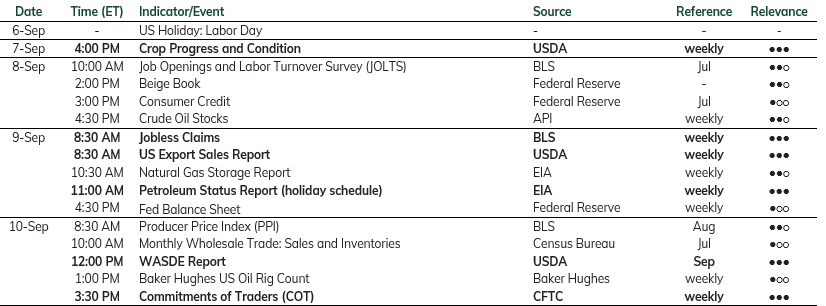
Over the next few days, the release of lower-impact economic data is expected for the American economy, such as the Job Openings and Labor Turnover Survey (JOLTS) for July, on Wednesday (8). In addition, the first-time claims for unemployment benefits, for the period ending September 4, in addition to the Producer Price Index (PPI) for August. However, despite providing additional details to the labor market outlook and the consumer inflation outlook in the United States, central themes for monetary policy, the indicators schedule may take a back seat due to the speeches by members of the Federal Open Market Committee (FOMC) scheduled for this week.
Next Saturday (11), the blackout period that will precede the Fed's meeting on September 21 and 22 begins, during which members of the Committee are not allowed to make public statements. Thus, this week should offer the last windows into the monetary authority's decision-making process with the speeches of John Williams of the New York Fed, Robert Kaplan of the Dallas Fed, Mary Daly of the San Francisco Fed, and Loretta Mester of the Cleveland Fed.
As previously noted, it is possible that the Fed's vice chairman, Richard Clarida, will make a statement next Friday (10), updating the market on his reading of the American monetary policy and its next steps. In addition to marking the first decision since the Jackson Hole symposium, when Powell suggested announcing the beginning of tapering, the meeting on September 21 and 22 will be symbolic due to the publication of the Fed's dot plot and quarterly projections for important macroeconomic variables. For example, the recent surge in Covid-19 new cases and deaths in the United States and its effects on economic normalization and recovery should be captured by the monetary authority's estimates for GDP growth, unemployment rate reduction, and price level developments possibly resulting in an easing of these numbers.
Still, regarding the pace of global economic recovery, the confirmation of a slowdown in trade flows from China may also be a factor of attention for assets and currencies of emerging economies in the coming days. In the early hours of Tuesday (7), the country's export and import data will be released, for which a weaker performance than the one recorded in July is already expected due to the interruption of activities and logistical problems caused by regional outbreaks of Covid-19 associated with the delta variant in the country. After growing 19.3% in July, compared to the same month last year, the median of expectations suggests a 17.1% increase in August. For imports, the projections are for an annual increase of 26.8% in August, down from the 28.1% rate recorded in July.
Last week, the manufacturing PMI had already revealed a slight deterioration in business conditions in China, with the indicator measured by IHS Markit/Caixin dropping to 49.2 points in August from 50.3 points in July. This was the first time the indicator was below 50 points, the threshold separating contraction and expansion, since April 2020, when the Chinese economy was already showing signs of recovery after the initial impacts of the pandemic, which affected the country in the first months of the year.
The recent increase in Covid-19 cases, following outbreaks of the delta variant on Chinese territory, especially in major cargo terminals, put pressure on industrial production due to the bottlenecks registered by the supply chains for inputs and components. The impacts on port activities also hampered the flow of products from Chinese industry, resulting in increases in inventories of finished goods and delays in export logistics.
Similarly, the resurgence of Covid-19 in China impacted the demand for intermediate and final goods, as social distancing measures had to be reinstated and activities suspended to contain the spread of the virus in some regions. Furthermore, besides the difficulties in receiving cargo, the slowdown in industrial production in August is also a negative factor for imports growth.
Domestic Scenario
Signs of economic cooling, presented by the release of the Quarterly National Accounts by the Brazilian Institute of Geography and Statistics (IBGE) last week, uncertainties in the political and fiscal fields, and the prospect of accelerated inflation given the higher electricity tariffs and the water crisis, resulted in adjustments in the projections of financial institutions polled by the Focus Survey of the Central Bank.
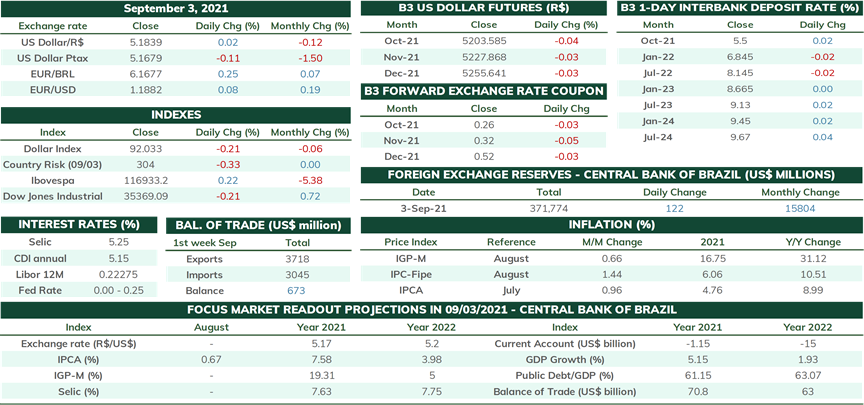
The most recent data, released last Friday, showed a considerable increase in the Extended National Consumer Price Index (IPCA) estimate, which rose from 0.60% to 0.67% in August and from 0.50% to 0.61% in September. With these revisions, the projection for the index at the end of the year jumped from 7.27% a week ago to 7.58%, 0.7 p.p. above the median estimated four weeks ago. In addition, the change from the level 2 red flag to the water scarcity tariff flag, which came into force on September 1, meant a 49.6% increase in the electricity surcharge, which went from BRL 9.49 per 100 kWh to BRL 14.20. Besides the direct effect on consumers' pockets, the rise in electricity prices will also impact the production costs of countless goods and services, with indirect effects on a large part of the market basket.
Until last week, the median of expectations for the Selic rate indicated an increase of 100 basis points in September to 6.25%, and smaller adjustments of 75 basis points in October and 50 basis points in December. However, with prospects for inflation at the end of 2022 exceeding the 3.50% target, currently at 3.98%, it has become more likely that the Central Bank of Brazil will opt for more intense adjustments to the basic rate in the short term. According to the most recent Focus Bulletin, the market is already betting on another 100 basis point hike in October and an increase of more than 50 basis points in December's monetary policy decision.
Given the risks imposed by the water crisis, the more rapid monetary contraction and the tone of uncertainty in the political, institutional and economic spheres, the median of projections for Brazilian GDP growth was also revised downwards, dropping from 5.22% a week ago to 5.15% in 2021 and from 2.00% to 1.93% in 2022. In addition, the outlook also incorporated the unexpected contraction of 0.1% of the Brazilian economy in the second quarter, announced by the IBGE last week.
Throughout the week, attention should turn to the unfolding of the pro-government protests scheduled for this Tuesday, which will serve as a thermometer for the risks of deepening tensions between the Executive and Judiciary branches and the radicalization of Jair Bolsonaro's discourse. Over the weekend, the president called on military police officers to participate in acts in Brasília, and São Paulo spoke again of a tendency towards institutional "rupture" and accused Ministers Luís Roberto Barroso and Alexandre de Moraes of acting unconstitutionally.
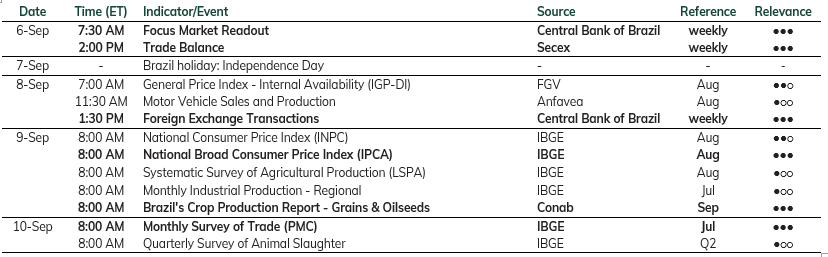
The highlights of the week will be the release of the General Price Index - Internal Availability (IGP-DI) on Wednesday (8), the IPCA on Thursday (9) and the Monthly Survey of Trade on Friday.