Foreign scenario
In the United States, with the period of silence for the Federal Reserve authorities in effect, the focus should fall on economic data and the activity of the American Congress. Next week, the November Consumer Price Index (CPI) will be released, and it is expected to remain high, around the same level as in October – 0.9% acceleration for the consolidated index and 0.6% for the "core" index, which excludes the more volatile food and energy sectors. The increase in the price level shows no signs of cooling, which should lead the Federal Open Market Committee (FOMC) to reduce the stimulus to the American economy more quickly, i.e., to early terminate the Fed's asset purchase program and, possibly, anticipate the process of raising the institution's interest rate. In addition, the job openings and turnover survey for October will also be released, allowing a more contextualized reading for the employment situation in the country and the increases in workers' income. Finally, the University of Michigan will update its consumer sentiment index, which provides insight into consumers' inflationary expectations.
On Capitol Hill, Congress members will continue to work on a long list of demands that need to be finalized before the end of the year. This week, lawmakers passed a short-term measure that funds the government until February 18. However, a solution to the country's public debt limit still needs to be provided. The debt limit is a law established in 1917 that sets the maximum that the US Treasury Department can issue to pay its expenses. According to that Department, since 1960, Congress has on 79 occasions authorized raising or temporarily suspending the debt limit. The last debt limit increase happened in October of this year, which extended to mid-December. In testimony to the House Financial Services Committee, Treasury Secretary Janet Yellen warned US congress members that unless the debt limit is raised or suspended by October 15, the US will default for the first time in its history, meaning it will fail to honor its obligations to investors.
For a resolution raising or suspending the debt limit to take effect, it must be passed in the House, where Democrats have enough votes to pass the measure, and also in the Senate, where 60 votes are needed in an equally divided chamber of 50 Democratic and 50 Republican senators. Republican senators are currently refusing to support their Democratic colleagues as they seek to pass in the House a bill to expand public health care, childcare, housing, and renewable energy production called "Build Back Better," one of Biden's legislative priorities. The package would cost USD 1.75 trillion over ten years. Since there are no indications that ten Republican senators will support the resolution, that would force the Democrats to use budget "reconciliation," a bureaucratic maneuver, which takes one to two weeks to accomplish and could raise (but not suspend) the government's debt ceiling provisionally. Due to the deadline for avoiding a debt default, this would need to be accomplished in December.
Domestic scenario
Next week's agenda will be marked by the Monetary Policy Committee's (Copom) monetary policy decision and the National Broad Consumer Price Index (IPCA) release for November. In addition, after a week of important victories in the legislature, President Jair Bolsonaro, newly affiliated to the Liberal Party, should take the opportunity to publicize his achievements. Meanwhile, market analysts await further information regarding the new variant of the coronavirus, Omicron, while early preliminary information seems to rule out worst-case scenarios.
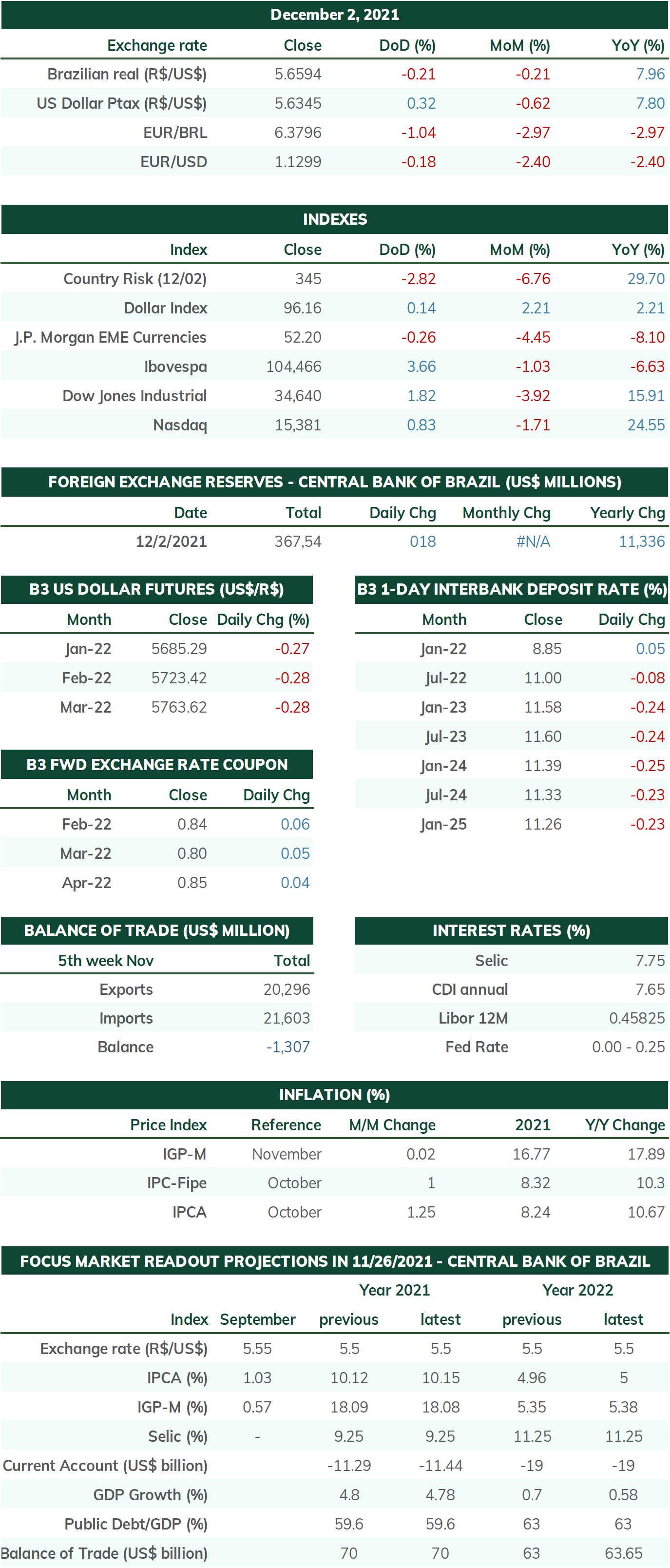
Next week, the Monetary Policy Committee will make its last monetary policy decision of the year. With the IPCA pointing to an increase of more than 10% in 2021, there is a debate about the appropriate degree of reduction of economic stimulus by the Central Bank of Brazil. The median of analysts' expectations points to an increase of 1.50 p.p. in the basic interest rate (Selic), from 7.75% per year to 9.25% per year, but some analysts bet on a 1.75 p.p. increase. In the last Focus report collected by the Central Bank, the median of the 135 financial institutions' estimates already pointed to a growth of 5.0% in the IPCA in 2022, the maximum acceptable margin within the target proposed by the monetary authority.
On the other hand, the Copom may avoid a much harsher monetary tightening due to the frustrating data for economic activity released this week, when the Brazilian Institute of Geography and Statistics (IBGE) reported that the Gross Domestic Product (GDP) fell 0.1% in the third quarter of this year after a 0.4% drop in the second quarter. Therefore, this means that the country is in recession – the technical term used when the GDP shrinks for a period of two or more quarters.
This week, President Jair Bolsonaro's government achieved an important legislative victory by approving two proposals central to its agenda. The ratification of the Provisional Measure that created the Auxílio Brasil program (MP 1061/2021) was approved with some changes compared to the text that the government sent to Congress. The text also removed the limit of 5 beneficiaries per family stipulated in the original provisional measure, included nursing mothers as possible beneficiaries, and increased the income limits for inclusion of eligible families from BRL 100 to BRL 105 as the extreme poverty and from BRL 200 to BRL 210 for the poverty threshold. With the new limits, Auxílio Brasil will serve 17 million families. However, unlike the text approved by the Chamber of Deputies, which determined the immediate entry of the beneficiary family as long as it met the program's criteria, without the possibility of a waiting list, the MP's rapporteur in the Senate, Roberto Rocha (PSDB-MA), included that the absence of a waiting list only occurs if there is a budget for it, i.e., if it is possible to "match the number of beneficiaries and financial benefits (...) with the available budget appropriations," which can open up loopholes for the creation of queues if the government argues it has no available budget. Furthermore, the measure desired by parliamentarians, which faced resistance from the government's economic team, was also approved without the automatic annual correction by the National Consumer Price Index (INPC).
In addition, the senators approved the proposed constitutional amendment of judiciary bonds (PEC 23/21). In short, the PEC allows the 2022 budget to be increased by BRL 106.1 billion by changing the period for calculating the inflationary correction of the constitutional limit on government spending and extending part of the Union's judicial debts with a final decision, called judiciary bonds. Effectively, the government stops honoring an obligation issued by the Justice and postpones it to the following fiscal year, corrected by interest, just like a debt default.
To ensure the text's approval, the government leader and proposal's rapporteur, Senator Fernando Bezerra Coelho (MDB-PE), incorporated several changes to the text, which now needs to be approved again in two rounds by the Chamber of Deputies. Among the most significant changes in the final version of the text, presented today to the senators, is the one that limits the term allowed for the "subceiling" of the judiciary bonds to 2026 instead of 2036, i.e., the government could only extend part of the judiciary bonds until 2026 and would need to pay its debts in full starting in the following year. In addition, it was incorporated into the text that the fiscal space opened up until 2026 by the postponement of the judiciary bonds will be linked to social spending. Finally, Bezerra Coelho highlighted the inclusion in the Constitution of a provision ensuring that "every Brazilian in a socially vulnerable situation will have the right to a basic income."
In this new version, the Independent Fiscal Institution (IFI) of the Federal Senate has estimated on Friday (03) that the total unpaid debts in judiciary bonds by the end of 2026 could reach from BRL 420 billion to BRL 744 billion, including the interest correction and the settlement outside the Fundef's judicial bonds spending cap. "As you can see...the contracted liabilities will tend to grow exponentially, even when the Fundef judicial bonds are paid outside the ceiling and the maximum limit (subceiling). The PEC's solution, in this sense, would not solve the issue of the increase in judiciary bonds", states the institution in its publication. According to the institution, the short-term gains from reducing expenses are quickly canceled out by the negative effects resulting from the change. "In addition to the increase in risk and interest, the legal uncertainty associated with this measure stands out," the document says.