Foreign scenario
Next year, despite the possibility of the emergence of more aggressive mutations of the coronavirus (Sars-CoV-2), the biggest concern seems to be the acceleration of prices, which is a global phenomenon caused mainly by supply shocks. Thus, limited input production capacity, reduced feedstock stocks, high freight costs and overloaded logistics chains, high prices of energy commodities such as oil and natural gas all contribute to cost inflation that simultaneously affects almost all countries.
As the months go by, however, these distortions tend to reduce, because there is a tendency for global demand to weaken, allowing an easier rebalancing between supply and demand. In addition, the period of greatest impact of the pandemic has passed, and governments are removing fiscal and monetary stimulus as their economies recover to pre-pandemic levels of economic activity. As a result, there is a reduction in aggregate demand. Also contributing to this decline is the likely reduction in Chinese economic growth over 2022, which depresses global expansion, contributes to restrained commodity prices, and thus helps stabilize prices.
The reduction in Chinese Gross Domestic Product (GDP) growth rates, in turn, has four main factors: (i) The crisis in the real estate sector is expected to deepen and thus reduce productive investments; (ii) A shift in demand from durable goods to the service sector in the core economies, with the process of reopening and normalization of productive activity, which should negatively influence Chinese exports; (iii) the “zero tolerance on Covid-19" strategy should be increasingly costly for China, in particular for personal consumption expenditures; and (iv) the prolonged closing of factories in 64 cities in light of the Winter Olympics in Beijing to produce a pollution-free sky during the games. Although the Chinese government is stimulating the recovery of its economy, its measures are only expected to take effect in the second half of the year.
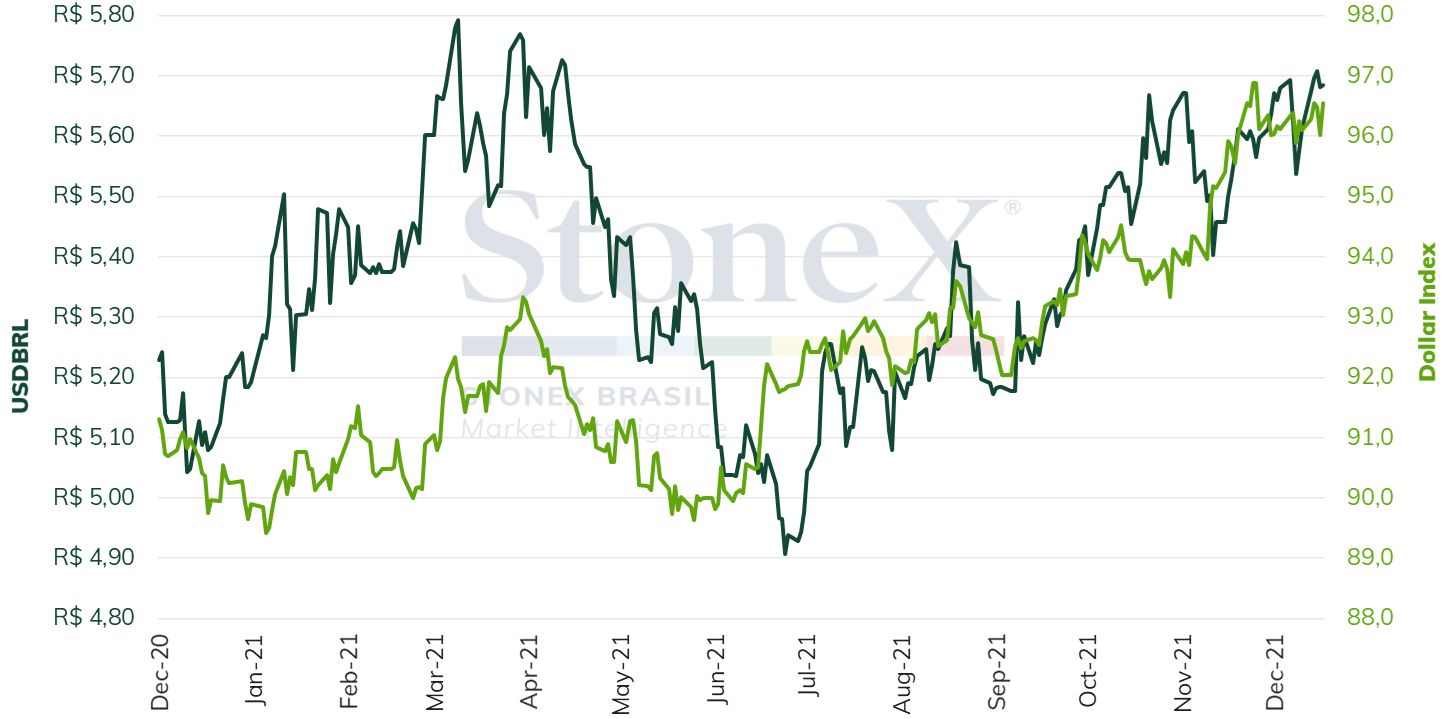
In the United States, the panorama is different because, besides the supply restrictions, a robust demand can make the rise in prices more persistent. The Federal Reserve (Fed) has already begun to rapidly reduce its monetary stimulus, scheduling the end of its asset purchase program for mid-March. The Federal Open Market Committee (FOMC) members mostly envision three interest rate hikes in 2022 to stabilize prices in the country. Considering that the European Central Bank thinks it is very unlikely that there will be interest rate increases in the European Union – on the contrary, the schedule is for a gentle reduction in monetary stimulus, without ending it – the most likely path for the dollar should be a strengthening one next year. If inflation rates in the US fall more quickly and the need for interest rate increases loses urgency, then there could be a weakening starting in the second half of the year.
Domestic scenario
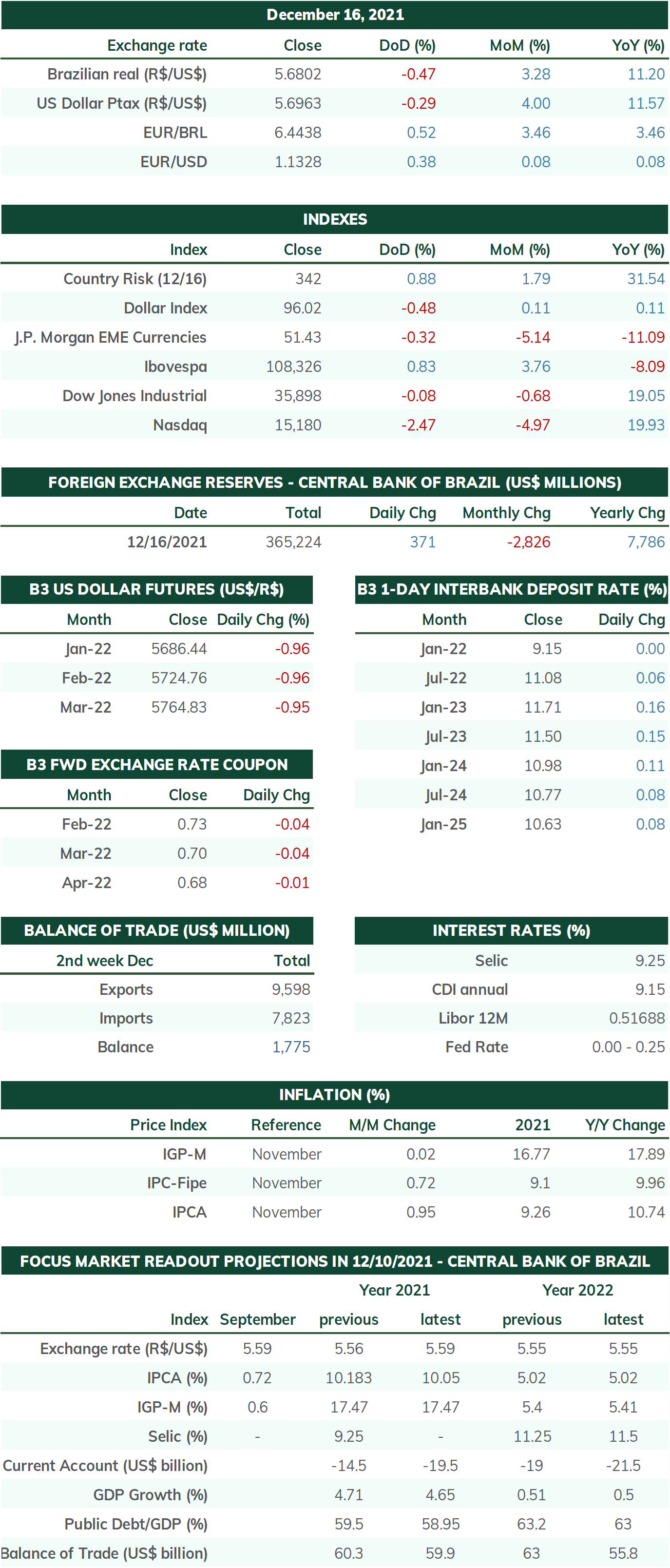
On the domestic front, 2022 should be a challenging year. Despite being a global phenomenon, price acceleration in Brazil has certain factors, such as rapid increases in fuel prices, a severe water crisis, which caused an increase in production costs of electricity and food, and the devalued exchange rate, which makes imported inputs, such as fertilizers, more expensive. As a result, inflation in the country is still accelerating, and it should take another month or two before it cools down. Current forecasts for 2022 already put the National Broad Consumer Price Index (IPCA) close to the maximum tolerance margin of the 2022 target – 5.0%. In a report released this week, the Central Bank (BC) estimates a 41% probability of exceeding the target.
Committed to resuming price stability, the Central Bank is readjusting the basic interest rate (Selic) in high doses, currently at 9.25% a year. The monetary authority has already detailed that the adjustment cycle will be long and that it is not yet possible to know what the interest rate will be at the end of the cycle. Despite the credibility the monetary authority inspires in the markets, these interest rate hikes reduce potential economic growth and compromise aggregate demand. Hence, the median of analysts' expectations for 2022 is a GDP expansion of only 0.5%. More than two-thirds of Brazil's population is already fully vaccinated, and the growth potential of the services sector is already close to exhaustion. In addition, the low Chinese economic growth mentioned in the previous section should contribute to the lower growth of Brazilian exports. There is also a certain risk of dropping the prices of the commodities most exported by Brazil, such as iron ore, soybeans and corn. Thus, the agribusiness growth potential may be somewhat reduced in 2022.
The labor market, in turn, is recovering. Still, most of the jobs created are concentrated in more precarious occupations with lower income potential, such as informal employees and the self-employed. Thus, today, the average income from work is 11% lower than a year ago, even though unemployment has been reduced from 14.9% to 12.6% in the period. The lower disposable income of the population limits internal demand and the capacity for growth in the coming year.
Finally, it is important to mention the possibility of fiscal and political uncertainties in 2022. Traditionally, presidential election years bring with them cautious and risk-averse behavior from agents, and there is the possibility that next year's elections will be polarized and troubled. Brazil has experienced several institutional crises and frictions this year that were not part of its everyday life until recently. Next year, if the elections give rise to an adverse political picture, the macroeconomic variables – particularly the exchange rate – may oscillate with intensity.