StoneX logo

FX Weekly Summary (Brazil Issue)

By: StoneX Intelligence Brazil, StoneX Intelligence Brazil

USDBRL drops for the fourth week in a row, closing at BRL 5.325
 
Vitor Andrioli
Leonardo Rossetti
Leonel Oliveira Mattos
Monetary policy decisions in Brazil, England and the European Union marked the week.
 
 
BULLISH FACTORS
  • Fed's Monetary Policy report should detail the degree of consensus on future interest rate hikes and may attract investments to the dollar;
  • High fiscal risk after two PECs were presented proposing the possibility of reducing or zeroing tax rates on fuel and other products, which may scare investors away;
  • Continued tensions between Russia and Ukraine tend to reduce the appetite for risks, damaging the currencies of emerging countries, such as Brazil.
 
BEARISH FACTORS
  • High foreign appetite for Brazilian assets is attracting resources, particularly to the Brazilian stock exchange;
  • Minutes of the Copom meeting can better inform the forecast for the trajectory of Selic interest rates, which could attract investors to Brazil;
  • Publication of the January IPCA may surprise positively, strengthening the real.
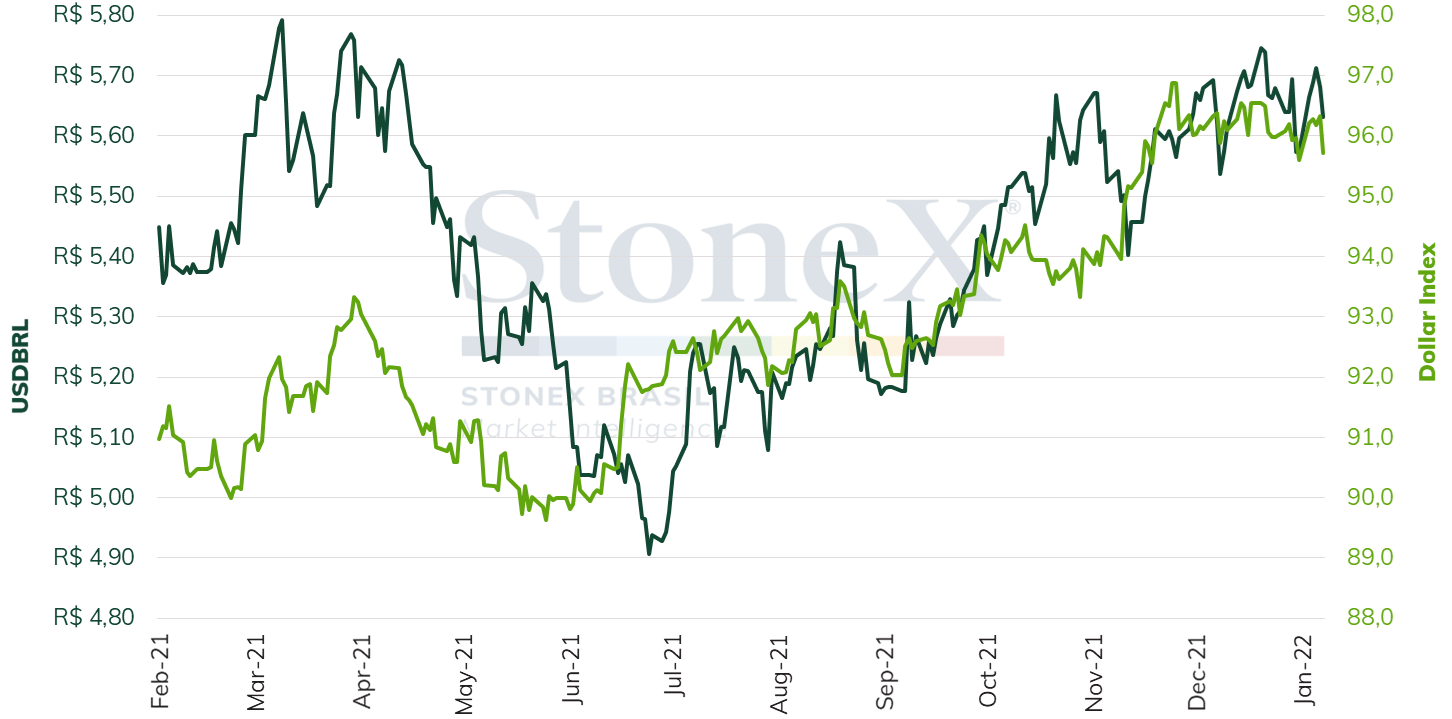
The exchange rate continued to depreciate for the fourth week and ended Friday's session (4) at BRL 5.325, a weekly variation of -1.2% and an annual of -4.5%. On the other hand, the dollar index ended the session at 95.4 points, a variation of 1.9% in the week and practically stable in the year. After a strong dollar rally in the previous week, this week was marked by a reversal just as abrupt due to the coordinated effort of several members of the Federal Reserve (Fed) to reduce the dispersion of estimates existing among market analysts. Also contributing to the depreciation of the American currency were monetary policy decisions by the British Central Bank, which raised its interest rate, and the European Central Bank, which kept its monetary instruments unchanged but adopted a discourse interpreted as firmer in the fight against inflation. In Brazil, a statement from the Monetary Policy Committee (Copom) signaling that it will reduce the pace of monetary tightening this year also led to a drop in the Brazilian real against the US currency, but not enough to offset its weekly gain.
USDBRL AND DOLLAR INDEX (POINTS)
image 28475
Source: CommodityNetwork Traders’ Pro. Design: StoneX.

Foreign scenario

This week, the focus will be on the Federal Reserve's monetary policy report on Friday. The document is sent every six months to the US Senate Banking Committee by the institution and details the Fed's view on the current economic and financial environment, the conduct of monetary policy by the US central bank and the institution's outlook for some key economic indicators, such as gross domestic product growth, unemployment and inflation rate developments and the evolution of the interest rate anticipated as appropriate for each year. The report should help reduce the current dispersion of estimates among market analysts about how the Fed should carry out the monetary tightening this year. Expectations range from three 0.25 percentage point interest rate hikes (e.g., Barclays) to seven hikes of the same magnitude (e.g., Bank of America), with most analysts anticipating four hikes.

Also noteworthy is the January Consumer Price Index (CPI) release next Thursday. In December, the accumulated indicator for 12 months accelerated to 7.1%, its highest since June 1982. With the hike in oil prices in the previous month, the possibility of an increase in the index is considerable, which should put pressure on the Fed to raise its interest rate at the next meeting in March and be more forceful in its monetary policy tightening this year.

Domestic Scenario

This week, the focus should be on the Central Bank of Brazil's Monetary Policy Committee (Copom) meeting minutes after the Committee surprised the market with a statement less rigorous than expected in the commitment to fight inflation. Despite the 1.5 percentage point increase in the basic interest rate (Selic), its eighth consecutive increase, from 9.25% per annum to 10.75% per annum, the monetary authority signaled that it foresees a reduction in the pace of monetary tightening for the next decision, without specifying what the next adjustment will be. In its communiqué, Copom emphasized that the cumulative effects will become apparent over the relevant horizon, suggesting that it should promote Selic hikes more gently but for a longer period. This strategy would be compatible with the convergence of inflation to the target "to a greater extent" in 2023, indicating that the Committee is not prone to abrupt readjustments to pursue the inflation target this year.

This stance had strong repercussions on the interest and currency markets. Future interest rates fell sharply, and bets that the Selic rate would close the year above 12.00% lost strength. Moreover, estimates for the monetary authority's next steps began to grow in amplitude: Regarding the March meeting in the digital options market, which measures the direct bets of the agents on Copom decisions, there is a concentration of bets on a 1.0 percentage point increase in the Selic; 16% possibility of a 0.75 p.p. adjustment; 10% chance of a 0.50 p.p. increase; and 7% probability of a 1.25 p.p. increase.

There is also greater dispersion as to the final level of the basic interest rate at the end of the monetary tightening cycle, with the scenarios that forecast a rate above 12.00% per annum losing strength.
Thus, the minutes of this week's meeting may bring important elements about the context of the decision and consolidate expectations around how the authority anticipates the next steps of monetary policy. Although warnings about risks and the need to observe the behavior of economic data are expected, greater clarity about the reference scenarios for the future is necessary to maintain the credibility of the institution and the good functioning of the markets.

Next week will bring important data for evaluating the economic situation, such as the volume of services and the level of retail sales in December. However, the most important data should be January's National Broad Consumer Price Index (IPCA). There are risks for both a higher and lower figure. On the one hand, January saw a significant rise in international oil prices, which led Petrobras to readjust fuel prices on January 11. In addition, the south of the country is going through a water crisis, which raises the prices of horticultural food products. On the other hand, the exchange rate appreciated 4.8% last month, which helps to reduce costs of imported inputs and may provide some relief to the price index.

Finally, it is worth noting the proposed constitutional amendment (PEC) filed this week that seeks to reduce the increase in items that most contribute to the recent acceleration of prices. On Thursday, deputy Christino Áureo (PP-RJ) filed a PEC at the Chamber of Deputies to allow the Union, States and Municipalities to reduce or zero the tax rates levied on fuel and cylinder gas in 2022 and 2023 to reduce their price without needing to comply with the Fiscal Responsibility Law (LRF), i.e., without the need to indicate another revenue or spending cut to offset the drop in tax collection. The Planalto Palace has discussed the proposal since at least January 20. The newspaper Valor Econômico revealed that the text filed by Áureo in Congress was written by the Deputy Chief of Public Finance (SAFIN) of the Civil House Ministry, Oliveira Alves Pereira Filho. As the proposal would directly benefit Bolsonaro, it could not be presented by the Executive this year due to the Electoral Law. Therefore, it would need to be presented by a congressman. According to calculations made by the Ministry of Economy - which is against the proposal -if approved, the amendment could cause losses of up to BRL 54 billion in federal tax revenues alone, not including municipal and federal entities. This amount is higher than the total public investments foreseen for 2022, of BRL 44 billion (the lowest value in the historical series).

On Friday, Senator Carlos Favaro (PSD-MT) filed another PEC, this time in the Senate, even broader, proposing to exonerate fuels, gas cylinders and electricity, create a diesel aid for truck drivers, subsidize low-income families to buy gas, and generate a transfer of federal funds for urban mobility for the elderly. Since all these measures would be carried out without fiscal compensation, the initial estimate is that the loss of federal revenue will be BRL 100 billion. According to press reports, the Ministry of Economy has dubbed Fávaro's version as the "PEC of fiscal irresponsibility" and "PEC kamikaze" (aimed at reducing fuel prices).
The constant changes in the budget and government priorities with a clear focus on the October election reduces the government's credibility and increases the financial risk, which can increase investors' risk premium requirements and weaken the Brazilian currency. In its last statement, Copom warned that "fiscal policies that imply an additional boost to aggregate demand or worsen the future fiscal path may negatively impact important asset prices and raise the country's risk premiums.



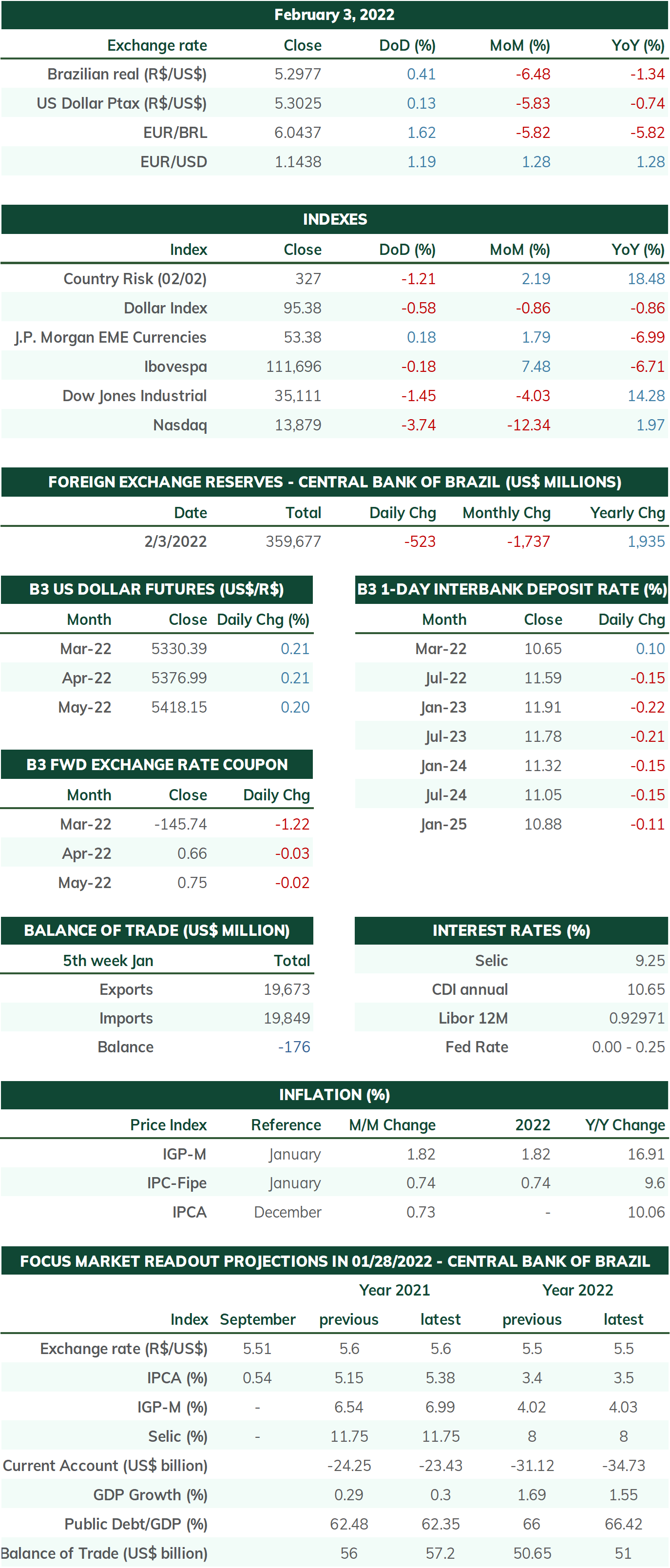
ECONOMIC INDICATORS
image 28476
Sources: Central Bank of Brazil; B3; IBGE; Fipe; FGV; MDIC; IPEA and CommodityNetwork Trader’s Pro.
 
  • Currencies

The StoneX Group Inc. group of companies provides financial services worldwide through its subsidiaries, including physical commodities, securities, exchange-traded and over-the-counter derivatives, risk management, global payments and foreign exchange products in accordance with applicable law in the jurisdictions where services are provided. References to over-the-counter (“OTC”) products or swaps are made on behalf of StoneX Markets LLC (“SXM”), a member of the National Futures Association (“NFA”) and provisionally registered with the U.S. Commodity Futures Trading Commission (“CFTC”) as a swap dealer. SXM’s products are designed only for individuals or firms who qualify under CFTC rules as an ‘Eligible Contract Participant’ (“ECP”) and who have been accepted as customers of SXM. StoneX Financial Inc. (“SFI”) is a member of FINRA/NFA/SIPC and registered with the MSRB. SFI is registered with the U.S. Securities and Exchange Commission (“SEC”) as a Broker-Dealer and with the CFTC as a Futures Commission Merchant and Commodity Trading Adviser. References to securities trading are made on behalf of the BD Division of SFI and are intended only for an audience of institutional clients as defined by FINRA Rule 4512(c). References to exchange-traded futures and options are made on behalf of the FCM Division of SFI . StoneX is a trading name of StoneX Financial Ltd (“SFL”). SFL is registered in England and Wales, Company No. 5616586. SFL is authorized and regulated by the Financial Conduct Authority [FRN 446717] to provide to professional and eligible customers including: arrangement, execution and, where required, clearing derivative transactions in exchange traded futures and options. SFL is also authorised to engage in the arrangement and execution of transactions in certain OTC products, certain securities trading, precious metals trading and payment services to eligible customers. SFL is authorised & regulated by the Financial Conduct Authority under the Payment Services Regulations 2017 for the provision of payment services. SFL is a category 1 ring-dealing member of the London Metal Exchange. In addition SFL also engages in other physically delivered commodities business and other general business activities which are unregulated and not required to be authorised by the Financial Conduct Authority. StoneX Group Inc. acts as agent for SFL in New York with respect to its payments services business. StoneX APAC Pte. Ltd. acts as agent for SFL in Singapore with respect to its payments services business. ‘StoneX’ is the trade name used by StoneX Group Inc. and all its associated entities and subsidiaries.
 
Trading swaps and over-the-counter derivatives, exchange-traded derivatives and options and securities involves substantial risk and is not suitable for all investors. Past performance of any futures or option is not indicative of future success. Indicators are not a trading system and are not published as a specific trade recommendation. The information herein is not a recommendation to trade nor investment research or an offer to buy or sell any derivative or security. It does not take into account your particular investment objectives, financial situation or needs and does not create a binding obligation on any of the StoneX group of companies to enter into any transaction with you. You are advised to perform an independent investigation of any transaction to determine whether any transaction is suitable for you. No part of this material may be copied, photocopied or duplicated in any form by any means or redistributed without the prior written consent of StoneX Group Inc.
 
© 2026 StoneX Group Inc. All Rights Reserved.

Satellite view of Earth at night showing illuminated cities across Asia and the Middle East

Discover more insights

Our subscribers have access to comprehensive market analysis from StoneX spanning commodities, equities, currencies and more.

StoneX: We open markets

Our market expertise, advanced platforms, global reach, culture of full transparency and commitment to our clients’ success all set us apart in the financial marketplace.

Reach

With access to 40+ derivatives exchanges, 180+ foreign exchange markets, nearly every global securities marketplace and numerous bilateral liquidity venues, StoneX’s digital network and deep relationships can take clients anywhere they want to go.

Transparency

As a publicly traded company meeting the highest standards of regulatory compliance in the markets we serve, our financials and track record are matters of public record. StoneX’s commitment to “doing the right thing over the easy thing” sets us apart in the industry and helps us build respect, client trust and new partnerships.

Expertise

From our proprietary Market Intelligence platform to “boots-on-the-ground” expertise from award-winning traders and professionals, we connect our clients directly to actionable insights they can use to make more informed decisions and achieve their goals in the global markets.