Foreign scenario
This week, the focus will be on the developments of Russia's military invasion of Ukraine and possible new economic sanctions on Moscow. On February 21, 2022, Russia recognized the two Ukrainian areas dominated by pro-Kremlin separatists within Donbas as independent, namely Luhansk and Donetsk. In a long televised speech, Putin harshly criticized Ukraine, stated that the nations of the West and especially the United States had broken their promises in the past by allowing, on five different occasions, NATO to expand into Eastern Europe and that the discourse of the Western nations was increasingly hostile and anti-Russian, with constant threats of economic sanctions. Finally, it declared that faced with "evidence" - so far non-existent - of a genocide of the Russian population in the breakaway territories, it needed to disregard the Minsk agreements and recognize the independence of these territories to protect them. Then, Moscow declared that it would send troops to the region to "guarantee peace." Finally, on February 24, 2022, the Russian president authorized what he called a "special military operation" aimed at the "demilitarization and denazification" of Ukraine. Although there are few details about Moscow's next steps, Ukrainian territory has been the target of air, ground, and naval attacks on several cities. Ukrainian President Volodymyr Zelensky broke diplomatic relations with Russia, declared martial law, closed the country's airspace, called for Western sanctions, and said his country would militarily repel the Russian advance. Faced with missiles and bullets, the West responded with words and sanctions. US President Joe Biden has said that Americans will not get involved in the conflict unless Russia attacks a North Atlantic Treaty Organization (NATO) country, excluding Ukraine. After consulting with the other G7 nations, Biden announced sanctions that fundamentally target Russia's financial sector, its ability to transact with the West, and freezing assets of 27 individuals in those nations. However, the absence of sanctions on Russia's energy sector, on which Europe is considerably dependent, and the permanence of the country's banks in the Swift international transaction system, a sanction that some analysts thought would be imposed.
The next steps in the conflict are uncertain. The European Union is dependent on Russian natural gas, and stocks are low, although they will probably be enough to secure supplies until the end of winter. For the moment, supply flows continue at normal volumes, but any reduction would impact industrial production and electricity costs on the European continent. There is also a risk of impacts on the supply of agricultural and metal commodities and additional difficulties and burdens on global supply chains. In addition, Ukraine has already closed its airspace and ports for commercial purposes. Further sanctions in the future may make it forbidden, or inadvisable, to use routes through Ukraine or Russia, forcing the use of alternative means longer, riskier, or both. Finally, the duration of the war itself will influence the impacts on financial markets.
In the United States, Federal Reserve (Fed) Chairman Jerome Powell will testify to the US House and Senate as part of his semiannual testimonies to Congress. Last week, several Fed officials persisted on the need to start interest rate increases in March, despite the tension, and conflict, between Russia and Ukraine.
Analysts believe that Powell will reinforce the message of the need for monetary tightening by highlighting the risks of inflationary pressure caused by the war in Eastern Europe. In addition, important data will be released for the US labor market in February, allowing us to read the continued dynamism of employment in the country, where the unemployment rate is at 4.0%.
Domestic Scenario
In a reduced workweek due to the Carnival holiday in Brazil, the highlight for Brazil will be the release of the Quarterly National Accounts next Friday (04). The median of analysts' expectations is for a Gross Domestic Product (GDP) growth of 0.1% in the last quarter of the year, after shrinking in the second (-0.6%) and third quarters (-0.1%). October showed largely negative results in terms of productive activity, with a downturn in industrial production (-0.5%), service volumes (-1.6%), and stability in retail sales. However, November and December saw a recovery, as can be seen, for example, in the Central Bank's Economic Activity Index (IBC-Br), which showed variations in October, November, and December of -0.1%, +0.5%, and +0.3%, respectively. For the annual variation, estimates are around 4.5%.
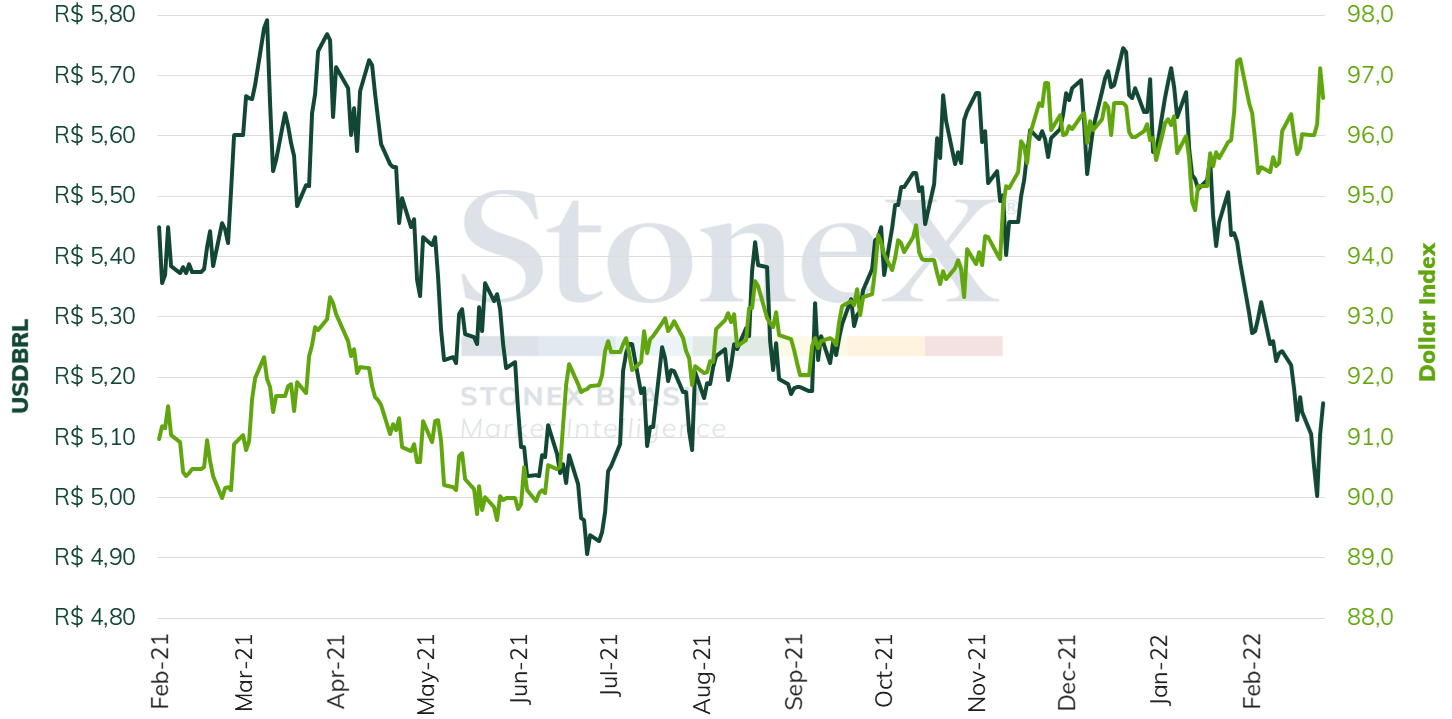
February was marked by a strong inflow of foreign capital into the country, and there was a reversal of this movement after Russia invaded Ukraine. Therefore, it will be very important to observe how foreign investments behave during the conflict since this was the determining factor for the exchange rate appreciation in February. Usually, military conflicts stimulate caution and risk aversion, which harms risky assets and emerging currencies, as is the case of BRL.
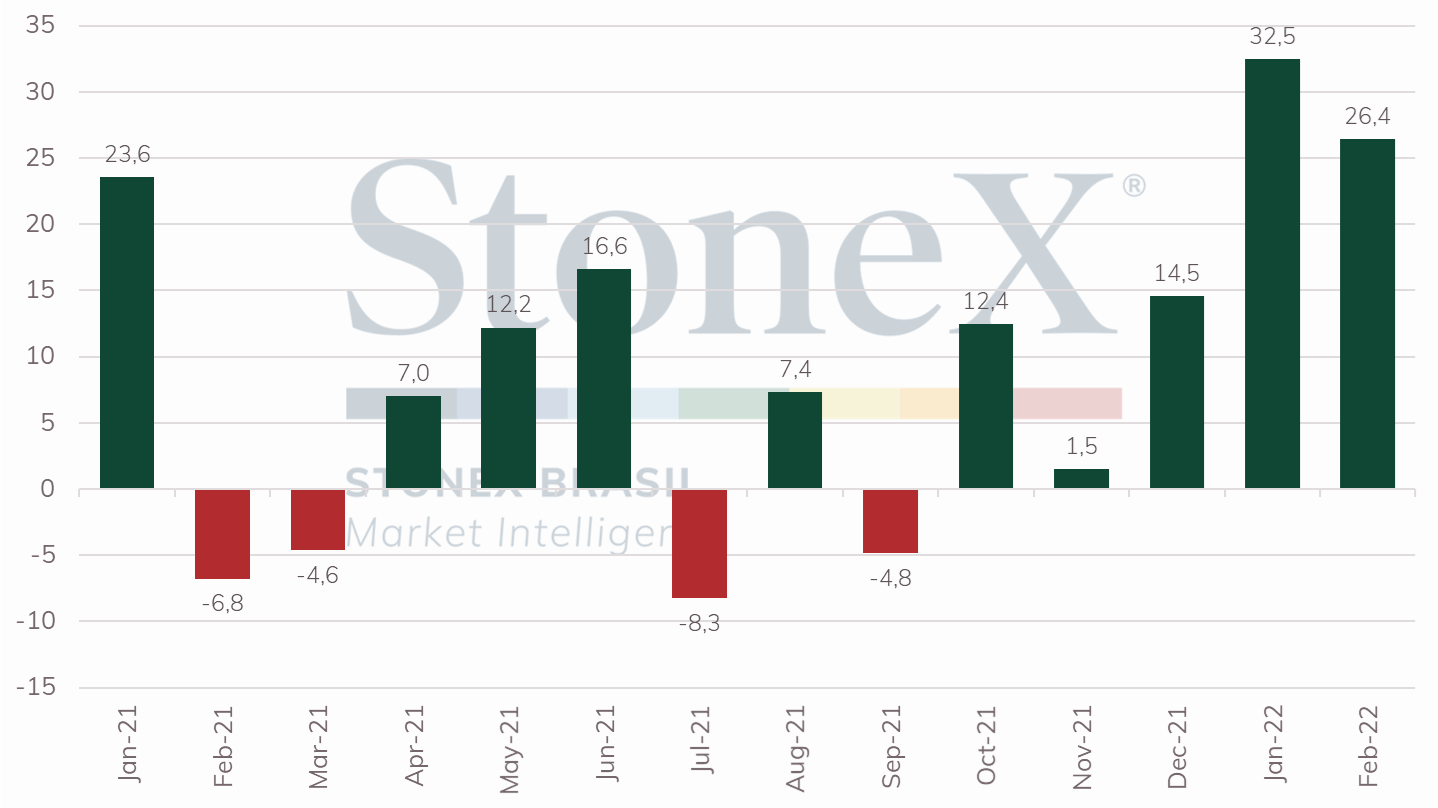
According to B3, in 2022, both January and February show a net inflow of foreign funds higher than any month in 2021, namely, a balance of BRL 32.491 billion in January and BRL 26.406 billion between February 1 and 23. Furthermore, a survey in last week's Valor Econômico newspaper shows that ten stocks account for 94.4% of the Ibovespa's appreciation in the year, nine of which belong to the mining sector (Vale), attractive due to the rise in iron ore prices, the oil and gas sector (Petrobras), attractive due to the rise in energy commodity prices, and the financial sector (Itaú Unibanco, B3, Banco do Brasil, Bradesco, Itaúsa and BTG Pactual), attractive due to the rise in Selic interest rates.
Balance of foreign capital flow on the B3 - as of February 23 (BRL billion)
Source: B3. Design: StoneX.
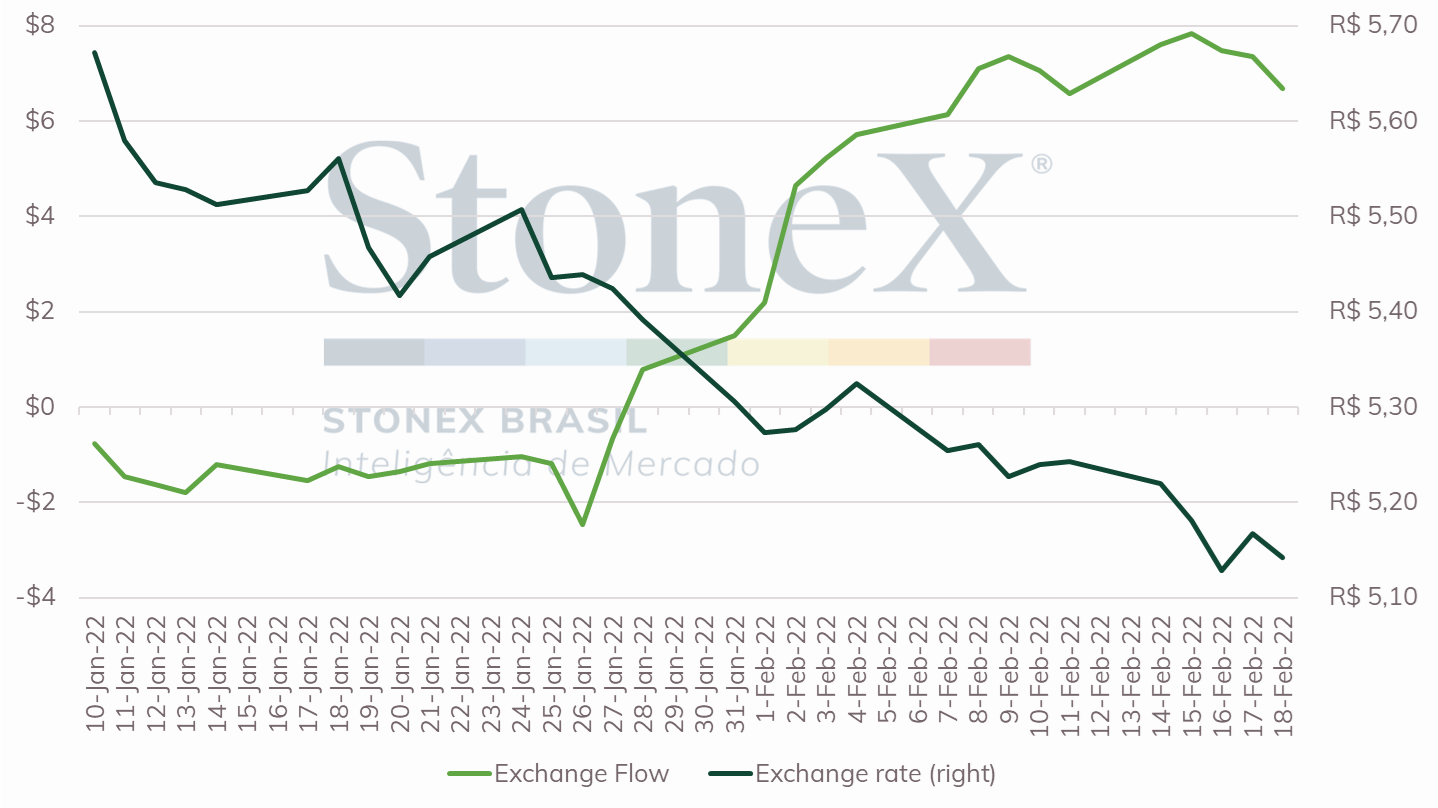
On Wednesday (23), the Central Bank of Brazil updated the weekly data of the country's foreign exchange flow until February 18. Suppose the trading account presents a negative balance in 2022 of USD -3.576 billion. In that case, the financial account presents a strong surplus of USD 10.268 billion due to the inflow of foreign capital into the country. Thus, the total exchange flow for the year is positive by USD 6.692 billion. However, it is necessary to point out that there is a net financial inflow of USD 8.575 billion only between January 27 and February 18, coinciding with the period of greatest exchange rate appreciation.
Accumulated Foreign Exchange Flow (USD bi) and exchange rate (USDBRL):
Source: Central Bank of Brazil and CommodityNetwork Traders' Pro. Design: StoneX.
Finally, it is worth mentioning that the Federal Senate postponed, once again, the voting of two projects that alter fuel prices in Brazil, which are expected to take place on March 8. Under the rapporteurs of Senator Jean-Paul Prates (PT-RN), the bills seek to contain the recent high fuel prices in the country. The first bill (PL 1472/2021) proposes the creation of a Fuel Price Stabilization Fund, which a new oil export tax would finance, and changing the Petrobras price policy to its national costs instead of the international parity. However, the Ministries of Economic and Mines and Energy criticized the measure, worrying about a loss of foreign investments. The second bill (PLP 11/2020) changes the format of the State Tax on the Circulation of Goods and Services (ICMS) on fuels. It proposes a single-phase rate (i.e., a single taxpayer responsible for the entire chain) of ICMS for fuels. In this case, the measure is resisted by governors and mayors, who fear losing tax autonomy.