StoneX logo

FX Weekly Summary (Brazil Issue)

By: StoneX Intelligence Brazil, StoneX Intelligence Brazil

USDBRL ends the week lower at BRL 5.054
 
Vitor Andrioli
Leonardo Rossetti
Leonel Oliveira Mattos
BRL benefits from demand for commodity-related assets
despite heightened international caution
 
 
Bullish factors
  • Russian invasion of Ukraine continues to cause turbulence and exacerbate volatility in financial markets. Usually, assets in emerging countries perform worse in situations of risk aversion.

  • Interest rate hikes by the Federal Reserve, together with the release of future monetary policy projections, should reinforce the attractiveness of the dollar at a time when it is already strengthened as a safe asset in times of uncertainty.

 
Bearish factors
  • Escalating commodity prices favors the appetite for assets of commodity-exporting countries, such as Brazil, and may help the BRL appreciation.

  • Increase in the basic interest rate (Selic) may attract foreign funds to the fixed income market attractive because of the country's high-interest differential and the lower risk involved compared to other assets.

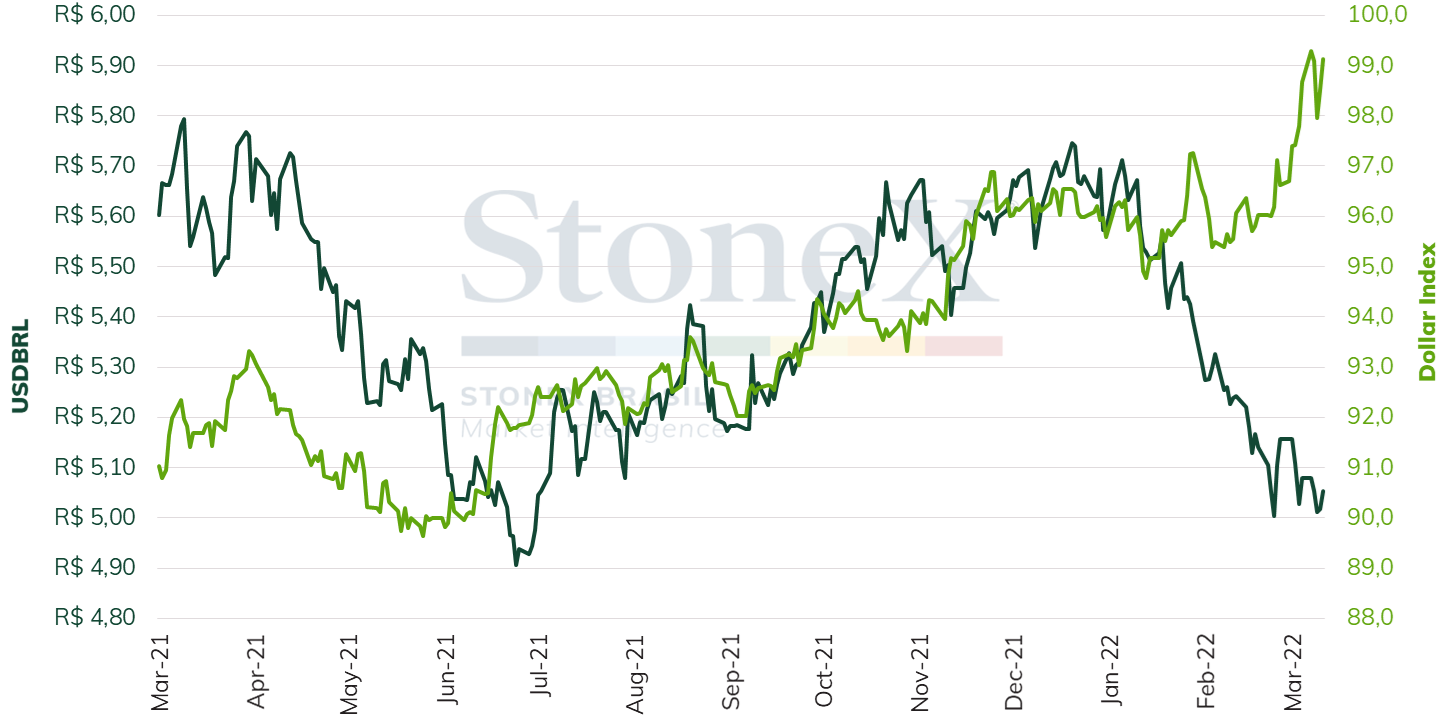
The USDBRL retreated this week, ending Friday’s session (11) at BRL 5.054, down by 0.5% for the week and 9.3% for the year. The dollar index ended Friday's session at 99.1 points, a gain of 0.5% for the week and 3.7% for the year. This was another week of caution and risk aversions, favoring safe-haven assets such as the dollar, particularly after the US Consumer Price Index (CPI) reached its highest value in four decades. However, there is a high foreign appetite for assets in commodity-exporting countries such as Brazil, which favored the appreciation of the Brazilian real against the dollar this week.
USDBRL AND DOLLAR INDEX (POINTS)
image 31655
Source: CommodityNetwork Traders’ Pro. Design: StoneX.

Foreign Scenario

This week, the focus should once again be the unjustifiable war between Russia and Ukraine, which, beyond humanitarian catastrophe, continues to exacerbate market volatility, disrupt global trade and supply chains, redraw global geopolitics, and amplify uncertainty about future economic prospects. Russian troops appear to be advancing at a much slower pace than desired, relying centrally on a strategy of besieging cities, depriving them of supplies, and bombing them to destruction. Hospitals, daycare centers, homes, schools, churches, civilian and military infrastructure, nothing escapes the Russian carpet of bombs. This past week, the Kremlin began mentioning, without offering evidence, that the Pentagon and the Ukrainians were preparing a biological attack against Russian separatists in the Donbas region, which led to the United States warning that possibly Russia is planning some biological or chemical attack that it intends to make it look like an accident. The future of the conflict is uncertain, as diplomatic negotiations are ongoing but without much in the way of ceasefire or humanitarian corridors, and as Ukrainian resistance has exceeded expectations.

Russia and Belarus have been the target of dozens of economic sanctions in retaliation for the invasion of Ukraine, which impairs their ability to trade with the G7 countries, either because a product is prohibited from being imported or because of the difficulty for Russian and Belarusian banks to make international payments and receipts with other countries. In addition, dozens of companies are suspending or terminating their activities with the Russians, increasing Moscow's economic isolation. Finally, there is a general discouraging effect on trade with Russia for fear of future sanctions, reputational damage, or fear of non-payment. It is also noteworthy that Moscow troops have not yet targeted the largest Ukrainian port in Odessa. However, should the Russians decide to head west and take Odessa, Ukraine would have its access to the Black Sea cut off. All these factors have contributed to an intense variation in the prices of food, metal, and energy commodities over the past fortnight, and nothing suggests that this trend will change in the coming weeks.

Another highlight of the coming week will be the meeting of the Federal Reserve's Federal Open Market Committee (FOMC), which on Wednesday is expected to raise its key interest rate for the first time in two years – on March 15, 2020, the FOMC cut it to a range between 0% and 0.25% a year. The US central bank has the difficult challenge of dealing with a high, persistent, and widespread price acceleration amid supply shocks and other turbulence caused by the war between Russia and Ukraine.

Against this backdrop, there is a certainty that the monetary authority wants to be firm in its pursuit of price stabilization but wants to be patient in observing market movements in such turbulent times. In 2022, there will still be seven monetary policy decisions by the FOMC. Most analyses expect at least five 0.25 percentage point increases in the basic interest rate this year, within a trajectory of adjustments that raise interest rates to 2.5% to 2.75% per year.

Domestic Scenario

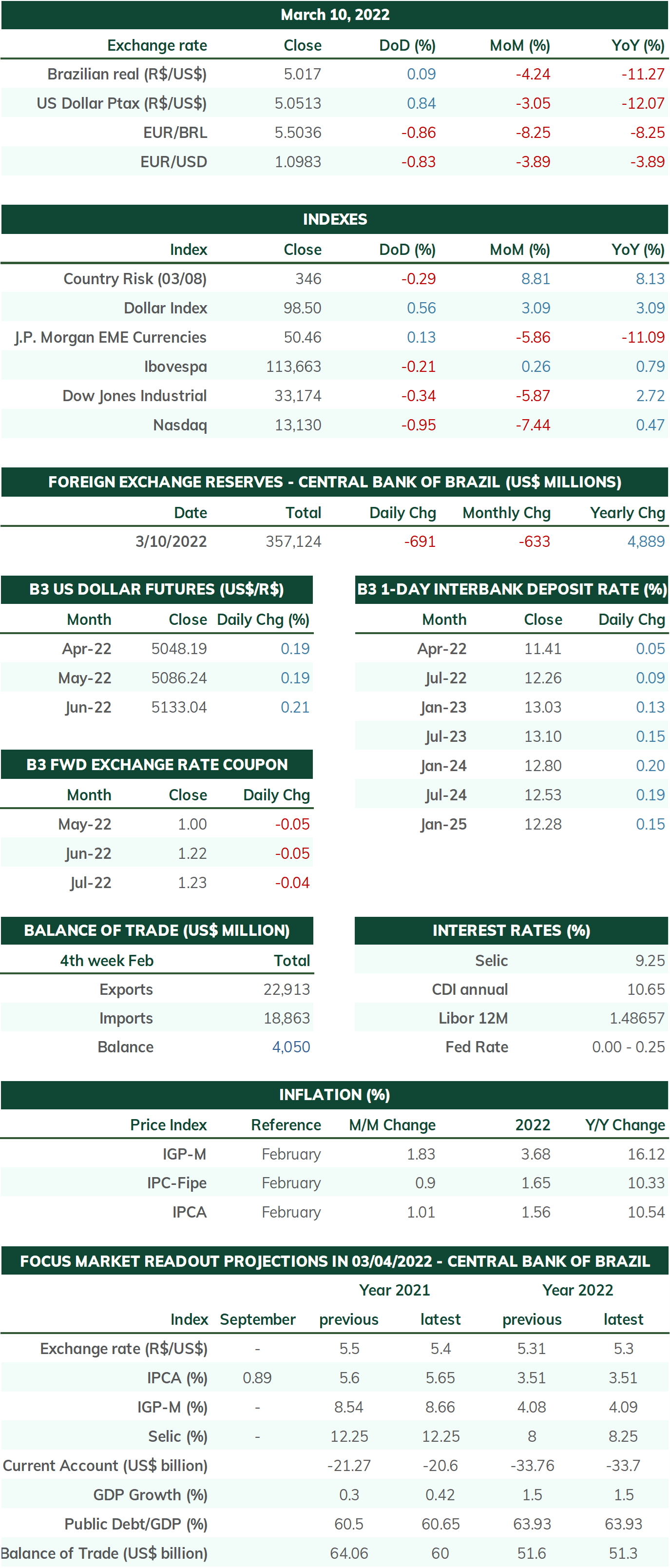
In Brazil, this week’s focus should be the meeting of the Central Bank's Monetary Policy Committee (Copom), which is also expected to raise the basic interest rate (Selic) next Wednesday (16) from 10.75% to 11.75% per year. Today, the Brazilian Institute of Geography and Statistics (IBGE) informed that the Broad Consumer Price Index (IPCA) accelerated 1.01% in February, slightly above analysts' expectations, whose median indicated a growth of 0.95%. This is the largest increase for February since 2015. The index was 0.47 percentage points higher than in January (0.54%) and accumulated a twelve-month increase of 10.54%, also above the January level (10.38%). The deterioration in inflationary expectations in the wake of commodity price shocks due to the war in Ukraine has caused analysts to revise their estimates for the Selic rate, predicting a longer cycle of higher rates to try to stabilize prices domestically, with negative side effects on economic growth for the coming years.

Last week, Petrobras announced a readjustment of 18.7% in gasoline prices, 24.9% in diesel and 16% in cooking gas (LPG) to reduce the disparity of international oil prices with those practiced domestically. The target of constant criticism by the Planalto Palace and the Legislative, the State-owned company had not changed diesel and gasoline prices for 57 days and 152 days without readjustments in the cooking gas. Yesterday, Congress mobilized to contain, in some way, this increase for the final consumer. The Chamber of Deputies and Senate approved a bill (PLP 11/2020), which changed the format of the taxation of the Tax on the Movement of Goods and Services (ICMS), making it single-phase (that is, a single taxpayer is responsible for collecting the entire chain) and with a fixed value for the entire country, instead of being a percentage of revenue. Only presidential sanction is pending. The Senate also approved another bill (PL 1472/2021) that creates a stabilization fund (price band) to contain the oscillation of fuel prices, in addition to establishing a gasoline aid of up to BRL 300 per month for low-income autonomous drivers, intended for beneficiaries of the Auxílio Brasil program. However, the president of the Chamber, Arthur Lira (PP-AL), did not seem very motivated to put it to a vote.

Another topic that may return to the spotlight is a proposal by the Executive to grant a package of subsidies to reduce the price of fuel to the final consumer. During the week, there were multiple meetings involving the president of Petrobras, Joaquim Silva e Luna, the ministers of Mines and Energy, Bento Albuquerque, of Economy, Paulo Guedes, and the Civil House, Ciro Nogueira, as well as the president of the Central Bank, Roberto Campos Neto, to discuss the theme, but the format of such subsidies was not defined.
Finally, it is noteworthy that this was another week of strong inflow of foreign capital into the country, even in a more pessimistic scenario abroad. Usually, military conflicts stimulate caution and risk aversion, which tends to harm risky assets and emerging currencies, as is the case of Brazil. However, due to the rise in commodity prices, the commodity-exporting countries are receiving voluminous inflows of foreign resources, both from productive and financial investments related to the area.

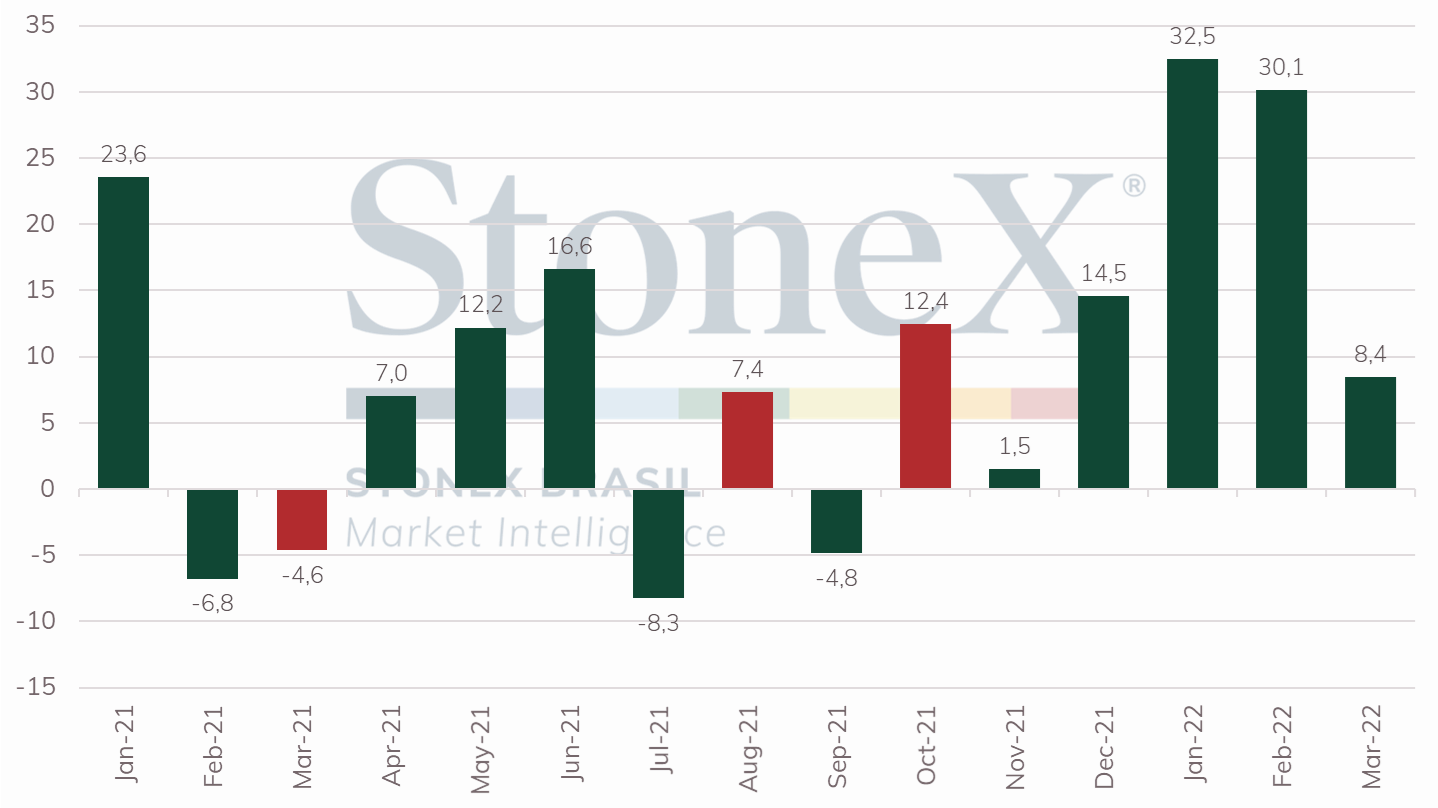
According to B3, in 2022, January and February show a net inflow of foreign funds greater than any month in 2021, namely, a balance of BRL 32.491 billion in January and BRL 30.129 billion in February. A surplus of BRL 8.444 billion was seen this month as of March 9.

BALANCE OF FOREIGN CAPITAL FLOW ON THE B3 - AS OF MARCH 9 (BRL BILLION)
image 31654
Source: B3. Design: StoneX.



ECONOMIC INDICATORS
image 31656
Sources: Central Bank of Brazil; B3; IBGE; Fipe; FGV; MDIC; IPEA and CommodityNetwork Trader’s Pro.
 
  • Currencies

The StoneX Group Inc. group of companies provides financial services worldwide through its subsidiaries, including physical commodities, securities, exchange-traded and over-the-counter derivatives, risk management, global payments and foreign exchange products in accordance with applicable law in the jurisdictions where services are provided. References to over-the-counter (“OTC”) products or swaps are made on behalf of StoneX Markets LLC (“SXM”), a member of the National Futures Association (“NFA”) and provisionally registered with the U.S. Commodity Futures Trading Commission (“CFTC”) as a swap dealer. SXM’s products are designed only for individuals or firms who qualify under CFTC rules as an ‘Eligible Contract Participant’ (“ECP”) and who have been accepted as customers of SXM. StoneX Financial Inc. (“SFI”) is a member of FINRA/NFA/SIPC and registered with the MSRB. SFI is registered with the U.S. Securities and Exchange Commission (“SEC”) as a Broker-Dealer and with the CFTC as a Futures Commission Merchant and Commodity Trading Adviser. References to securities trading are made on behalf of the BD Division of SFI and are intended only for an audience of institutional clients as defined by FINRA Rule 4512(c). References to exchange-traded futures and options are made on behalf of the FCM Division of SFI . StoneX is a trading name of StoneX Financial Ltd (“SFL”). SFL is registered in England and Wales, Company No. 5616586. SFL is authorized and regulated by the Financial Conduct Authority [FRN 446717] to provide to professional and eligible customers including: arrangement, execution and, where required, clearing derivative transactions in exchange traded futures and options. SFL is also authorised to engage in the arrangement and execution of transactions in certain OTC products, certain securities trading, precious metals trading and payment services to eligible customers. SFL is authorised & regulated by the Financial Conduct Authority under the Payment Services Regulations 2017 for the provision of payment services. SFL is a category 1 ring-dealing member of the London Metal Exchange. In addition SFL also engages in other physically delivered commodities business and other general business activities which are unregulated and not required to be authorised by the Financial Conduct Authority. StoneX Group Inc. acts as agent for SFL in New York with respect to its payments services business. StoneX APAC Pte. Ltd. acts as agent for SFL in Singapore with respect to its payments services business. ‘StoneX’ is the trade name used by StoneX Group Inc. and all its associated entities and subsidiaries.
 
Trading swaps and over-the-counter derivatives, exchange-traded derivatives and options and securities involves substantial risk and is not suitable for all investors. Past performance of any futures or option is not indicative of future success. Indicators are not a trading system and are not published as a specific trade recommendation. The information herein is not a recommendation to trade nor investment research or an offer to buy or sell any derivative or security. It does not take into account your particular investment objectives, financial situation or needs and does not create a binding obligation on any of the StoneX group of companies to enter into any transaction with you. You are advised to perform an independent investigation of any transaction to determine whether any transaction is suitable for you. No part of this material may be copied, photocopied or duplicated in any form by any means or redistributed without the prior written consent of StoneX Group Inc.
 
© 2026 StoneX Group Inc. All Rights Reserved.

Satellite view of Earth at night showing illuminated cities across Asia and the Middle East

Discover more insights

Our subscribers have access to comprehensive market analysis from StoneX spanning commodities, equities, currencies and more.

StoneX: We open markets

Our market expertise, advanced platforms, global reach, culture of full transparency and commitment to our clients’ success all set us apart in the financial marketplace.

Reach

With access to 40+ derivatives exchanges, 180+ foreign exchange markets, nearly every global securities marketplace and numerous bilateral liquidity venues, StoneX’s digital network and deep relationships can take clients anywhere they want to go.

Transparency

As a publicly traded company meeting the highest standards of regulatory compliance in the markets we serve, our financials and track record are matters of public record. StoneX’s commitment to “doing the right thing over the easy thing” sets us apart in the industry and helps us build respect, client trust and new partnerships.

Expertise

From our proprietary Market Intelligence platform to “boots-on-the-ground” expertise from award-winning traders and professionals, we connect our clients directly to actionable insights they can use to make more informed decisions and achieve their goals in the global markets.