StoneX logo

FX Weekly Summary (Brazil Issue)

By: StoneX Intelligence Brazil, StoneX Intelligence Brazil

USDBRL ends the week higher at BRL 4.712
 
Vitor Andrioli
Leonardo Rossetti
Leonel Oliveira Mattos
BRL reflected expectations of a hard monetary tightening by the Fed in 2022
 
 
Bullish Factors
  • Russian invasion of Ukraine continues to cause turbulence and exacerbate volatility in financial markets, strengthening the dollar on the international scene due to its role as a safe haven in times of uncertainty.

  • The American Consumer Price Index (CPI) is expected to register the highest inflation in 40 years, consolidating expectations that the Fed needs to act aggressively to curb the inflationary process.

  • Public statements by Federal Reserve officials may cause oscillations in the currency market, particularly those that advocate a more aggressive monetary tightening to control inflation in the country, which would raise the profitability of dollar-denominated bonds and attract investments into this currency.

 
Bearish Factors
  • The release of the weekly trade balance should reinforce the good performance of primary product exports due to the rise in commodity prices, which could attract foreign investments to the sector.

  • After a disappointing January, the services and retail sales data may surprise in February and help with BRL appreciation.


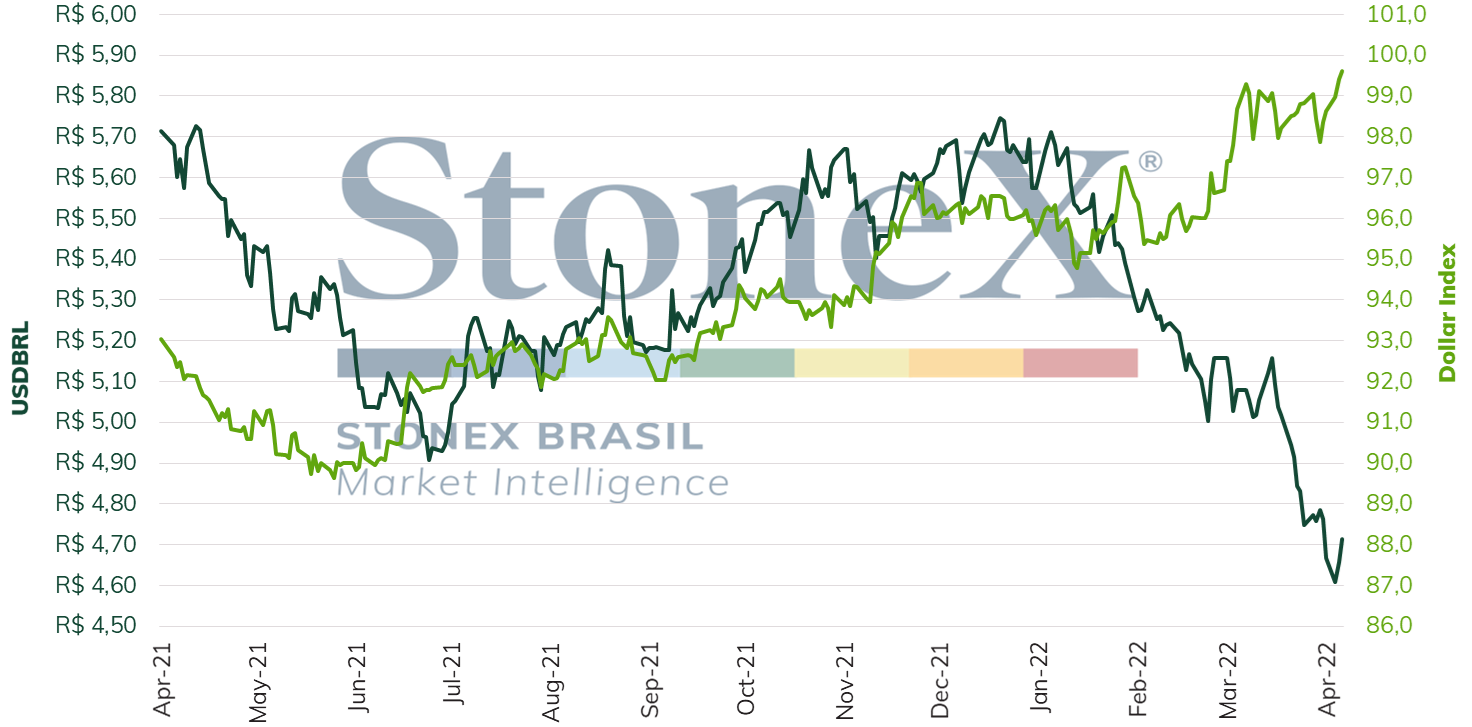
After five consecutive weeks of BRL gains against the USD, the USDBRL pair presented a week of significant correction and ended Friday (08) at BRL 4.712, high by 1.0% in the week but down 1.1% in the month and 15.5% in the year. The amplitude of operations throughout the week draws attention, with a low at BRL 4.579 on Tuesday and a high at BRL 4.793 on Friday. Meanwhile, the dollar index ended the session quoted at 99.8 points, its highest value since May 2020, with a variation of +1.2% in the week, +1.5% in the month, and +4.4% in the year. The dollar traded in the interbank market reversed its long downward trend after releasing the Federal Reserve's monetary policy decision minutes, which consolidated expectations of a rapid monetary tightening by the institution in the coming months. Meanwhile, the continuing war between Russia and Ukraine keeps the environment of pessimism and lower risk appetite abroad.
USDBRL AND DOLLAR INDEX (POINTS)
image 34173
Source: CommodityNetwork Traders’ Pro. Design: StoneX.

Foreign Scenario

The war between Russia and Ukraine is now six weeks old, and there is still little clarity about what its outcome may be. Negotiations for a possible ceasefire have stalled after the heinous scenes uncovered in Bucha, on the outskirts of Kiyv, this week. The United States and other allied nations have harshly condemned what they called a war crime and implemented new rounds of sanctions against Moscow, increasing the country's geopolitical and economic isolation. The European Union banned the import of coal, among other products, and the export of advanced materials and further restricted Russian ships and banks from doing business with the economic bloc. The US Congress ratified the ban on Russian oil, natural gas and coal imports and excluded Russia and Belarus from preferential economic partner status, making the sanction a law. Thus, the United States may apply differentiated economic tariffs on these countries.

This week, investors will await the publication of the Consumer Price Index (CPI) for March, which is expected to rise due to the effects of the conflict in Eastern Europe. After a 0.6% increase in January and 0.8% in February, the median of analysts' estimates points to a 1.1% increase in March, which would bring the accumulated figure in 12 months to 8.4% – its highest value since December 1981. In addition, other productive activity data for the US, such as retail sales and industrial production, should reveal that economic growth remains healthy, while the price index should keep accelerating for a few more months.

The March monetary policy decision minutes were considered firm by market analysts, as they indicated that the Federal Open Market Committee (FOMC) members were open to a 0.50 percentage point interest rate adjustment already at the previous meeting and set an accelerated pace of asset reduction on the US central bank's balance sheet. For this reason, attention should also continue to be focused on public statements from members of the Federal Reserve (Fed) as analysts try to gauge how many interest rate hikes will be seen this year. The public speeches by Raphael Bostic, Michelle Bowman, Charles Evans, Lael Brainard, Thomas Barkin, Loretta Mester, and Patrick Harker are scheduled for this week.

Finally, investors will also follow news about the Covid-19 contagion that China is going through and the containment measures being put in place. This week, the isolation measures in Shanghai were deepened, as the two-phase approach did not have the desired effect. The Asian country is experiencing the worst wave of Covid-19 and the biggest lockdowns since the new disease was discovered in late 2019, as the highly infectious omicron variant exponentially raises the economic, social and political costs of the "zero Covid" strategy and reaps fewer and fewer benefits. Shanghai remains in lockdown with no end date, burdening the logistics chain of the country's industrial hub and site of the world's largest port terminal. Although the port remains in partial operation, businesses and cargo sheds were forced to close during the lockdown, causing delays and hampering port operations. The new coronavirus strains defy the practicality of isolating entire metropolises for weeks, repeatedly, at the enormous political and economic expense.

Domestic Scenario

Last week, the consolidation of expectations of a rigorous monetary tightening by the United States in a few months in a scenario of exacerbated uncertainty and volatility – mainly due to the conflict between Russia and Ukraine, but, to a lesser extent, to the possibility of the victory of the extreme right in the French presidential elections -, provoked strong gains in the dollar against other currencies. The dollar index reached 100 points for the first time in almost two years, and the BRL, which had appreciated against the American currency for five consecutive weeks, retreated.

The factors driving the appreciation of the Brazilian currency in recent weeks have not fundamentally changed. The Brazilian interest rate differential from other nations is still quite high. Friday's release of the Higher than estimated National Broad Consumer Price Index (IPCA) for March – 1.62% versus 1.30% –reinforced that the acceleration of prices is still slow to cool down. The Central Bank of Brazil will probably still be quite forceful in its next interest rate readjustments. On Friday, the real interest rate – the difference between the nominal interest rate minus inflation – in Brazil is only lower than that of Russia, a country that faces difficulties in attracting foreign investors. This wide Brazilian interest differential helps attract investors looking for "carry trade" strategies – taking financing in a low-interest country to invest in a high-interest country.

In addition, the continuing war between Russia and Ukraine and the failure of another attempt to end the conflict through diplomatic means keep pressure on the prices of food, metal and energy commodities. The UN Food and Agriculture Organization (FAO) said that the Food Price Index, which tracks changes in international prices for a basket of agricultural commodities, rose to 159.3 points in March, up 12.6% from February. This is the highest level since the indicator was created in 1990 and the highest monthly rise since 2008. Since the end of January, the general upward trend in commodity prices has benefited the value of Brazilian exports and increased foreign exchange inflows through the trading account, thanks to the country's diversified commodity export capacity. In addition, there was a keen foreign appetite for Brazilian assets because of the low exposure, in relative terms, to the risks posed by the Russian-Ukrainian conflict and the low price of Brazilian assets in foreign currency terms. It will be extremely important to observe whether the movement of exchange rate flows next week will favor the factors contributing to the exchange rate's fall or its increase.

Finally, it is important to note that the strike by Central Bank employees significantly hinders the reading of the macroeconomic and exchange rate conjuncture in the country. Staging demonstrations and stoppages since February, these employees have interrupted their work after not receiving any proposals from the government for months. As a result, since the last week of March, the Central Bank has stopped publishing fiscal, monetary and credit statistics, foreign sector statistics, weekly data on foreign exchange flows, commodity indices and even the Focus bulletin. The vacuum of information worsens the ability to interpret economic movements in real-time.



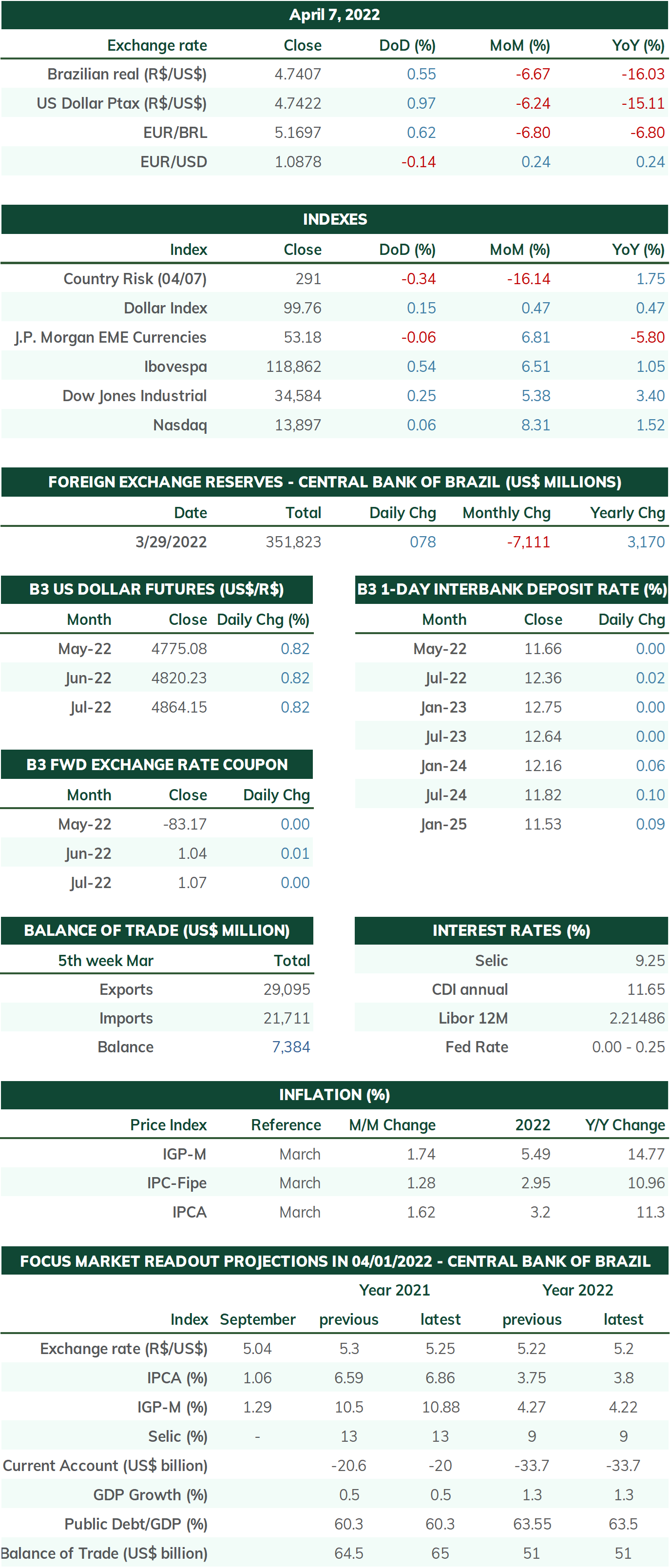
ECONOMIC INDICATORS
image 34174
Sources: Central Bank of Brazil; B3; IBGE; Fipe; FGV; MDIC; IPEA and CommodityNetwork Trader’s Pro.
 
  • Currencies

The StoneX Group Inc. group of companies provides financial services worldwide through its subsidiaries, including physical commodities, securities, exchange-traded and over-the-counter derivatives, risk management, global payments and foreign exchange products in accordance with applicable law in the jurisdictions where services are provided. References to over-the-counter (“OTC”) products or swaps are made on behalf of StoneX Markets LLC (“SXM”), a member of the National Futures Association (“NFA”) and provisionally registered with the U.S. Commodity Futures Trading Commission (“CFTC”) as a swap dealer. SXM’s products are designed only for individuals or firms who qualify under CFTC rules as an ‘Eligible Contract Participant’ (“ECP”) and who have been accepted as customers of SXM. StoneX Financial Inc. (“SFI”) is a member of FINRA/NFA/SIPC and registered with the MSRB. SFI is registered with the U.S. Securities and Exchange Commission (“SEC”) as a Broker-Dealer and with the CFTC as a Futures Commission Merchant and Commodity Trading Adviser. References to securities trading are made on behalf of the BD Division of SFI and are intended only for an audience of institutional clients as defined by FINRA Rule 4512(c). References to exchange-traded futures and options are made on behalf of the FCM Division of SFI . StoneX is a trading name of StoneX Financial Ltd (“SFL”). SFL is registered in England and Wales, Company No. 5616586. SFL is authorized and regulated by the Financial Conduct Authority [FRN 446717] to provide to professional and eligible customers including: arrangement, execution and, where required, clearing derivative transactions in exchange traded futures and options. SFL is also authorised to engage in the arrangement and execution of transactions in certain OTC products, certain securities trading, precious metals trading and payment services to eligible customers. SFL is authorised & regulated by the Financial Conduct Authority under the Payment Services Regulations 2017 for the provision of payment services. SFL is a category 1 ring-dealing member of the London Metal Exchange. In addition SFL also engages in other physically delivered commodities business and other general business activities which are unregulated and not required to be authorised by the Financial Conduct Authority. StoneX Group Inc. acts as agent for SFL in New York with respect to its payments services business. StoneX APAC Pte. Ltd. acts as agent for SFL in Singapore with respect to its payments services business. ‘StoneX’ is the trade name used by StoneX Group Inc. and all its associated entities and subsidiaries.
 
Trading swaps and over-the-counter derivatives, exchange-traded derivatives and options and securities involves substantial risk and is not suitable for all investors. Past performance of any futures or option is not indicative of future success. Indicators are not a trading system and are not published as a specific trade recommendation. The information herein is not a recommendation to trade nor investment research or an offer to buy or sell any derivative or security. It does not take into account your particular investment objectives, financial situation or needs and does not create a binding obligation on any of the StoneX group of companies to enter into any transaction with you. You are advised to perform an independent investigation of any transaction to determine whether any transaction is suitable for you. No part of this material may be copied, photocopied or duplicated in any form by any means or redistributed without the prior written consent of StoneX Group Inc.
 
© 2026 StoneX Group Inc. All Rights Reserved.

Satellite view of Earth at night showing illuminated cities across Asia and the Middle East

Discover more insights

Our subscribers have access to comprehensive market analysis from StoneX spanning commodities, equities, currencies and more.

StoneX: We open markets

Our market expertise, advanced platforms, global reach, culture of full transparency and commitment to our clients’ success all set us apart in the financial marketplace.

Reach

With access to 40+ derivatives exchanges, 180+ foreign exchange markets, nearly every global securities marketplace and numerous bilateral liquidity venues, StoneX’s digital network and deep relationships can take clients anywhere they want to go.

Transparency

As a publicly traded company meeting the highest standards of regulatory compliance in the markets we serve, our financials and track record are matters of public record. StoneX’s commitment to “doing the right thing over the easy thing” sets us apart in the industry and helps us build respect, client trust and new partnerships.

Expertise

From our proprietary Market Intelligence platform to “boots-on-the-ground” expertise from award-winning traders and professionals, we connect our clients directly to actionable insights they can use to make more informed decisions and achieve their goals in the global markets.