StoneX logo

FX Weekly Summary (Brazil Issue)

By: StoneX Intelligence Brazil, StoneX Intelligence Brazil

USDBRL trends lower to end the week at BRL 4.738
 
Leonel Oliveira Mattos
Leonardo Rossetti
Vitor Andrioli
Investors' risk appetite and the flight from the dollar in the international market marked the week
Bullish Factors
  • US labor market indicators may show that economic activity in May remained heated and that a possible economic slowdown has not yet set in, attracting investments into the dollar.

  • Public speeches by Fed officials should reinforce the urgency of the US central bank to control inflation in the country through a rapid and intense monetary tightening, which would raise the profitability of dollar-denominated securities and attract investments into this currency.

  • Crisis among the branches of the Republic and increased public spending raise the perception of fiscal and political risks associated with Brazil, resulting in higher risk premium demands by investors, hindering the inflow of foreign resources into the country and devaluing the exchange rate.

Bearish Factors
  • Fears that the spread of inflation and the economic slowdown may be more intense than anticipated may motivate a reallocation of investment portfolios, especially avoiding the US and seeking, among others, commodity-related assets.

  • Possibility that the Q1 GDP for Brazil surprises positively may attract foreign investments to the country and contribute to the strengthening of the Brazilian real.

  • Progressive improvement in controlling the Covid-19 spread in China allows a progressive reduction of lockdown measures, increasing the expectation of recovery in production, logistics chains and the resumption of Chinese demand, which could positively affect Brazilian exports to its main trading partner.

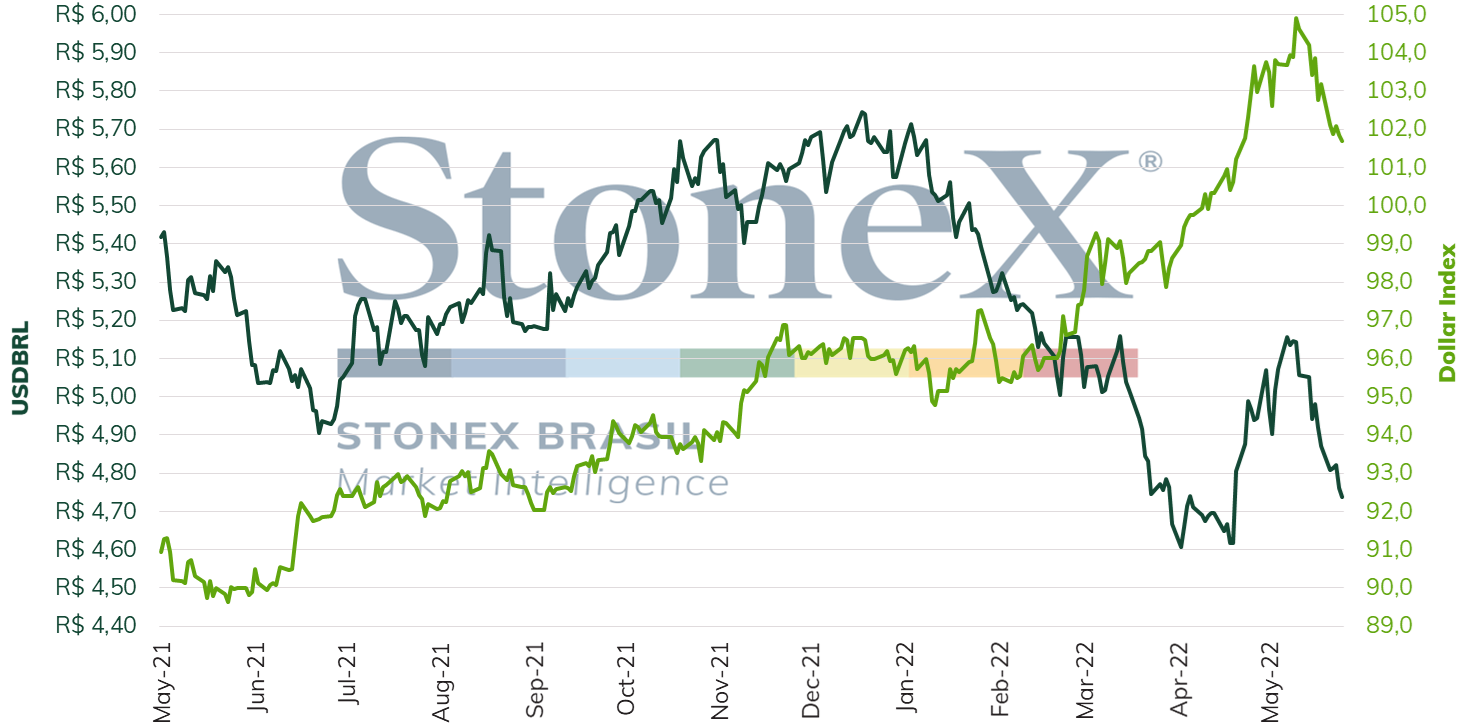
The USDBRL depreciated for the third week to close Friday's session (27) at BRL 4.738, a drop of 2.7% in the week, 4.1% in the month and 15.0% in the year. The dollar index extended its depreciation trend and ended Friday's session quoted at 101.7 points, a variation of -1.4% in the week, -1.2% in the month, but still gaining 6.4% in the year. Last week was marked by the recovery of international investors' risk appetite, who continued to sell dollar-denominated positions and invest in European assets, stock indexes, commodities and currencies of emerging economies. In Brazil, political topics dominated the news after President Jair Bolsonaro (PL) replaced, once again, the president of Petrobras and the Chamber of Deputies approved a bill that limits to 17% the Tax on the Movement of Goods and Services (ICMS) on fuels, electricity, public transportation, and telecommunications.
USDBRL AND DOLLAR INDEX (POINTS)
image 39059
Source: CommodityNetwork Traders’ Pro. Design: StoneX.

Foreign Scenario

This week the spotlight should be on labor market conditions in the United States amid concerns over a slowdown in economic activity in the country. The May ISM Purchasing Managers' Indexes (PMI) for manufacturing and services should moderate their expansion rates, in line with other high-frequency indicators of business activity. The May Employment Situation Report should also indicate lower net job creation than in previous months and likely stabilize the unemployment rate, currently at 3.6% of the labor force. The average income per worked hour should cool slightly, from 5.5% in April to 5.2% in May. In any case, this moderation in the indicators should be mild and not cause excessive concerns about stagnation... yet. Some recent indicators for production and demand have surprised negatively.
This week will also be the last for Federal Reserve officials before the mandatory quiet period required for the June 14 and 15 Federal Open Market Committee (FOMC) meeting. This week, the minutes of the May 4 FOMC monetary policy decision indicated that its members supported two more 0.50 percentage point interest rate hikes in the next two meetings and suggested that at that point, a reassessment of the economic environment would be appropriate to decide the best path for ongoing financial tightening. Speakers this week include New York Fed President John Williams, St. Louis Fed President James Bullard, and Cleveland Fed President Loretta Mester.
Unfortunately, the war between Russia and Ukraine presented major developments that caused concern last week. The Ukrainian Defense Ministry calls this the "maximum intensity" phase in the war so far, with the Russian army gaining a lot of ground in the Donbas region, particularly in the area consisting of the cities of Lyman, Serevodonetsk, Popasna, and Lysychansk. In addition, on May 24, the Ukrainian General Staff warned that Moscow had deployed Iskander-M missile launchers, which can carry traditional and nuclear cargo to the Brest region on the Poland-Belarus border. These ballistic missiles have a (short) range of between 400 and 500 kilometers, which puts the entire central and northern Ukraine in danger, depending on where they are positioned. The conflict seems destined for a long protracted war, with increasing threats of Russia's use of military weaponry and no near end in sight.
Finally, it is worth noting that an analysis by Nomura bank on May 23 estimated that 26 Chinese cities are in partial or total lockdown, affecting 208 million people. The analysis highlights the first week with a large drop in the number of people in lockdown (-25%). However, this still corresponds to approximately 14.8% of the Chinese population and 20.5% of China's Gross Domestic Product. In Shanghai, the restrictions are slowly being reduced; however, approximately one million residents (out of 25 million) are still confined to their homes. The municipal authorities have promised to open the city by June 1, but it is unclear how open it will be as some cases have been reported again. Beijing's capital is moving in the opposite direction, with an increase in restrictions, but still without full lockdown status. Districts are administering the measures, and only essential sectors operate freely.

Domestic Scenario

This week, the focus should be on the release of the Gross Domestic Product (GDP) for the first quarter of 2022 by the Brazilian Institute of Geography and Statistics (IBGE) on Thursday (02). High-frequency indicators of economic activity, such as industrial production volume, services and retail sales, showed growth in February and March, so there is an expectation of around 1.0% growth for the quarterly GDP. However, in case of surprise - positive or negative - investors may react and oscillate their investment levels for the country.
In addition, this week will bring other important gauges for the Brazilian economic situation. On Tuesday (31st), the IBGE will publish labor market data for April, including the unemployment rate and the average labor income, important references for the demand capacity. Furthermore, the General Price Index - Market (IGP-M) and the Consumer Price Index calculated by FIPE (IPC-Fipe), both for May, will be updated, allowing a more recent reading about inflationary pressures in the domestic scenario. Finally, S&P Global will release the Purchasing Managers' Index (PMI) for industry, services, and consolidated. In general, there is an expectation of cooling for these indicators.
It will also be important to note the news that the federal government's economic team intends to send a decree to Congress stipulating a cut in the 2022 Budget to request a 5% linear salary readjustment for all federal servers. According to press reports, the Planalto Palace will reduce BRL 14 billion in the education, health, and defense budget to finance the salary increase for federal employees and accommodate the increase in other mandatory expenses. Although promised in March by President Bolsonaro, the adjustment to the public servants has not been formalized yet. Employees of the Central Bank and the National Treasury are on strike, searching for improvements in their working conditions.
Finally, it is worth noting that this week the Chamber of Deputies approved a bill that classifies fuel, natural gas, electricity, communications, and public transportation as "essential and indispensable sectors," limiting the ICMS rate - a state tax - to a maximum of 17%. The text also establishes that there will be, until December 31 of this year, compensation paid by the federal government to the states for the loss of revenue through discounts in installments of debts refinanced by the entities together with the Union. Now, the president of the Federal Senate, Rodrigo Pacheco (PSD-MG), will discuss with the bench leaders if the project will be discussed in the standing committees of the House or will be voted directly in Plenary. Congress had already approved another bill changing the ICMS rate on fuels to fixed values in March this year.


image 35317
 
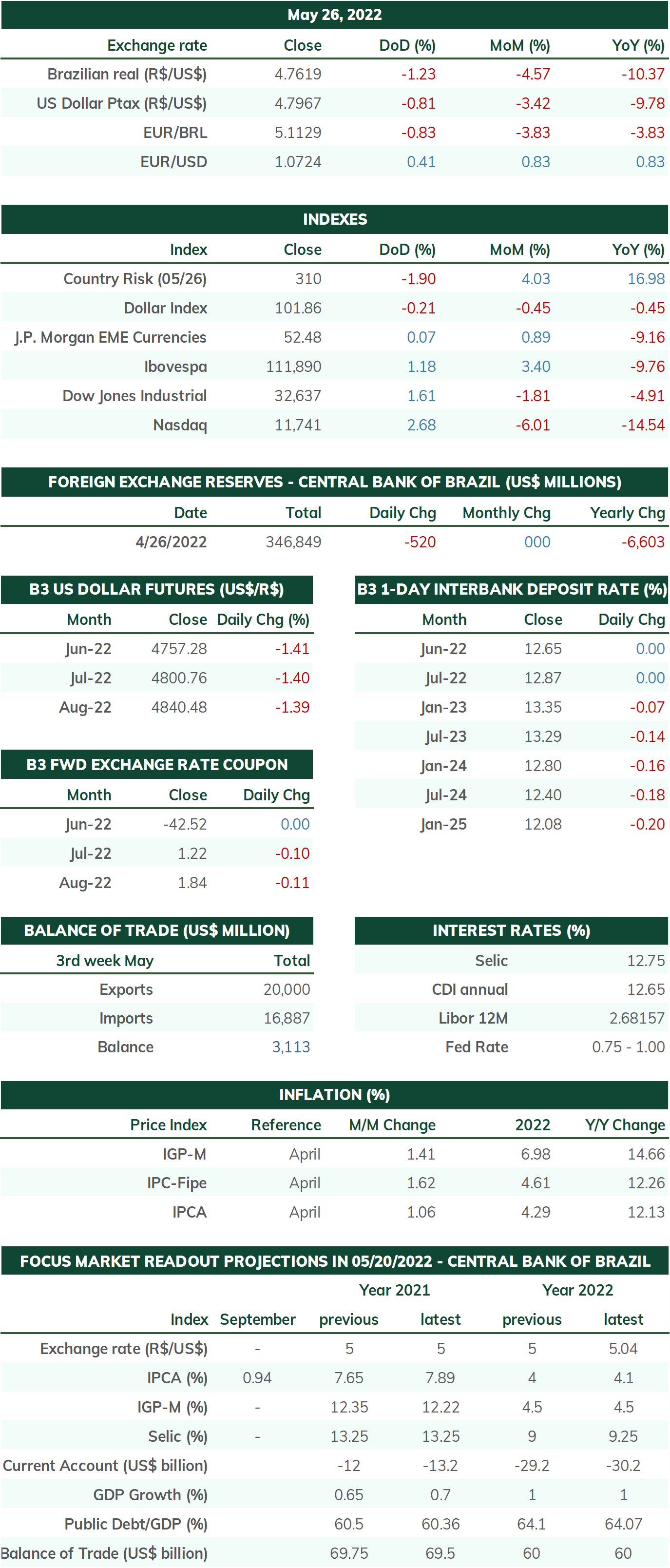
ECONOMIC INDICATORS
image 39060
Sources: Central Bank of Brazil; B3; IBGE; Fipe; FGV; MDIC; IPEA and CommodityNetwork Trader’s Pro.
 
  • Currencies

The StoneX Group Inc. group of companies provides financial services worldwide through its subsidiaries, including physical commodities, securities, exchange-traded and over-the-counter derivatives, risk management, global payments and foreign exchange products in accordance with applicable law in the jurisdictions where services are provided. References to over-the-counter (“OTC”) products or swaps are made on behalf of StoneX Markets LLC (“SXM”), a member of the National Futures Association (“NFA”) and provisionally registered with the U.S. Commodity Futures Trading Commission (“CFTC”) as a swap dealer. SXM’s products are designed only for individuals or firms who qualify under CFTC rules as an ‘Eligible Contract Participant’ (“ECP”) and who have been accepted as customers of SXM. StoneX Financial Inc. (“SFI”) is a member of FINRA/NFA/SIPC and registered with the MSRB. SFI is registered with the U.S. Securities and Exchange Commission (“SEC”) as a Broker-Dealer and with the CFTC as a Futures Commission Merchant and Commodity Trading Adviser. References to securities trading are made on behalf of the BD Division of SFI and are intended only for an audience of institutional clients as defined by FINRA Rule 4512(c). References to exchange-traded futures and options are made on behalf of the FCM Division of SFI . StoneX is a trading name of StoneX Financial Ltd (“SFL”). SFL is registered in England and Wales, Company No. 5616586. SFL is authorized and regulated by the Financial Conduct Authority [FRN 446717] to provide to professional and eligible customers including: arrangement, execution and, where required, clearing derivative transactions in exchange traded futures and options. SFL is also authorised to engage in the arrangement and execution of transactions in certain OTC products, certain securities trading, precious metals trading and payment services to eligible customers. SFL is authorised & regulated by the Financial Conduct Authority under the Payment Services Regulations 2017 for the provision of payment services. SFL is a category 1 ring-dealing member of the London Metal Exchange. In addition SFL also engages in other physically delivered commodities business and other general business activities which are unregulated and not required to be authorised by the Financial Conduct Authority. StoneX Group Inc. acts as agent for SFL in New York with respect to its payments services business. StoneX APAC Pte. Ltd. acts as agent for SFL in Singapore with respect to its payments services business. ‘StoneX’ is the trade name used by StoneX Group Inc. and all its associated entities and subsidiaries.
 
Trading swaps and over-the-counter derivatives, exchange-traded derivatives and options and securities involves substantial risk and is not suitable for all investors. Past performance of any futures or option is not indicative of future success. Indicators are not a trading system and are not published as a specific trade recommendation. The information herein is not a recommendation to trade nor investment research or an offer to buy or sell any derivative or security. It does not take into account your particular investment objectives, financial situation or needs and does not create a binding obligation on any of the StoneX group of companies to enter into any transaction with you. You are advised to perform an independent investigation of any transaction to determine whether any transaction is suitable for you. No part of this material may be copied, photocopied or duplicated in any form by any means or redistributed without the prior written consent of StoneX Group Inc.
 
© 2026 StoneX Group Inc. All Rights Reserved.

Satellite view of Earth at night showing illuminated cities across Asia and the Middle East

Discover more insights

Our subscribers have access to comprehensive market analysis from StoneX spanning commodities, equities, currencies and more.

StoneX: We open markets

Our market expertise, advanced platforms, global reach, culture of full transparency and commitment to our clients’ success all set us apart in the financial marketplace.

Reach

With access to 40+ derivatives exchanges, 180+ foreign exchange markets, nearly every global securities marketplace and numerous bilateral liquidity venues, StoneX’s digital network and deep relationships can take clients anywhere they want to go.

Transparency

As a publicly traded company meeting the highest standards of regulatory compliance in the markets we serve, our financials and track record are matters of public record. StoneX’s commitment to “doing the right thing over the easy thing” sets us apart in the industry and helps us build respect, client trust and new partnerships.

Expertise

From our proprietary Market Intelligence platform to “boots-on-the-ground” expertise from award-winning traders and professionals, we connect our clients directly to actionable insights they can use to make more informed decisions and achieve their goals in the global markets.