Foreign Scenario
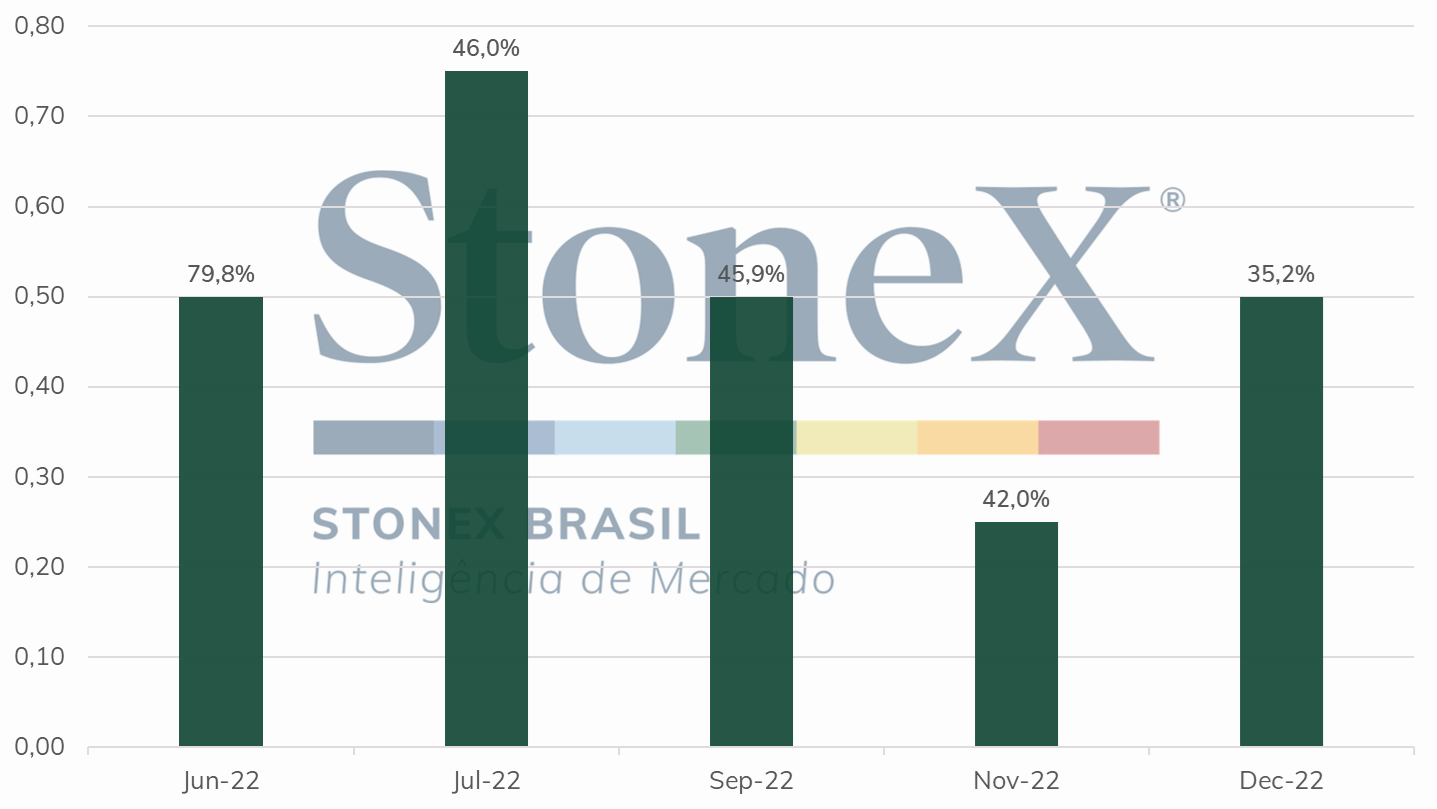
This week, the focus will be on the monetary policy decision of the Federal Reserve's (Fed) Federal Open Market Committee (FOMC) and its signals for the September meeting. In the minutes of the last meeting, the FOMC indicated that it intends to raise its benchmark interest rates (fed funds rate) by 0.50 p.p. in June and July. However, the Consumer Price Index (CPI) in May surprised analysts. It again reached the highest level since December 1981, possibly coercing the monetary authority to act faster and more rigidly in its tightening financial conditions. Investors will also be focused on the FOMC's update of the economic projections, which will provide more details about its members' expectations for growth, inflation, and the level of interest rates expected for 2022, 2023, and 2024. Most analysts believe these projections should show a rising path for inflation and a reduction in economic activity in the short term, as well as an anticipation of interest rate adjustments, seeking to reach a "neutral rate" as soon as possible. The press conference of the Fed's Chair will also be much followed in searching for more information about the US monetary policy trajectory this year. On June 10, the median of market estimates pointed to an interest rate between 3.25% and 3.50% by the end of 2022. However, only the expectation for June accounted for more than 50% of the bets on the futures market.
ADJUSTMENT TO THE MOST LIKELY US FEDERAL funds rate ON JUNE 10
Source: CME FedWatch. Design: StoneX.
This week, important indicators of US economic activity will also be released, such as retail sales and industrial production for May. There are no indications of an economic slowdown at the moment. However, retail sales may show a slight retraction due to the recovery of in-person services, which have been growing faster.
It is also worth noting that the war between Russia and Ukraine has reached its 107th day in an intense battle for dominance of the Donbas region, but without any major territorial changes compared to the previous week. Although Russia has not declared its real objectives with the conflict, the battlefront dynamics suggest that, at this moment, the Kremlin's focus is on controlling the southern and eastern portions of Ukrainian territory. Today, Moscow already owns approximately 20% of former Ukraine. Although it has not been able to take the port city of Odessa, it has effectively blocked sea entry and exit with its naval superiority. There is debate about how the Ukrainian economy can subsist without the possibility of maritime exports and imports, and its land infrastructure is and continues to be damaged. On the other hand, the Kremlin uses this superiority to bargain for the relaxation of sanctions with the West to establish humanitarian corridors for trade. Still, Russian credibility in a negotiation is low.
Finally, it is worth noting that the Covid-19 situation in China is slowly improving, with the restrictions imposed on Shanghai and Beijing being notably reduced last week. An analysis by Nomura bank on June 6 estimated that 8 Chinese cities are in partial or total lockdown, affecting a total of 73.6 million people, a weekly drop of almost 45% in the number of people in lockdown. This still corresponds to approximately 5.2% of the Chinese population and 9.5% of China's Gross Domestic Product. Nevertheless, the economic impacts of the strict quarantines imposed in April and May should continue to have repercussions on economic activity, such as reduced inventories, logistical bottlenecks, and order backlogs. Furthermore, the authorities have shown that they are unwilling to revisit the zero-tolerance strategies against the coronavirus, even in the face of new and highly transmissible variants, which means that if new outbreaks appear around the country, prolonged lockdowns may be applied again. Currently, one detected case is enough to determine the shutdown of a neighborhood or district.
Domestic Scenario
This wee, the focus should continue on the decision of the Central Bank of Brazil’s Monetary Policy Committee (Copom). Despite the National Broad Consumer Price Index (IPCA) for May having risen just 0.47%, the lowest monthly increase since April last year, most analysts are betting that the Committee will readjust the basic interest rate (Selic) from 12.75% p.a. to 13.25% p.a., as signaled in the latest Copom minutes. It is still too early to believe that the IPCA will start to reduce, given that the small reading for May was influenced by punctual factors, such as the change in the tariff flag, the seasonality of some horticultural products and the maintenance by Petrobrás of the price of gasoline and cylinder gas for three months, making domestic prices unleveled compared to international prices. Therefore, the monetary authority should stick to its plan to raise the Selic once more and keep it at this level while assessing the evolution of domestic prices.
Brasilia's plans to combat rising fuel prices should remain in the spotlight this week. The vote on the Complementary Bill 18/22, which makes fuels, electric energy, natural gas, communications and collective transportation essential and indispensable goods and services, imposing a maximum ICMS rate of 17% on such products, is scheduled for Monday. The project, conceived by the Planalto Palace and reported by Senator Fernando Bezerra Coelho (MDB-PE), aims to reduce the value of fuels, improve IPCA readings, and recover the popularity of Jair Bolsonaro's reelection bid but comes at a high cost. According to the rapporteur's calculations, the federal government will receive BRL 35.2 billion in reimbursement resources to the states, a figure substantially lower than that estimated by the National Committee of Secretaries of Finance, Finance, Revenue or Taxation of the States and the Federal District (Comsefaz), which measured the impact of PLP 18 at more than BRL 100 billion.
In addition, the Executive has a proposed constitutional amendment (PEC), which has not yet been officially presented to Congress, which aims to zero the federal (PIS/Confins and Cid) and state (ICMS) taxes on fuel after the approval of PLP 18. Yesterday, speaking to journalists, Bezerra Coelho stated that the PEC would have an additional reimbursement cost to the states of BRL 29.6 billion, which would be done through extraordinary resources. Such expenses would not be accounted for in the so-called spending cap, the constitutional spending limit, in a similar dynamic to the emergency aid funding. Furthermore, none of these costs consider the losses in federal tax revenues, only the Union's payment to the states for the fall in their tax revenues. Thus, the public sector will increase its fiscal deficit by tens of billions of Brazilian reais in six months, which should be reflected in an increase in public debt.
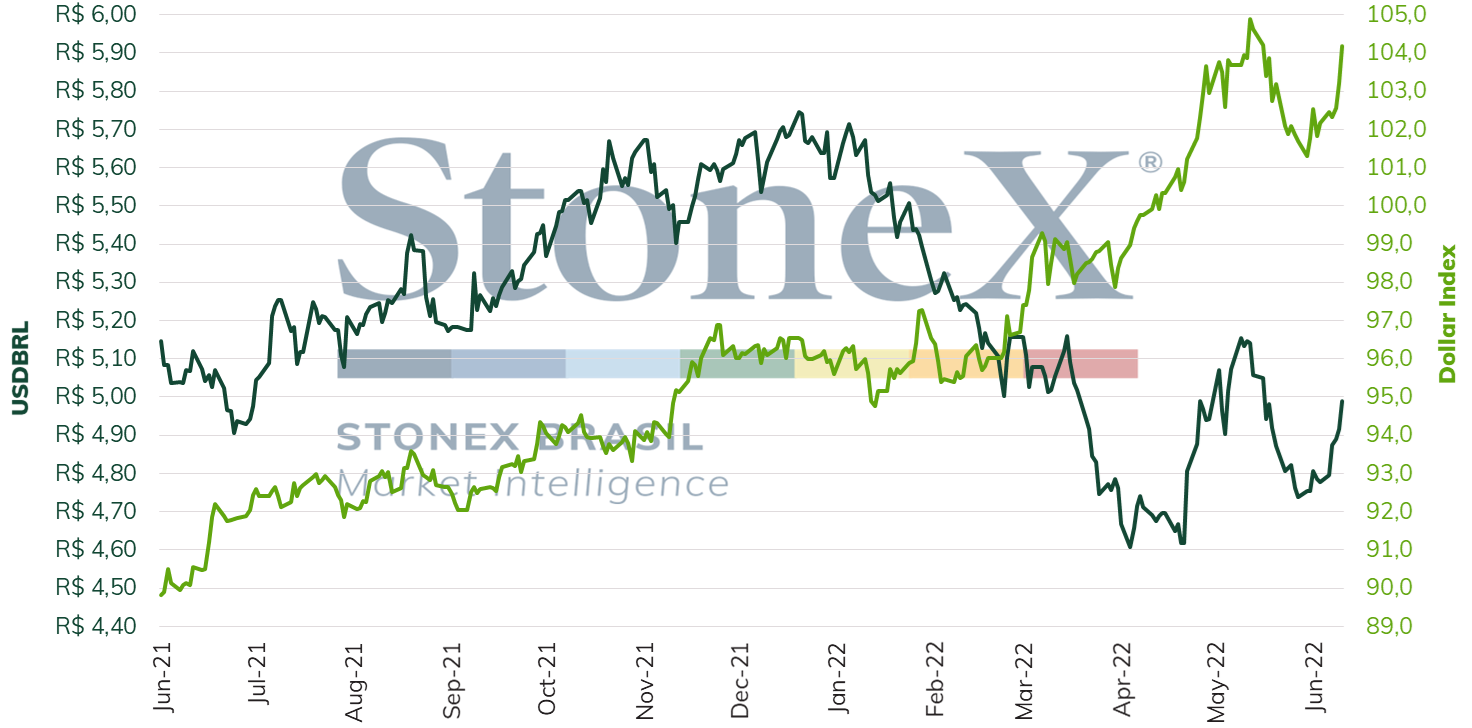
The fact that the loss of tax collection in the order of tens of billions of Brazilian reais four months before an election cannot be ignored, which disrespects the spending cap, in a context of visible pressure on Petrobras' pricing policy, does not constitute a measure that amplifies the perceived fiscal risks for Brazil. The constant improvisations and changes in the 2022 Budget that represent an increase in spending or a reduction in tax collection may raise the perception of fiscal risk associated with Brazil, raising the demand for a risk premium by investors, which, in turn, could reduce the foreign capital flow into the country and weaken the BRL.
Finally, this week, Bolsonaro stepped back again from his proposal to grant salary increases to federal civil servants. Bolsonaro said that "everything indicates" it will not be possible to offer any salary increase to civil servants this year. On Monday (06), the Ministry of Economy had already redirected BRL 1.72 billion in the budget for the servers' salary increase. Since November last year, the president has oscillated between promises of a linear readjustment for the entire federal service, only the federal security personnel or nobody. According to the law, any salary increase must be decided, processed and approved by July 2. It is forbidden to grant salary increases in the final six months of a term of office.