Foreign Scenario
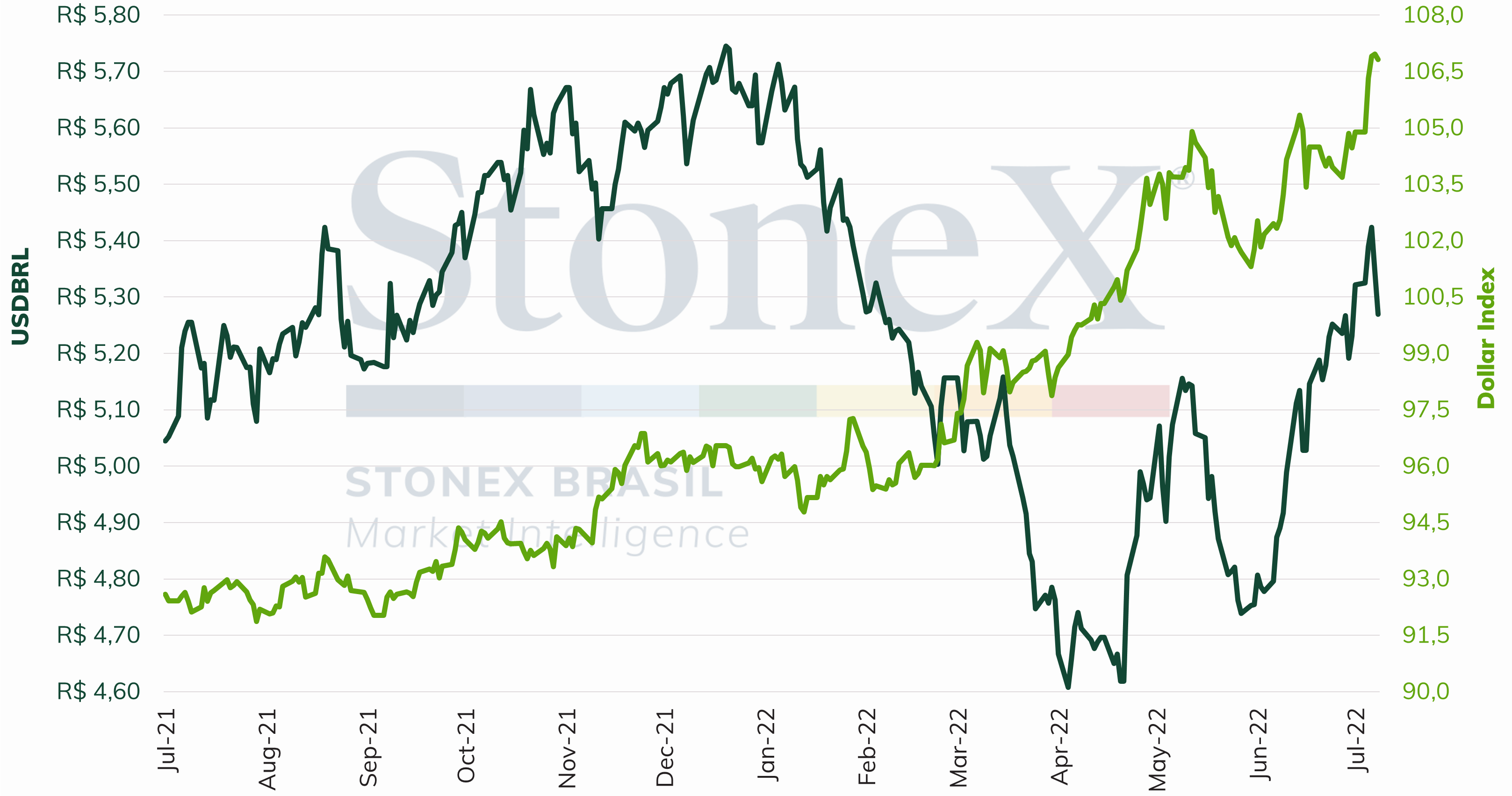
Last week, markets around the world traded in tune with the evolution of expectations for the level of economic activity in advanced economies, especially with the prospects for the next steps of the American central bank.
The release of the minutes of the Federal Reserve's Federal Monetary Policy Committee (FOMC) monetary policy decision, referring to the meeting held on June 14 and 15, brought mistrust among investors. With no major news and reinforcing the clear message that the central bank will act firmly to control inflation, the document was seen as out of context by the market, given the publication of weaker economic activity figures and the growing fears of a recession in the American economy since then. As a result, some agents started to consider that the Fed may not have room to follow a significantly restrictive monetary policy and control the acceleration of prices in the country without sacrificing the economy's growth or the level of jobs in the process.
On Thursday, statements by FOMC member Christopher Waller and St. Louis Fed President James Bullard reinforced the monetary authority's inclination to follow through with a further 75 basis point adjustment at the meeting later this month and also stated that they consider it appropriate to take the prime rate to 3.5% p.a. by the end of 2022. It will be important to follow the statements of the other Fed members this week to verify if the strong intensity of monetary tightening continues as a unanimous opinion among the collegiate.
On Friday morning, the employment situation report showed a much more robust scenario for the American labor market than what had been priced in until then and once again favored the bets on a more contractionary stance by the Fed. The report counted the opening of 372,000 new jobs in June, only slightly below the number observed in May, of 384,000, but exceeding the median of analysts' estimates of 270,000 hires. The resilience in the generation of jobs in the country favors the reading that the Federal Reserve may act intensely to stabilize the price level in its decision on July 27, practically confirming the conditions for an increase of 75 basis points in the interest rate to a range of 2.25% to 2.50%.
In contrast, the follow-up of first-time claims for unemployment benefits released each Thursday by the Department of Labor (DOL) has suggested a slightly less virtuous dynamic in the US labor market. First-time claims for unemployment benefits reached 235,000 in the week ended July 2, their highest level since January and above the median of analysts' estimates at 230,000. The indicator points to a gradual increase in dismissals; this can be confirmed by looking at the trajectory of the four-week moving average of unemployment insurance claims, which has advanced consistently since April this year.
Economic indicators for the United States should be more in the spotlight this week. In particular, worthy of attention are the Consumer Price Index (CPI), which is scheduled for Wednesday (13), the Producer Price Index (PPI), which will be released on Thursday (14), and the price indexes for exports and imports on Friday (15). The median of market expectations points to a 1.1% increase in the CPI in June, a slight acceleration compared to the +1.0% variation computed in May, taking the accumulated 12-month rate of the indicator to 8.8% – its highest value since January 1982. Likewise, the PPI, which precedes consumer inflation, is estimated by economists at a monthly increase of 0.8% for June, repeating what was seen in May and taking the annual variation to +10.7%.
The evolution of the activity level and possible indications of a slowdown in the US economy may be followed by the update of the retail sales and industrial production figures, both for June, and the consumer confidence forecast measured by the University of Michigan for July. This set of indicators will be among the last to enter the Federal Open Market Committee (FOMC) reading for its July 26-27 meeting.
China
Recently, new Covid-19 outbreaks have again affected the outlook for the Chinese economy's rebound. From July 1 to July 7, 325 new disease cases were reported, eight times the number recorded 15 days earlier. Shanghai, which had been easing restrictions after a prolonged lockdown, recorded 45 new infections recently, maintaining concerns about a possible reversal in the city's reopening plans.
Seeking to offset the economic impacts of the country's zero Covid policy, the Chinese Ministry of Finance announced that it is considering allowing local governments to issue bonds to fund infrastructure works starting in the second half of the year. The anticipated 1.5 trillion yuan ($220 billion) would correspond to the anticipation of next year's bond issue quota.
The economic agenda reserves relevant indicators for China for next week, including the release of the trade balance data, with expectations of a slowdown in the growth of exports (from 16.9% in May to 12.0% in June) and in demand for imports (from 4.1% to 3.9%). Important data about the activity level, such as second-quarter GDP, industrial production, and retail sales in June, are also expected.
Cenário Doméstico
In Brazil, the political news, with the advancement of the PEC for income transfer programs and its approval in a special commission in the Chamber of Deputies, dominated the attention during most of the week, amid concerns about the deterioration of the country's fiscal statistics. Leaders of the House and allies of the government adopted a series of measures to ensure the speed of the process and get the benefits provided in the proposal to the population as soon as possible. The president of the Chamber of Deputies, Arthur Lira (PP-AL), signed the order that links the PEC recently approved by the senators to the PEC on Biofuels, which was already being processed in the House to skip some steps and gain more agility for its conclusion. The highlight suggested on Monday (4) by the rapporteur of the proposal in the Chamber, Deputy Danilo Forte (União-CE), about the creation of a benefit of up to BRL 200.00 for app drivers was also disregarded so that once approved in the House, there is no need for the PEC to return for a new vote in the Senate to create several benefits less than three months before elections, with an estimated cost of BRL 41.25 billion that does not respect the spending cap rule or provide any counterpart on the revenue side, the text creates a state of emergency in Brazil, a maneuver used to evade the electoral law, which prohibits the creation or expansion of social programs in an election year.
The expansion in the imbalance of public accounts and the debt tends to be accompanied by the demand for a higher risk premium by investors, which, in turn, may weaken the flow of foreign capital to the country and the BRL.
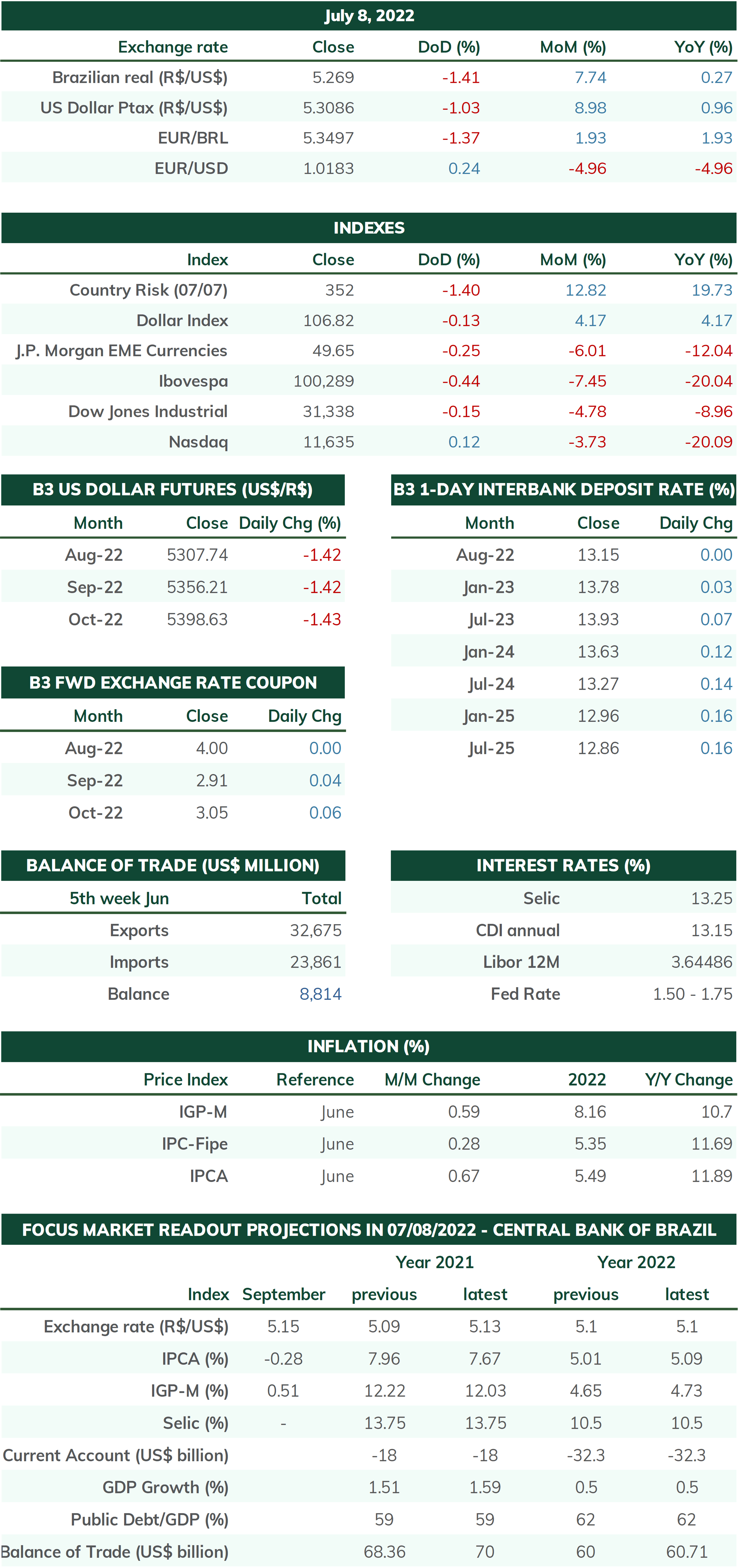
The release by the IBGE on Friday of the National Broad Consumer Price Index (IPCA) revealed that prices rose 0.67% in June, in line with what had been expected by the market, but once again indicating acceleration by surpassing the 0.47% rise posted in May. With this, the accumulated figure for the last 12-month period advanced from 11.73% in the previous month to 11.89%, marking the tenth consecutive double-digit month for the index. The higher comparative bases suggest that the accumulated 12-month accumulated IPCA should be able to retreat somewhat over the next few months. However, it will still close 2022 significantly above the 3.5% p.a. target established by the Central Bank of Brazil.
It is also worth mentioning that last week saw the end of the strike by the Central Bank's servers, with the monetary authority resuming the publication of some of its main indicators after a three-month interruption. On Friday morning, the Central Bank released the Focus Bulletin referring to market expectations up to July 1. The document showed an improvement in the agents' projections for the IPCA at the end of this year, at 7.96% against bets of 8.89% four weeks earlier, but forecasts for 2023 increased from 4.39% to 5.01% over the same period. Expectations for GDP growth this year have risen to 1.51% from 1.20% in early June, but with slower growth for the Brazilian economy in 2023, from 0.76% to 0.5%. The Focus also suggests that the year will end with a basic interest rate (Selic) of 13.75% p.a., requiring a further 0.5 p.p. increase until December.
Among the highlights for next week is the vote on the PEC of income transfer programs in the Chamber of Deputies, which should happen next Tuesday (12). The attempt to vote last Thursday (7) was postponed by the president of the House, Arthur Lira (PP-AL), due to failure to achieve quorum. Of the 513 deputies, only 427 were present, which, in the evaluation of the parliamentary, offered a tight margin since 308 votes in favor are required for approval of a proposed constitutional amendment. The measure is expected to be approved by next Friday (15), before the parliamentary recess, which starts on July 17.
There is also the expectation that the Executive will publish through a decree a package of measures to stimulate the recovery of industrial activity in the country and attract investments. According to media sources in the government, the initiative, already in an advanced stage of preparation, would be presented in the form of a Provisional Measure (MP), with disclosure expected before the elections, and would be divided into three axes: (i) incentives for the installation of semiconductor companies, (ii) simplification of tax payments with the replacement of the Reintegra program, and (iii) new regime for the deduction of depreciation from the Social Contribution on Net Income (CSLL) calculation basis, instituting "super-accelerated" depreciation.
In the schedule of economic indicators, the highlight is the release of the Monthly Survey of Services and the Monthly Survey of Trade by IBGE on Tuesday and Wednesday and the Central Bank's Economic Activity Index (IBC-Br) for May on Thursday. In addition, the Central Bank of Brazil is expected to resume updating the data for the exchange rate flow in the country.