Foreign Scenario
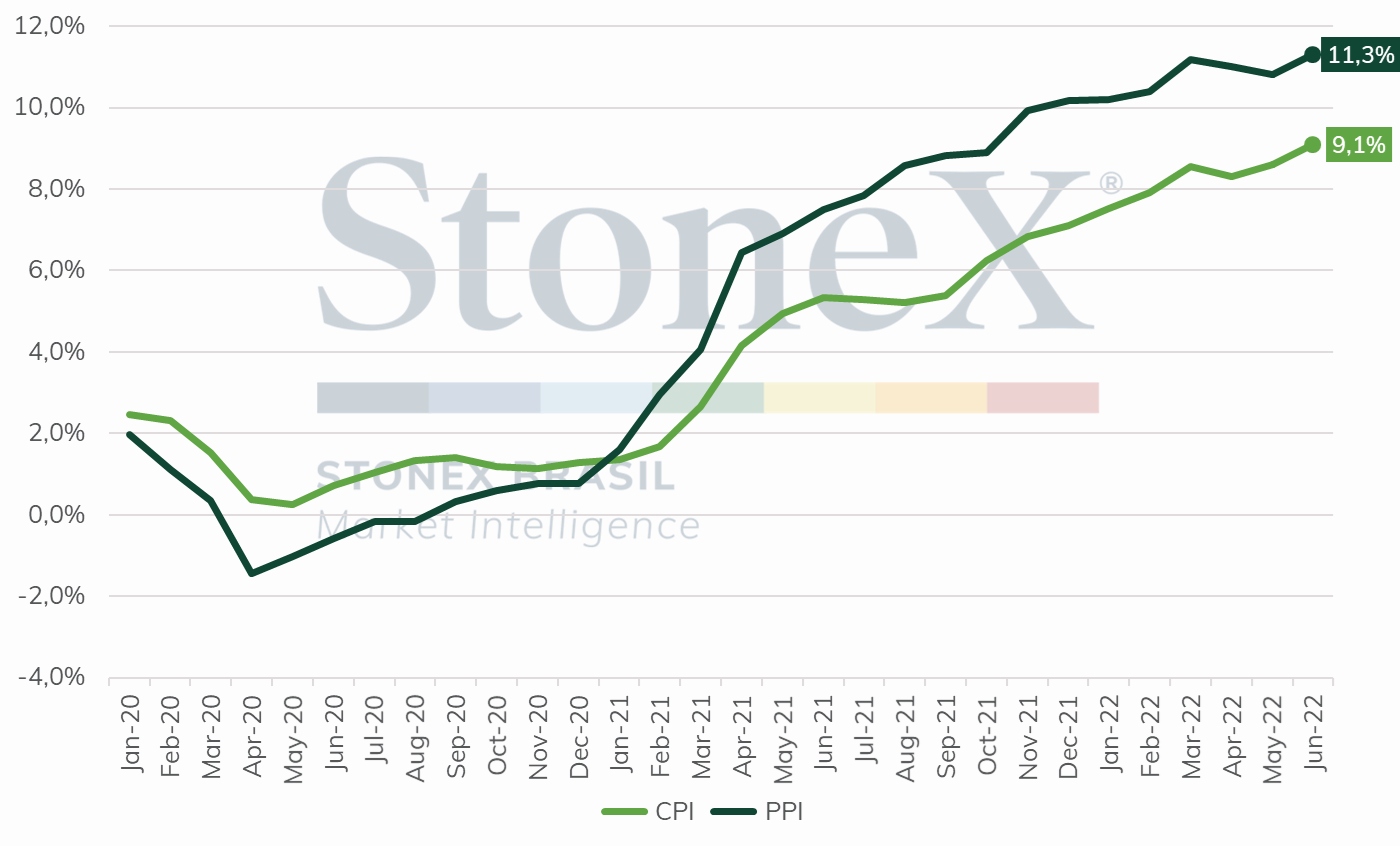
This week, attention should turn to the release of the US Consumer Price Index (CPI) and Producer Price Index (PPI) for July. The median of estimates shows that there should be a slight monthly slowdown for both indexes, reducing the accumulated over twelve months by a few points. However, it is not expected that there will be a change in expectations due to these readings. There has been much debate recently about the possibility of a short-term economic recession in the country, and the consensus is still far from reaching. An unexpected drop in the US Gross Domestic Product (GDP) in the second quarter and the gradual increase in weekly unemployment claims have strengthened the arguments of those who believe that an economic slowdown will come soon. However, this week, the release that the country generated a positive balance of 528,000 new jobs in June, more than twice as anticipated by analysts, seemed to show that, at least momentarily, the US economy remains in expansion. The great question for investors is how the Federal Reserve (Fed) will act in the coming months, whether it will maintain a rigid monetary tightening process or reduce the pace of interest rate hikes. A more heated economy favors price acceleration and, in theory, demands higher doses of interest rates to contain inflationary rates. At the same time, a slowdown in economic activity contributes to the cooling of prices and allows for a softer Fed stance.
US CONSUMER PRICE INDEX (CPI) AND PRODUCER PRICE INDEX (PPI) 12-MONTH PERCENTAGE CHANGE
Source: Federal Reserve Bank of St. Louis. Design: StoneX.
In Europe, although the nature of the conflict between Russia and Ukraine remains that of a war of attrition, with minimal territorial advances for both sides, a predominance of defensive positions, and much artillery exchange and bombing (especially by the Russians), its geographic focus has shifted significantly in the last two weeks. The intensification of counterattacks by Ukrainian troops in the south of the country, on the axis between Mykolaiv, Kherson and Zaporijia, has forced the Kremlin to move battalions from the Donbas region in the east to the south. Consequently, the Russian advance to the east, significant in recent months, has been virtually halted. The southern region is of vital strategic importance to both sides. For Kyiv, it means regaining an important port region and demonstrating its military forces' competence. For Moscow, it means maintaining its ambitions of isolating Ukraine from its maritime access and leaving open the possibility of integrating its territory with Moldova's separatist Transnistria region.
Last week, the first vessel was able to leave the port of Odesa for Lebanon under the terms of the maritime agreement between Russia, Ukraine, Turkey, and the United Nations. The ship, flying the flag of Sierra Leone and loaded with corn, was jointly inspected in Istanbul. Seventeen other vessels are said to be ready to sail, but there is no timetable for when this may occur. Russia, which had already attacked port infrastructure in the port of Odesa less than 24 hours after signing the understanding, attacked the port of Mykolaiv, reinforcing analysts' doubts about its intention to honor its agreements. Apparently, for Moscow, the biggest interest is to use global food insecurity to maximize pressure on Western nations to reduce sanctions on their economy. As the editor-in-chief of the RT media group, Margarita Simonyan, said at the June International Economic Forum in St. Petersburg, "all our hope is in the famine."
Finally, it is important to note the increased tensions between Taiwan and China following the visit of US House Speaker Nancy Pelosi to Taiwan. She is the most senior US official to visit the country since 1997. Her arrival was met by angry responses from Chinese diplomacy, in addition to the largest air and naval military exercises with live ammunition and conventional ballistic missile tests across the strait in history. Diplomatic relations between the United States and China are being soured in the episode, with both countries' governments summoning the other side's diplomats for explanations and rebukes. In addition, Beijing has broken off dialogues with Washington on climate issues and maritime and military security. The dialogue between the nation's military leaders is important precisely so that, in moments of crisis, there can be conversations that reassure the parties about what is (or is not) happening, increasing the possibility that a mistake in a military exercise will provoke a response from the other side.
Domestic Scenario
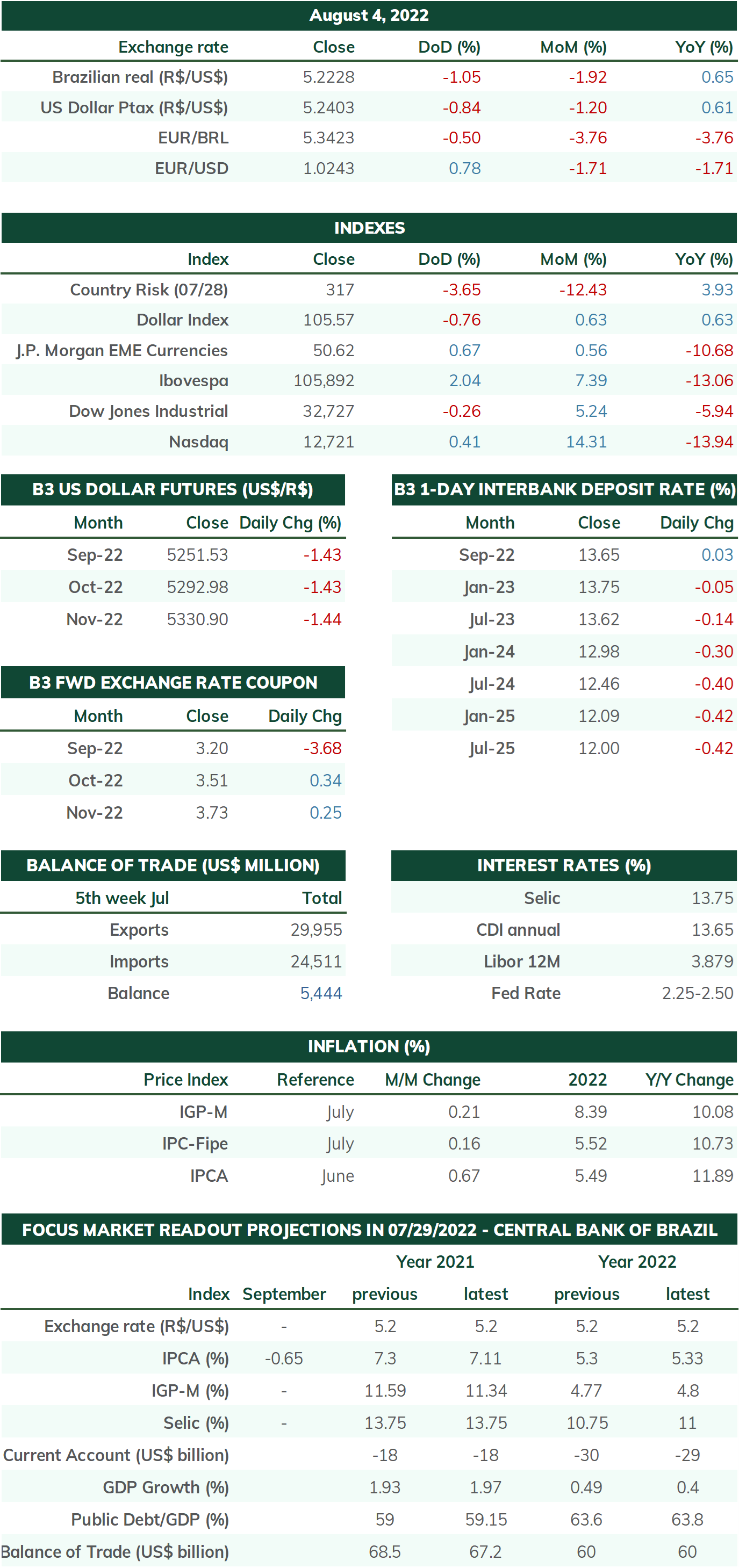
This week, attention should be turned to the minutes of the decision by the Monetary Policy Committee (Copom), which readjusted the basic interest rate (Selic) from 13.25% p.a. to 13.75% p.a. last Wednesday. Although market agents had widely anticipated this increase, the Committee did not dispel doubts about the next steps of the country's monetary policy when it wrote that "it will evaluate the need for a residual adjustment, of a smaller magnitude, in its next meeting." Today (05), the interest rate futures market bet a majority (58.50% of the bets) that the Central Bank (BC) will keep the Selic rate steady in the September 21 decision, while others bet on an increase of 0.25 p.p. (35.00%) or of 0.50 p.p. (3,97%).
The readings for the National Broad Consumer Price Index (IPCA) for 2022 should significantly decelerate due to the federal government's recent tax subsidies. In this sense, the median estimates for the July IPCA reading, which will be released next Tuesday, stand at -0.65%. However, there is uncertainty about how the Committee will behave given the continued deterioration of inflationary expectations for 2023. Therefore, it seems that the chosen stance is to observe how prices will behave in the current level of monetary tightening, even if there is a risk of unanchoring expectations for longer terms.
This week, production activity indicators will also be released, allowing for a more up-to-date reading of the current economic conditions of the Brazilian economy. In addition, the June publication of the Monthly Trade Survey and the Monthly Services Survey is noteworthy. While the volume of services had a more erratic behavior in 2022, with three months of expansion and two of fall, retail showed growth in the five months of this year.
Finally, it is worth noting the strong trade account surplus for June, updated by the Central Bank last Wednesday (03), the best monthly result since May 2013. Despite the month having presented a deficit of USD 3.665 billion in the financial account (and an accumulated deficit of USD 5.167 billion in the first semester), this figure is more than offset by the USD 10.148 billion surplus for June (which contributes to the positive balance of USD 16.864 billion for the semester). The main factor explaining this strong result was the sustained increase in prices of food, metal and energy commodities, which favor national export revenues.