Foreign Scenario
This week, attention is turned to the European economy with monetary policy decisions by the European Central Bank. The institution finds itself in a complex dilemma as it is increasingly likely that the continent will experience an energy crisis that is likely to cause deep economic stagnation on the one hand and worsen the acceleration of prices on the other. In speeches and talks over the past few weeks, the authorities that make up the central bank have signaled that they intend to raise interest rates rapidly, in high magnitude adjustments, to contain inflation as much as possible. Thus, the debate for next Thursday has been whether the decision will be a hike of 0.50 p.p. or 0.75 p.p.
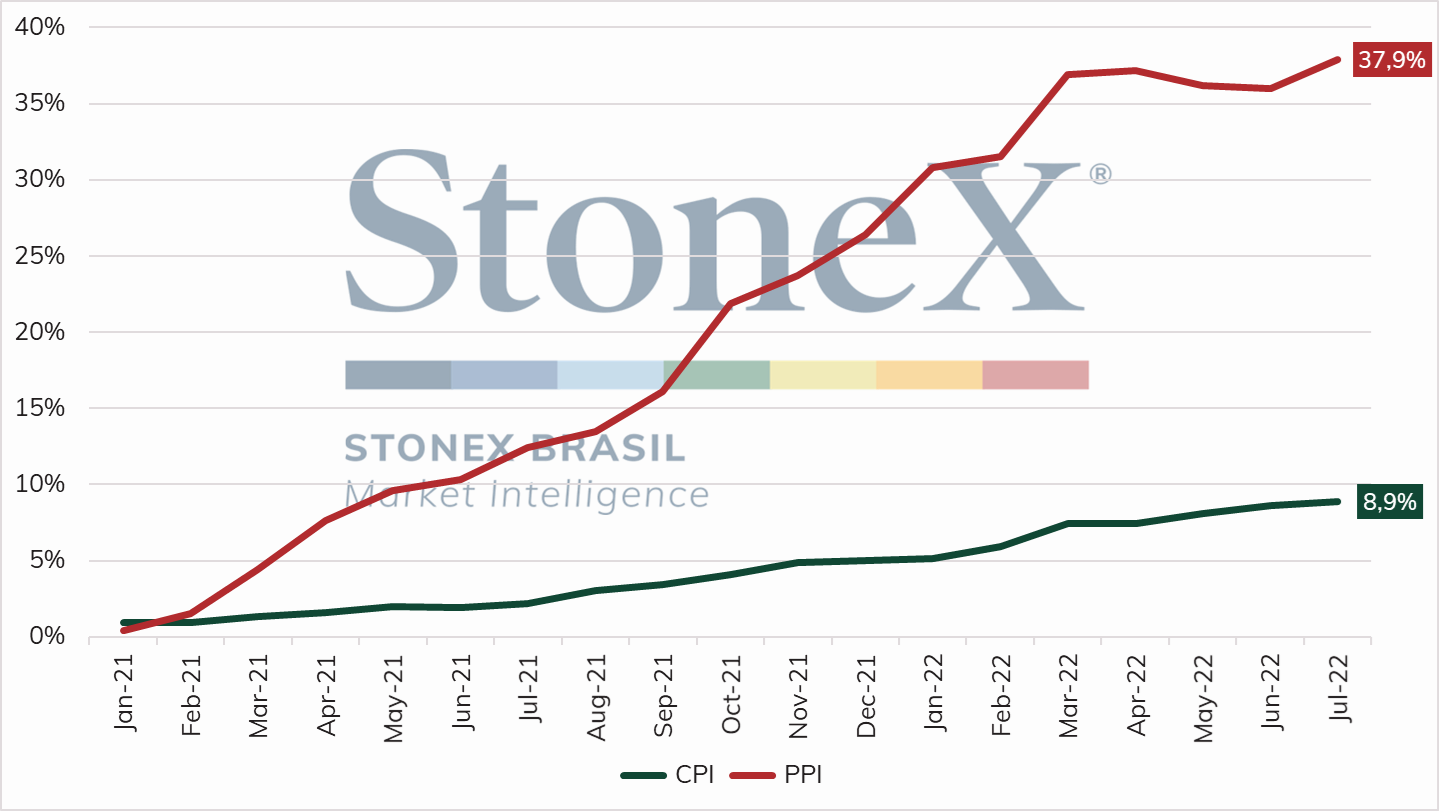
This week, energy security for the European winter became even more uncertain. After already reducing the flow of natural gas through the Nord Stream 1 pipeline to 20% of its maximum capacity, citing problems in its turbines, Moscow halted the supply for three days this week for exceptional maintenance and then suspended it indefinitely, citing mechanical problems. Although stock levels of the input are close to 80% of the total capacity for the European Union, continuous supply is essential to ensure the availability of the input during the winter months. One of the consequences of the uncertainty about the supply of this raw material is the sharp increase in natural gas prices and, as a consequence, in electricity costs, which can be seen in the difference between the price indexes for producers (free) and consumers (tighter).
US CONSUMER PRICE INDEX (CPI) AND PRODUCER PRICE INDEX (PPI) 12-MONTH PERCENTAGE CHANGE
Source: Eurostat. Design: StoneX.
In the US, after Monday's holiday, the most relevant event will be the publication by the ISM institute of the Purchasing Manager's Index (PMI) for the services sector for August. After the industrial PMI remained stable at 52.8 points, contrary to analysts' estimates, whose median pointed to a reduction to 52.0 points, most analyses foresee a reduction in the services PMI from 56.7 points in July to 55.5 points in August, i.e., a slower expansion of the sector.
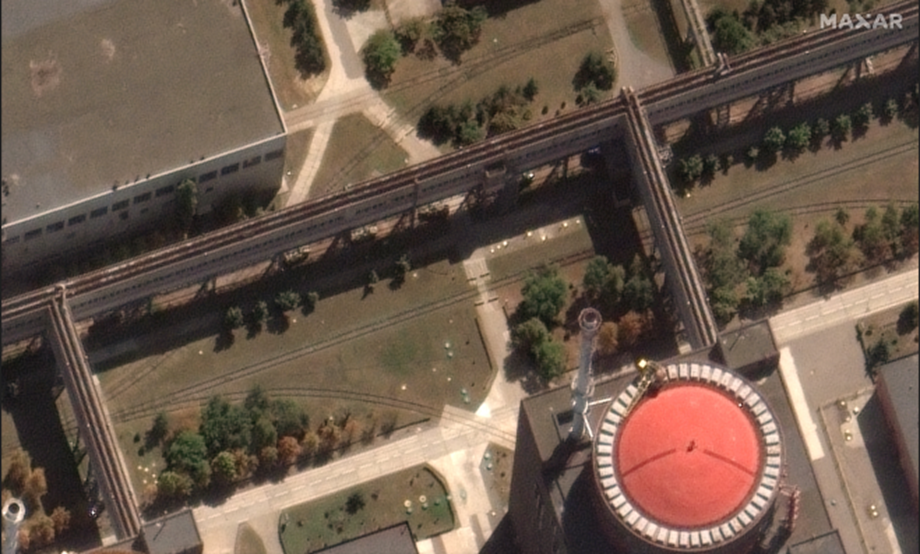
Regarding the war between Russia and Ukraine, this was another week in which the territory lines remained practically immobile, with defensive positions and artillery exchanges between the parties predominating. Of note is the exchange of narratives about the alleged bombing around the Zaporizhzhya nuclear power plant. Both accuse each other of attacking the plant's surroundings, denying it. On August 29, the company Maxar Technologies released satellite images showing Russian combat vehicles supposedly sheltering under the infrastructure at the Zaporizhzhya nuclear power plant and very close to one of the reactors (red dome). Several military analysts claim that Moscow has been launching artillery strikes from the region, which increases the chances of the plant being hit in a counterattack.
Russian combat vehicles near one of the reactors at the Zaporizhia nuclear power plant
Source: Maxar Technologies
The recent military aid packages announced by the US for Ukraine are also worth mentioning, which reaffirm the prospect of a long-lasting conflict. Firstly, there is the inclusion of various equipment that has not been supplied so far, such as specialized missiles for attacking radar systems, armored vehicles for detonating mines, light tanks, and antitank artillery cars. The package also mentions ordering various equipment and services directly by Ukraine (with external funding) to replenish its army, which will take months, or even years, to produce and deliver. This could signal both a concern about Ukraine's stockpiles of armaments and preparation for a long-term war. Likewise, one could interpret that the US's ability to supply equipment wholesale is running out.
In China, tensions with its neighbor Taiwan are running high. After weeks of military air and naval exercises by Beijing that challenged the current border lines between the nations, the Taipei government has declared that it will counterattack any armed force that invades its territory. The Taiwanese military fired on drones flying over the island last Tuesday (30) and Thursday (01), highlighting the possibilities of a confrontation in the event of a mistake by either side. The Chinese government insists on treating Taiwan as its territory and disrespecting its autonomy.
Finally, it is worth noting that investors fear further confinements brought about by China's zero-tolerance policy against Covid-19. The city of Chengdu, the economic center of the southwest with a population of 17 million, has announced a mandatory 4-day lockdown to contain the growing number of cases in the city. At least 28 cities are under partial or total mobility restrictions because of the disease, and all provinces in the country have recorded cases this week. According to official statistics from the Chinese Centers for Disease Control, 3.43 billion vaccine doses have been administered as of August 30, which would be enough to fully immunize 1.268 billion people or 90.5% of the population. However, the authorities worry that the vaccination rate for the elderly above 80 years old is estimated to be approximately 60%, well below the average.
Domestic Scenario
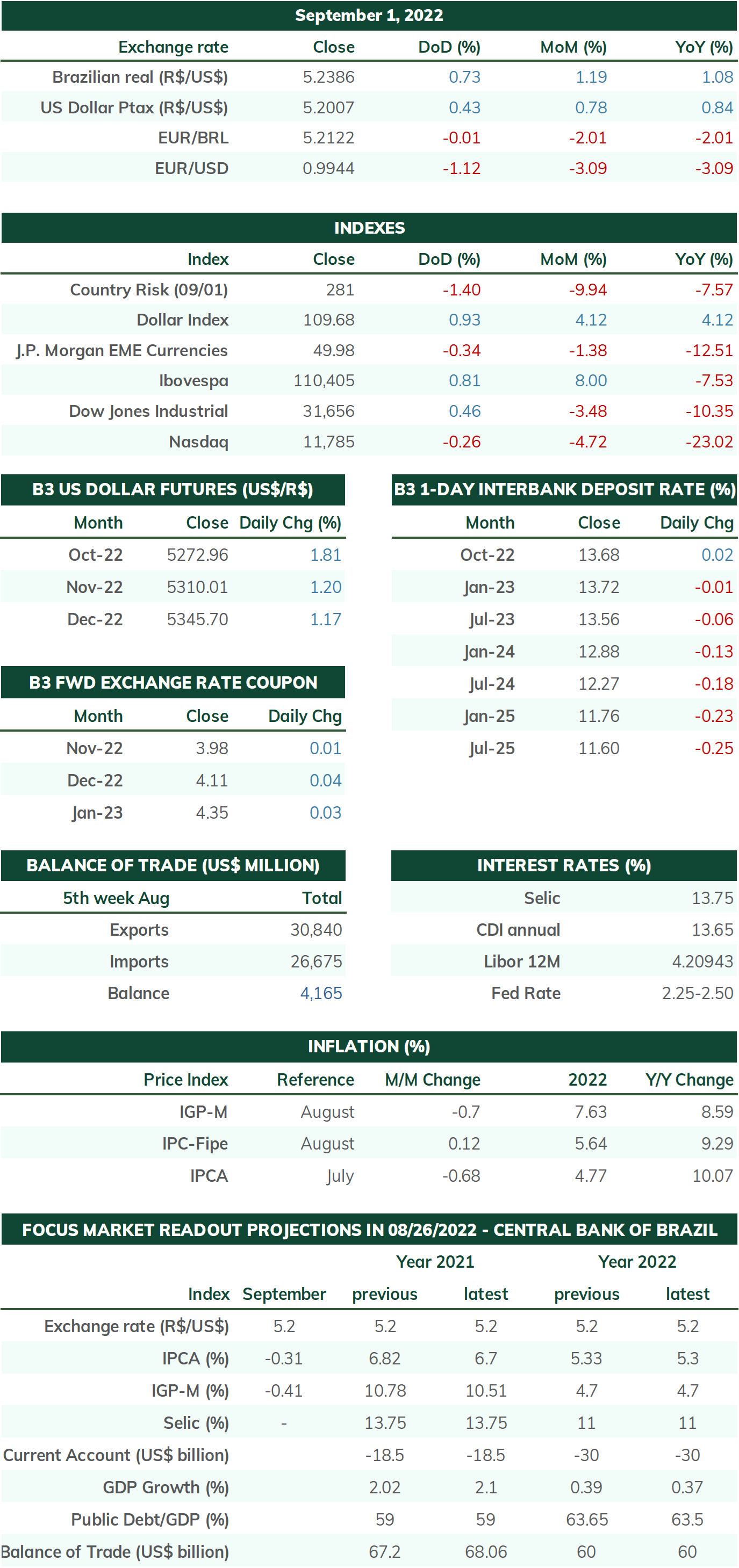
This week will bring a few indicators for the Brazilian economy, highlighting August's National Broad Consumer Price Index (IPCA). The median of the estimates collected by the Focus bulletin from the Central Bank is that the index will present deflation of 0.31%, bringing the accumulated figure for 12 months to 8.8%. The federal government's recent subsidies to the fuel, electricity, communications, and public transportation sectors and Petrobras' reductions in the price of gasoline at the refineries should promote the second monthly deflation in a row. However, other categories of goods, such as food and beverages, should register an increase from July to August.
It will also be important to note the celebrations of the 200th anniversary of the Independence of Brazil on September 7 and the potential tension between the branches of government. Last year, the president of the Republic, Jair Bolsonaro, had already used the date to call for popular mobilizations and attack democratic institutions, especially the Supreme Court and its ministers. However, after the terrible repercussion, the president released a statement two days later, backing away from his more confrontational tone. Now in second place in the polls with less than 30 days to go before the first round of the elections, Bolsonaro again called on his supporters for "transparency and freedom," and investors will monitor whether there are any new anti-democratic demonstrations.