Foreign Scenario
This week, attention will be on the inflation readings for August in the United States and Europe. Financial markets have been greatly impacted by fears of a near-term slowdown in global demand brought on by persistently high and widespread inflation rates and rigid monetary tightening strategies by major central banks to regain price stability. In the US, the Consumer Price Index (CPI) and the Producer Price Index (PPI) are expected to fall slightly in August, mainly due to the decline in international oil prices. However, a slight increase is expected in the "core" of the indicator, which excludes the volatile energy and food components, suggesting that the inflationary problem is not yet overcome.
Besides the price indices, this week, the retail sales and food services for August will be released, as well as the industrial production for the same month. Such indicators will allow for a more up-to-date assessment of the conditions of the American productive activity and if there are signs of impacts from the current policy of tightening financial conditions being implemented by the Federal Reserve. Recent data for the labor market suggest that the US economy remains in expansion, so most estimates point to growth, albeit moderate, for both indicators.
In Europe, the situation is more complex and challenging. The serious energy crisis continues to be the topic of most attention and debate since the continuous reduction of natural gas from Russia has caused the steep rise in prices for this input and, as a consequence, strong cost pressures in the production of thermoelectric power, chemical products, and steel products. This week, the European Union, Britain, Switzerland, Finland, Sweden, and Germany released details of tax proposals designed to soften the impacts of the crisis on companies and consumers. Among the measures proposed, one can highlight emergency credits for power generators to avoid bankruptcy, tax subsidies to ease the rising electricity costs and the imposition of price caps for final consumers.
Finally, it is noteworthy that the International Atomic Energy Agency (IAEA) has issued a report on the situation at the Zaporijia nuclear power plant in Ukraine and confirmed several aspects previously warned by military analysts about the Russian occupation compromising the safety of the site. While the report does not seek to lay blame and focuses on charging "all relevant parties" to ensure the safe operation of the plant throughout the conflict, it specifically notes the presence of military equipment in the cooling turbines and around the plant, points out that the plant's operational staff are denied access to the local emergency center, which is occupied by the military, and need permission to access some technical areas of the plant, such as the cooling ponds, and cites the possibility of interference in decision-making by the presence of officials from Russia's state atomic energy agency (ROSATOM). With frequent reports of artillery attacks being fired from the vicinity of the plant, the risk of an emergency occurring and an inadequate response provoked by the presence of Russian troops is not negligible.
Domestic Scenario
In Brazil, this week's highlight will be the data for the Brazilian productive activity. After announcing deflation for August and a higher-than-expected growth for the second quarter Gross Domestic Product, analysts are waiting for information about retail sales and volume of services for August, as well as for the publication of the Central Bank's Economic Activity Index (IBC-Br) for the period. The expectation is that there will be a statistical carry from the July performance, implying growth for services and the IBC-Br, but retraction for retail.
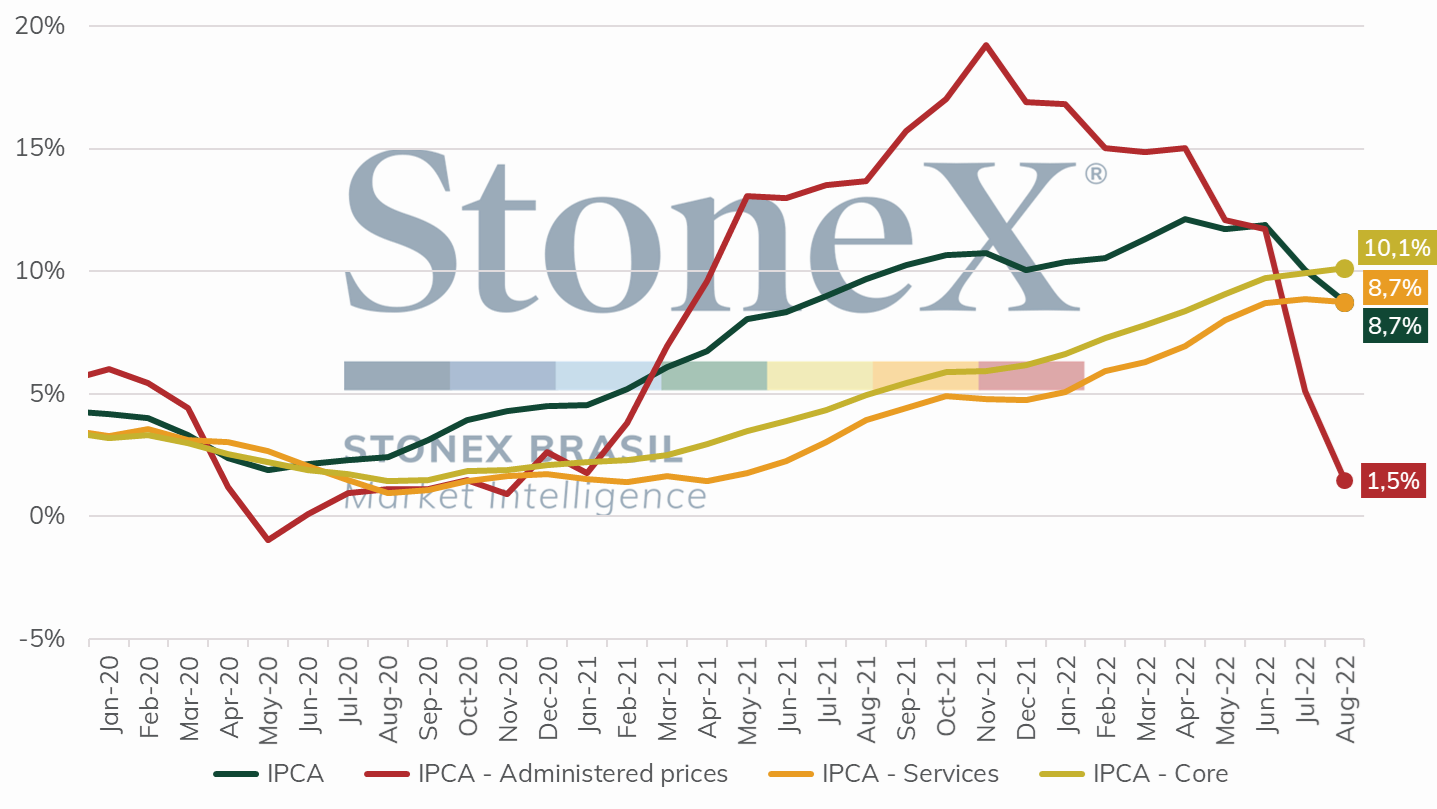
This week the National Broad Consumer Price Index (IPCA) showed a negative variation for the second consecutive month, going from -0.68% in July to -0.36% in August, accumulating a high of 8.73% in 12 months, the lowest accumulated figure since June 2021. However, this deflation was the result of the significant drop in commodities prices with considerable weight in its calculation, namely, fuels – gasoline (-11.64%), hydrous ethanol (-8.67%), diesel oil (-3.76%) and vehicular natural gas (-2.12%) – and residential electricity (-1.27%). These products, in turn, still reflect federal and state tax subsidies issued by the government in July and the drop in Petrobras' fuel prices at its refineries. When one checks these five items' total impact on the August IPCA, one observes a reduction of -0.80% in the index. In other words, by removing these products from the August inflation calculation, the result would be an increase of 0.44%. Another way to view this information is through the "core" of the IPCA, which removes the more volatile components of energy, fuel, food, and beverages from the calculation. Looking at the accumulated increase over 12 months, while the total IPCA retreats in August to 8.73%, its core remains in expansion to 10.12%. Monitored prices, which include fuels and electricity, dropped to 1.46%.
Inflation readings for Brazil (accumulated over 12 months)
Source: IBGE - Brazilian Institute of Geography and Statistics. Design: StoneX.
Finally, with the proximity of the elections, investors should follow the next polls, especially Datafolha on Friday (09), Ipec next Monday (12) and Genial/Quaest next Wednesday (14). Since they are carried out in person, they are more closely monitored by the parties. The aim is to observe whether the tone considered more moderate by President Bolsonaro in the September 7 demonstrations will reduce his distance from the frontrunner, former President Luiz Inácio Lula da Silva, and take the election to the second round.