Foreign Scenario
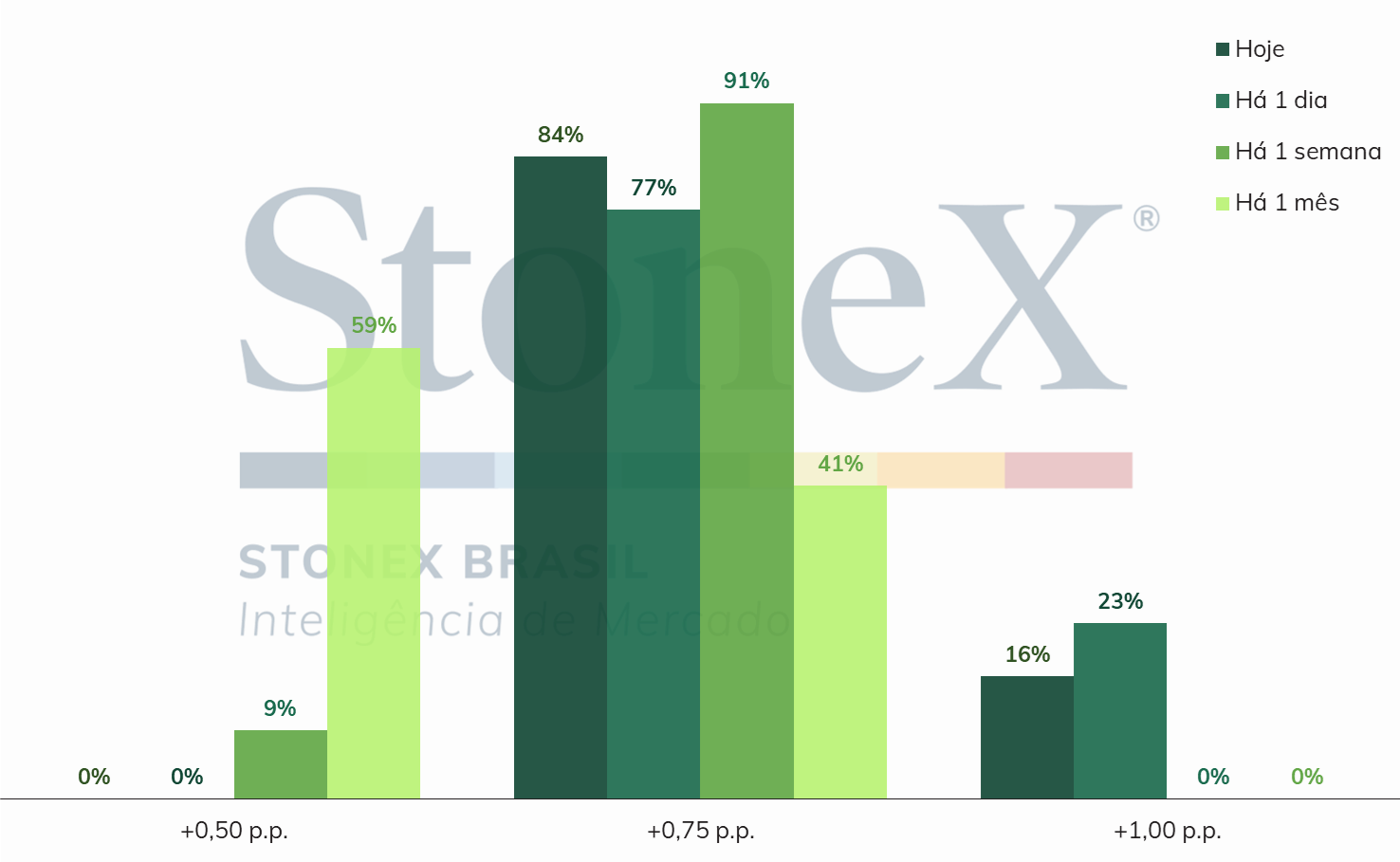
This week, the focus will be on the monetary policy decision of the Federal Reserve’s (Fed) Federal Open Market Committee (FOMC). Last week, investors started to bet (albeit in the minority) on the possibility of a very rare 1.00 p.p. readjustment in the reference interest rate after a sequence of indicators suggested that economic activity, the labor market and inflation (especially its "core") remain in expansion in the country, in such a way that the central bank needs to be more forceful in its monetary tightening to be successful in restabilizing prices. As a result, the FOMC will have to balance the risks of excessively slowing economic activity, should it opt for a 100 basis point increase, with the risks of a detachment from inflationary expectations, should it opt for 75 basis points.
Bets for the Federal Reserve's interest rate decision on September 21
Source: CME FedWatch Tool. Design: StoneX. Futures market's interest rate probabilities as of September 16, 2022
This week, the focus will be on the monetary policy decision of the Federal Reserve’s (Fed) Federal Open Market Committee (FOMC). Last week, investors started to bet (albeit in the minority) on the possibility of a very rare 1.00 p.p. readjustment in the reference interest rate after a sequence of indicators suggested that economic activity, the labor market and inflation (especially its "core") remain in expansion in the country, in such a way that the central bank needs to be more forceful in its monetary tightening to be successful in restabilizing prices. As a result, the FOMC will have to balance the risks of excessively slowing economic activity, should it opt for a 100 basis point increase, with the risks of a detachment from inflationary expectations, should it opt for 75 basis points.
It will also be important to note the update to the FOMC members' economic projections, released in conjunction with the monetary policy decision, in particular, the dot plot chart, which marks what the appropriate interest rate is at the end of the year 2023, 2024, and 2025 in each Committee member's view. The median interest rate is expected to increase yearly, given that consumer prices also remained rising from June to September, with a final rate above 4% p.a. Moreover, the estimates for the Gross Domestic Product (GDP) growth and the unemployment rate are also noteworthy, as they reveal the authorities' view on the degree of stagnation required to contain the country's inflation.
This week will also see the release of the September manufacturing, services, and consolidated Purchasing Managers' Indexes (PMI), allowing for a preliminary reading of the production environment in the United States. The most recent data for the country has been mixed, but generally, it points to growth at a slower pace.
Monetary policy will also be in the spotlight outside the United States, as there will be decisions from several relevant Central Banks: Japan, England, Switzerland, Sweden and Norway (plus Brazil, Turkey and South Africa). In Europe, PMI forecasts will also be released, but the situation is much more complex than that of the US, with a downward trend in recent months. Moreover, with the deterioration of macroeconomic prospects in the eurozone, this trend should continue this week, with readings below 50 points (contraction) for manufacturing, services, and consolidated.
As for the energy crisis in the European continent, last week, the European Union (EU) presented more details about its plans to face the winter with a reduced supply of natural gas, proposing a price cap for both natural gas and electricity. However, such proposals need ratification by the countries that make up the EU. Moreover, some countries also fear that Russia may interrupt what remains of the supply through the other smaller pipelines, such as the Yamal (through Poland), the Brotherhood (Ukraine) and the Turkstream (Turkey). Still, Moscow's reactions are uncertain at this point.
Finally, it is noteworthy that Ukraine decided to shut down the Zaporizhia nuclear power plant because of the unsafe operations at the plant indicated by the International Atomic Energy Agency (IAEA) and the risks of an accident due to the constant artillery attacks from the site. This shutdown can be considered a tactical victory for Moscow since the plant generated 22% of the Ukrainian grid's total electricity. In addition, this week, the Russians intensified attacks on civilian infrastructure installations such as hydroelectric and thermal power plants and water distribution networks, interrupting electricity and water supply in several cities. On the other hand, Kyiv launched a successful counterattack in the northeast of the country, in the Kharkiv region, gaining more territory in one week than total Russia has gained in the conflict since April, as well as disrupting several secure logistical and communications supply lines.
Domestic Scenario
In Brazil, this week’s focus should be on the decision of the Central Bank of Brazil’s Monetary Policy Committee (Copom). The Copom option market indicates that approximately 60% of investors believe the basic interest rate (Selic) will be kept at 13.75% p.a., while around 40% of bets see an increase to 14.00% p.a. Although they have already signaled a preference for the end of the monetary tightening cycle at 13.75% p.a., the expectation of higher interest rates by the Fed, the release of robust indicators of economic activity for Brazil and the higher-than-expected expansion of the "core" National Broad Consumer Price Index (IPCA) could pressure the Copom authorities to promote a final readjustment.
This week should be empty of economic indicators. It is worth mentioning, however, that the first round of elections is coming up in two weekends (October 2). Last week saw another round of polls, with a lead for former president Luiz Inácio Lula da Silva over current president Jair Bolsonaro. The possibility of victory in the first round is still undefined, but there are indications that Lula will reach at least half of the valid votes. When looking at spontaneous voting intentions, when the interviewer does not present a list of candidates, Datafolha indicates 39% of the answers for Lula versus 31% for Bolsonaro, Quaest indicates 33% for Lula versus 29% for Bolsonaro, and Ipec indicates 44% for Lula versus 30% for Bolsonaro. It is also worth noting that a face-to-face survey of 2,100 people conducted between August 3 and August 13, released last week, revealed that 67.5% of people said they feared physical aggression because of their political preferences. Finally, this week will see two more polls with a face-to-face collection of responses, Ipec on Monday (19) and Genial/Quaest next Wednesday (21).