Foreign Scenario
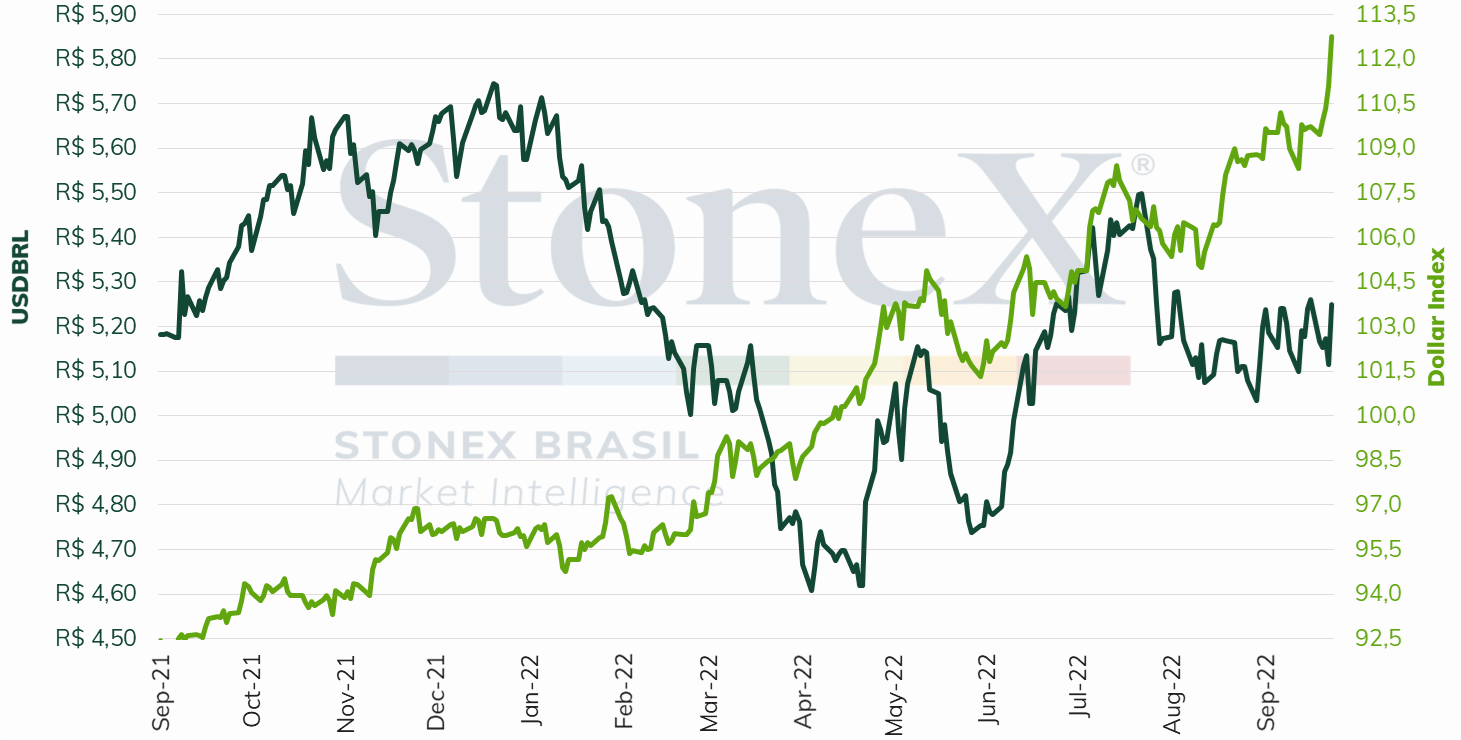
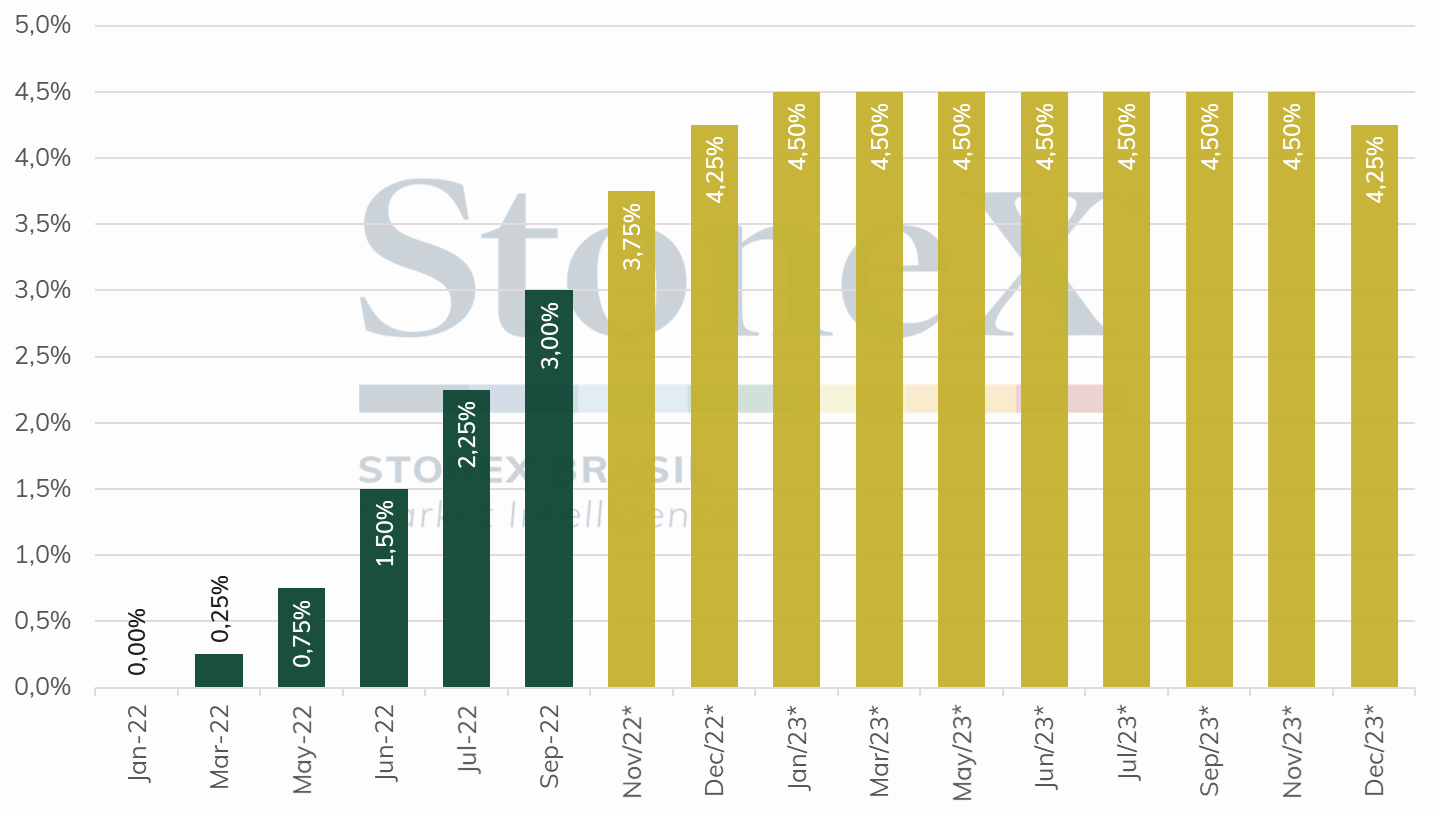
The focus this week is likely to be on the Federal Reserve's (Fed) officials' speeches after the institution's latest monetary policy decision, the press conference of its chairman, Jerome Powell, and the update of the Fed members' economic forecasts provoking a wave of risk aversion and search for safe-haven assets. The dollar has strengthened significantly against its peers, stock indexes have plummeted, and interest rates on American bonds have risen. The US central bank is committed to communicating to investors an unwavering commitment to containing rising inflation in the country, even if this may cause an economic slowdown and increased unemployment. Yet the forecasts released by the institution last week suggest only mild economic discomfort. At the same time, monetary tightening is expected to increase rigidly in the coming months. Thus, one imagines that the members of the Federal Reserve should be asked more about the degree of recession imagined for the coming years. Scheduled to speak this week are Fed Chairman Jerome Powell, Boston Fed President Susan Collins, Atlanta Fed President Raphael Bostic, Cleveland Fed President Loretta Mester, Chicago Fed President Charles Evans, St. Louis Fed President James Bullard, San Francisco Fed President Mary Daly, and New York Fed President John Williams.
US interest rate history and higher probability bets on the futures market
Source: CME FedWatch Tool. Design: StoneX. Futures market interest rate probabilities as of September 23, 2022
Also, in a week full of economic indicators, it is worth noting the release of the August Personal Consumption Expenditure (PCE) Price Index, the Federal Reserve's preferred metric for tracking consumer prices. Given that the Consumer Price Index unexpectedly rose in the period, especially in its "core" (which removes the more volatile categories of energy and food), it is expected that similar behavior will be observed for the PCE, with a slight rise in the full indicator and a higher rise in its core.
In Europe, European assets depreciated intensely this week after a sequence of unfortunate facts, such as an escalation of the belligerent Russian speech (explained below), Purchasing Managers' Indexes (PMI) indicating contraction for the eurozone and its major economies, and the prospect of an even more aggressive Federal Reserve. As a result, this week holds few indicators for the continent, the highlights being the Consumer Price Index (CPI) forecast and the unemployment rate, both for the eurozone. Nevertheless, the labor market is expected to remain resilient to the negative economic situation. Still, consumer inflation should continue to accelerate due to the serious energy crisis the European Union is going through.
In the war between Russia and Ukraine, as Kyiv consolidates its gains on the northern front of the country and Moscow struggles to reinforce its defense lines, Russian President Vladimir Putin gained the spotlight by giving a televised address to the nation in which he declared support for "referendums" to annex the four conquered regions of Ukraine (Kherson, Zaporizhia, Donetsk, and Luhansk), called for "up to" 300,000 reservists to act in the war, and made several threats to use nuclear weapons against the West. However, military analysts draw attention to what Putin did not say; he mentioned each of these topics at different times in his speech. Of course, a speech with these three factors suggests a link, but he took pains to avoid a direct connection between the topics.
The nuclear threat was made in response to an alleged "possibility and the admissibility of using weapons of mass destruction against Russia - nuclear weapons" that would have been made by North Atlantic Treaty Organization (NATO) countries, to which he replied that "if the territorial integrity of our country is threatened, we will use all available means to protect our people - this is not a bluff." The annexation referendums on the territory were mentioned later. The Russian leader did not explicitly state whether he would retaliate against an attack on the new Ukrainian territories with nuclear weapons. The context may infer that he would, but the connection is unclear. Finally, the Russian president did not directly connect the call for reservist troops with the invasion of Ukraine but stated that the Russian borders had expanded by more than a thousand kilometers and, therefore, more troops were needed.
Domestic Scenario
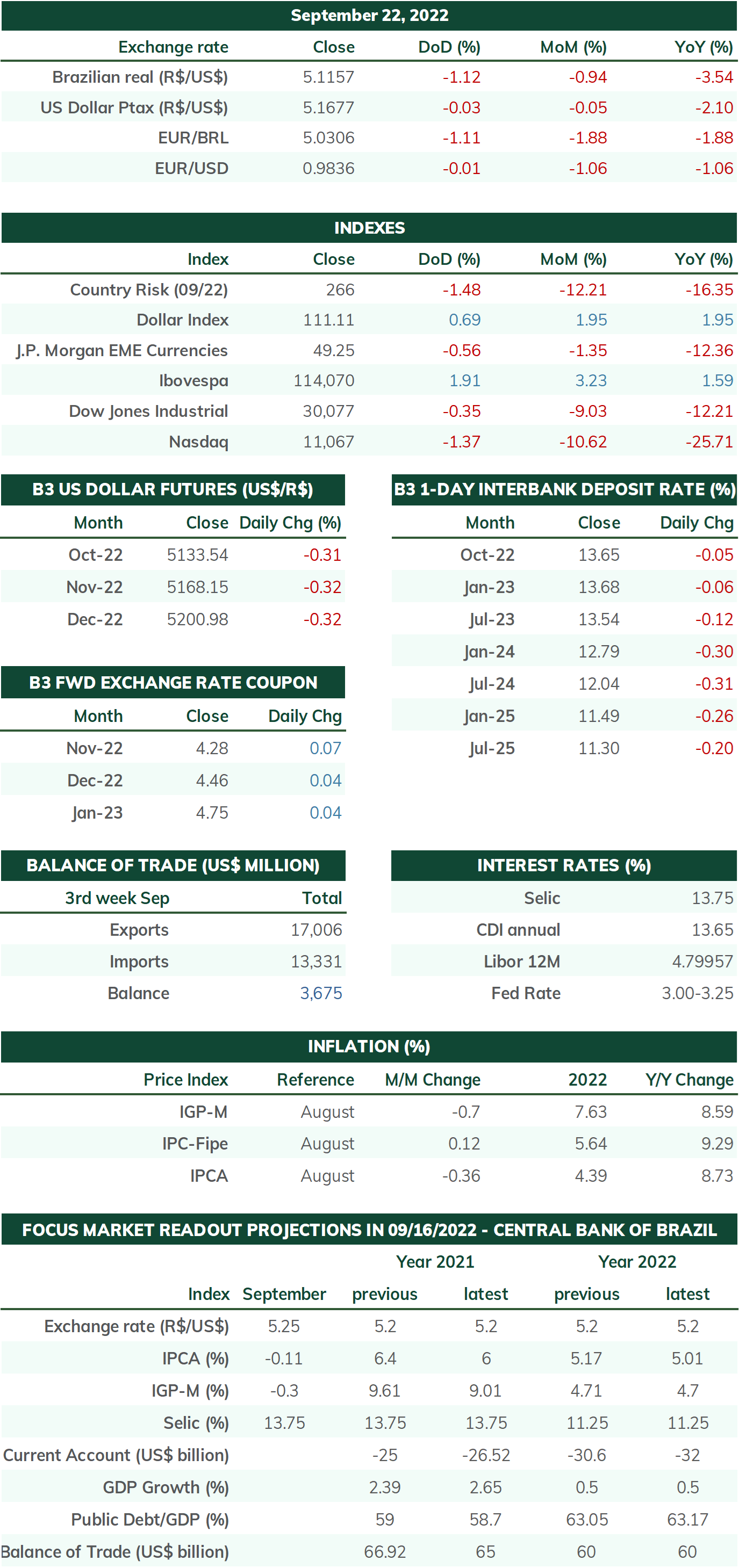
In Brazil, this week’s focus should be the decision of the Central Bank of Brazil’s Monetary Policy Committee (Copom). It has drawn analysts' attention that the decision to maintain the basic interest rate (Selic) at 13.75% p.a. was not unanimous, with two votes in favor of raising it to 14.00% p.a. The minutes may shed light on this divergence and clarify the option of ending the cycle of hikes even in the face of the continuous growth of "core" inflation in the country. It is also expected that the authority will explain how it views the trajectory of monetary policy now that it proposes to maintain interest rates at this level for the "relevant horizon," possibly commenting on what would be the criteria for initiating a reduction in the future.
In addition, this week, the Central Bank will publish its quarterly inflation report, which presents an in-depth analysis of the domestic and international economic scenario and expectations for prices in the coming years. Furthermore, with the publication of fiscal and foreign sector statistics, the Central Bank should provide a comprehensive reading of the current conjuncture.
Also worthy of note is the publication of the National Broad Consumer Price Index - 15 (IPCA-15) and the General Price Index - Market (IGP-M). Both should show a deceleration of prices, motivated mainly by the drop in fuel prices in the period under survey. On the other hand, the IPCA-15 should show an increase in categories such as food and services, while the IGP-M may reveal the impact of the recent hike in iron ore prices.
Finally, it is important to note that next week will be the last before the country's first round of presidential elections. Last week, a face-to-face Datafolha poll polled the largest sample: 6,754 people in 393 cities. It found that former president Luiz Inácio Lula da Silva had exactly 50% of the valid votes, making victory in the first round possible but uncertain. This week there will also be the debate between the candidates on Globo, traditionally the most watched and, therefore, with chances to define the race.