Foreign Scenario
Attention this week will be on the Consumer Price Index (CPI) and the Producer Price Index (PPI) for September in the US. With signs of an economic slowdown and a slight weakening of the labor market, there are huge expectations as to whether the price dynamics will show some moderation. Moreover, in recent weeks, the financial markets have shown enormous volatility due to projections about the future path of American interest rates, that is, whether the Federal Reserve (Fed) would maintain an aggressive pace of interest rate hikes even in the face of signs of retraction in productive activity or whether it would try to accommodate the objective of fighting inflation with that of sustaining the level of income and demand.
It is worth noting that investors are pondering the possibility of easing monetary tightening and balancing price stability with economic growth despite repeated statements by Federal Reserve officials to the contrary, that the US central bank will maintain its policy of restrictive interest rates until it achieves a consistent reduction in inflation. This week alone, one can highlight the speech by Fed Board of Governors member Philip Jefferson: “ I want to assure you that my colleagues and I are resolute that we will bring inflation back down to 2 percent. (...) we are committed to taking the further steps necessary.” From San Francisco Fed Chairwoman Mary Daly: The path is clear: we are going to raise rates to restrictive territory, then hold them there for a while. (...) "We are committed to bringing inflation down, staying course until we are well and truly done." From Board of Governors member Lisa Cook: "it's appropriate [the anticipated interest rate increase]. "Although lowering inflation will bring some pain, a failure to restore price stability would make it much harder and much more painful to restore it in the future." From Minneapolis Fed President Neel Kashkari: "there is almost no evidence" that inflation has already reached its inflection point and the US central bank "still has a long way to go" before pausing interest rate increases, and Cleveland Fed Chairwoman Loretta Mester: "We have to be singularly focused on inflation."
Such questioning gained momentum after a brief but intense crisis in UK government debt markets stemming from an ill-received fiscal stimulus plan by Prime Minister Liz Truss, which forced the Bank of England to spend £65 billion to prevent a more serious systemic risk. Thus, analysts fear that if the US goes through a period of weak economic indicators or a liquidity crisis in the financial markets, the Federal Reserve may start cutting interest rates even if inflation has not returned to the institution's target. However, so far, there are no official signs that justify these questions.
Speakers this week are Chicago Fed President Charles Evans, Fed Vice Chair Lael Brainard, Philadelphia Fed President Patrick Harker, Cleveland Fed President Loretta Mester, Fed Board of Governors member Michelle Bowman, and Fed Board of Governors member Michael Barr.
In Europe, attention this week should be on the local energy market after the 23 members of OPEC+ decided to reduce production quotas for November well above the projected 2 million barrels per day. Analysts point out that most of these countries were no longer reaching their production quotas and that the effective reduction should be close to 900,000 barrels per day. Even so, the timing of the decision should penalize European economies since it raises oil costs just as they are trying to substitute natural gas for other energy sources to maintain high stock levels for the winter months. In addition, they are on the eve of the implementation of the ban on imports of crude oil and its refined products from Russia.
In the war between Russia and Ukraine, after Moscow officially annexed the four occupied regions in Ukraine and called up reserve forces for its army, a sequence of setbacks left President Vladimir Putin in a very uncomfortable situation. First, his call-up of reservist forces was poorly received in the country, with rare protests and criticism in the official media. Additionally, Kyiv scored important strategic victories, with the recapture of Lyman in the north of the country and a blitz in the Kherson region in the south of the country, liberating more than ten villages in an area of approximately 800 km². According to Russian media, the vexing defeat led to a change in military command in the region, in which Lieutenant-General Roman Berdnikov replaced Colonel-General Alexander Zhuravlev as the commander of the Western Military District.
Domestic Scenario
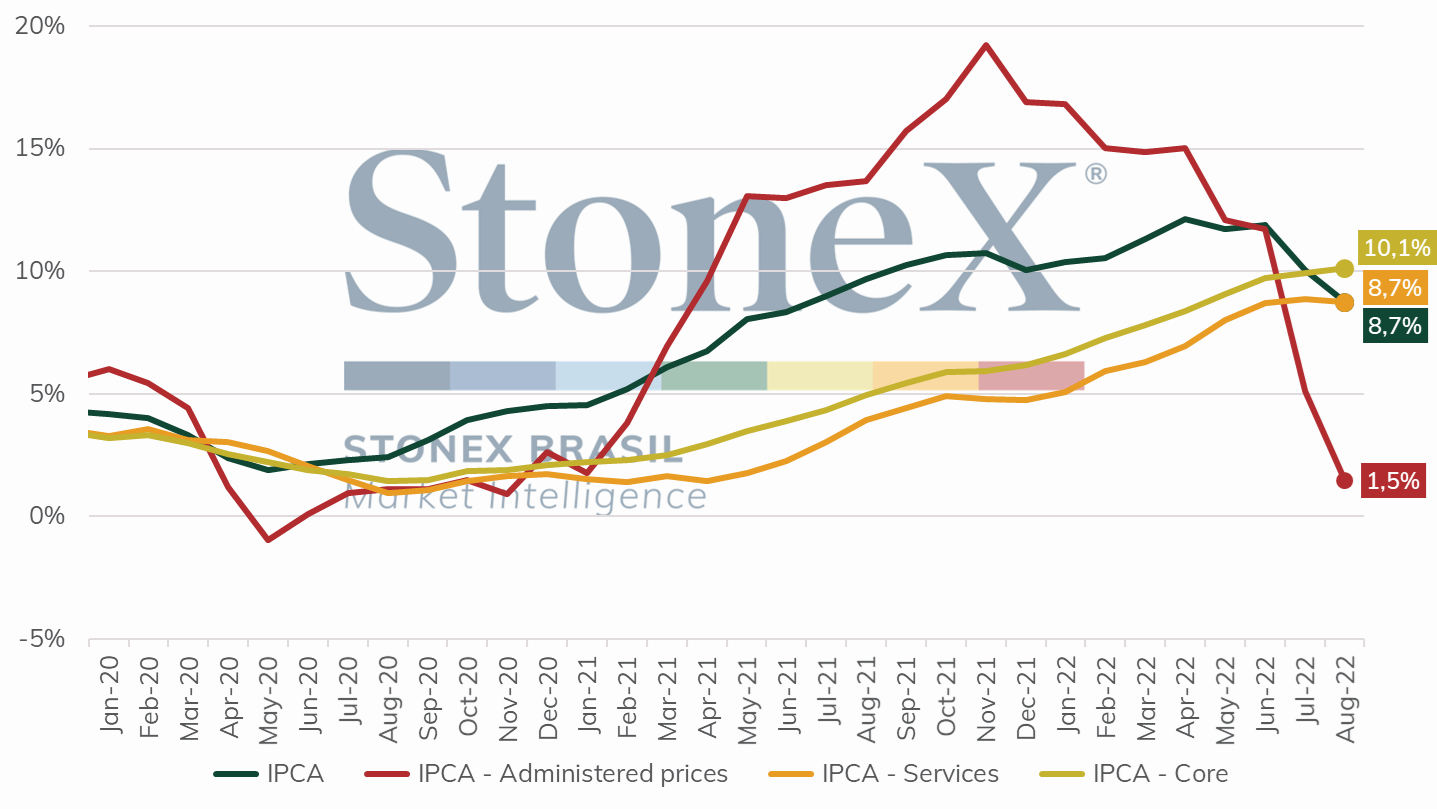
In Brazil, this week will be empty of indicators, broken up by a national holiday on Wednesday. The highlight should be the National Broad Consumer Price Index (IPCA) for September and especially the dynamics of the prices of the so-called "core" indicator, which removes the volatile categories of energy and food and beverages. For September, most estimates foresee another monthly deflation, but with a small increase in its core. Last month, while the IPCA as a whole retreated for the second consecutive month and accumulated a 12-month high of 8.7%, the core of the IPCA continued to accelerate and accumulated a 12-month high of 10.1% - returning to double digits for the first time since December 2003.
Inflation readings for Brazil
Source: Central Bank of Brazil. Design: StoneX.
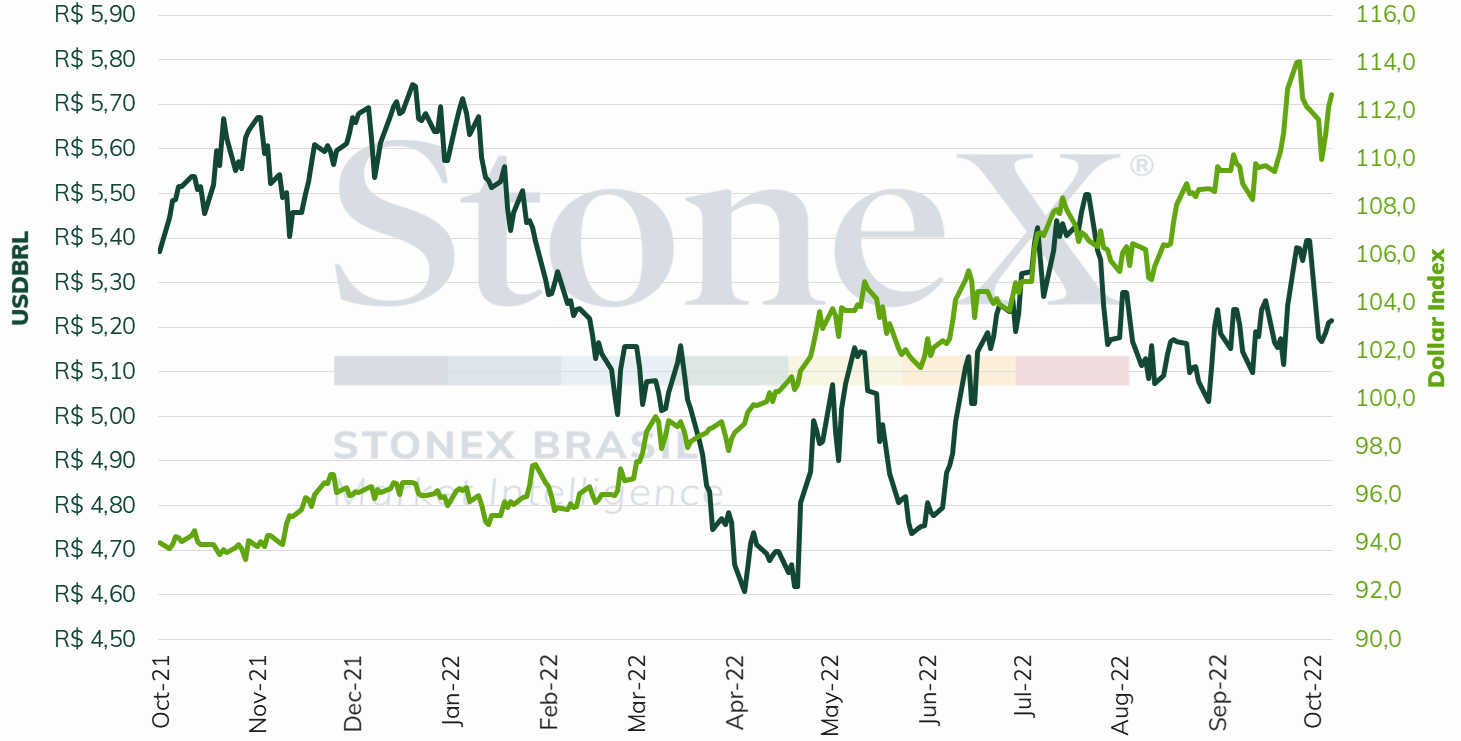
This week, news regarding the second round of the presidential elections should also be reflected in the foreign exchange market. Last week, voting intention polls pointed to a competitive scenario: Luiz Inácio Lula da Silva stands with approximately 50% of intentions, and Jair Bolsonaro stands with around 45%. The first days after the beginning of the second round were dedicated to sewing alliances with defeated candidates and with senators and governors elected or who will also run in the second round. Additionally, the candidates are taking the opportunity for a detailed analysis of their performance on October 2 to calibrate the strategies they will set from now on.