Foreign Scenario
This week, attention should be on the reaction of the Federal Reserve (Fed) authorities to the higher-than-expected reading for the September Consumer Price Index (CPI) in the United States. The indicator rose 0.4% from August to September, against a median expectation of +0.2%, accumulating a 12-month high of 8.2%, while the core of the indicator, which removes the volatile food and energy categories, rose by 0.6%, against a median estimate of 0.4%, accumulating a 12-month high of 6.6%. This is the highest accumulated variation of the core CPI since August 1982, when it recorded a 7.1% growth over 12 months. The increase in prices in the country has proven comprehensive and persistent, affecting a wide range of goods and services. Fed officials surely intend to convey reassurance and commitment to investors the week before the required quiet period for the November 2 meeting. The St. Louis Fed President James Bullard, Board of Governors member Philip Jefferson, Board of Governors member Lisa Cook, Board of Governors member Michelle Bowman, New York Fed President John Williams, Minneapolis Fed President Neel Kashkari, and Chicago Fed President Charles Evans are scheduled to speak next week.
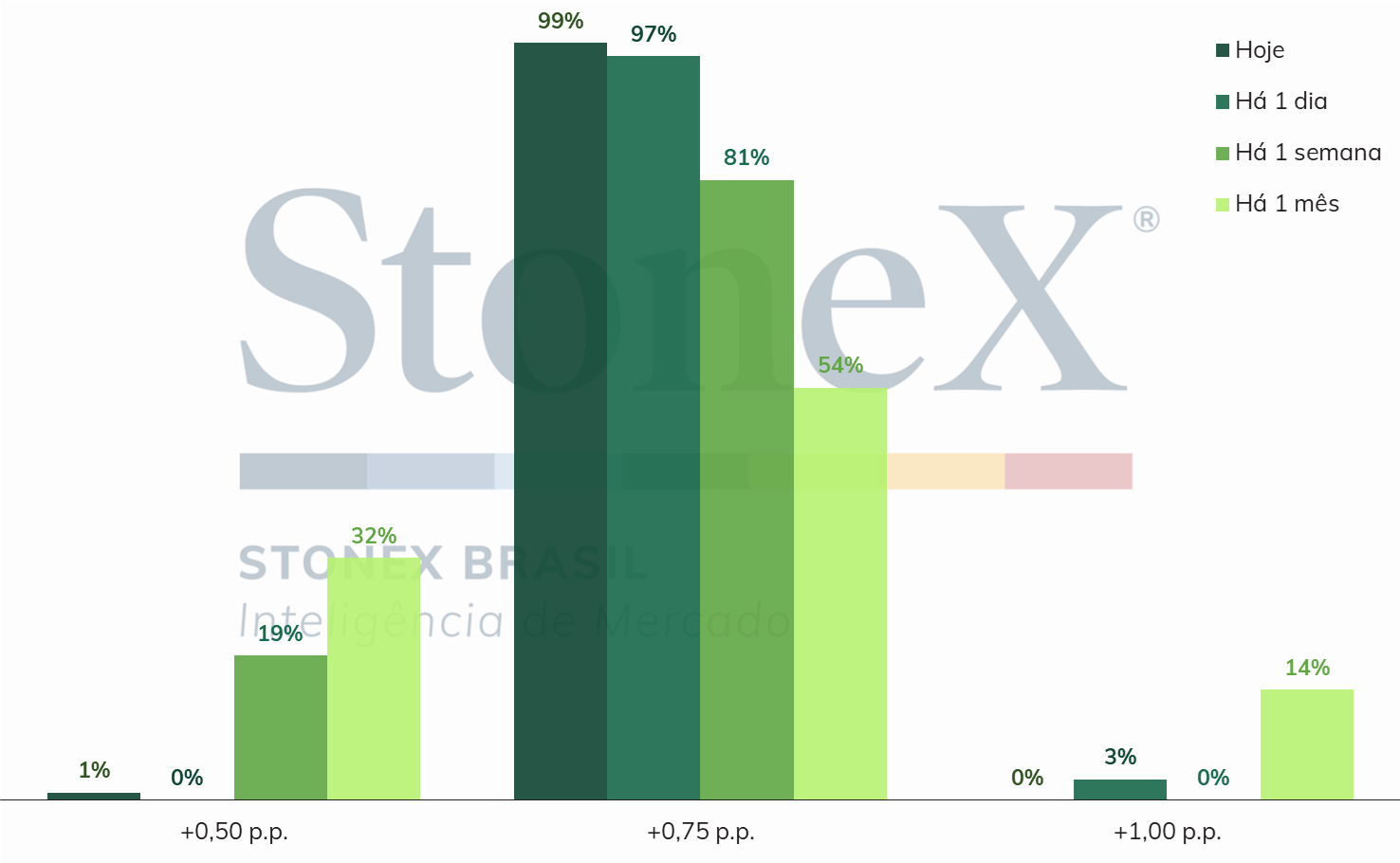
After the surprise reading of the September CPI, investors started to visualize an even more vigorous monetary tightening by the Federal Reserve in its quest to restabilize prices, raising bets in the interest rate futures market of a 0.75 p.p. readjustment for the November 2 decision, another readjustment of the same magnitude on December 14 and the last rise of 0.25 p.p. on February 1, which would take the interest rate in the United States to a range between 4.75% and 5.00% p.a. However, some analysts claim that further higher than projected inflationary readings could push interest rates even higher, as the Fed has consistently stated that restoring price stability is the institution's singular focus.
Bets for the Federal Reserve's interest rate decision ON November 02
Source: CME FedWatch Tool. Design: StoneX. Interest rate futures market probabilities for the October 14, 2022, meeting.
In Europe, the week was tumultuous in the United Kingdom, with wide volatility in the pound sterling value and yields on the country's government debt, called gilts. On the monetary side, the Bank of England (BoE) caused alarm in international markets by stating that it would not extend a gilt buyback program beyond Friday (14), even though it acknowledged that there are considerable risks of malfunctioning (illiquidity) in British financial markets. On the fiscal side, Prime Minister Liz Truss faces a serious credibility crisis after sacking Finance Minister Kwasi Kwarteng and backtracking part of proposals for a fiscal stimulus plan. Investors shunned pound-denominated assets after pointing out that Truss and Kwarteng's fiscal plan was in conflict with the BoE's monetary tightening policy and could worsen the inflationary crisis the UK is going through.
Such questioning gained momentum after a brief but intense crisis in UK government debt markets stemming from an ill-received fiscal stimulus plan by Prime Minister Liz Truss, which forced the Bank of England to spend £65 billion to prevent a more serious systemic risk. Thus, analysts fear that if the US goes through a period of weak economic indicators or a liquidity crisis in the financial markets, the Federal Reserve may start cutting interest rates even if inflation has not returned to the institution's target. However, so far, there are no official signs that justify these questions.
It is also important to highlight the escalated tension between the United States and China. Initially, the US government disclosed the new National Security Strategy, which assigned China the greatest challenge to the International Order, much to Beijing's irritation. Later, it imposed restrictions on exports of advanced chips and semiconductors and access to US technology, aiming to slow down Chinese commercial and military advances. The measure may provoke a diplomatic or commercial retaliation soon.
In the energy market, the decision by the OPEC member countries to reduce their production quotas for November led to accusations by the White House that the organization is protecting Russia and that the US is reassessing its relations with Saudi Arabia, the group's leader. Thus, this week, US President Joe Biden is considering extending the release of oil from the country's strategic reserves to influence international prices for the commodity downward, especially keen that fuel prices go back up before the important legislative elections on November 8.
Finally, regarding the war between Russia and Ukraine, last week was marked by the bomb attack on the bridge in the Querche Strait, which connects Ukrainian Crimea, occupied by the Russians since 2014, with the Russian region of Krasnodar. The attack damaged only part of the bridge, with the railway and a portion of the road bridge remaining operational. Nevertheless, the Russian response was infuriating, with precision missiles and Iranian Shahid-136 kamikaze drones in several cities throughout Ukraine, well behind the battle lines and fundamentally on infrastructure targets such as power, water supply and heating stations, schools and hospitals, as well as residential areas. On the battlefront, Kyiv has slowed its pace of advance but has expanded its control to the northeast and south of the country.
Domestic Scenario
In Brazil, this week brings a leaner economic calendar, with the highlight being the Central Bank's Economic Activity Index (IBC-Br) and the Getúlio Vargas Foundation's GDP Monitor, both for August and to promote a prior reading of productive activity before the most relevant indicator, the Gross Domestic Product, which is released only quarterly. August showed mixed performance for some of the main economic measures. On the one hand, the unemployment rate, the labor income mass, and the service volume improved in the period, while industry and retail trade performed negatively in the month.
This week, investors should reflect on the impacts of the first presidential debate for the 2nd round held this Sunday (16). The latest face-to-face polls have shown an approximate eight-point gap between the candidates: 49% for Luiz Inácio Lula da Silva versus 44% for Jair Bolsonaro (Datafolha), 51% for Lula versus 42% for Bolsonaro (Ipec) and 49% for Lula versus 41% for Bolsonaro (Quaest).
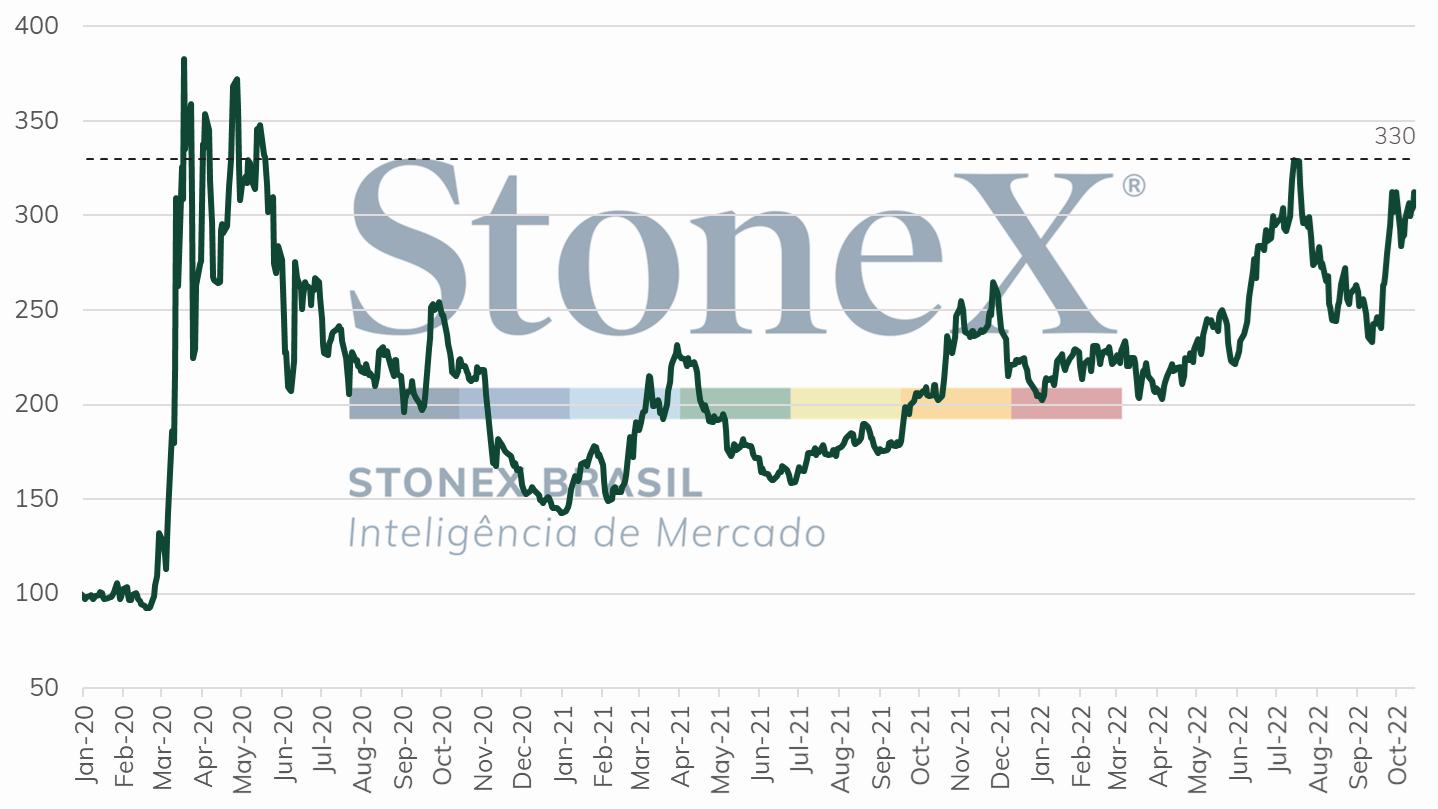
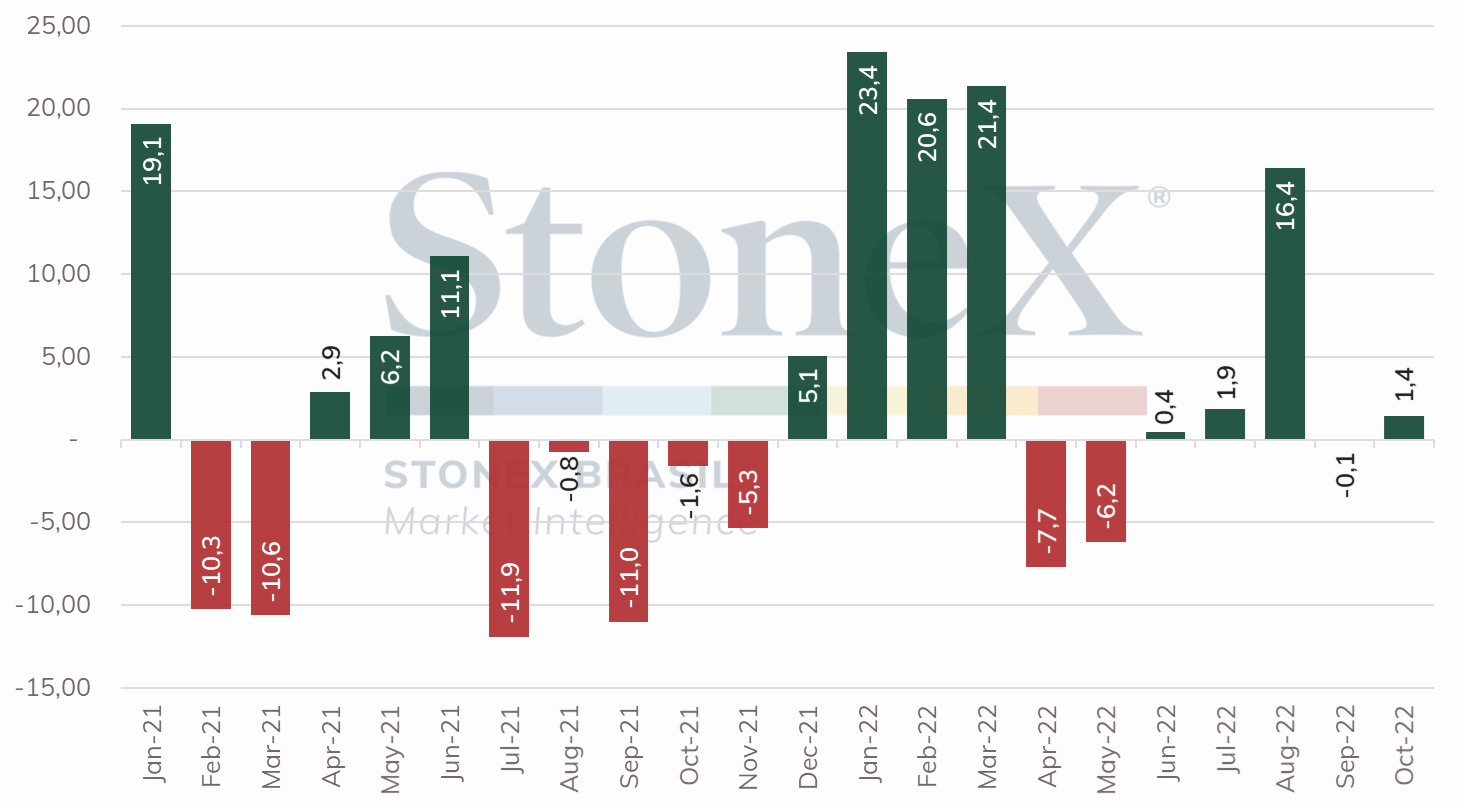
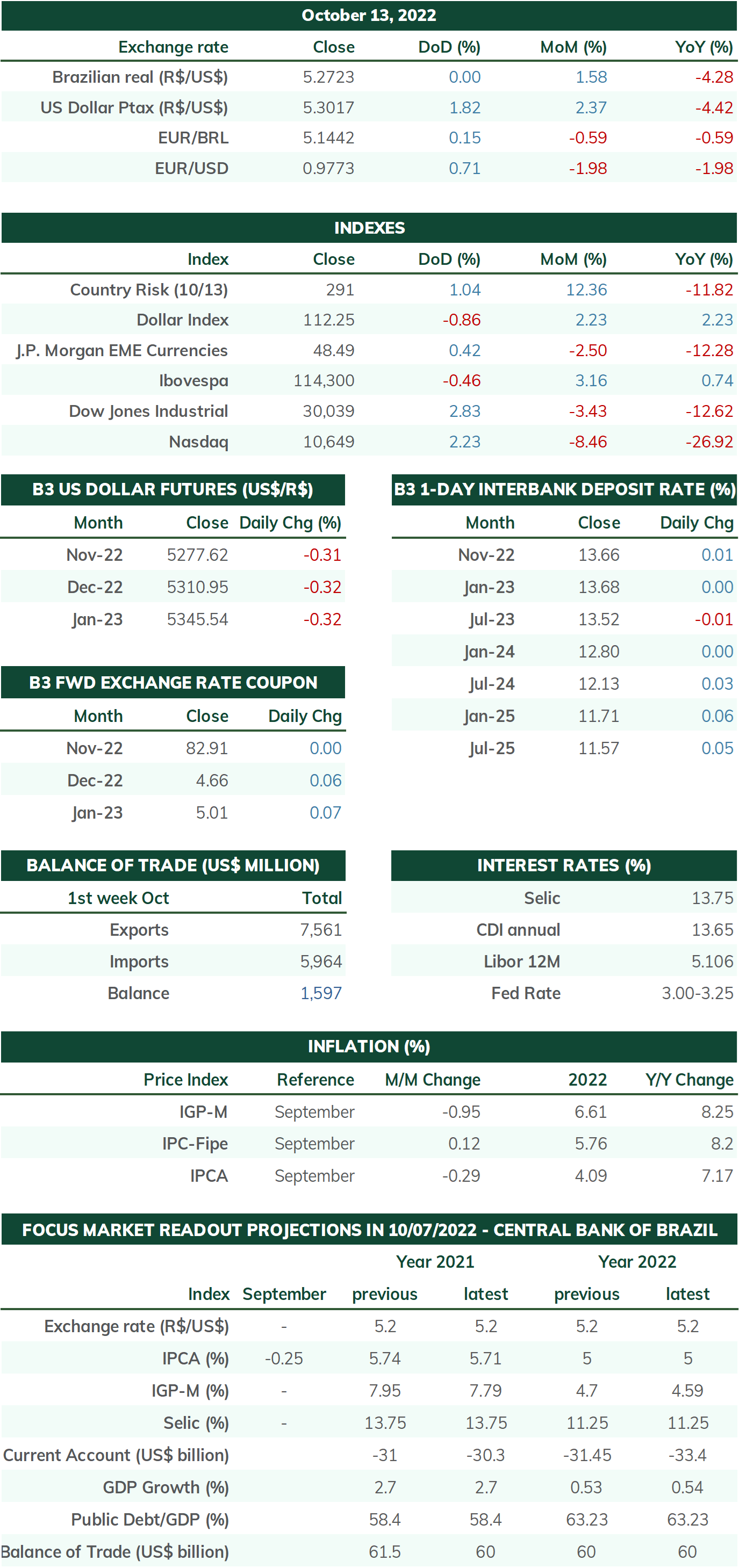
Finally, it is worth noting that the global environment of greater risk aversion and global caution has also been reflected in Brazilian assets, with lower inflows of foreign funds into the country and an increase in the rates of the 5-year Credit Default Swap for Brazilian bonds, a measure of risk measurement for the country.
Spread of the Brazilian 5-year Credit Default Swap (CDS) contracts (basis points):
Source: Bloomberg. Design: StoneX.
Balance of foreign capital flow on the B3 as of October 11, 2022 (BRL billion)
Source: B3. Design: StoneX.