Foreign Scenario
This week, attention should remain on prices and the labor market in the United States as the Federal Reserve (Fed) authorities begin the required quiet period for the November 2 monetary policy decision. First, the third quarter Employment Cost Index, the metric most used by the Fed to track wage costs in the country, will be released. The indicator tends to keep accelerating, with an accumulated rise of around 5% in annual terms. Additionally, the Personal Consumption Expenditure Price Index (PCE) for September will be released, also the Fed's preferred metric to follow consumer prices, which should maintain the August trend with a significant rise in the core of the indicator and present an increase of more than 5% in 12 months.
Economic activity indicators will also be announced, such as the forecast of the Gross Domestic Product for the third quarter in the United States, with an estimated expansion of 2.0%, due to the growth in the trade balance and the rebuilding of inventories. Furthermore, S&P Global will report the Purchasing Managers' Indexes (PMI) for manufacturing and services for October, allowing for a first impression of the country's economic condition at the start of the fourth quarter.
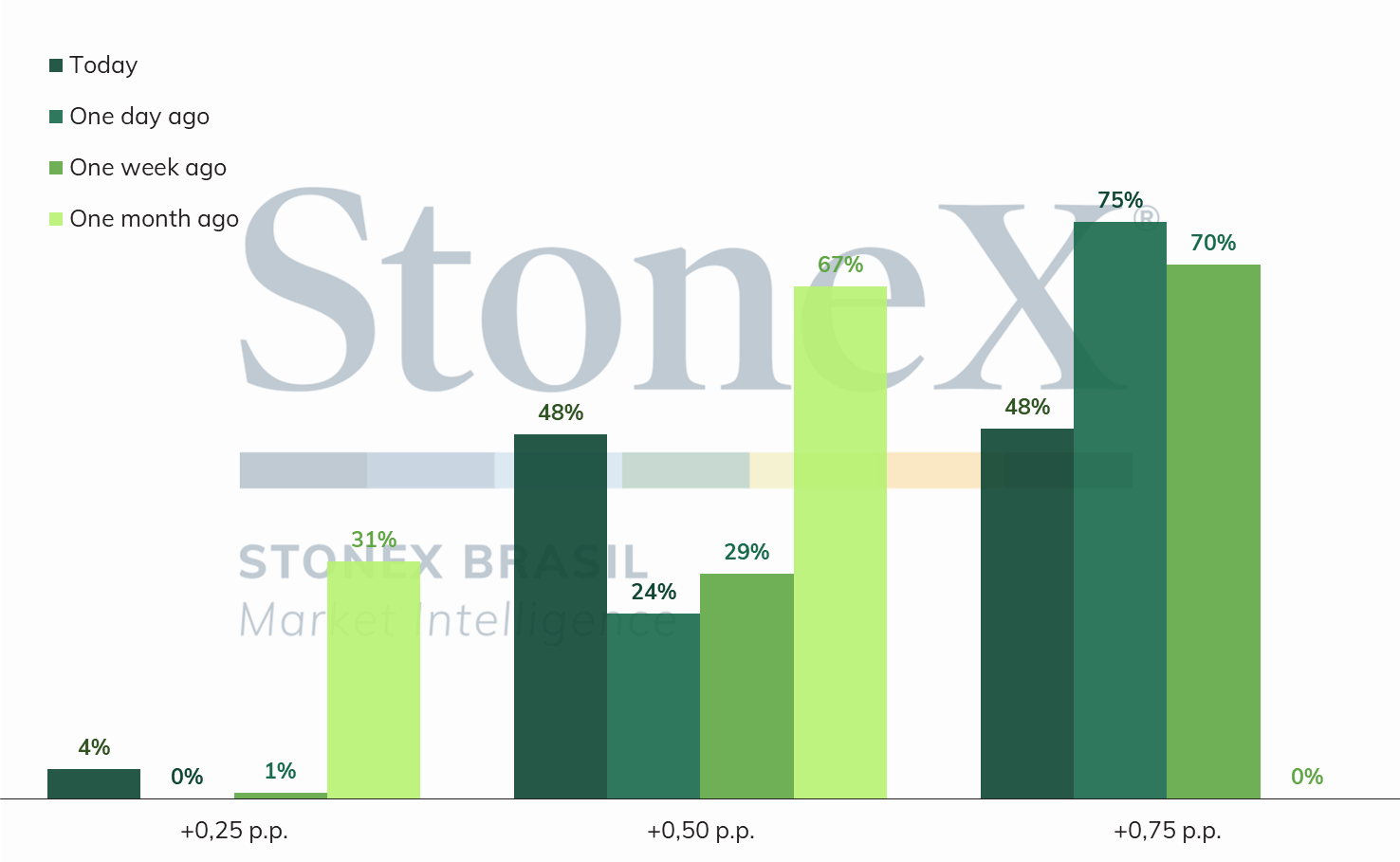
All these data still point to an environment of inflationary pressures in the US, where prices remain at high, widespread, and persistent levels, economic activity is still expanding, and the labor market remains heated. The fundamentals suggest the Federal Reserve must maintain a strict stance in its interest rate adjustments. It seems premature to consider a slowdown in the pace of adjustments. Even so, The Wall Street Journal published a report last Friday (21) stating that the Federal Reserve authorities are debating how to communicate to investors their desire to raise the basic interest rate by 0.75 p.p. in November and "a smaller adjustment in December." After the report, bets on the interest rate futures market for December 14 were sharply reduced.
Bets for the Federal Reserve's interest rate decision on December 14
Source: CME FedWatch Tool. Design: StoneX. Futures market interest rate probabilities as of October 21, 2022
The week will be full of economic indicators in Europe, but the focus is on the European Central Bank's monetary policy decision. Given the serious energy crisis and the intense acceleration of prices on the continent, most analysts are betting on a readjustment of 0.75 p.p. in Thursday's decision, probably followed by another readjustment of the same magnitude on December 15. Facing a complex conjuncture in which the inflationary dynamics are as worrying as the possibility of an economic recession, it is believed that the monetary authority will prioritize price stabilization for the time being.
In the UK, the coming week is also expected to be uncertain as the process to replace Liz Truss as Prime Minister gets underway. While the conservative party wants to replace her quickly, the other opposition parties are clamoring for an early general election (initially scheduled for January 2025) due to the huge unpopularity and incredible turbulence brought about by the prime minister in her 45 days in power. In any of the options, there is no way to anticipate the future government's direction regarding critical fiscal policy variables, such as the proposal for subsidies on energy bills for businesses and households, initially offered for two years, then for six months, and now in doubt. All the turmoil weakens the pound, hinders the search for price restabilization, and brings volatility to global markets.
Finally, in the war between Russia and Ukraine, the week was marked by stability on the battle lines but intense activity and movement outside them. The Russians intensified their use of aerial bombardment with Shahed-136 missiles and Iranian Camicase drones on several cities throughout Ukraine, just as they did last week, well behind the battle lines and concentrating on infrastructure targets such as power and water distribution stations. The Russian posture begs the question that Moscow may no longer have the goal of reconquering new territory, at least in the short term, instead seeming to prioritize punishing the Ukrainian civilian population for its army's recent victories. Surely, this will be a difficult winter for them, and the Kremlin seems like banking on lowering the population's morale. Additionally, Russian President Vladimir Putin has declared martial law in the occupied territories of Ukraine (Kherson, Zaporizhia, Donetsk, and Luhansk), while the military has ordered evacuations to remove civilians from these regions forcibly. Some military analysts believe that Moscow may be preparing for another tactical retreat west of the Dnipro River in the southern Kherson region and could be preparing a fake attack on the Kakhova hydroelectric dam to flood the region, making it difficult for Ukrainian troops to cross to the east.
Domestic Scenario
In Brazil, the final stretch of the second round of the presidential elections should mark the week. Attention is expected to be on the latest polls, which have shown Jair Bolsonaro to be closer to Luiz Inácio Lula da Silva, and on Friday's last debate before the election (28). Lula has scored close to 50% of voting intentions, while Bolsonaro has around 45% of intentions. The last week before the first round was very risk-averse since there was the possibility of immediate victory for the former president, but optimism and appetite for Brazilian assets are anticipated in the week leading up to the second round, given the greater possibility of the re-election of the current president. The release of new Ipec (sample of 3,008 people) and Quaest (sample of 2,000 people) surveys are already scheduled for Monday (24) and Wednesday (26), respectively.
There will also be a decision by the Central Bank's Monetary Policy Committee (Copom), in which it is almost unanimously predicted that the basic interest rate (Selic) will remain at 13.75% p.a. There is more expectation for the announcement of the decision and for how the evolution of prices in the period will be analyzed since there was deflation for the third month in a row in the National Broad Consumer Price Index (IPCA), but a significant increase in the indicator's core.
Additionally, the week's economic calendar is loaded with economic indicators, among which are the IPCA-15 and the General Price Index - Market (IGP-M), in addition to data for the labor market for September, such as the unemployment rate and the real income from work, statistics for the foreign sector for September and disclosure of the tariff flag for electric energy for November.