The most important: inflation in the United States
Expected impact on USDBRL: bullish
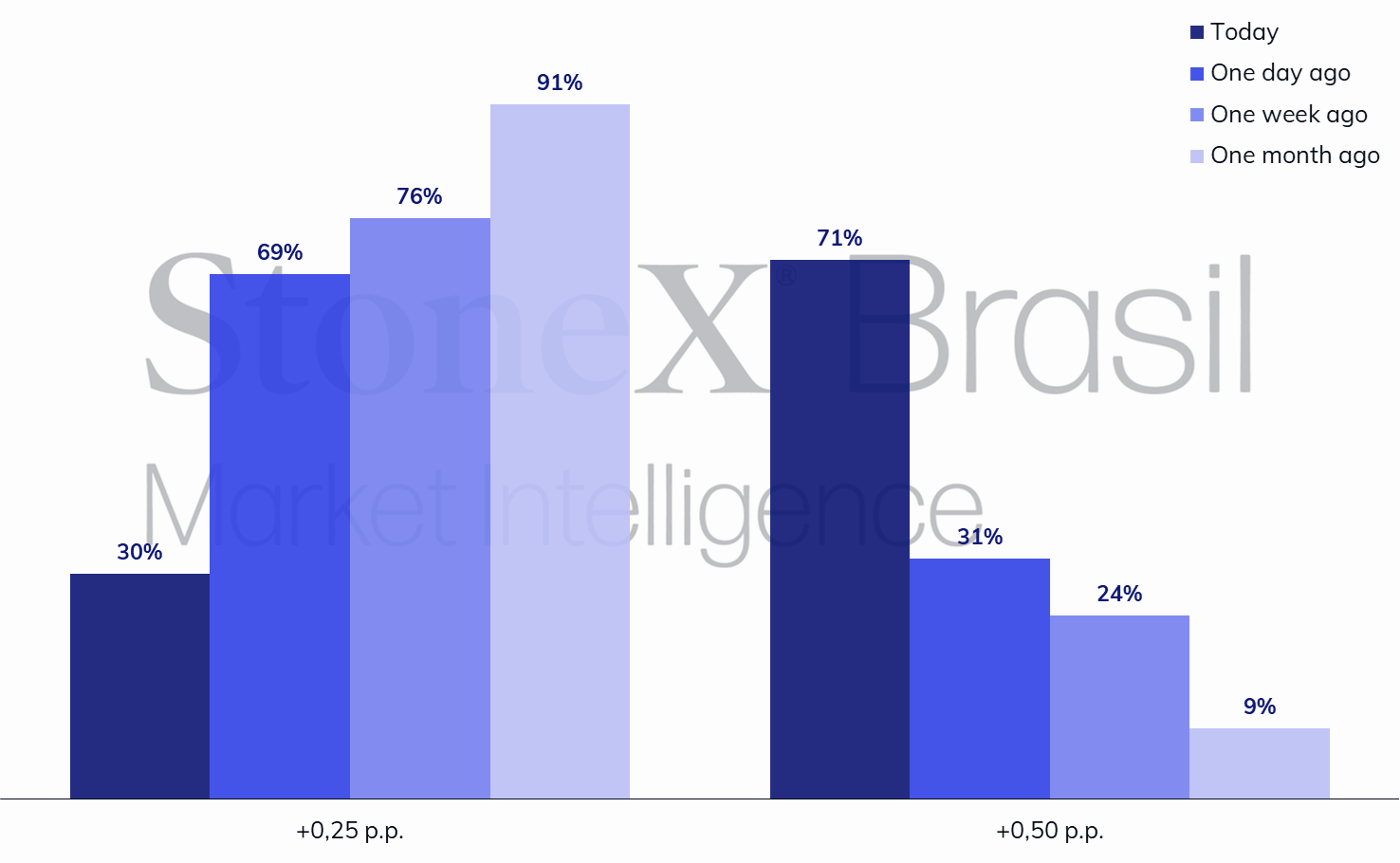
This week, attention will be on the February Consumer Price Index (CPI) publication next Tuesday. After a string of indicators that exceeded expert estimates in January, there is a debate among analysts whether inflation has become more persistent (sticky) and widespread than anticipated, which in turn caused doubts about which would be the best monetary policy decision for the Federal Reserve on March 22: to repeat a rise of 0.25 p.p. or raise the pace to a readjustment of 0.50 p.p. The February indicators released so far have not been striking enough to define the best strategy clearly.
Last week, Fed Chairman Jerome Powell struck a firm and cautious tone in his remarks to Congress, warning that the path to inflation reduction will be bumpy, that the latest economic indicators suggest the US interest rate ceiling will be higher than previously estimated and said the Fed is prepared to accelerate the pace of interest rate adjustments if the totality of the data warrants such a move. These comments resulted in a rapid rise in bets on the US interest rate futures market, reaching their highest value since the current monetary tightening cycle began.
Thus, the publication of the CPI on Tuesday (14) will provide a fundamental reading for the state of inflation in the country and allow us to anticipate the next Fed decision. Analysts expect the core CPI to remain warm, with monthly growth of 0.4% and a cumulative 12-month high of 5.6%, identical to January. The most relevant subgroup will be core services ex shelter, which is highly correlated with gains in labor income and which, in recent months, represents most of the acceleration in prices. Complementing the reading of the US context is the release of the producer price index (PPI) and retail sales for February, both on Wednesday (15).
Bets on the Federal Reserve's March 22 interest rate decision
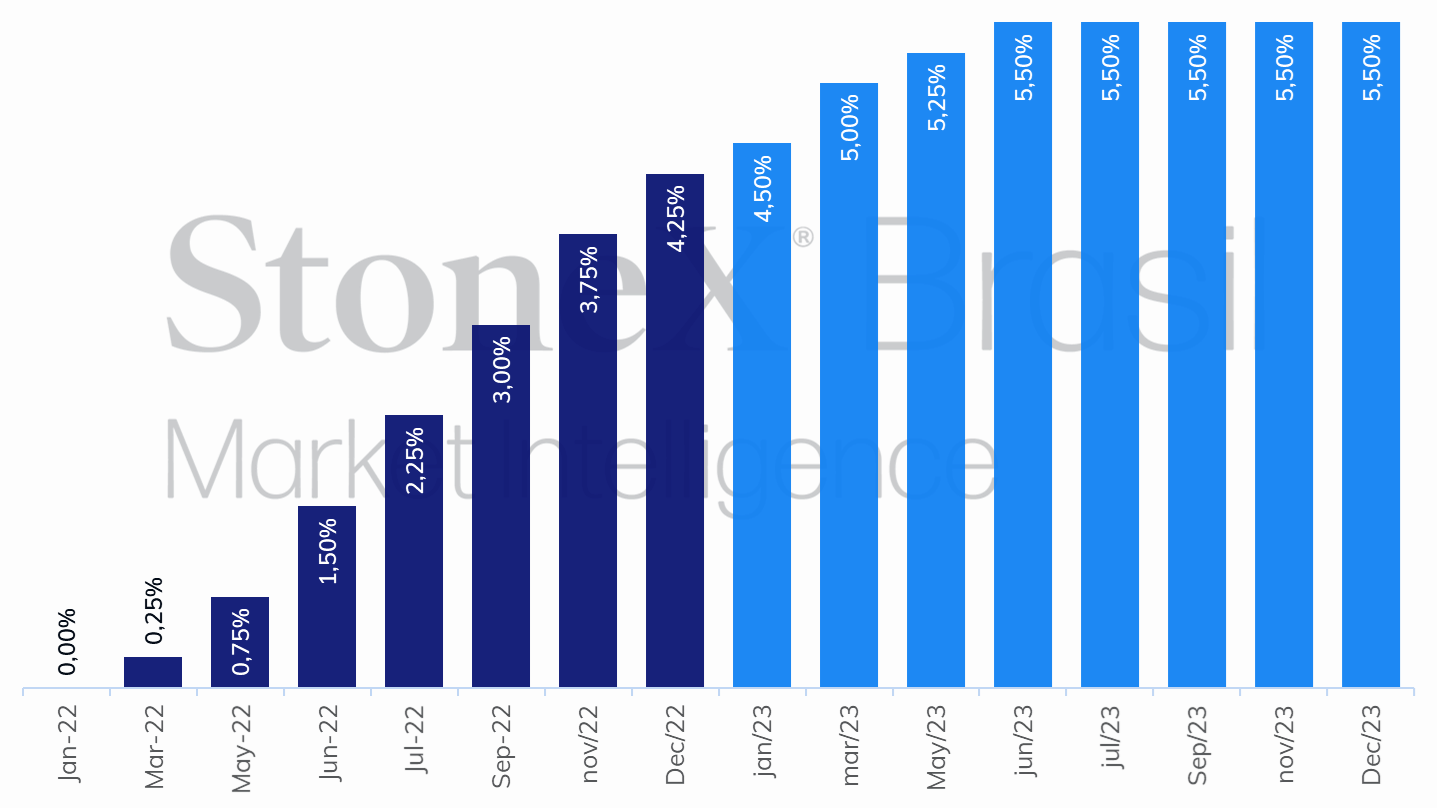
US interest rate history and higher probability bets on the futures market
Source: CME FedWatch Tool. Design: StoneX. Probabilities in the interest futures market regarding March 09, 2023
Monetary policy decision in Europe
Expected impact on USDBRL: bullish
Next Thursday (16), there will be a decision on monetary policy by the European Central Bank (ECB). There is a reasonable consensus that the European institution should readjust interest rates by 50 basis points, from 2.50% p.a. to 3.00% p.a., since the ECB itself anticipated such a readjustment in its last decision. After taking significant time to start its cycle of interest rate hikes, the European monetary authority has implemented sizeable readjustments to contain rapid inflation and narrow the yield differential with the United States. It remains to be seen whether the ECB members will commit to signaling another 0.50 p.p. readjustment for the next decision or whether they will adopt a more cautious stance without indicating any future trend.
Fears of a credit crunch
Expected impact on USDBRL: bullish
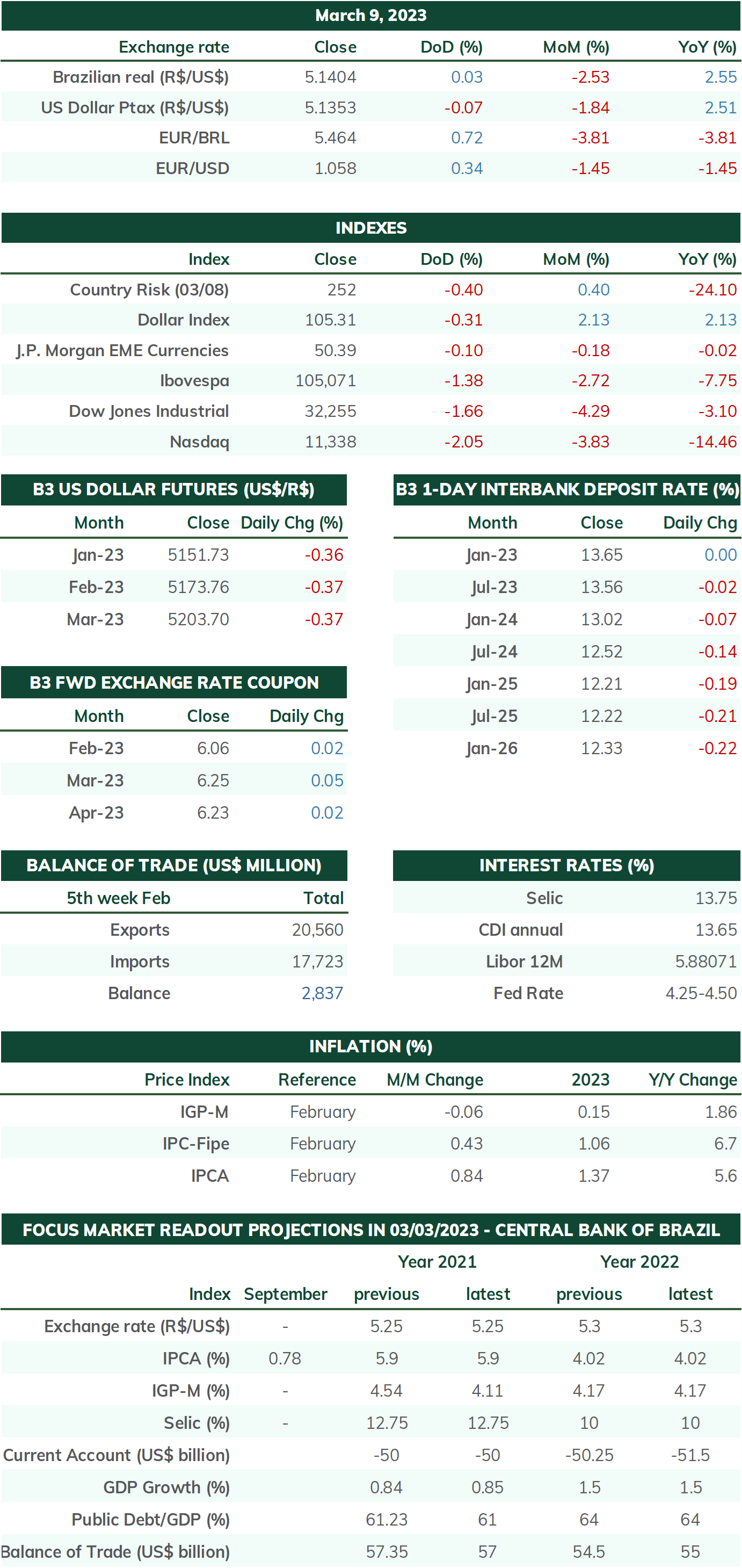
Last week, the DI future interest rate retreated considerably, indicating that investors are betting on cuts in the basic interest rate (Selic) by the Central Bank starting in the first half of this year, dropping to 13.00% by December 2023 and 12.50% by July 2024. Among the reasons pointed out for the bets on the reduction of basic interest rates by the central bank would be a worsening of the balance of risks that the Monetary Authority faces, particularly due to the indication that the private credit market (debentures) would be showing incipient signs of a possible crisis. Since the outbreak of the Americanas case, investors have been withdrawing their investments in private equity securities, making it more difficult for companies that need to raise funds in the fixed-income market and, consequently, raising the cost of this financing. Thus, analysts bet that the central bank would be pressured to reduce basic interest rates to avoid premature insolvency of cash-strapped companies.
These fears intensified last Friday (10) after the collapse of SVB bank in the United States, the first bank to be closed in the country since the 2007 financial crisis. SVB, the 16th-largest financial institution in the country and focused on capitalizing on start-ups, suffered a federal intervention after the bank's board announced that it would try to raise USD 2 billion due to a significant loss in its portfolio. The announcement alarmed its account holders, who rushed to withdraw their investments and deposits with the bank, accelerating its collapse. Analysts fear that the episode will amplify investors' risk aversion and make it even more difficult to finance companies more exposed to the new macroeconomic environment of rapidly growing interest rates and falling consumer spending.
New fiscal framework proposal
Expected impact on USDBRL: bearish
Another reason for the bets on the reduction of basic interest rates by the Central Bank is the optimism of market agents that investors will well receive the new proposal for the government's fiscal framework, will indicate a greater commitment to fiscal responsibility and, as such, will allow a reduction in inflationary forecasts. Last week, the Minister of Planning and Budget, Simone Tebet, reinforced that the new rules will be "fiscally responsible, with the primary deficit, with the stabilization of the debt/GDP," but without compromising the level of public investments. The Minister of Finance, Fernando Haddad, declared that he is "socializing [the proposal] with the economic team" and will present it to the president of the Republic, Luis Inácio Lula da Silva. The government's goal is to send the proposal along with the 2024 Budget Guidelines Law, whose deadline for submission to the National Congress is April 15. However, it is unknown whether some details of the measure will be presented in advance to the press.