The most important: Fed Monetary Policy Decision
Expected impact on USDBRL: bullish
This week, the focus will be the monetary policy decision of the Fed's Federal Open Market Committee (FOMC) amid the turbulent and unstable environment caused by the bankruptcies of US banks. The past week has been one of extreme volatility, caution and uncertainty, with the bankruptcy of three US banks in quick succession – Silvergate, SVB and Signature Bank – and the injection of USD 30 billion by 11 other big banks to stave off a fourth, First Republic Bank, failure. Fears of a financial crisis on a global scale were heightened after Credit Suisse in Switzerland also faced difficulties and a bank run, which was stabilized after an emergency credit line of 50 billion Swiss francs. Last Friday (17), the scenario was of moderate caution, without knowing if the banking crisis was finally solved or if new institutions would present difficulties in the following days.
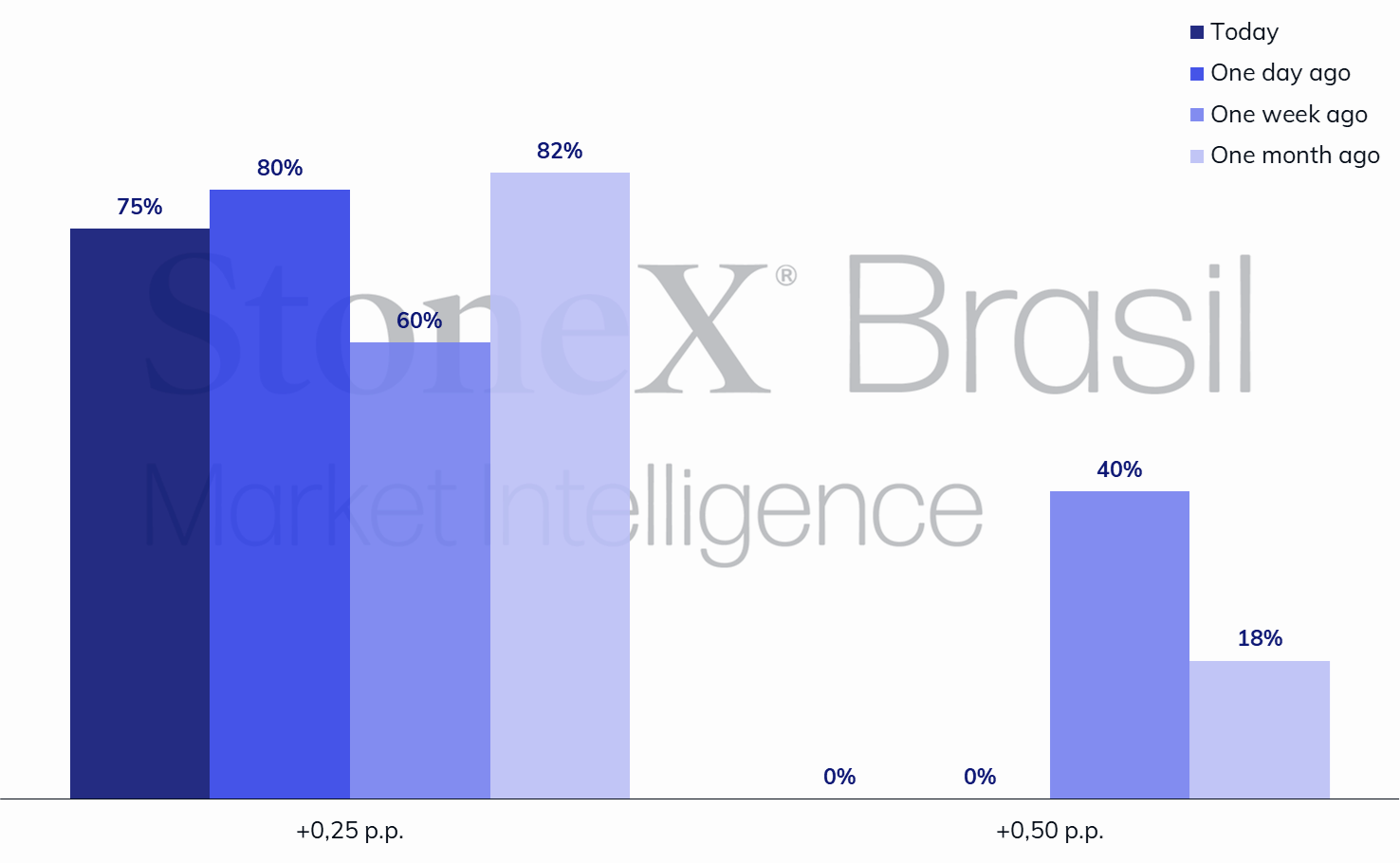
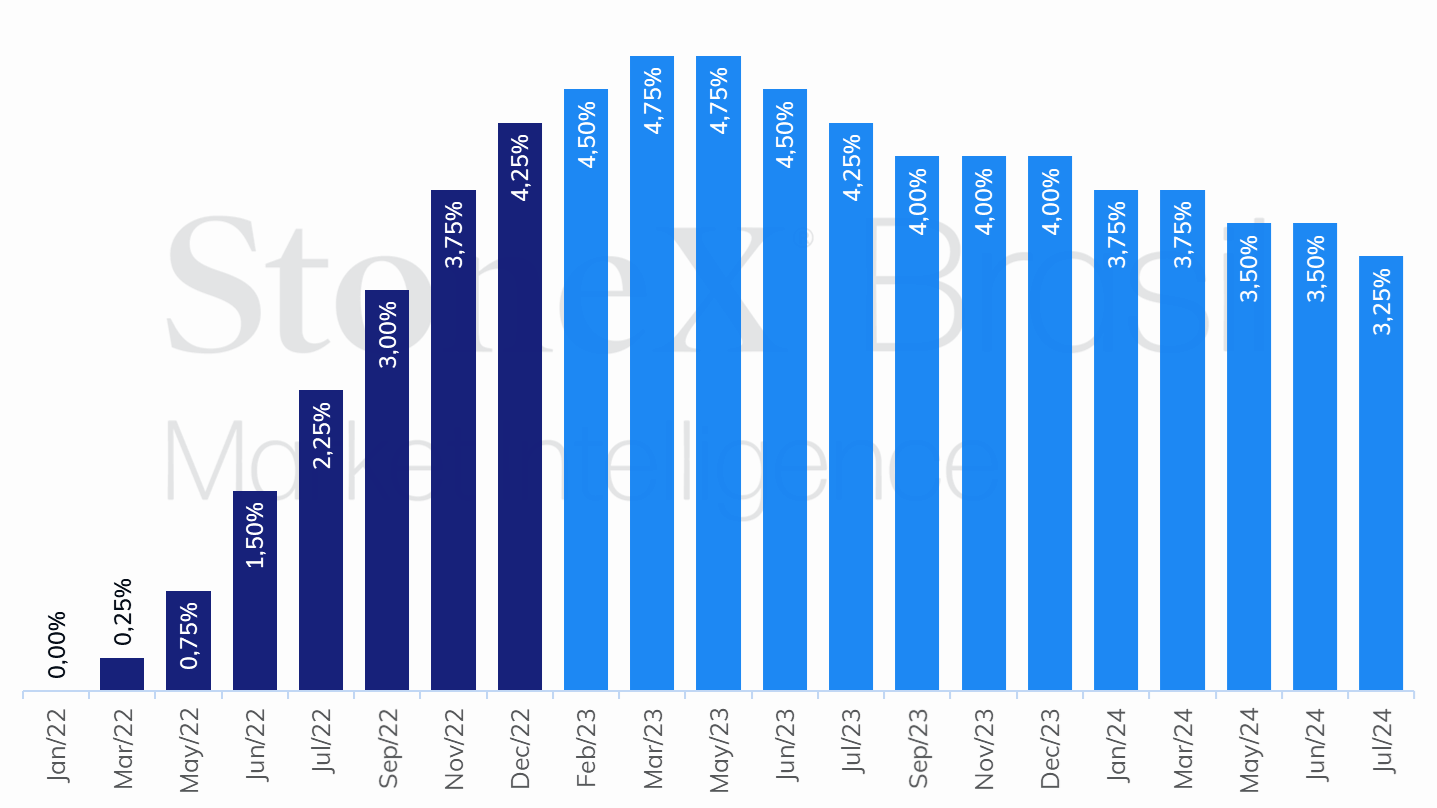
Attention now turns to how the FOMC will behave in its decision in this context. Last Thursday (16), the European Central Bank surprised everyone by deciding to raise its interest rate by even 0.50 p.p., privileging the search for price reestablishment to a more passive posture that would allow a thorough evaluation of the current situation, stating that there is no "trade-off" between financial stability and price stability. However, it seems undeniable that the balance of risks facing the Federal Reserve has shifted in the last week and that the rapid rise in interest rates has stressed the asset balance of several financial institutions, even if inflationary pressures remain high and persistent. Most bets on the interest futures market point to a 0.25 p.p. rise in the interest rate. However, some analysts point out that macroprudential measures alone may not be enough to ensure financial stability at this point and that a pause may be more appropriate so that the Fed can more adequately assess the strength of the banking system before deciding whether to continue with the pace of increases.
Finally, the FOMC will need to indicate its summary economic forecasts for some important macroeconomic variables after its interest rates decision, such as GDP growth, inflation, unemployment, and the expected level for interest rates at the end of each year. This is an extraordinarily volatile and uncertain time to make economic forecasts, particularly on the level of interest rates. Still, the document may signal consensus (or lack thereof) among committee members.
Bets on the Federal Reserve's March 22 interest rate decision
Source: CME FedWatch Tool. Design: StoneX. Probabilities in the interest futures market regarding March 17, 2023
US interest rate history and higher probability bets on the futures market
Source: CME FedWatch Tool. Design: StoneX. Probabilities in the interest futures market regarding March 17, 2023
Copom Monetary Policy Decision
Expected impact on USDBRL: bearish
This Wednesday, also, the Central Bank of Brazil's Monetary Policy Committee (Copom) will announce its decision on the basic interest rate (Selic). More than 92.5% of bets on the interest futures market on March 16 predicted the rate to remain at 13.75% p.a., with the remaining 7.5% betting on a reduction of 0.25 p.p. Between the decision of February 01 and this Wednesday, there was no major change in domestic market conditions and should raise a statement quite similar to the previous one, which considers, on the one hand, inflationary and fiscal risks and, on the other, a weakening of Brazilian economic activity. The statement may mention external banking events as an additional monitoring factor within the risk balance. Analysts will look for possible signals about the trajectory of interest rates by the committee as investors' price cuts from the end of the first half.
New fiscal framework proposal
Expected impact on USDBRL: bearish
The optimism of national market operators is high with the presentation of the new fiscal framework proposal by the federal government. Last Friday (17), the President of Brazil, Luis Inácio Lula da Silva, met with the ministers of Finance, Fernando Haddad, of Development, Industry, Commerce and Services, vice president Geraldo Alckmin of the Civil House, Rui Costa, of Planning and Budget, Simone Tebet, and of Management and Innovation in Public Services, Esther Dweck, to discuss the new rules for the state tax regime. This is believed to be the last stage before publicly announcing the proposal's text and sending it to Congress. Although it is not officially admitted, analysts assess that the economic team wants to make the proposal public before the monetary policy decision of the Central Bank on Wednesday (22) to contribute to an eventual cut in the basic interest rate (Selic). In any case, investors have reduced their bets on the interest rate futures market (DI) based on a good reception of the new measure, believing that it will indicate a greater commitment to fiscal responsibility and, in this way, allow a reduction in inflationary forecasts.
Monetary policy decisions in Europe
Expected impact on USDBRL: bullish
In addition to the Federal Reserve, this week, the central banks of England, Switzerland and Norway will also have monetary policy decisions, and investors will be attentive to these authorities' reaction to the financial system's stability concerns. Each central bank, of course, faces a different balance of risk. In England, the BoE has already significantly raised interest rates, and the economy shows clear signs of slowing down. On the other hand, despite Switzerland being at the center of last week's worries about Credit Suisse's difficulties, the SNB is only at the beginning of its monetary tightening and is expected to readjust by 0.25 p.p. or 0.50 p.p.
Economic data in the US
Expected impact on USDBRL: bullish
Although the global context of instability is overshadowing economic data, this week will be released the previews of the Purchasing Manager Index (PMI) of industry, services and composite, reported by S&P Global. The data should signal how economic activity is progressing in March, as the first indicators of the month came in lower than anticipated. Investors will pay particular attention to the "price paid" subgroup of indices, as price acceleration still poses a challenge. In addition, January durable goods orders will be published this week.