As we headed towards the latter stages of Q3 and into Q4, the Fed had just hiked rates in a hawkish FOMC meeting, while the likes of the ECB and BoJ had also tightened their respective policies. Oil prices remained elevated amid the prolonged US-Iran conflict. Meanwhile, bond yields were breaking out, and the dollar was higher across the board. Yet, remarkably, gold was still holding in the positive territory for the third quarter, even if it had weakened somewhat in September. Surging bond yields had no doubt increased the opportunity cost of holding the zero-yielding gold, but clearly not enough to trigger a sharper sell-off. Given gold’s ability to remain steady in what should otherwise have been a tough macro environment, the precious metal could have a shinier Q4. We are thus cautiously optimistic on the gold outlook for the remainder of the year. A potential deal to re-open the Strait of Hormuz could see central banks delay or pause rate hikes and that, in turn, could see the metal thrive.
Q3 was a mixed quarter for gold
After the big 14% drop in Q2, gold bounced back in the first couple of months of Q3 and was up 6.4% on the quarter at the time of writing as of 25th September. The metal was down 4% on the month at the same time, meaning that the early momentum in the quarter was weakening heading into Q4. As things stood, the metal was around 23% off from its January peak of $5,598, meaning it would require a +30% rally to get to new highs again.
Gold spent much of the Q3 bouncing around $4,000 and $4,500, as volatility compressed with investors not sure whether to buy the dip as fiat currencies continues to lose value to inflation, or sell the metal short against a backdrop of rising US dollar and rising bond yields, mostly negative traditional macro factors.
Gold Q4 2026 outlook: Mostly negative traditional macro factors may not matter much
Most of the traditional macro drivers represented a not-so-supportive backdrop for gold heading into Q4. But did that matter? On major source of support was continued central bank buying, and that meant the downside was limited.
The biggest headwind for gold in Q4 is perhaps policy tightening from major central banks, including the Fed. The FOMC’s September rate hike was hawkish and market pricing for further hikes increased in the weeks after that meeting. That helped to send the dollar surging higher against most major currencies.
Gold is obviously priced in the US dollar, and with the greenback having staged a sharp rally, this was part of the reason why the metal was lower on the month when this report was written.
But unlike major foreign currencies like the EUR, CHF, GBP and JPY, Bitcoin and to a lesser degree gold both held steady for much of September, suggesting that investors were not too concerned about the FX markets working against them.
Meanwhile, nominal yields broke out following the Fed’s rate decision in September, with the US 10-year climbing above 5.2% and 30-year above 5.5%. When taking into account the impact of inflation, investors were evidently happy to see through much of the sharp gains in yields.
Still, with the latest US CPI reading of 3.4%, real yields on the 10- and 30-year bonds were around 1.6% and 2.1%, respectively. By holding onto gold instead of government bonds, investors were losing out in real terms.
So, it is worth keeping a close eye on the bond markets. If yields continue to rise, this may keep gold’s upside limited.
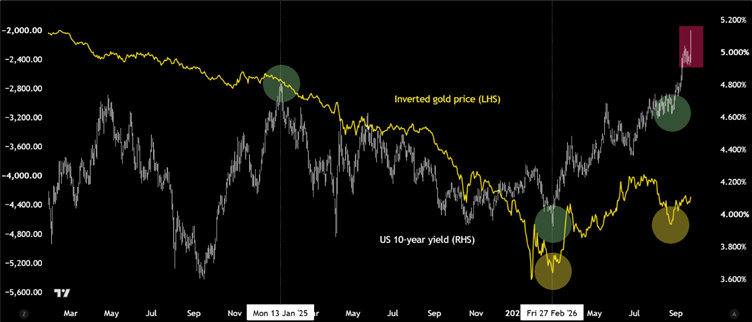
Figure 1: Gold’s relationship with bond yields
Source: TradingView.com
The above chart is the inverted price of gold vs. US 10 year bond yields. Gold typically goes up when yields go down as opportunity cost of holding the zero-yielding asset decreases. And when yields rise, gold typically heads lower for the same reason.
If yields continued to push higher in Q4, this will clearly be among the factors that could hold the metal back.
That said, if investors now lose faith in the Fed and its ability to control inflation or yields, then the dollar debasement trade could resurface and that could be positive for gold, silver and bitcoin, as well as currencies of countries with better fiscal discipline than the US.
Central bank gold buying likely to remain strong in Q4
Central banks continued their gold purchases in July, according to the latest data from the World Gold Council (WGC). It is likely that purchases continued for the rest of Q3 and given the troubles in the bond markets, we wouldn’t rule out further diversification into gold by major central banks in the remainder of the year, and a move away from US Treasurys. This should keep gold supported, all else being equal.
As per WGC, gold accumulation totalled 23 tonnes in July as central banks of China (20t) and Poland (8t) took the lead. In fact, buying from the People’s Bank of China (PBoC) has picked up pace in recent months: WCG says the PBoC has accumulated “double-digit monthly purchases of gold since May 2026”. Year-to-date, central banks reported purchases have totalled around 130t of gold. Granted, this was down from the ~160t over the same period last year, but what stands out is that high prices have not deterred central banks from accumulating gold.
Figure 2: Central bank gold buying
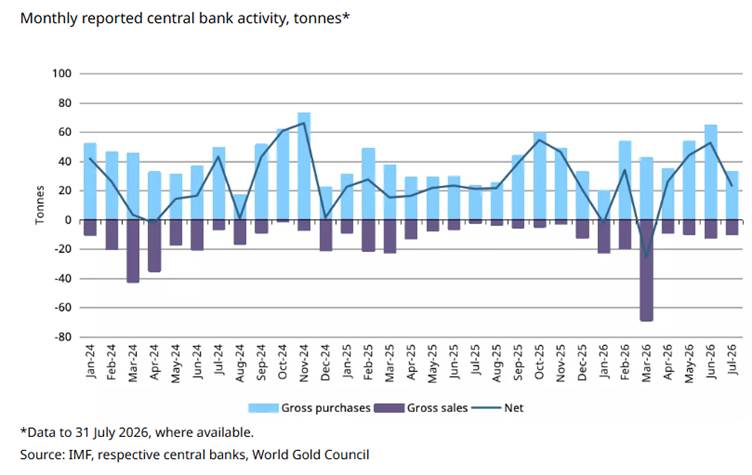
There are no major indications that demand for gold from central banks will ease in the final quarter of the year. If purchasing continues, we could see gold prices push higher as investors and speculators try to front-run central banks by increasing purchases via ETFs, spot and futures.
It is likely that additional central bank buying will also offset any negatives such as further strength in US dollar or yields.
Will the dollar debasement trade return?
One of the biggest potential sources of support for gold in Q4 could come from a weaker US dollar. This could either happen in the event of a US-Iran deal, triggering a slide in oil prices and rate hike expectations, or if the bond market selling intensifies so much that investors actively move away from the US dollar, triggering the so-called dollar basement trade.
If the US dollar falls, then gold, already showing relative strength in Q3, could start to move higher again. Otherwise, if the market losses faith in the ability of the Fed to combat inflation, gold could find itself in high demand anyway amid increased haven flows. The metal is among the best alternatives to fiat currencies.
Gold Q4 2026 outlook: Technical analysis
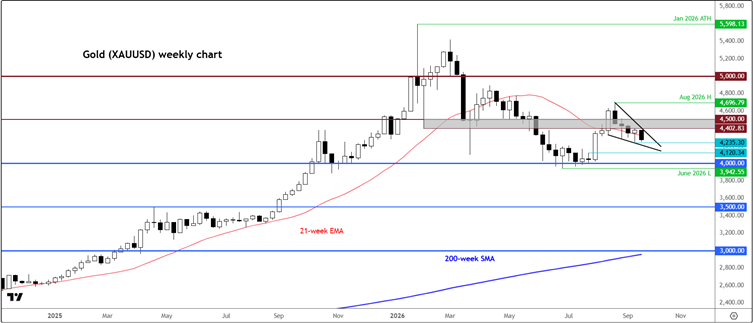
There is no doubt that the long-term trend is bullish on gold. This is highlighted for example by the series of long-term higher highs and higher lows, and the fact that price is still well above the 200-week moving average, despite the metal being in an effective consolidation mode since prices peaked in January. The near-term trend is not so bullish, however, and for that reason technical traders who have a bullish bias towards gold will need to be wary of that and wait for the right time and right signals.
That said, we saw gold stage a sharp rally away from the key $4,000 level, making this an important long-term support area. Since that rally in early August, gold has spent several weeks declining inside what appears to be a descending triangle pattern. This is a bullish continuation formation and a potential break above the resistance trend of it is required to validate the pattern, and potentially trigger follow-up technical buying above it.
Figure 3: Gold weekly chart
Source: TradingView.com
As per the chart, the resistance trend of the triangle pattern comes in around the $4,400 area, making it a pivotal level to watch in Q4. A break above there could see the metal head to $4,500 initially ahead of $4,700 area next – the latter coming in just above the August peak of $4,696. If there is acceptance above that level, then $5,000 is the next obvious target from a bullish point of view.
Now, that is all assuming that gold will stage a bullish breakout. However, if instead we see the metal decline and break the support trend of the triangle pattern, then $4100/20 area could be the next stop with $4,000 coming into focus next. A potential break below the summer lows of $3,942 would significantly deteriorate the longer-term technical outlook. In that potential scenario, gold could start dropping towards the $3,500 area.
Summary of our gold Q4 2026 outlook
Gold’s Q4 outlook presents weakening late-Q3 momentum and predominantly negative traditional macro conditions, while the metal’s relative strength compared to major FX pairs and ongoing central bank buying suggests the downside should be limited heading into Q4. If anything, the risks to our gold Q4 2026 outlook is now tilted to the upside, with a possible dollar-debasement scenario potentially triggering another wave of buying, especially if this is accompanied by a technical breakout above the triangle pattern and resistance near $4,400.