The USDA's January WASDE report is always highly anticipated by the market, as it will bring revisions to US soybean and corn production, if necessary. Also of note are concerns over weather, which has affected commodity production estimates around the world, and attention to demand amid the advance of the omicron variant of the coronavirus.
For soybeans, the USDA revised the US production 2021/22 to 120.7 million tonnes, a record level for the country due to slight yield adjustments. This small increase in production was in line with market expectations.
There were practically no changes on the demand side, and the country's ending stocks rose in the same proportion as production, to 9.52 million tonnes. Part of the market believed that the Department would reduce US exports in the 2021/22 cycle, amid delays in sales (13 million tonnes) and shipments (over 9 million tonnes) compared to the last cycle. Still, the stance adopted was conservative, waiting a little longer to make further adjustments.
For South America, the changes were sharper than the market expected. The Brazilian crop was cut from 144 million to 139 million tonnes, but exports remained at 94 million tonnes. The Argentine crop fell from 49.5 million to 46.5 million tonnes.
For the Chinese balance, there were no revisions, even amid concerns about the country's demand on poor margins in the pork industry.
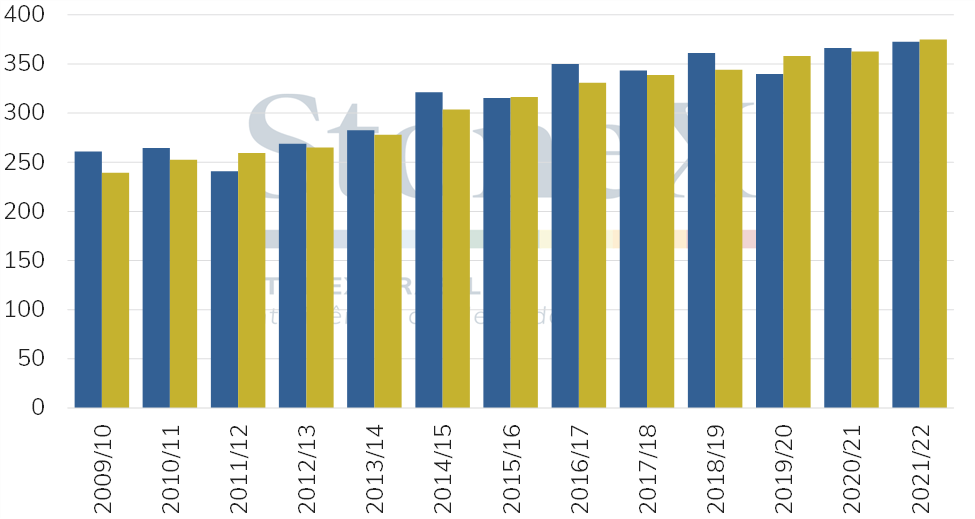
Given this scenario, for now, the losses of the South American crop point to a rearrangement in the global oilseed balance, with production falling short of consumption by 2.4 million tonnes. However, considering StoneX's estimate for Brazilian production, at 134 million tonnes, this difference between world production and consumption would be considerably larger.
World soybean production and consumption (MMT)
Source: USDA. Design: StoneX.
Corn
Regarding the revisions made to the corn crop, the increase of over 1 million tonnes in the 2021/22 North American production is worth mentioning, which increased to 383.9 million tonnes. On the demand side, there was an increase in domestic consumption, motivated by the increased use for ethanol production, which was offset by the decrease in exports. Thus, the higher production resulted in an increase in ending stocks, which went from 37.9 million to 39.1 million tonnes, a volume considerably above the market’s average estimates, at 37.7 million tonnes.
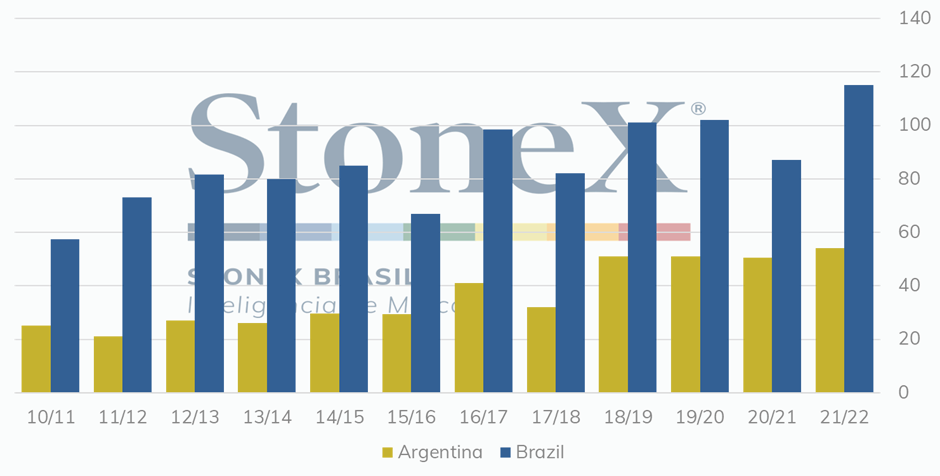
For soybeans, the revisions made to the South American crop also surprised the market. The Department reduced Brazilian production in 2021/22 from 118 million to 115 million tonnes, a cut about 1 million tonnes sharper than the market’s average estimates. However, the USDA kept domestic consumption and shipments unchanged, at 73 million and 43 million tonnes, respectively, even with the lower production.
There was a slight cut in Argentina's 2021/22 production of 500 thousand tons to 54 million tonnes.
Finally, it is also worth mentioning the increase in Ukraine's production in 2021/22, which increased from 40 million to 42 million tonnes, with exports raised by another 1 million tonnes to 33.5 million tonnes. Furthermore, it is important to note that Ukraine is an important corn exporter and a major supplier to China. Thus, it is essential to follow the country's crop since it may affect the volume exported by other important players, especially the US, which greatly benefited from the high Chinese imports in the 2020/21 season.
Corn production - Brazil and Argentina (MMT)
Source: USDA. Design: StoneX.
The USDA brought important revisions to both the US and global scenarios for the wheat crop. For the US, the Department reduced the supply level with 270,000 tonnes cut in imports, now at 2.7 million tonnes, due to the lower than expected pace of entry of the Durum and Hard Red Spring (HRS) wheat classes.
On the demand side, the January/2022 edition of the WASDE brought lower domestic consumption and exports numbers, thus raising the outlook for ending stocks. For domestic consumption, USDA estimates feed and residual use at 3.0 million tonnes, while human and seed use was maintained at 28.0 million tonnes. Exports, in turn, as we have been following in recent months, are below the expected pace and, therefore, the USDA cut them by 410,000 tonnes, locking the estimate for January/2022 at 22.45 million tonnes. It is worth noting that the entire cut was in Hard Red Winter (HRW) exports. Finally, ending stocks are estimated at 17.1 million tonnes, about 26% below the last cycle.
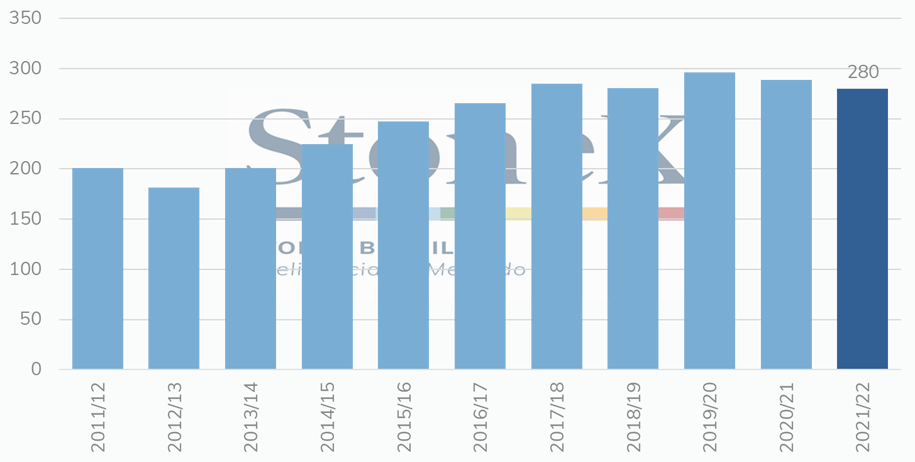
For the global scenario, the USDA kept its estimate for supply (carryin and production) practically stable, with a marginal negative correction of 110,000 tonnes. As a result, the January/2022 estimate for world wheat production stood at 778.6 million tonnes. On the consumption side, the Department reduced its estimate, from 789.35 million to 787.47 million tonnes, with more significant reductions on US consumption (22.45 million tonnes, as noted above), European Union (107.65 million) and Ukraine (8.8 million). In addition, with the adoption of the export quota by the Russian government, the USDA estimates that Russia's exports will reach 35 million, with a reduction of 1.0 million, which is partially offset by the increased estimate on European exports, now at 37.5 million. Finally, it is worth noting that despite the 1.8 million tonnes increase on the ending stocks estimate, which should total 280 million tonnes, the projection is the lowest since the 2017/18 crop year.
Wheat ending stocks - World (MMT)
Source: USDA. Design: StoneX.
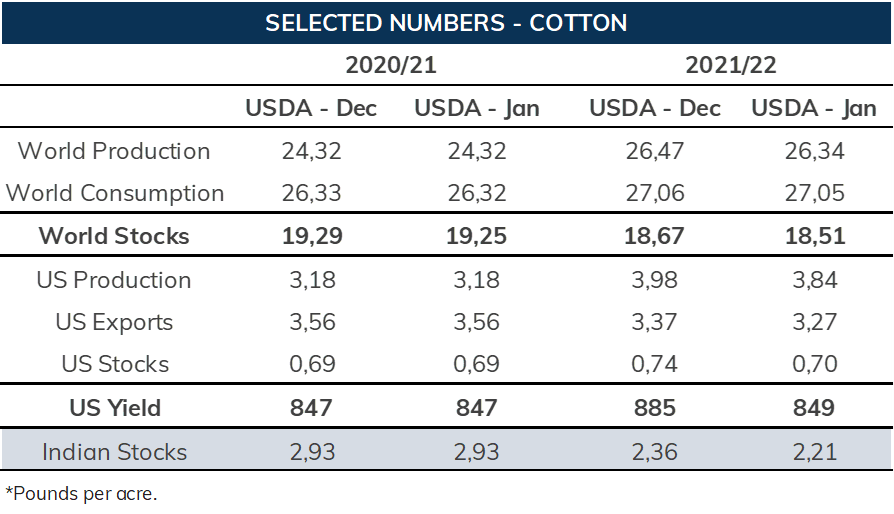
The data brought by the USDA in its first WASDE report of the year gave grounds for new rallies in cotton futures prices. Agents expected few changes in global S&D, considering the continued tight balance. However, the surprises came with the revisions in US production, which was projected at 3.98 million tonnes and was cut by 140,000 tonnes, closing at 3.84 million tonnes in the 2021/22 cycle, according to the January estimate. This correction came from the revision of the national yield from 885 lb/acre to 849 lb/acre, influenced by the cut in the Texas yield.
The size of the North American crop remains historically high and 20.7% larger than the previous season. However, the maintenance of firm international demand for cotton, followed by the recovery of economies, will put pressure on US stocks, which, in turn, had an expected relaxation in the January WASDE. Agents expected a decrease in the US 2021/22 exports as the pace of weekly shipments is slow, resulting, in particular, from the crisis in international ocean freight, which has dragged on since mid-2020. As a result, the USDA cut exports by 100 thousand tonnes. However, 3.27 million tonnes to be exported by the US this season still seems an optimistic volume and was not enough to prevent the expectations of lower ending stocks in the country, the main driver for the bullish mood caused in sessions after the report release.
Between Tuesday’s close (11) (before the WASDE) and Friday the (14), the March/22 contract accumulated an appreciation of USD 3.68/lb (3.1%), closing the week at USD 119.70/lb, a record for the contract.
Still, within what the market expected, the changes to the crop variables in India contributed to a bullish report. Production was cut by 110,000 tonnes to 5.99 million tonnes in the 2021/22 crop. The Indian crop suffered from several problems and seemed to directly impact the domestic market, which shows growing demand – something captured by the USDA as it increased consumption in India again. Thus, stocks continue to decrease in the country, supporting the international S&D tightening scenario. Finally, within this scenario, even with the slowdown in Chinese demand, the main global consumer, the USDA publication brought fundamentals for new climbs in NY, where prices were already at historically high levels.
Selected Indicators - Cotton (MMT)
Source: USDA. Design: StoneX.
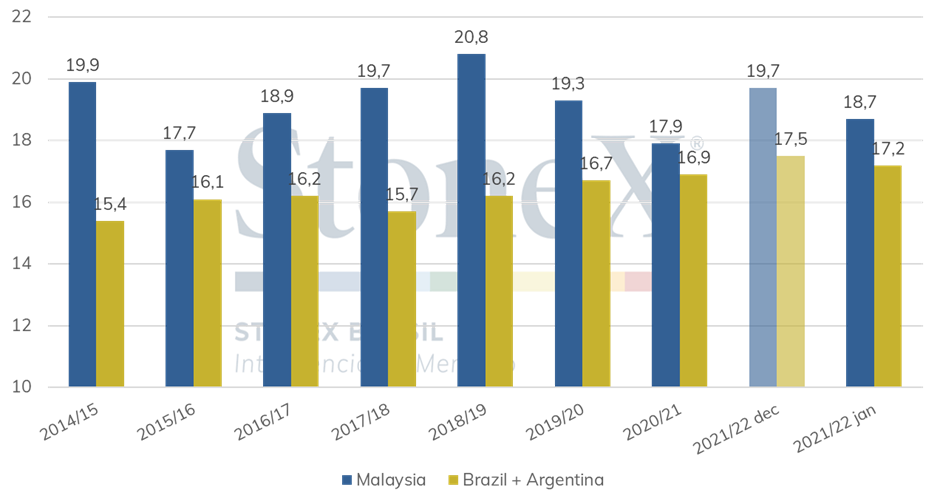
Among the changes promoted in January by WASDE/USDA in the vegetable oil complex, the highlights were the cuts in production expectations for soybean and palm oil due to weather problems the two crops face in different parts of the globe.
The downward revision in soybean production expectations in South America, amidst delayed rainfall in the southern portion of the continent, caused revisions in the oil production estimate. In Brazil, the production was reduced by 1% from December to 9.1 million tonnes, still slightly higher than the previous crop and the highest volume of soybean oil ever produced in the country. However, despite the lower production, soybean oil ending stocks in Brazil are expected to increase in 2021/22, mainly due to an upward revision in the previous crop ending stocks.
The cut in soybean oil production in Argentina was even bigger, around 2.5%, to 8.2 million tonnes. However, even with the reduction in production, Argentine ending stocks were also estimated higher due to a cut in export expectations for the period.
On the other side of the globe, in Malaysia, the production problems related to labor shortages and heavy flooding since the end of 2021 fostered a significant cut of 5.3% in palm oil production expectations in the second-largest producer of tropical oil. Also, due to current uncompetitive palm oil prices trading near historical highs, WASDE/USDA has also reduced demand in major consuming countries such as India, China, and the European Union by 2.7%, 0.7%, and 3.2%, respectively. With the production problems, the Department reduced the expectation for global ending stocks by 1.8% to 49.7 million tonnes.
Soybean oil production in Brazil + Argentina and palm oil in Malaysia (MMT)
Source: USDA. Design: StoneX.