The appreciation of grains, which has been occurring since 2020, led soybean and corn prices to historically high levels, and since then, producers' profit margins have followed this upward trend. However, the price readjustments in production costs, especially fertilizer prices, reduce the observed returns. For example, between April 2021 and 2022, the spending on fertilizers for production in Mato Grosso grew 91% for corn and 114% for soybean, while grain prices increased at a much lower rate.
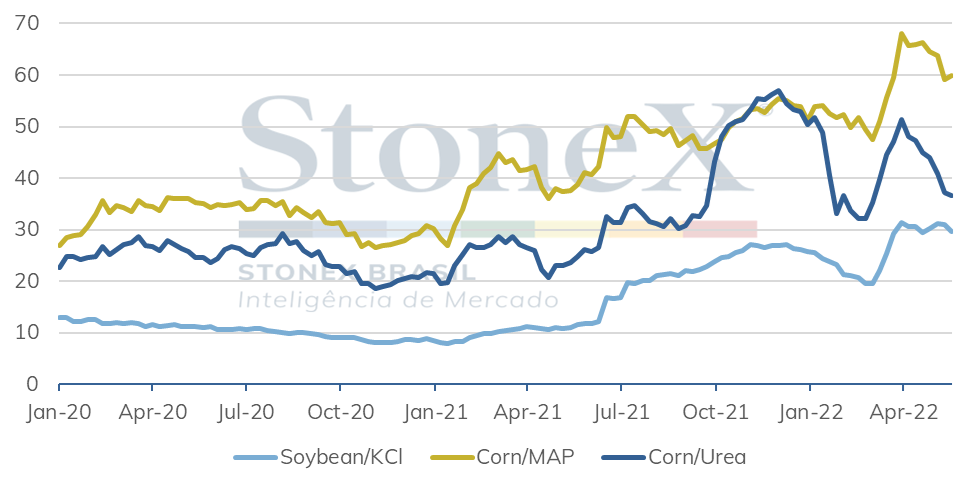
The discussion around the increase in costs of agricultural inputs has been on the agenda since mid-2021, when production costs began to be readjusted after a little variation in 2020. The surge in fertilizer prices worried producers since the exchange ratio increased rapidly, with nutrients showing a faster appreciation than soybean and corn.
Since then, fertilizer prices have continued to rise due to several external factors. Nitrogen and phosphate fertilizers have had part of their supply restricted because of export bans from important market players such as China and Russia. At the same time, the excessive rise in natural gas prices has raised ammonia production costs, escalating into an overvaluation of nitrogen and phosphate fertilizer production costs.
Furthermore, economic sanctions against Belarus affected exports from the third-largest potassium producing country and one of Brazil's main nutrient suppliers. However, the situation became even worse with the beginning of the Ukraine conflict, in late February 2022, when logistical difficulties in the Black and Baltic Seas started to interfere with nutrients sales coming from Russia, an important producer of N, P, and K.
History of the Exchange Ratio - Soybeans and Corn x Urea, MAP and KCL at Paranaguá
Source and Design: StoneX.
For the 2022 crop, producers could not secure fertilizers at a favorable exchange ratio, as occurred in the previous cycle. Thus, profit margins are expected to be lower this season than the last on the national average. In contrast, some producers are expected to reduce demand and apply part of the nutrients.
Even though margins are lower than in previous periods, it should be noted that they remain quite positive since soybean and corn prices remain supported. However, even with positive results, the producer takes a greater risk, given the higher costs. In case of any weather or sanitary problems resulting in productivity losses, for example, the producer would incur a greater loss. With this, no matter how much the grain prices compensate, the producer may adopt measures to protect himself, reducing investments in crops.
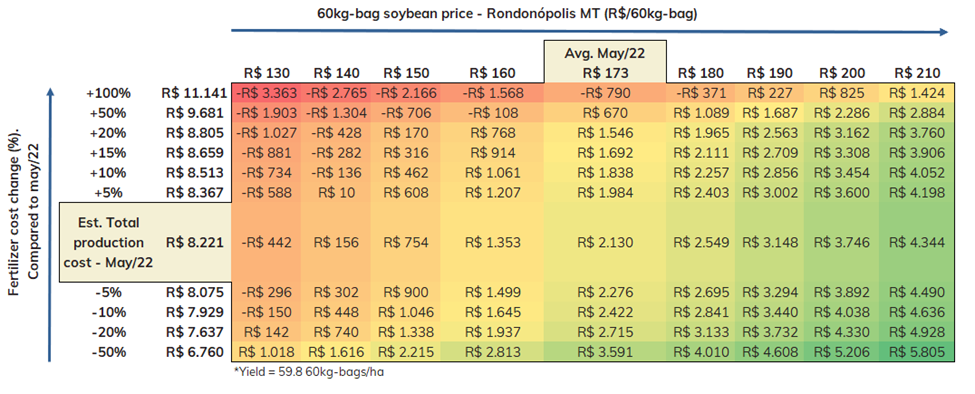
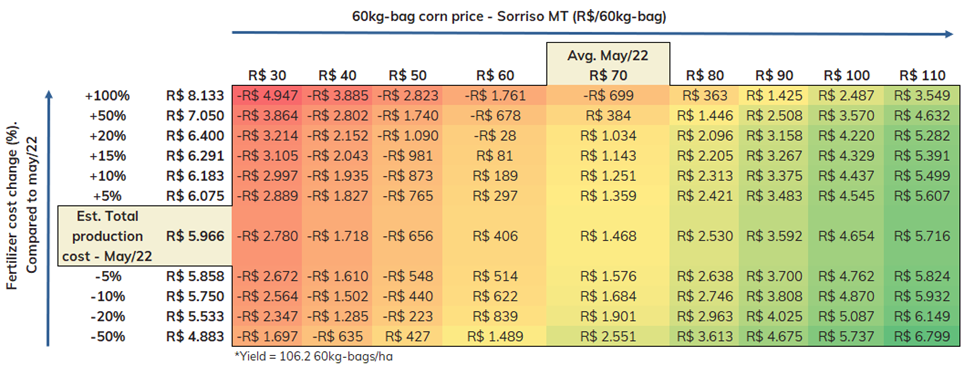
In addition, it is necessary to follow the evolution of soybean and corn prices. Even though there are no factors with great bearish potential in the market, the following simulations illustrate scenarios of prices and costs with fertilizers in Mato Grosso. In extreme scenarios, such as an overvaluation of fertilizers at levels even higher than the current ones, or a strong fall in commodity prices, margins would be negative for the producer, considering productivity in line with recent years.
Operational margin scenarios in a soybean production model - Mato Grosso (BRL/hectare)
Sources: IMEA, CEPEA and StoneX. Design: StoneX.
Operational margin scenarios in a safrinha corn production model - Mato Grosso (BRL/hectare)
Sources: IMEA and StoneX. Design: StoneX.