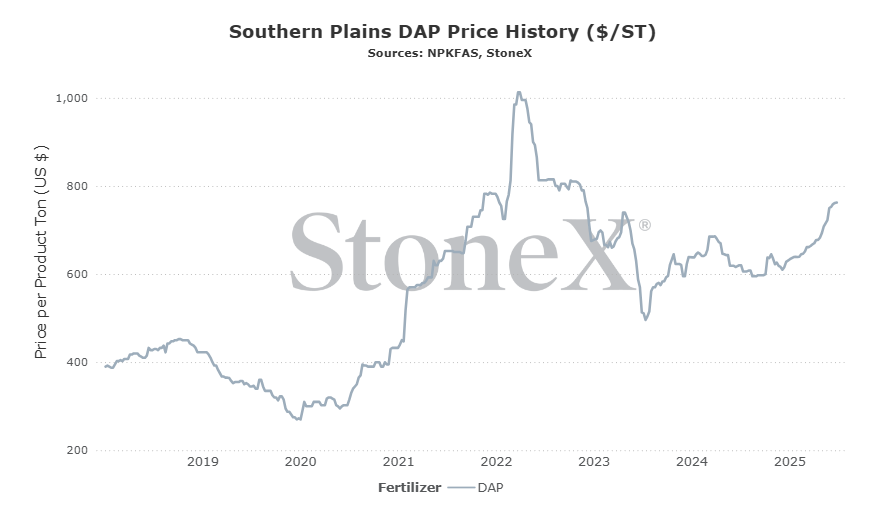
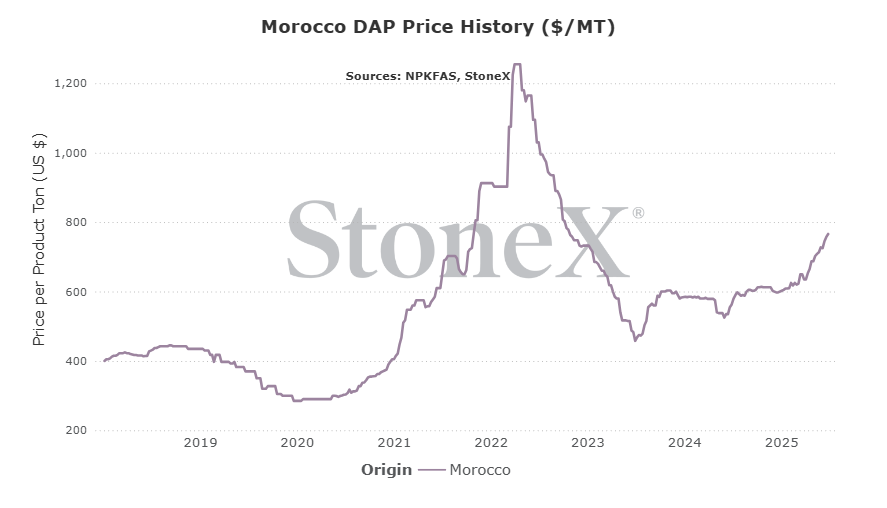
I will say this now and will say it going forward to eternity: these are the flat price graphs for each individual location. Your price where you are is going to be different. There are logistics. There is the cost of storage/interest/insurance/etc. These graphs should not be taken as "it shows the price at $700, why isn't my price $700". These graphs should be used to give an appreciation for price movements.
All values are in metric tons and USD currency.
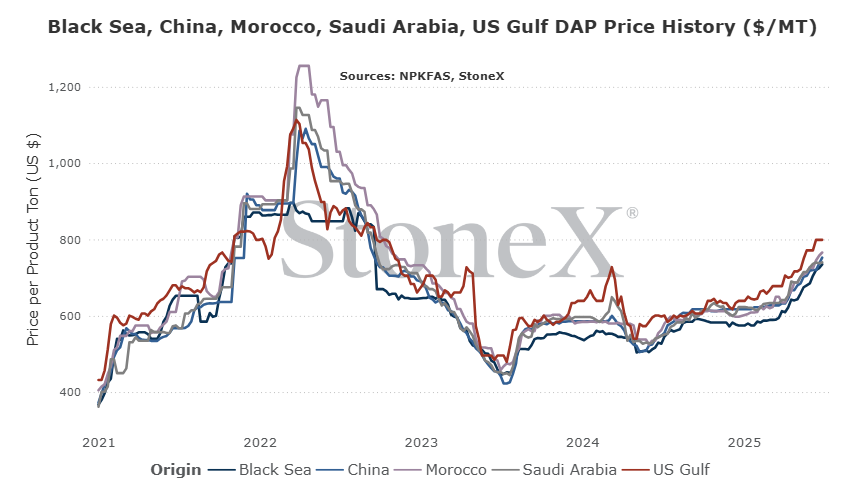
Global
"Josh, don't you dare say prices are going higher. They are already outrageous."
If that thought went through your mind, I do not blame you one bit.
However, allow me to disappoint you once again...seriously, I'm not happy and/or proud of this.
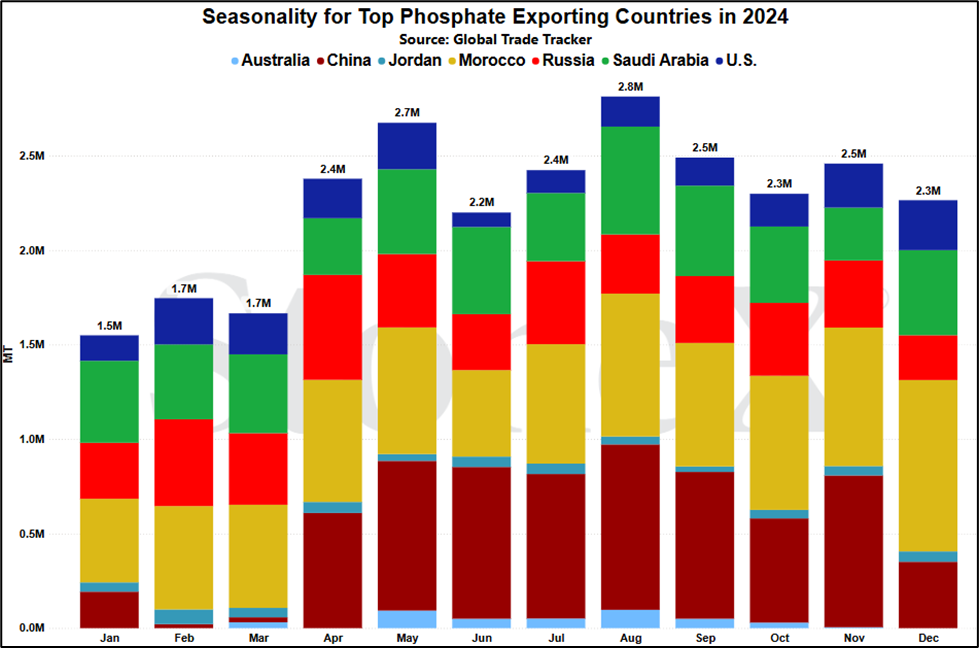
The global S&D is still unbalanced. Supplies are incredibly tight given that China has made the decision to only export 4M tons vs their normal 8 - 10M tons per year. The global phosphate market is largely comprised of 5 countries. When the leader of those 5 countries has their export flows reduced by over half, it hurts.
On the demand side, India is not doing anyone any favors. Their monsoon season is so far very good which should mean that coming demand is great. Their farmers could care less about the global price since their price is guaranteed low by the government. That same government allowed their stockpiles to drop to low levels which they have struggled to rebuilt...and the world knows it. They keep buying higher and higher priced phosphate which supports global prices.
As long as the China and India stories remain in play, it is very hard to see values falling. Eventually we will see new production start filling the supply hole, but we are measuring that in years, not months.
North America
The global market outlook remains supported.
Fertilizer Year 2026 (starts July 1) demand for phosphate remains big as we are expecting 93 - 94M acres of corn in 2026 (far too early but will be our starting point).
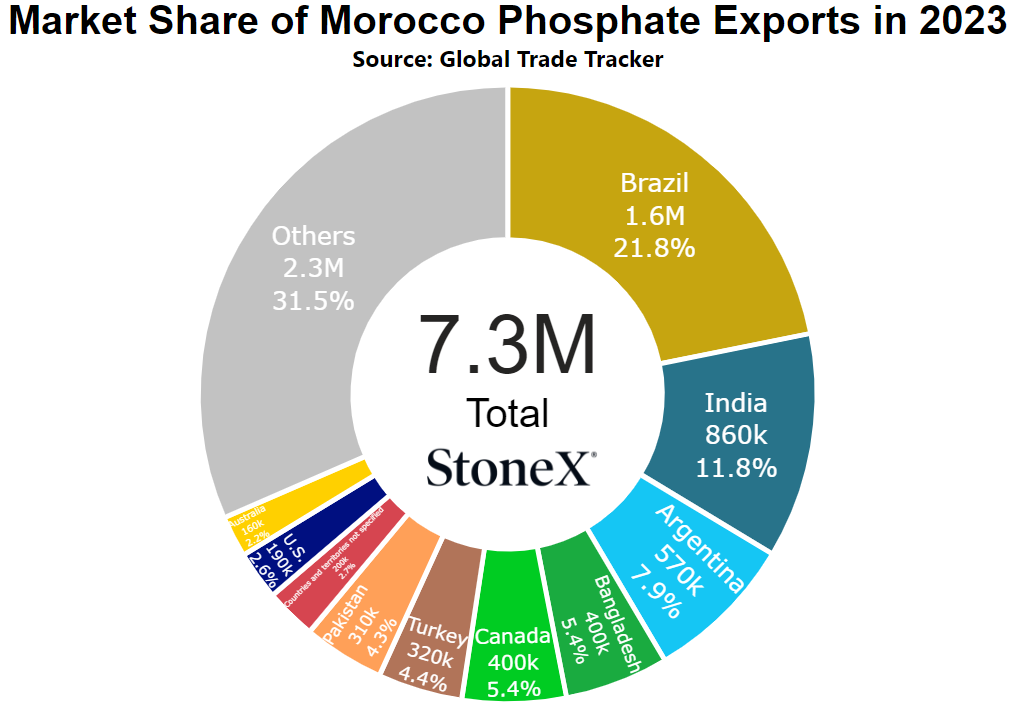
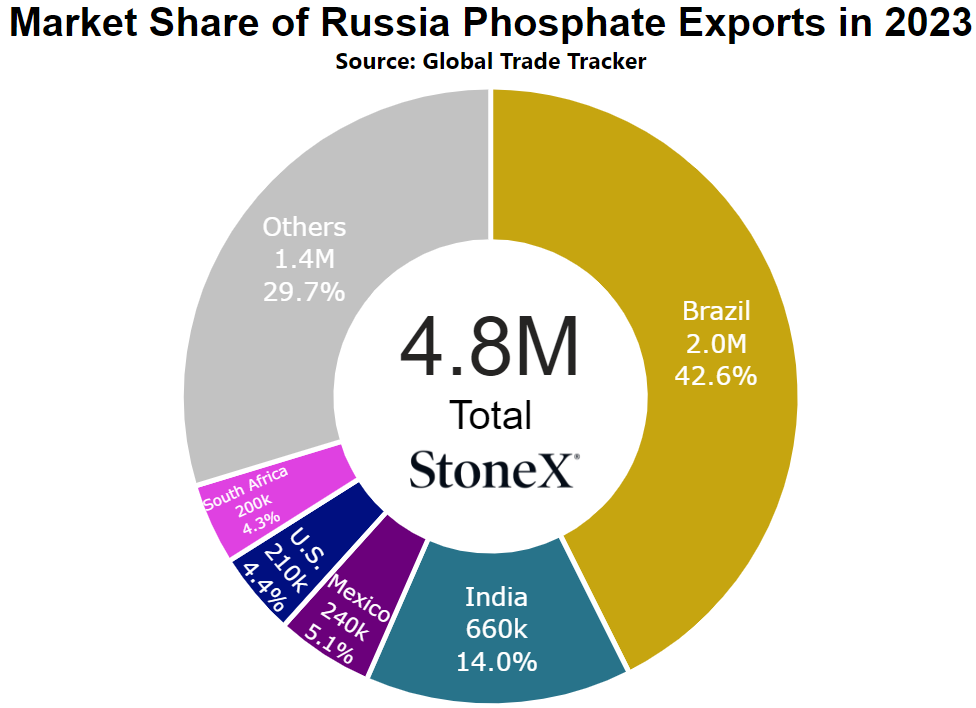
We have effectively blocked the 4 largest exporting countries in the world.
- China - tariffs
- Russia - duties
- Saudi Arabia - tariffs
- Morocco - tariffs AND duties
Our own production rates were extremely poor for Q4 '24 and Q1 '25. Q2 doesn't look much better so farm
There is a chance that the duty rates could be removed, but I'm not holding my breath. Even if they are, our prices are not a big premium vs the world. If we move to a discount, as tight as the world is supplied, they will just go to higher netback nations.
Even with prices so high, especially vs grain values, there is still upside. We could see N.A. values higher just as we build in a premium to the world to ellicit imports. However, farmers are struggling. End demand is going to be very skeptical and will likely wait until much closer to fall before stepping forward. There is a chance that values can soften a bit, but there is a bigger chance they hold steady or push higher.
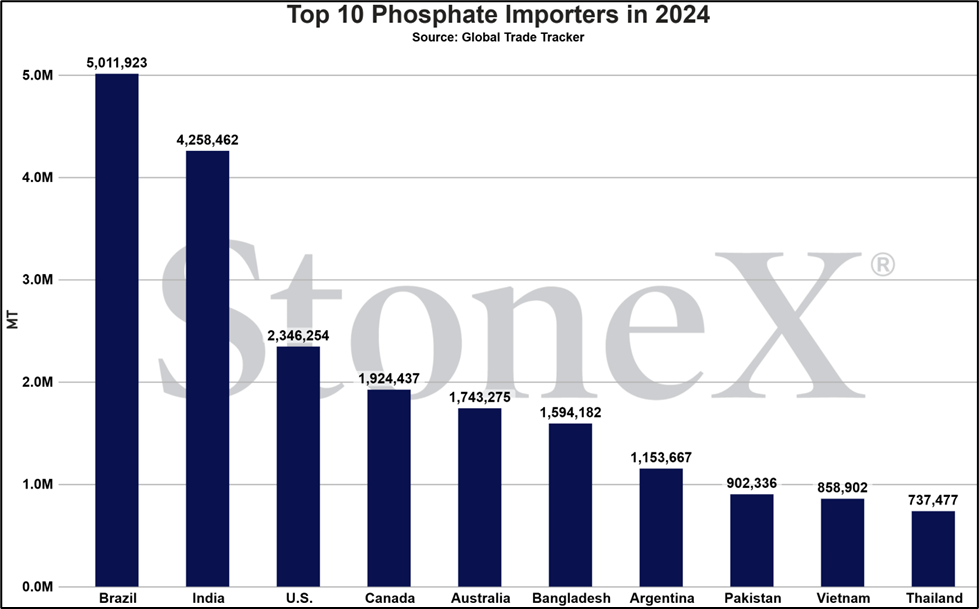

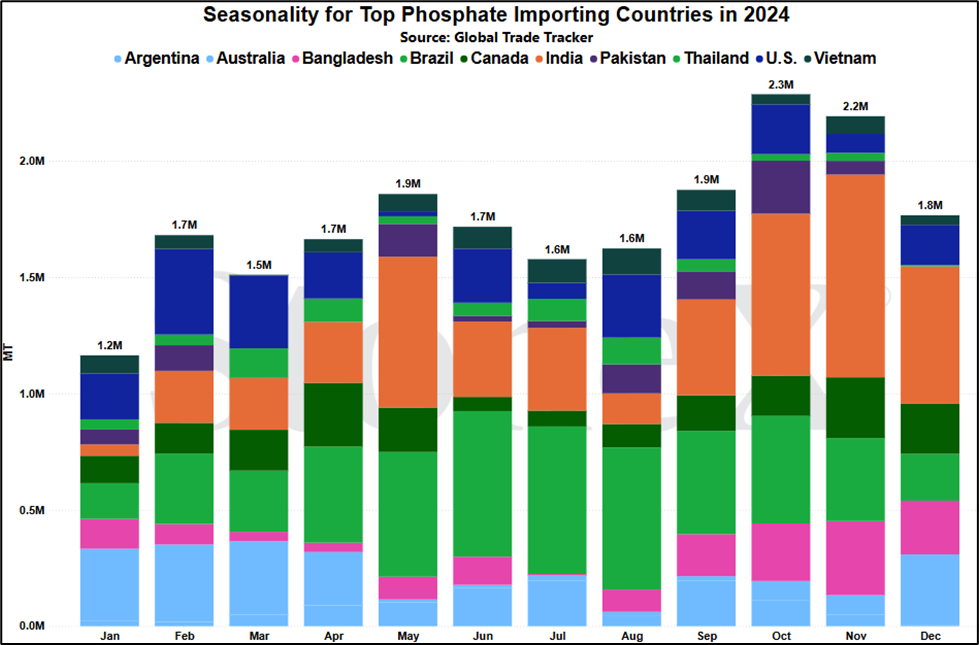
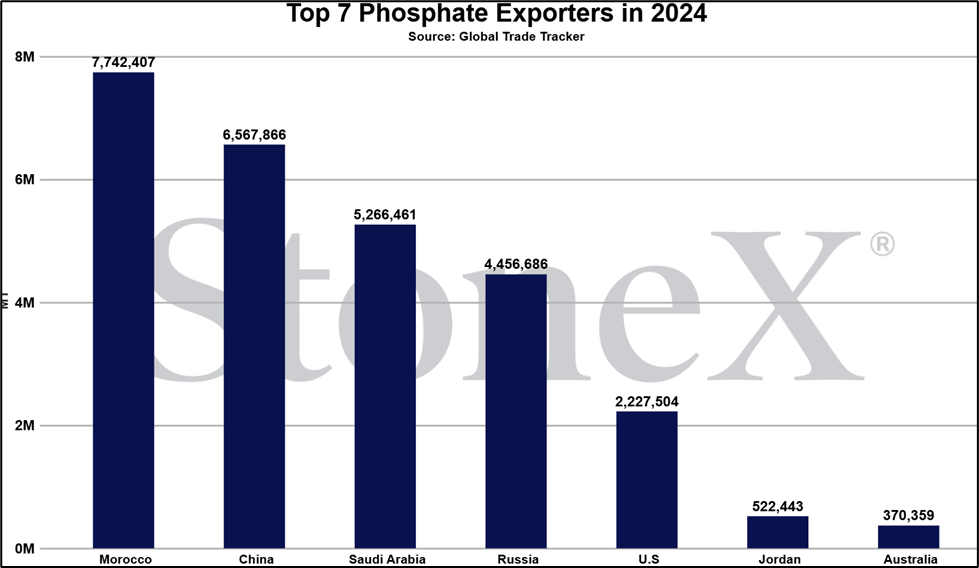
No change on low Chinese export program expectations
Historically, China has been the largest exporter of DAP/MAP to the world with those volumes typically reaching into the 8 to 10M tons range per year. Recent years has seen those totals slashed.
A brief history: in late 2021, the world was shocked at the news that Russia was preparing to invade Ukraine. Suddenly, a very real fear crept into the marketplace that Russian fertilizers would cease to exist. For the phosphate market, this was hugely impactful. The world of phosphate is largely driven by 5 countries. Losing one of those countries would have a massive impact on world prices. Suddenly, protectionism began with other countries scaling back their own exports to make sure their own people were well stocked.
China took that approach to the extreme.
The government suddenly started to step in and put restrictions in place. Rather than allow exports to flow freely, they decided to restrict the number of tons that could leave. They had two goals in place: ensure adequate domestic stockpiles and keep domestic values lower than the rest of the world.
Unfortunately for the rest of the world, this approach was successful...and so it continues to today.
For 2025, the government has restricted total exports to only 4M tons. At least, that was last heard and is currently expected in the marketplace.
Some have questioned how they restrict it to 4M tons when normal was 8 to 10M. I have two theories:
1. Domestic farm demand has risen - China in many ways is acting like a country preparing for war. They are becoming much more isolated. If that view is correct, then the government is likely going to its farmers and pressing them to grow more food so they are less reliant on imports. How do you grow your yield potential? Apply more fertilizer.
2. Battery demand continues to rise - the current new tech for battery manufacturing is phosphate based and China is a major manufacturer of products linked to that. We could certainly see domestic Chinese demand rising rapidly as their battery manufacturing capabilities continue to grow.
For all the noise, rumors, etc. that surround the Chinese export flows, the simple fact is that exports are down substantially and as a result, global supplies are taking a massive hit that will be felt by almost every farmer on earth.
What the closure of the Strait of Hormuz would have meant for phosphate
The biggest story of the last month was the conflict between Israel and Iran which eventually saw U.S. participation. Rather than allow Iran to continue building a nuclear weapon, Israel decided on preemptive strikes. Iran, as expected, responded with widescale rocket attacks on Israel. Israel continued their surgical strikes on Iran which saw more revenge attacks by Iran. This situation continued to spiral until President Trump authorized the use of B-2 bombers to fly halfway around the world to deliver bunker busting bombs on Iran's nuclear facilities. That is when tensions reached their peak.
Shortly after those attacks, the Iranian government voted to "close the Strait of Hormuz". For the many products that flow from the Persian Gulf, this was the nightmare scenario come true. No doubt Iran's focus was to stop the flow of energy products like oil from reaching the U.S. and to a certain extent a move like this would have had an effect. However, it quickly became apparent that their own ally, China, was much more reliant on oil flowing thru the Strait than the U.S.
Fortunately, calmer heads prevailed. After an announced rocket attack on U.S. military bases in Qatar (which was more a show of force and a symbol to government allies than an actual attack), a ceasefire agreement was reached which is still holding today.
It appears we can put this nasty chapter of global history behind us, but I think it is important to consider what could have been just in case it happens again.
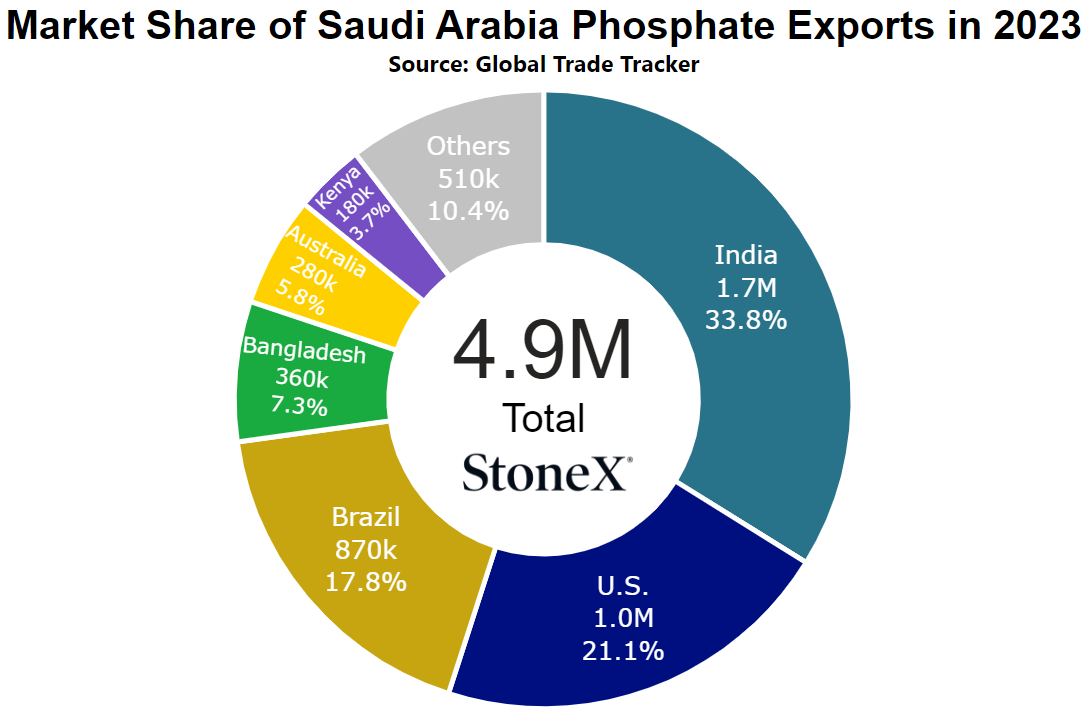
Looking at the global export chart above, you will notice that Saudi Arabia is the 3rd largest DAP/MAP exporter. If Iran had truly intended to try and close the Strait of Hormuz, they would not set up checkpoints in the water. They are not going to sit there and tell vessel A that they are ok to go through but vessel B needs to go back. They would attack ships with speedboats, rockets, etc. In the best case scenario, they would hit a ship sailing to the U.S. In the worst case scenario, vessel owners would refuse transit through the area as they refused to put their ship and crew in danger. If enough vessels made that decision, shipments would stop.
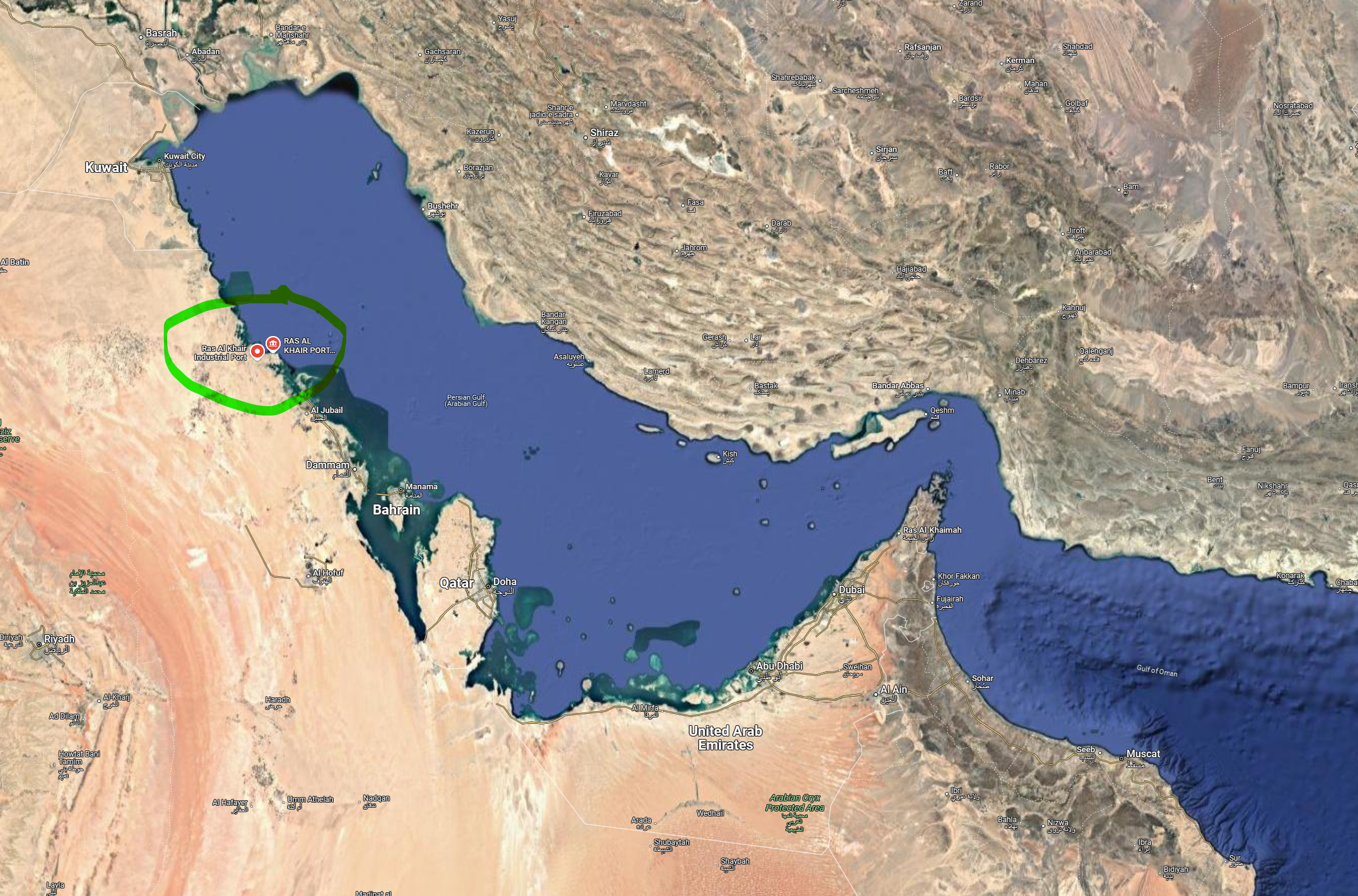
The map below is a snippet taken from Google maps where I have highlighted in green the Ras al-Khair port. That is the main port that Saudi Arabia uses to load their finished phosphate into vessels. From there, you HAVE to sail through the Strait of Hormuz in order to reach the rest of the world.
Basically, if you see in the news that this body of water starts to be targeted once again, know that the main fertilizer focus will be on nitrogen but also be aware that phosphate will also be impacted.
Source: Google maps
India continues to boost global values as it tries to rebuild stockpiles
As we have discussed many times over the last several months, India continues to prove to the world that higher prices ARE happening.
India was the 2nd largest phosphate importer in 2024. If their purchase strategy would have been more effective, they would have been number 1.
For those new, a backstory:
India is the world's largest democracy with the largest population. When looking at the breakout of people, those touching ag is the largest portion of people. Rather than subject their farmers to global fertilizer price volatility, the governments sets a price that is not allowed to raise. If you keep an input cheap for your biggest voting block, you have a much better chance of them voting for you!
But how do imports happen if global values are high and domestic values are low? The government creates a subsidy that makes up the difference. Over the last several years, this has become extremely expensive.
Last summer (2024), global phosphate values were falling as Chinese export flows started to improve. After years of paying massive subsidies, the government officials decided to try and put a bit of pressure on global price ideas. Their thought was that by lowering their subsidy rate, global sellers would have to lower their price to participate in India. If nothing had changed, it is very likely this would have been successful.
But the only constant in life is change.
Suddenly, Chinese exports started to slow once again on government interaction. Global values started to rise, but Indian officials were slow to react. Domestic stockpiles started falling fast and nearly reached critical levels before rates were changed enough to allow imports.
However, the damage was done. The world was seeing the world's largest exporter in China lowering their rates. The world also realized that India was in a bad way and that they didn't need to worry about farmer demand as they did not see the new prices. What do markets do when they see that kind of a situation? They raise the price.
That continues to be the case today. Stockpiles have continued to be low as they struggle to find large quantities. They also need to worry about the fact that monsoon season has so far been very good which is a great indication that demand will be high. Their prices have continued to raise nearly weekly and it found a fresh high toward the end of June when an importer finally paid over $800MT. Values have steadied since that contract was signed, but the fear is that more price increases could be on the way as India resumes purchasing.
I continue to see the lack of Chinese exports as the cause of higher global prices, but I see India as the effect and the thing that shows us that it is happening.
It does not matter where you read this from. This is causing your phosphate values to rise.
N.A. supply situation dire but still "in-line" with other major buyers
One of the things I hear from folks is that if the U.S. would abandon our tariff/duty approach, our phosphate values would fall through the floor.
There is no doubt that our supplies are in a bad place when we look at the world (check the global exporter chart for more insight above):
- Morocco - U.S. currently has duties and tariff's in place
- China - U.S. currently has tariff's in place
- Saudi Arabia - U.S. currently has tariff's in place
- Russia - U.S. currently has duties in place
- U.S. - operating rates for Q4 and Q1 were record low, bleak outlook for Q2
If we were to lift these tariff's and duties, I do believe we would see prices soften. Suddenly, the U.S. importers could fight for vessels on even footing rather than the disadvantage they are in right now. More plentiful supplies would make it so that buyers could drag their feet on fall purchases which could put more pressure on the market.
But to think that values would absolutely fall out of bed is not currently in the cards I see.
Simply put, global supplies are simply too tight with the lack of Chinese participation. Other sellers are able to be much more selective on where they go. If they have a single vessel to sell with one country willing to pay more than the other, they will select the highest paying.
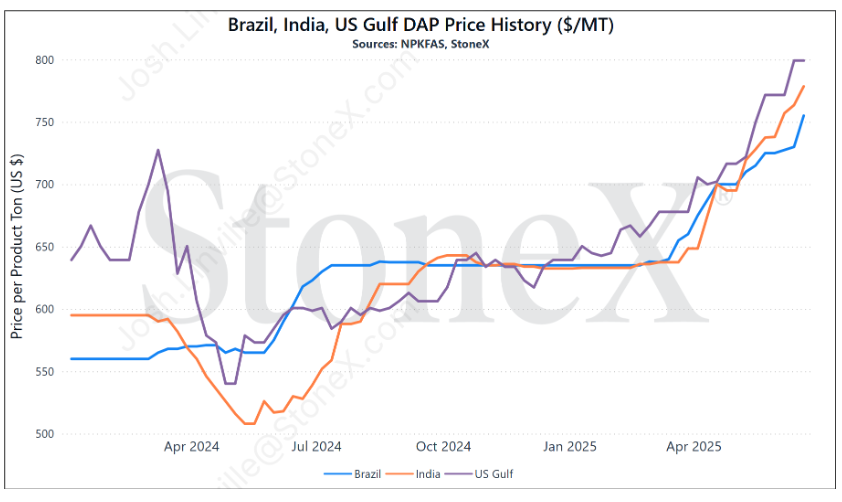
The chart below shows the world's 3 largest importers and their current values. NOLA DAP values are the premium market so should be getting a lot of imports, right? Unfortunately, this price does not reflect the tariff/duty penalties companies must pay to import. When I look at this chart, I am not surprised that NOLA is a premium. I am more surprised that NOLA is not a bigger premium to India/Brazil as it was on the left side of the chart.
Please do not read this and think "Linville doesn't want these barriers removed". That is absolutely NOT the case. I am just trying to temper expectations for if that scenario plays out. Prices should weaken if it does, but I think many folks will be disappointed by the price movement.
N.A. phosphate vs corn ratios break all-time high's
For those of us that lived through 2008, we never thought we would see a situation like that again.
Sorry to say, our current corn/DAP ratios have beated those values...and not in a good way.
Taking a look at the current situation:
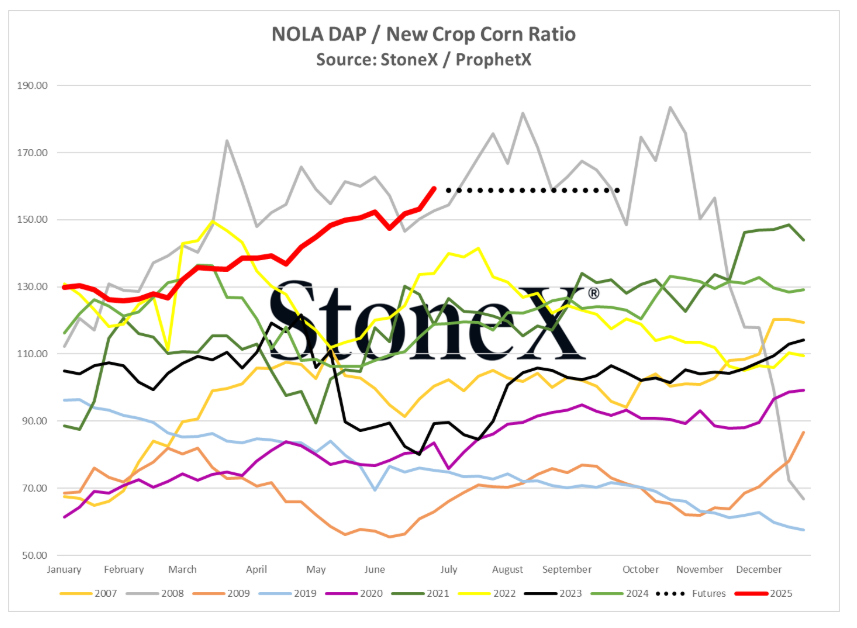
- NOLA DAP barges last traded at $725
- December 2026 corn closed at $4.54
- Ratio = 160
For this time of year, that is the highest we have ever seen. The thing that worries me more is that the all-time worst weekly ratio was 184 and if corn doesn't improve, we could challenge that one as well.
Today, there isn't much that can be done. This continues to be a situation that is being driven by global events. Many folks are talking about demand destruction but given what is missing on supplies, the market is actually wanting/needing that to an extent.
I did not write this section to rub you nose in this problem. I wanted to try and use it as an explanation of why we look at the ratios rather than the flat prices.
Notice the black line in that graph below? That was 2023. That is the cheapest the ratio value has been in recent years...but it looked like it was getting better. If I am being honest, at that point, I thought phosphate values were going to continue to fall and that corn values were going to continue to rise. I was right on the phosphate. Values would fall a little more, but corn shifted. That market suddenly went from $6/bushel to the $4/bushel range in a matter of a couple weeks.
The solid ratio value was gone just like that.
I know this is a bit of 20/20 looking. It was not easy to pull the trigger at that point. It was early. The crop was growing. Phosphate values were high. It is so easy to look backwards and say we should have done this or that.
That said, if we could go back in time, we would have been screaming to lock that ratio in regardless of market expectations. The ratio was very low. Low enough that we should have been discussing locking in layers to start building soil levels in case values got extremely high.
...like now.
If you have soils that can hold phosphate, imagine if you had secured this and built your soil profile. You would have been spending 80 bushels of corn per ton of DAP applied. Now, that ratio sits at 150 bushels of corn per ton of DAP applied. Assuming no destruction to yield potential, that insurance application could be used.
Again, it is easier to say I should have after the fact. I only write this so that next time there is an opportunity, we are ready to act rather than react.
Is there any hope on the horizon for high phosphate prices?
YES!!!!!
I've spent so long writing about bad situations that I wanted to end on a positive note!!
There is light at the end of the phosphate tunnel. While that light is still years away rather than months, it is still light.
There are several hopeful phosphate projects that have been discussed/announced/etc.
- Norway - a massive phosphate rock reserve has been found in Norway and they seem intent on developing it. While they will have the normal mining hurdles (construction, financing, environmental fights, etc), it is the most promising discovery in years.
- Saudi Arabia - we have heard that there are plans for an expansion on current production capabilities. It sounds like they intend to begin phase 3 construction which would expand production.
- Morocco - plans are in place to boost production of Triple Super Phosphate (TSP). While this is not a hugely popular phosphate product, it still represents phosphate units. If that product is adopted by some, it helps to free the more popular DAP/MAP supplies.
- Egypt - recently been hearing that the government is getting more serious about looking for further phosphate rock reserves and expanding current production.
- Australia - a company is pushing to create a new mine south of Darwin that could create more product.
This isn't even the end of the list but these are the most important and most likely to happen today. If, and that remains a big if, this list becomes reality, that will far outweigh the product that has been lost in Chinese exports.
We can also hope that battery manufacturing finds a new base. Battery tech has changed over the years and the current best base product is phosphate. That puts farmer demand in direct competition with battery demand. While I cannot believe what I'm about to say is right, farmers are at a disadvantage. There is far more margin in that than there is in growing food.
Seriously, what kind of a world do we live in where that statement is right?
Still, there is hope on the horizon for phosphate. I wish I could tell you that it is weeks/months away. Suppose I should be happy to finally have a positive story to share!!!
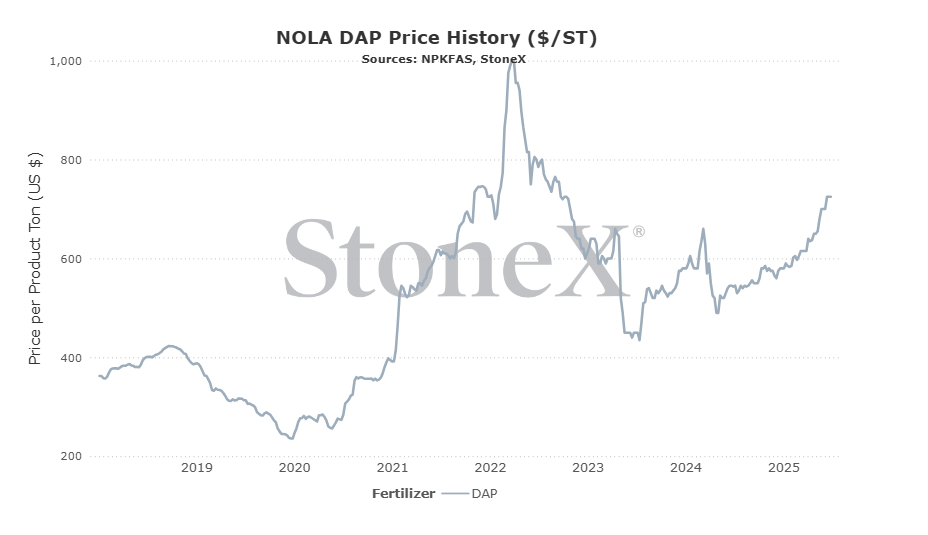
NOLA/New Orleans, Louisiana DAP price comparison
Number 5 global exporter in 2022
Price comparisons
Vs 30 days ago - 4% or approximately $25 higher
Vs 90 days ago -13% or approximately $85 higher
Vs 6 months ago - 25% or approximately $145 higher
Vs 1 year ago - 34% or approximately $182 higher
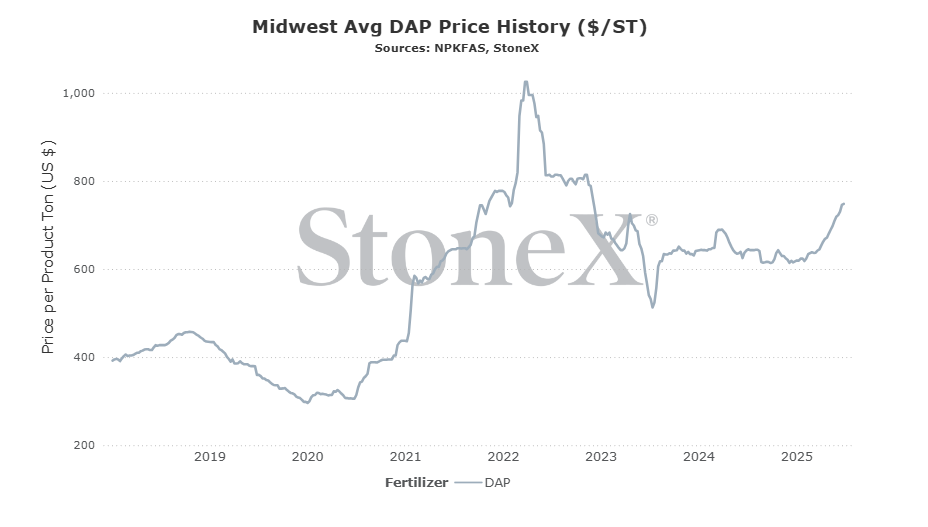
U.S. Midwest Average (using multiple points across Midwest) price comparison
Vs 30 days ago - 0% or approximately $0
Vs 90 days ago - 17% or approximately $113 higher
Vs 6 months ago - 18% or approximately $118 higher
Vs 1 year ago - 15% or approximately $103 higher
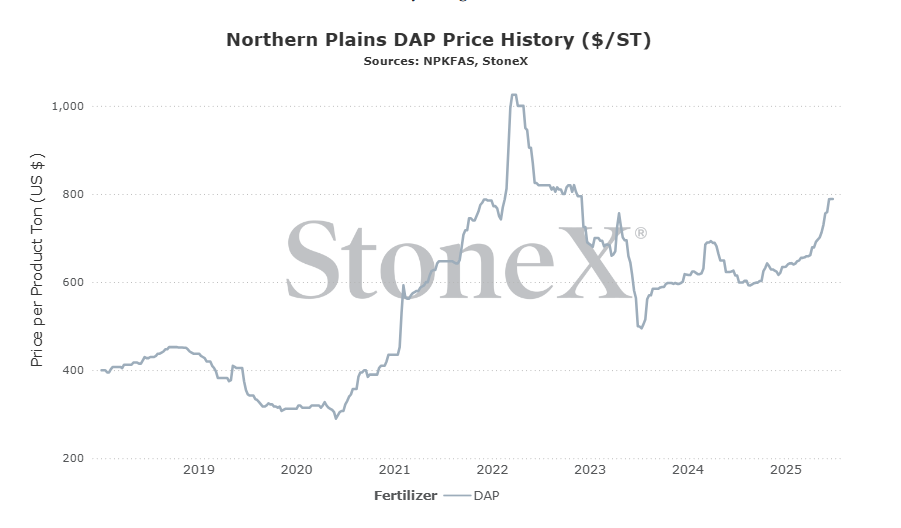
U.S. Northern Plains Average price comparison
Vs 30 days ago - 4% or approximately $33 higher
Vs 90 days ago - 19% or approximately $128 higher
Vs 6 months ago - 24% or approximately $154 higher
Vs 1 year ago - 31% or approximately $185 higher
U.S. Southern Plains Average price comparison
Vs 30 days ago - 2% or approximately $13 higher
Vs 90 days ago - 14% or approximately $93 higher
Vs 6 months ago - 20% or approximately $129 higher
Vs 1 year ago - 23% or approximately $143 higher
Morocco DAP price comparison
Number 1 global exporter in 2022
Price comparisons:
Vs 30 days ago - 5% or approximately $39 higher
Vs 90 days ago - 21% or approximately $131 higher
Vs 6 months ago - 27% or approximately $164 higher
Vs 1 year ago - 36% or approximately $204 higher
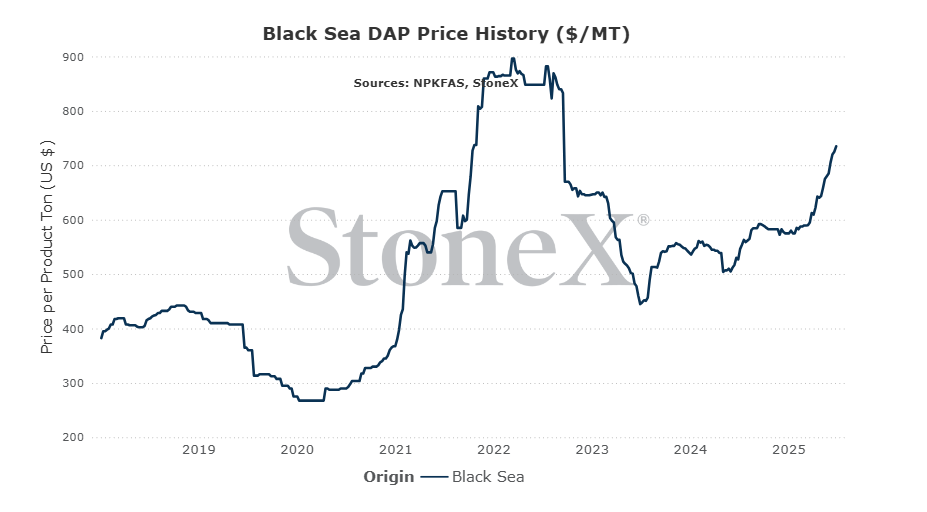
Black Sea DAP price comparison
Number 3 exporter of DAP/MAP in 2022
Price comparisons:
Vs 30 days ago - 7% or approximately $50 higher
Vs 90 days ago - 21% or approximately $126 higher
Vs 6 months ago - 28% or approximately $160 higher
Vs 1 year ago - 40% or approximately $209 higher
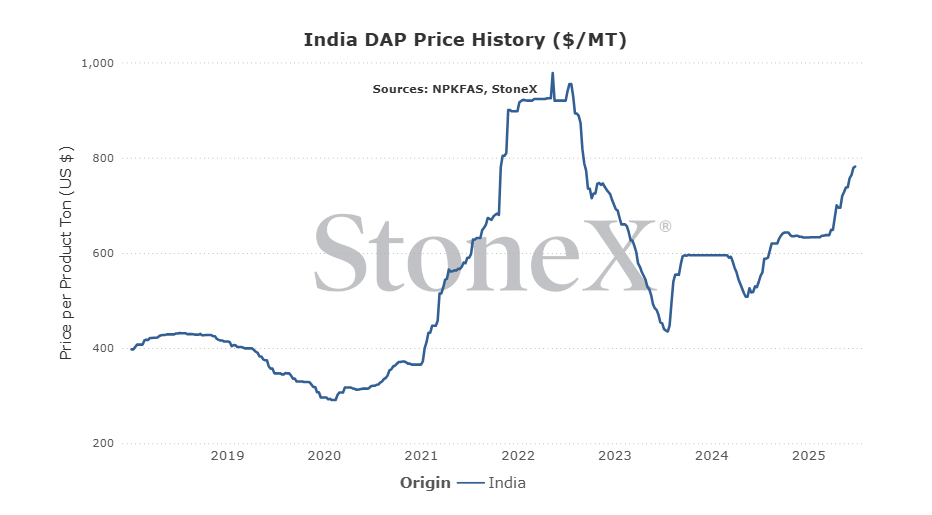
India DAP price comparison
Number 1 global importer in 2022
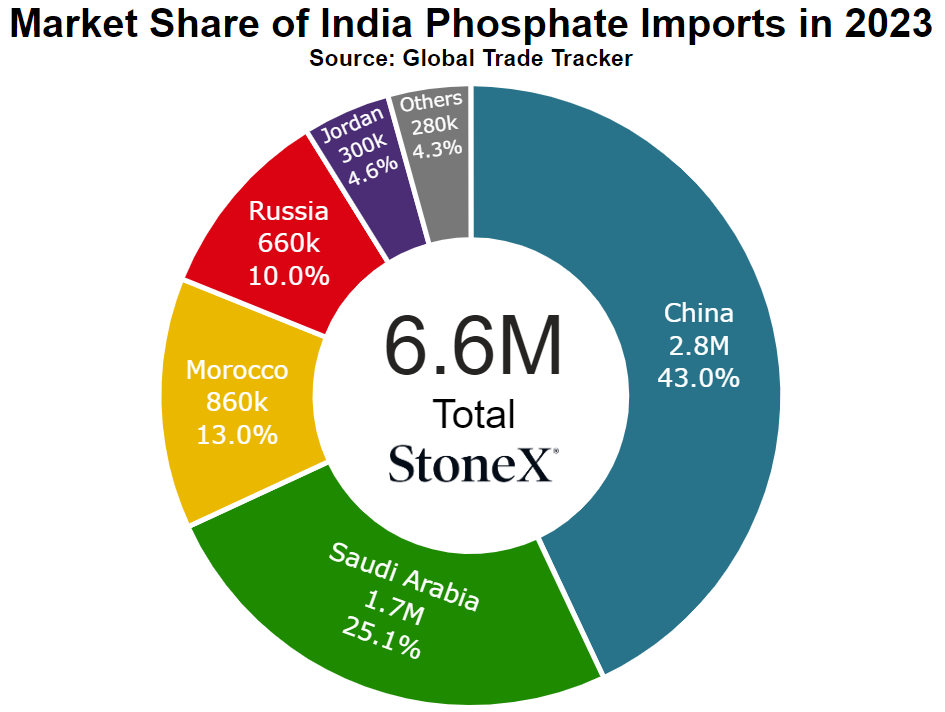
Price comparisons:
Vs 30 days ago - 6% or approximately $44 higher
Vs 90 days ago - 21% or approximately $133 higher
Vs 6 months ago - 24% or approximately $149 higher
Vs 1 year ago - 45% or approximately $243 higher
China DAP price comparison
Number 2 global exporter in 2022
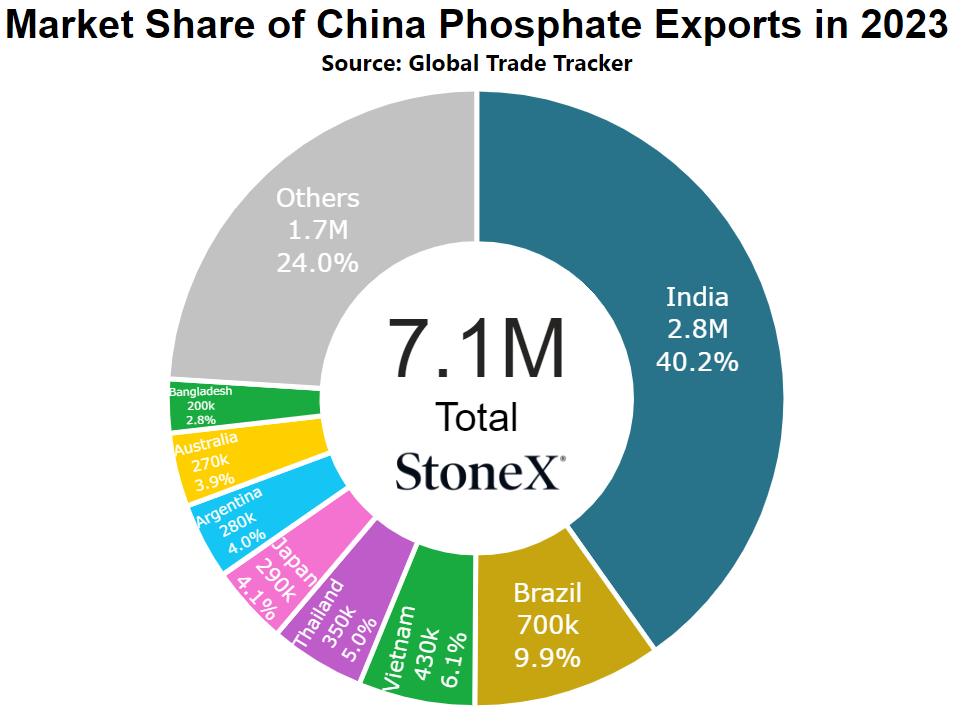
Price comparisons:
Vs 30 days ago - 5% or approximately $34 higher
Vs 90 days ago - 19% or approximately $120 higher
Vs 6 months ago - 22% or approximately $135 higher
Vs 1 year ago - 37% or approximately $205 higher
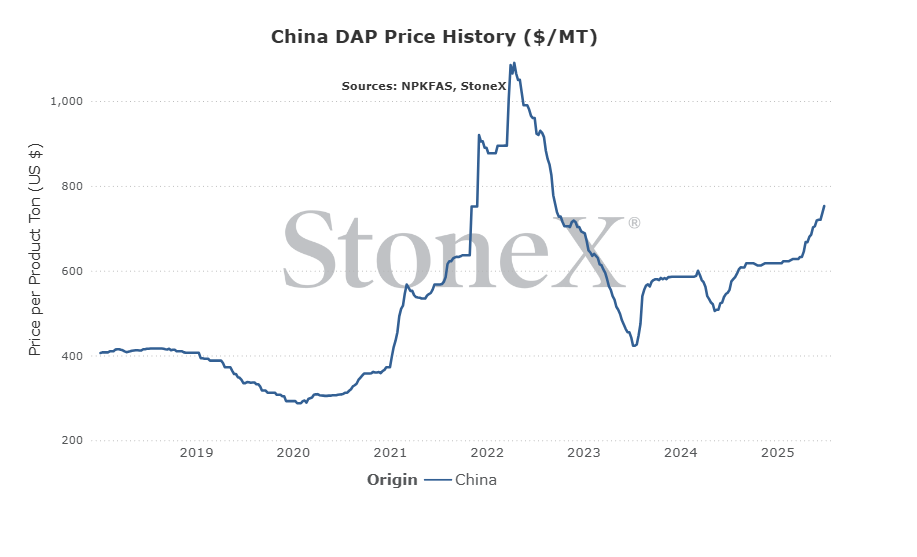
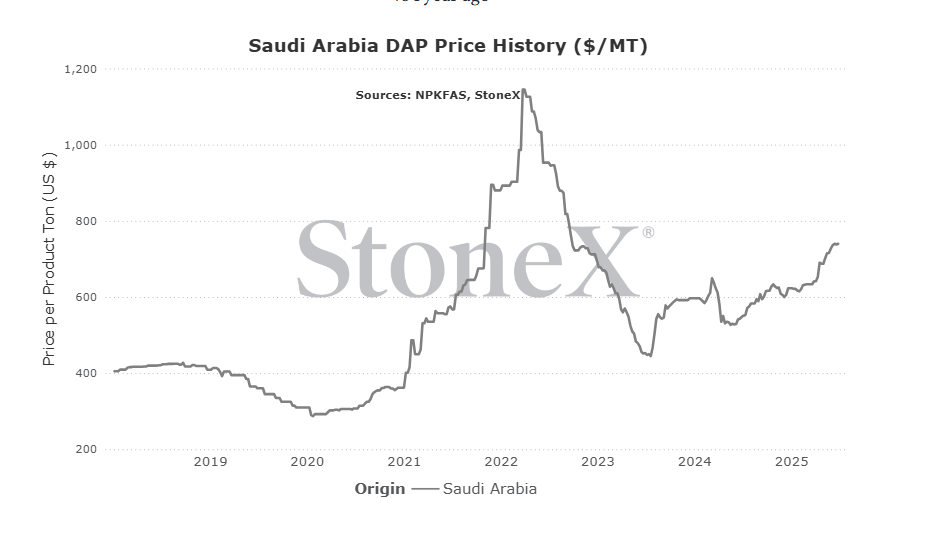
Saudi Arabia DAP price comparison
Number 4 global exporter in 2022
Price comparisons:
Vs 30 days ago - 2% or approximately $13 higher
Vs 90 days ago - 15% or approximately $99 higher
Vs 6 months ago - 19% or approximately $117 higher
Vs 1 year ago - 35% or approximately $192 higher
Brazil DAP price comparison
Number 2 global importer in 2022
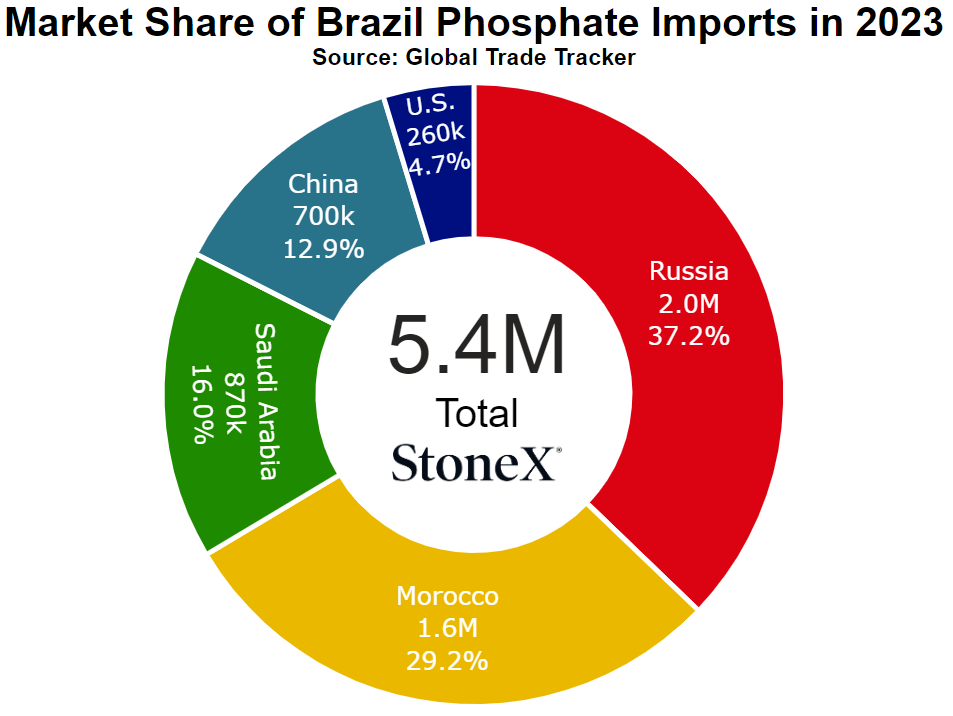
Price comparisons
Vs 30 days ago - 4% or approximately $33 higher
Vs 90 days ago - 12% or approximately $83 higher
Vs 6 months ago - 19% or approximately $123 higher
Vs 1 year ago - 22% or approximately $135 higher
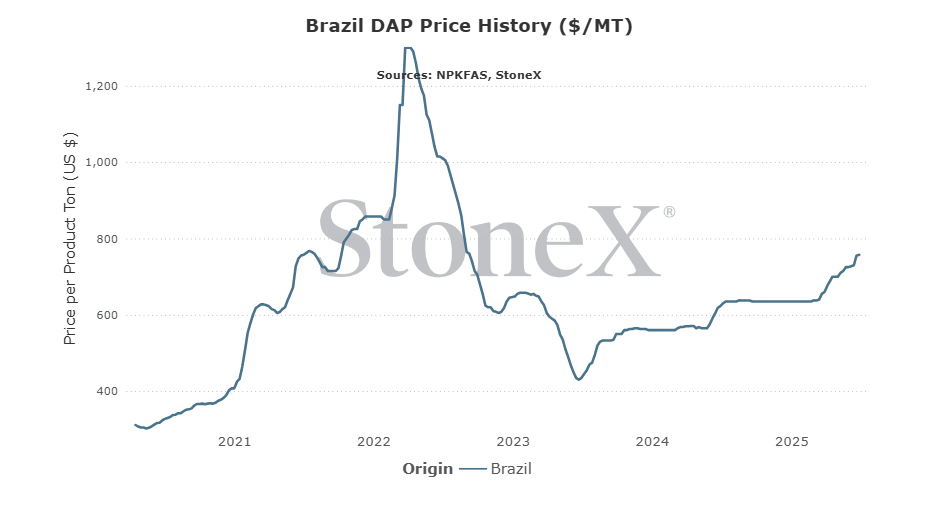
- Chinese government decides to lower export allowances – if the situation in the Middle East had continued to build and Iran proceeded with their threats of shutting down the Strait of Hormuz, this was going to become a much bigger possibility. Fortunately that does not appear to be the case. However, we still have to watch the Chinese government. If they suddenly decide that 4M tons were too many and/or domestic Chinese phosphate values rally too much, we could see them decide to cut that already low export figure. That would leave a much larger hole in global supplies.
- India's buying patterns continue/get worse – I've been saying the past few months that while the lack of Chinese exports was the cause of higher prices, India's buying patters are the effect of it. Unfortunately, India is still in catch up mode and the world knows it. That is why each time they buy, it seems like the price goes higher. India still needs to rebuild stockpiles ahead of what appears to be a very good Monsoon season which should equate to solid fertilizer demand. That should mean continued and regular buying which gives manufacturers/traders/suppliers more chances to push the price even higher.
- Tensions flare in the Middle East, shutting off Strait of Hormuz – as I write this, it appears that the ceasefire that was brokered between Israel and Iran is holding. For the common person in both countries, thank goodness. However, we all know how easily this flame can be restarted and we know that Iran very quickly moved to try and start blocking the Strait of Hormuz. The main focus of that story was all the nitrogen that flows through the narrow body of water. However, Saudi Arabia is a major phosphate manufacturer and exporter and the phosphate market is already tightely supplied. This would only make it worse.
- Demand destruction happens bigger than expected – right now, my POV on the phosphate market is that it is actively trying to destroy demand. The S&D is out of balance and it simply cannot boost supplies anymore. The only way to find balance is to kill demand. However, that can be overdone as has been proven in the past. If the market starts to believe it has hurt demand too much and unsold inventories start to build, that can cause prices to fall back to manageable levels...whatever those are today.
- U.S. operating rates start to improve rapidly – not only has the U.S. blocked the 4 largest phosphate exporting countries with tariffs/duties (sorry Canada, that includes a lot of you as well), phosphate operating rates for the Q4 '24 and Q1 '25 periods were record lows. So imports will struggle and production is down...for now. No doubt manufacturers are doing everything possible to get production rates higher at these margins. If they can be successful, that will add much needed supplies and hopefully put a lid on rising values.
- China shocks the world and allows more exports – I almost didn't list this as it does not seem feasible. That said, if it happens, the impact would be huge so I leave it. The Chinese government continues to keep phosphate exports reduced in an effort to keep domestic supplies high and values low. Now, if they run the numbers and realize that they have plenty of supply and values are already very low, there is a small chance that they could increase the current quota from 4M tons to 5/6/7/etc. Again, this is a very low probability/high impact situation. I wouldn't stay up at night thinking this happens.
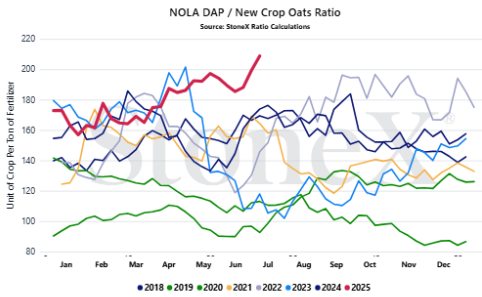
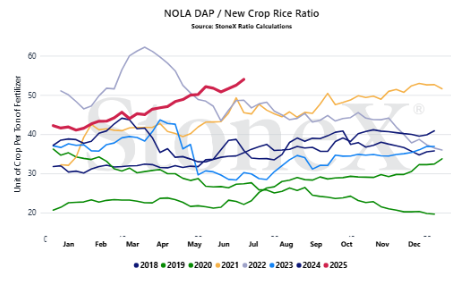
We believe that only looking at the flat price of either grains or fertilizer can be misleading:
-
Only selling grain can hurt you if fertilizer prices rise substantially
-
Only buying fertilizer can hurt you if grain prices fall
We look at the ratio "value" to get a better indication of where we are or how many bushels of X does it take to pay for 1 ton of fertilizer.
Would you rather:
-
Spend 150 bushels to pay for 1 ton of DAP
-
Spend 80 bushels to pay for 1 ton of DAP
When we compare the current ratio value against recent years, we start to see if we are high or low.
YOUR VALUES MAY LOOK DIFFERENT
This graph looks at the NOLA DAP price vs the flat grain price. There are no logistics on either product. Your location will look different due to fertilizer logistical costs, grain basis, etc.
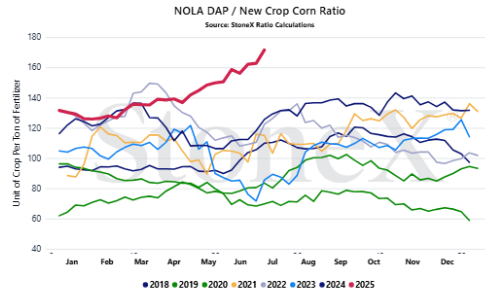
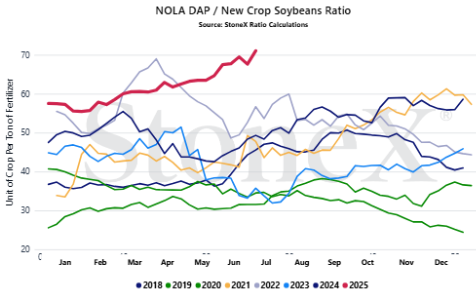
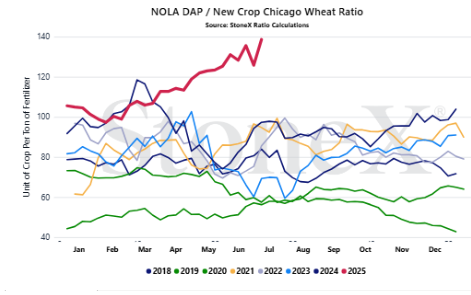
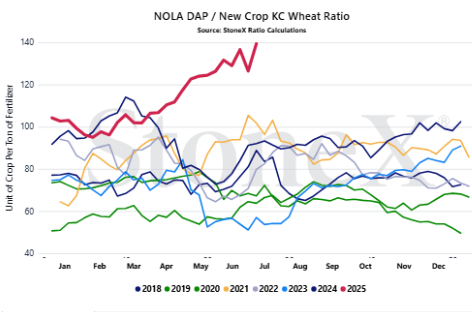
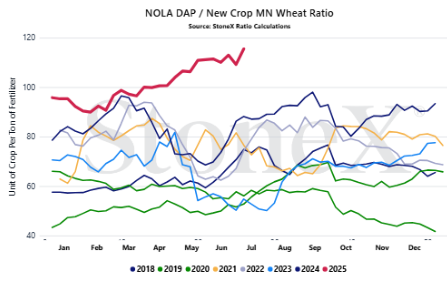
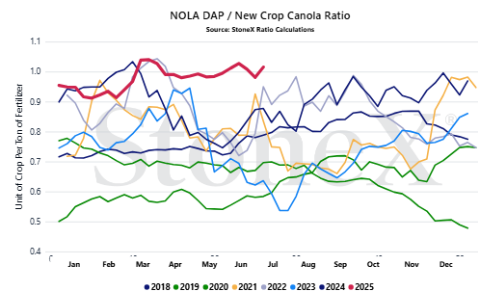
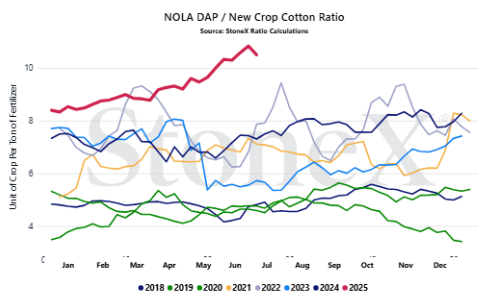
- How Chinese export flows continue to play out - to me, this is still the root of the problem for the global phosphate markets. China is normally the world's leading phosphate exporter with volumes hitting between 8 - 10M tons per year. This year, the government is only allowing around 4M tons. In a world where only 5 countries control so much of the flow (85 - 90%), losing one is bad enough. Losing the biggest one is worse. As long as they continue this approach, prices are going to stay high.
- When will India get caught up on stockpiles - on the other side of the phosphate blame coin sits India. Stockpiles have been low for about a year now. They have failed to rebuild to normal levels. Now, their monsoon is looking very good which should have farmer demand high. It is not a good situation there and the world knows it. The longer they remain low on stockpiles, the more the world phospahte market will take advantage of them with higher prices.
- Will the U.S. move to deter exports/boost production? - N.A. farmers are nearing breaking points. Current phosphate to grain ratio values are some of the worst ever seen. While much of the high price is attributed to global events, there is no getting around the fact that imports are largely blocked, operating rates are low, and exports are still allowed. What will Washington D.C. do, if anything, about all of this? Doubtful they can do anything about production rates, but will this event cause them to make it easier to expand current production? Will this event cause them to consider putting roadblocks in the path of exports? At this point, anything to help drive more supplies to the farmer would be appreciated.
- When is enough for farmers? - eventually, there needs to be a breaking point. Frankly, that is exactly what the phosphate market is looking for. It is looking to destroy demand short term. The S&D is out of balance and Econ 101 says those two need to find balance. Today, it does not look like anything can be done to fix supplies in a big way. That means going to demand. The price is going to continue to move higher until enough buyers say no thank you. So the magic question is what is that price point, if any?
StoneX Ratio Calculation
The ratio calculation is derived from Bloomberg historical grains values as well as fertilizer values from StoneX, NPKFAS, and Argus.
The calculation is simply dividing the fertilizer price by each grain price.
All data was sourced from StoneX unless otherwise noted.