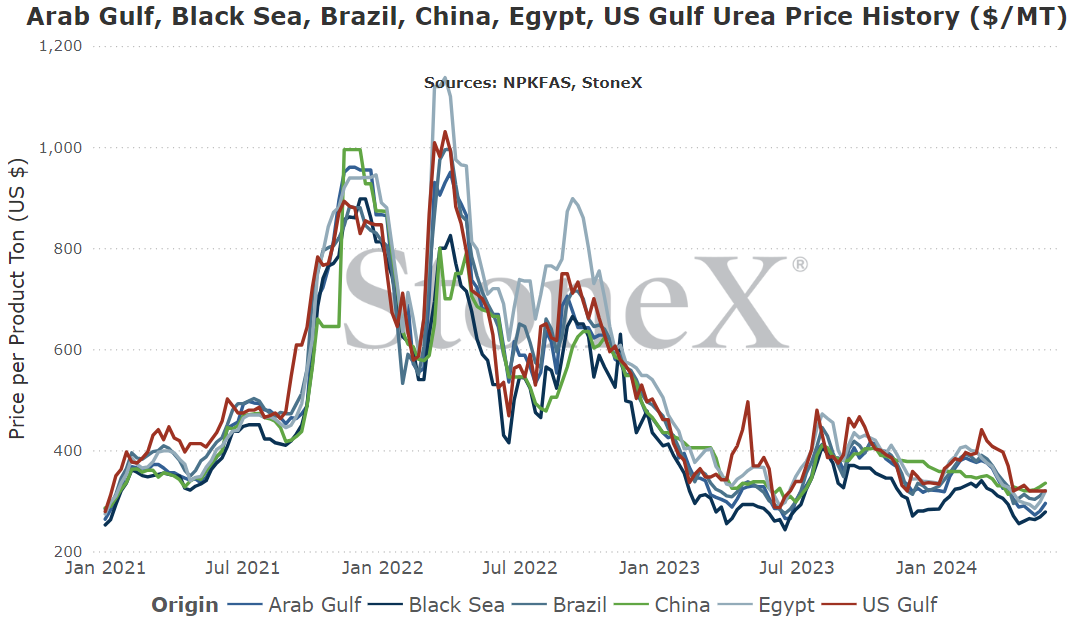
Demand returned and suddenly the markets caught fire. Amazing what happens when the market goes from a place where no one wants to touch the stuff to a place where people are lining up! As a result, global values have been rising and some regions are seeing a decent sales book built.
As long as demand remains and/or solid sales books are created, it gives little reason for manufacturers to drop price. However, I am still struggling with a lot of upside on currently values. While there are certainly questions on Chinese export programs and European production remains at 75% of normal, anything outside of that appears short term.
Long story short, I'm seeing this as likely supported near term but wondering if this will be a bit of a dead cat bounce when we get further into the calendar.
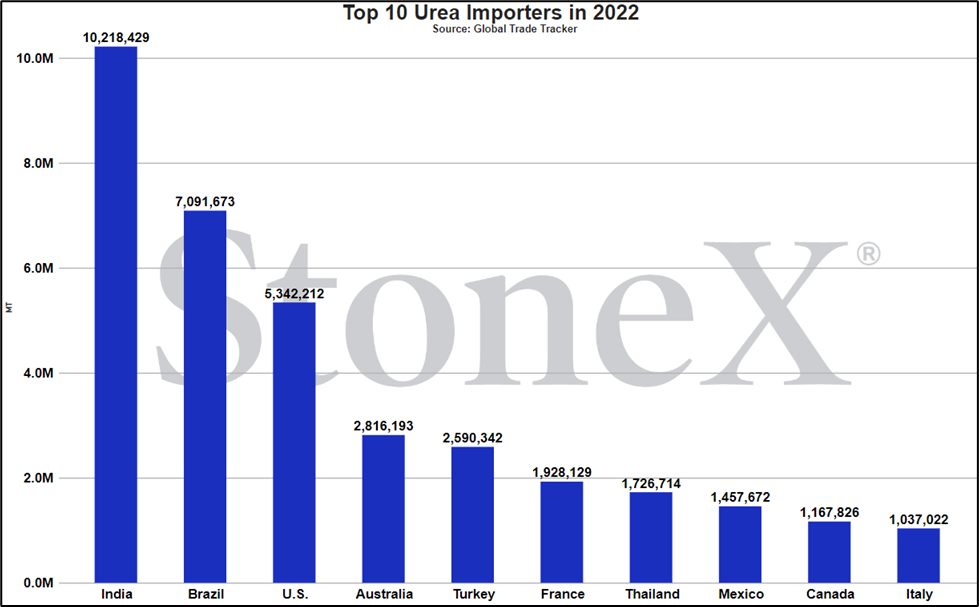
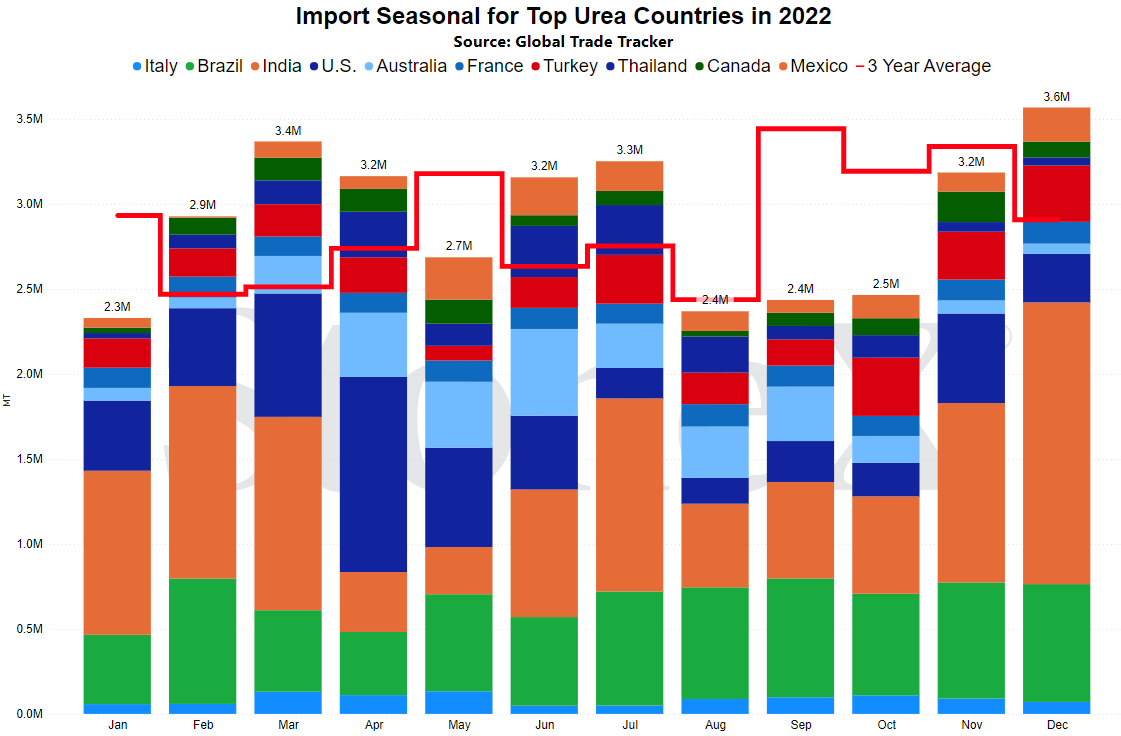
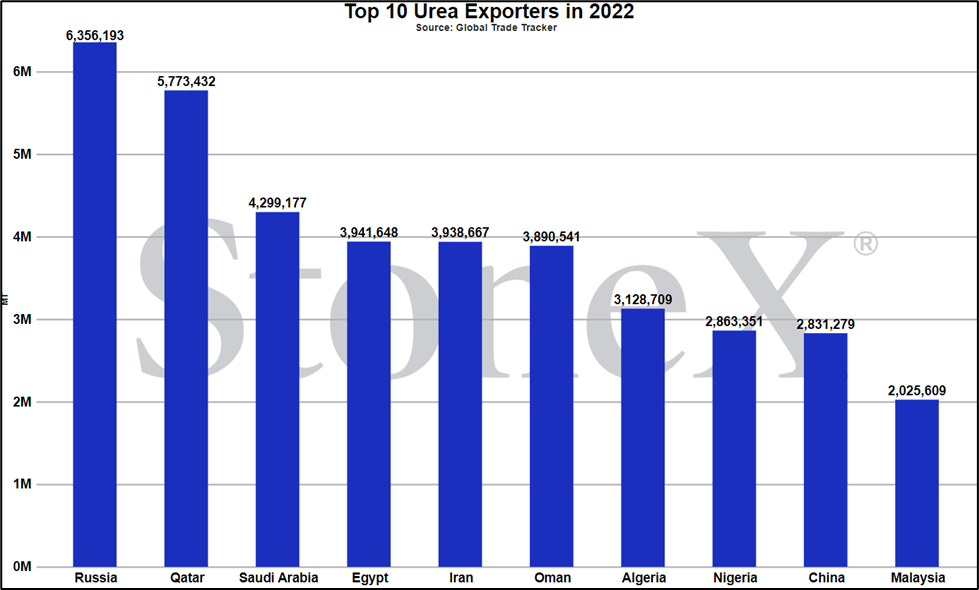
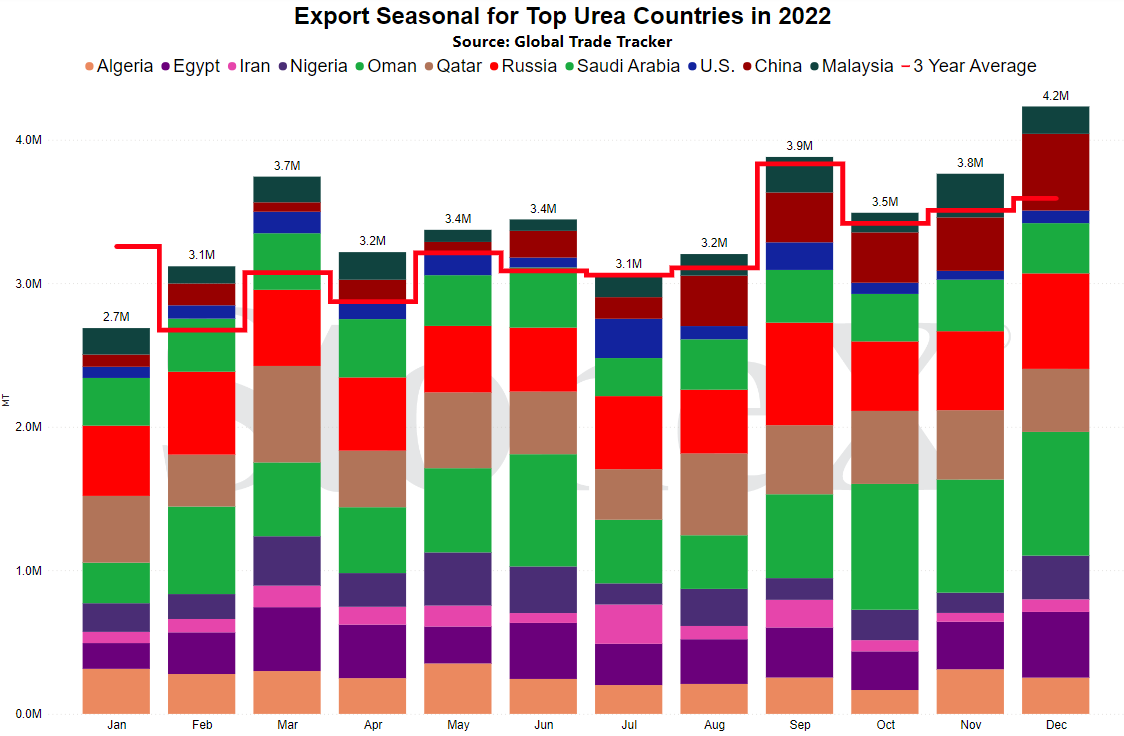
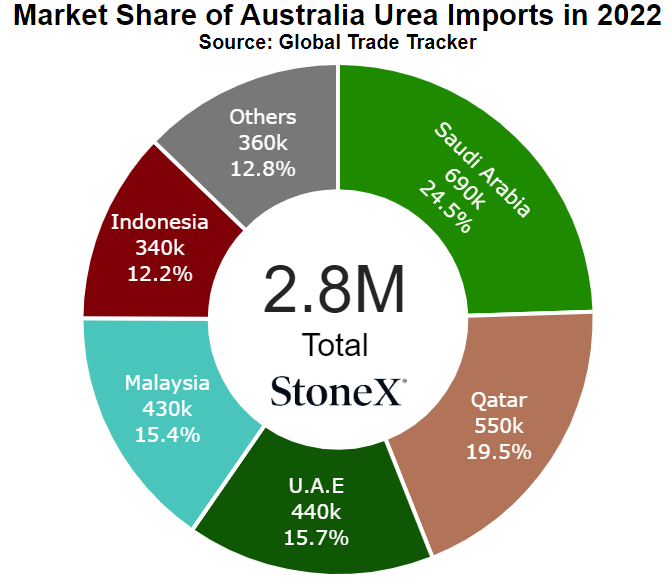
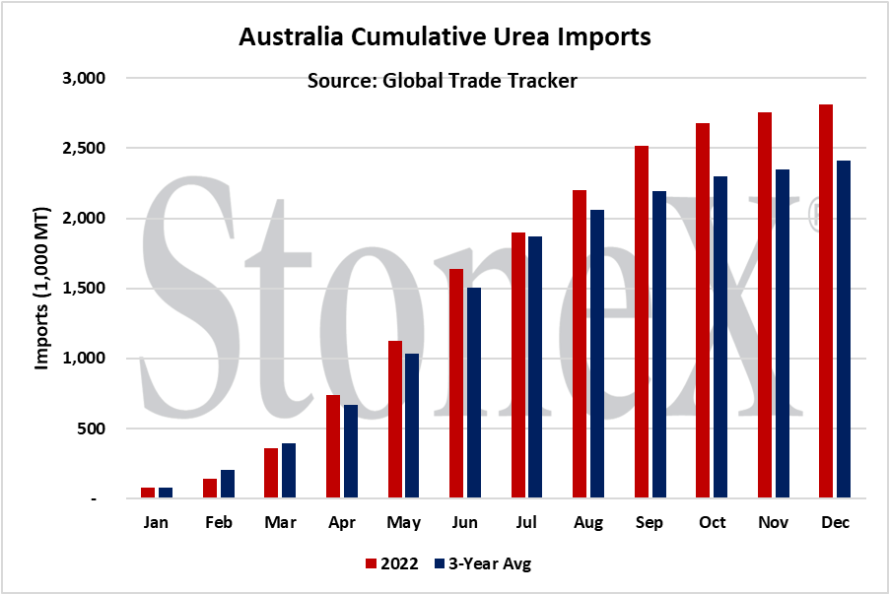
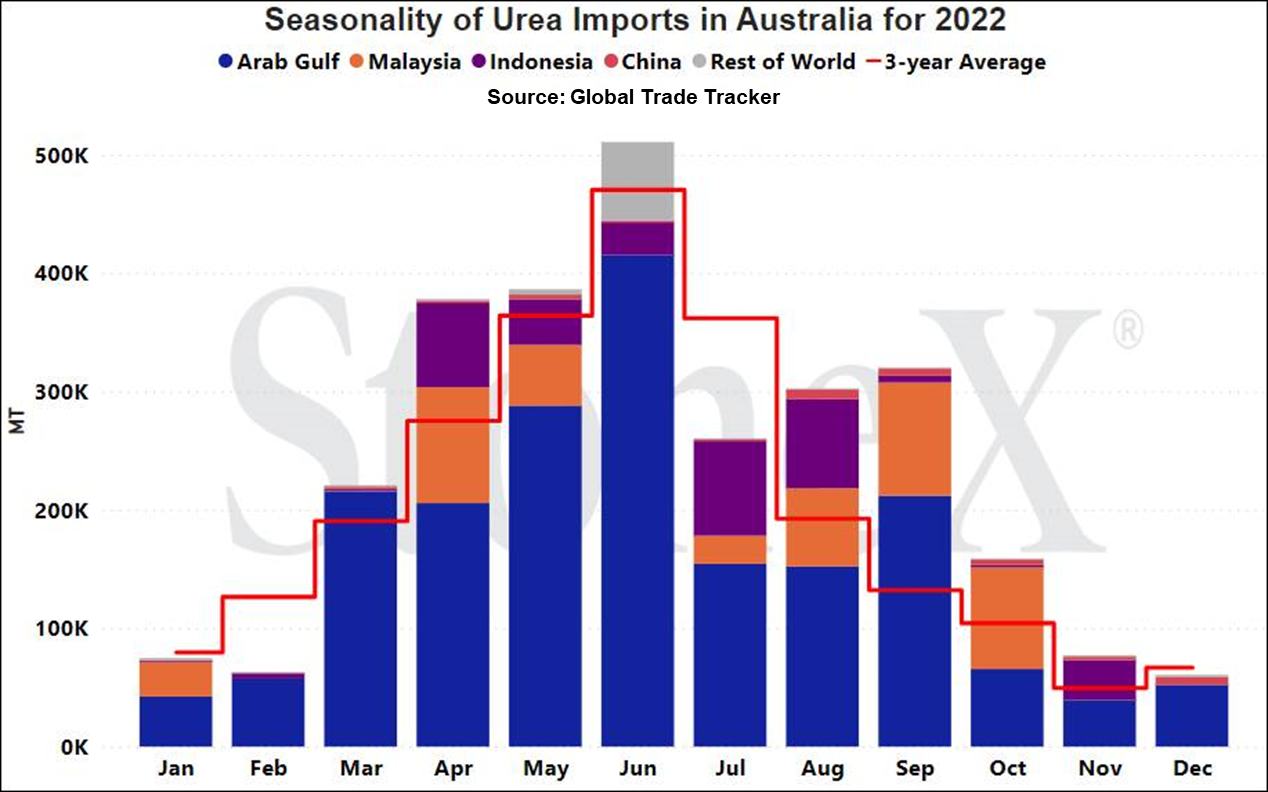
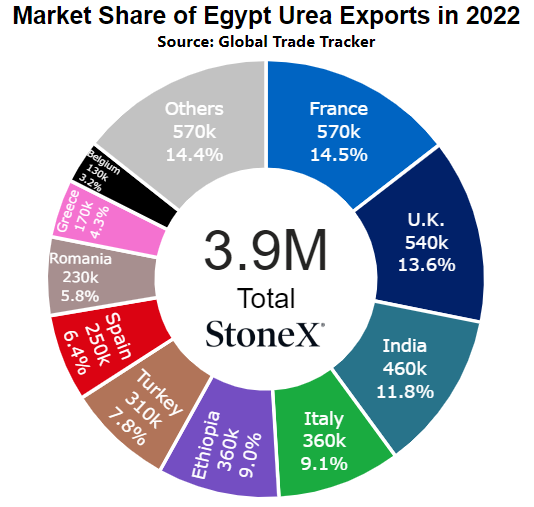
Egypt cuts nitrogen production by 20% on tight natural gas supplies
Egypt, the world's 4th largest urea exporter in 2022, saw the government tell nitrogen manufactures to scale back by 20% in recent weeks.
A heat wave had caused demand to skyrocket. To make sure there were adequate supplies for its population, the government made the move against the industrial sector.
Now, this is not a new thing as this has happened before. Frankly, rightfully so. In the past, these production reductions have been relatively short lived with production resuming fairly quickly. It just happens to be happening during a period where demand has returned.
Egypt/North African manufacturers were at the front of the world market in terms of getting demand back and as a result, pushing price ideas higher. They built a sizeable sales book in a relative short amount of time. Now that production is being reduced, that will only serve to extend the sales book...and make them that much more proud/comfortable.
What does this mean for Aussie farmers?
Basically, higher price ideas in the future. The world, as you will read below, was already seeing some excitement with demand returning which caused values to rise. This just added fuel to the fire.
While it does not guarantee that Aussie values will rise as a result. In my short time in Melbourne, I have seen where the world market rallies and the Aussie market doesn't budge...but I would say that is the exception and not the rule.
If global supplies get tighter and as a result, prices go higher, expect to see that on the farm.
Global demand returns, exciting values
As we have said over the last couple editions, the global urea market has been fairly bearish but we were watching for demand to return. Once that buying pattern started to return, it generally starts a wave that can be hard to stop.
Well, that buying started a couple weeks ago with Egypt finding buyers. It wasn't too long before other production regions started to join the fun.
There is plenty of speculation as to why buyers started to step forward. Some have speculated that traders had shorted the market and finally decided to cash out rather than risk going forward. My belief is a combination of that and the addition that some farmers saw the opportunity as too good to pass up.
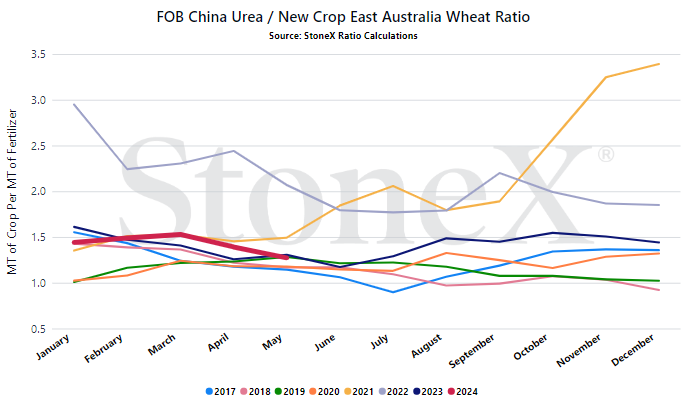
If you scroll down to the ratio chart section, you will notice that a lot of the current lines are fairly low compared against recent years. Now, we talk about our ratio approach as though it is some new thing and to a lot of farmers, it is. However, to a lot of parts of the world, this is just how business is done. Rather than trying to call the low of fertilizer and the high of grains, they barter or watch for that value to dip. Well, recent trends have caused the dip.
It is going to be interesting to see how long buyers return if values keep going higher and/or grain starts to fall. This only works if both sides continue to work for the farmer. If either side starts to fall out, then everything looks significantly different and likely causes demand to dry up...
What does this mean for Aussie farmers?
It is very temping to say just read the section above because it is almost verbatim!!!!
While it is not guaranteed that world values rising means Aussie values will rise, there is a very high chance of it eventually. In my short time in Melbourne, I actually watched the Australian market shun global values going higher because importers already had solid tons secured. That said, I wouldn't count on that being a normal situation!!!
If global values are going higher and hold, there is a good chance Australia values do the same.
European Dutch TTF (natural gas) values rise, lowering hopes of nitrogen plant restarts
While Europe as a whole is far from being the largest urea production region in the world, it is large enough that the market still needs to watch what is happening.
For a more detailed backstory, go check out the UAN or NH3 newsletters.
As mentioned in both of those, our hope that the remaining offline nitrogen plants would restart are dwindling. Dutch TTF values have crept higher into the $10 - $11MMbut range. Over the winter, we saw those values dip as low as $7 - $8MMbtu...but no real restarts were seen/heard. Some of the explanations were that either demand was very low since it had already been met with imports or that temperatures were very low which make it hard to restart old plants. Well, today there seems to more than sufficient demand out there as has been seen by North Africa/Middle East/Asia. It is also spring so temperatures are warming.
Still, no plant restarts have been heard.
I do not want to dive off the cliff and give up hope...but it is fading fast. It certainly does not look like normal relations with Russia will be obtained anytime soon so we have to assume Europe's natural gas market will remain elevated, hindering most hopes of restarts. The longer the plants remain offline, the harder it will be to restart.
What does this mean for Aussie farmers?
Again, this is just global S&D. If the world suddenly saw the remainder of offline European nitrogen plants come back online, it would be a huge step toward "normal" values. Today's values are not what we would consider "normal". They look good vs the last few years but are still high in comparison to the years before. Whether we will see those past values again has been the subject of debate for a while now.
As long as global supplies such as Europe remain lower than normal, global urea values will remain elevated. Australia is not immune to this.
Asian supplies not as large as hoped
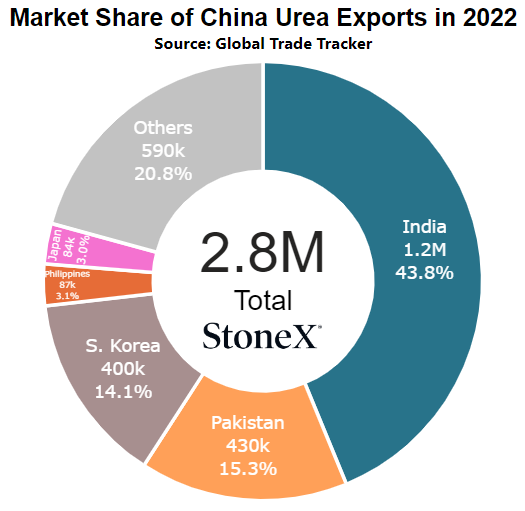
In the lead up to application season, there were signs that we would see supplies improve in the Asian region. Chinese exports were set to return as the government started to relax export restrictions. This was set to be a huge boost to exports as their "normal" annual exports usually sit around 5 - 5.5MMT (vs "only" 2.8MMT in 2022). It appeared that Indonesia production was going to improve. As a result, a lot of global points saw values lower.
Unfortunately, the best laid plans...
When it looked as though Chinese exports were going to return, Chinese domestic values started to move higher which makes sense. Manufacturers were no longer forced to only look internal China for demand. They now had the world to target. The government saw this and quickly put a stop to it to make sure Chinese farmers stayed well supplied at good values. That pulled the rug from the market rather quickly. While some Indonesia production came back as expected, another plant went down for repairs. On its own, not a huge deal, but combined with other issues, it was enough.
Ultimately, these events have forced importers to consider purchasing additional supplies from farther origin points. Longer sail time and higher logistical costs are not great in the middle of season...
What does this mean for Aussie farmers?
Rinse and repeat. Tight supplies typically mean higher prices.
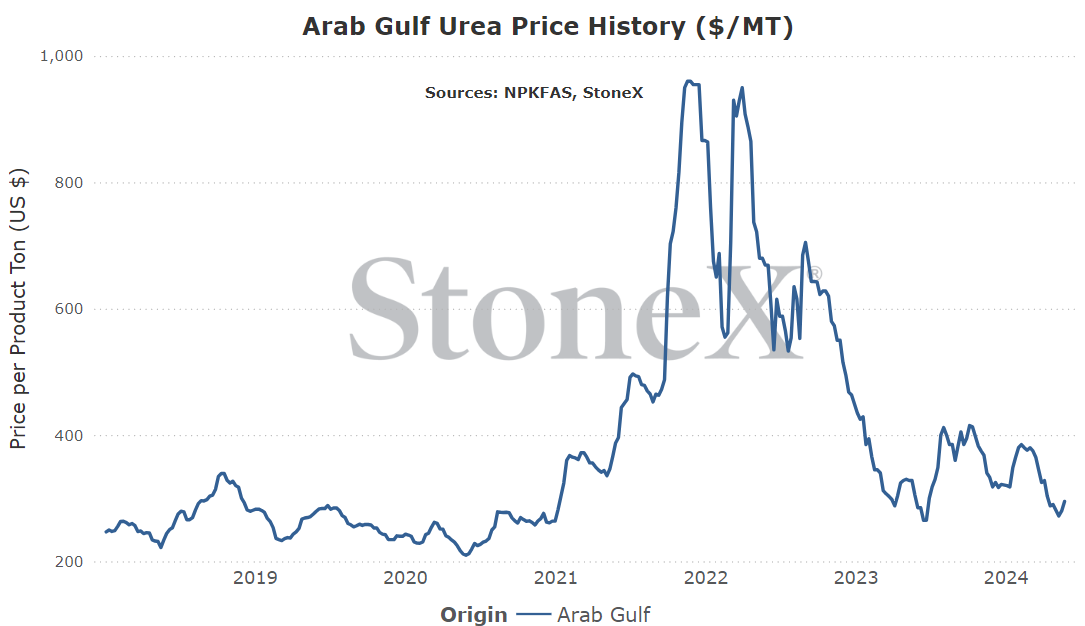
Number 1 exporter (as a region, not as individual nations)
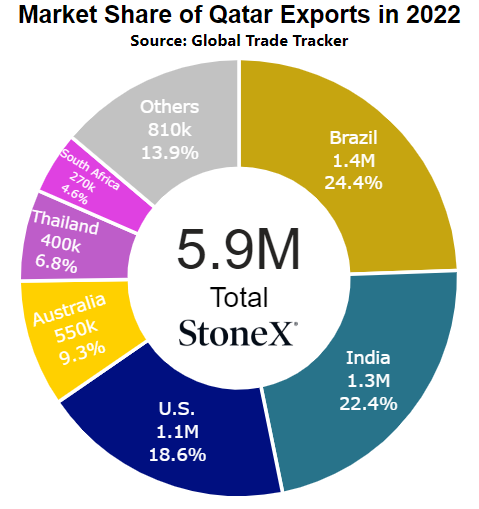
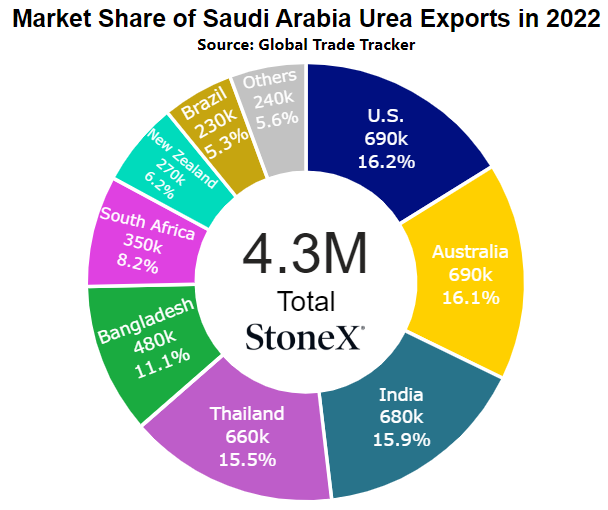
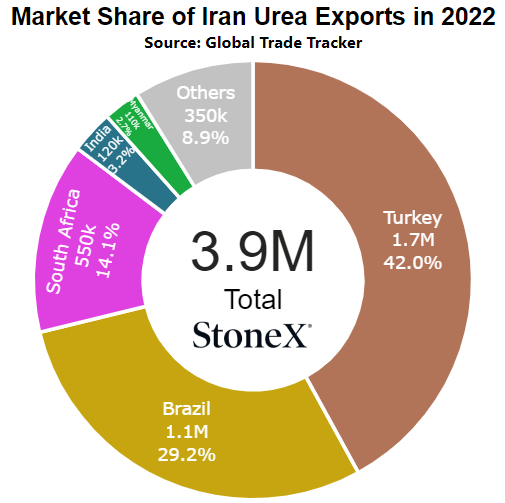
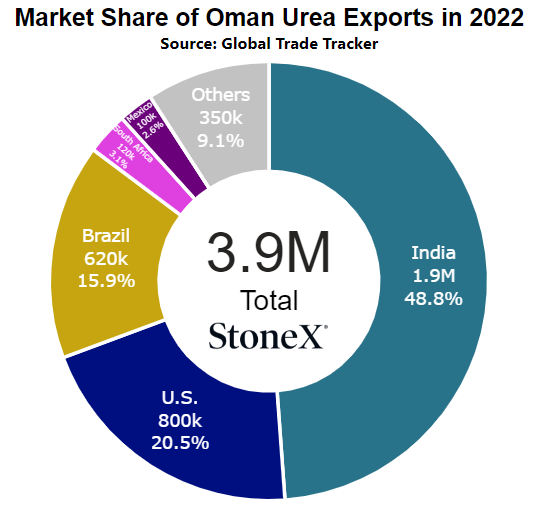
Vs 30 days ago - +2% or approximately $5 higher
Vs 90 days ago - -22% or approximately $81 lower
Vs 6 months ago - -11% or approximately $38 lower
Vs 1 year ago - -3% or approximately $10 lower
Egypt
Number 4 global exporter in 2022
Price comparisons
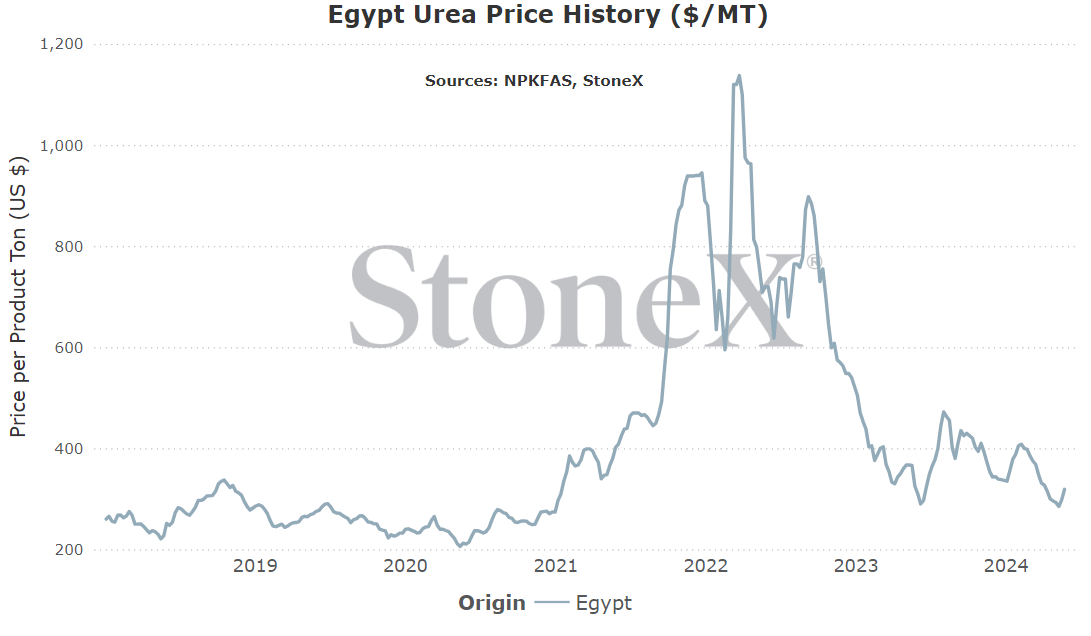
Vs 30 days ago - +8% or approximately $23 higher
Vs 90 days ago - -20% or approximately $79 lower
Vs 6 months ago - -10% or approximately $35 lower
Vs 1 year ago - -2% or approximately $6 lower
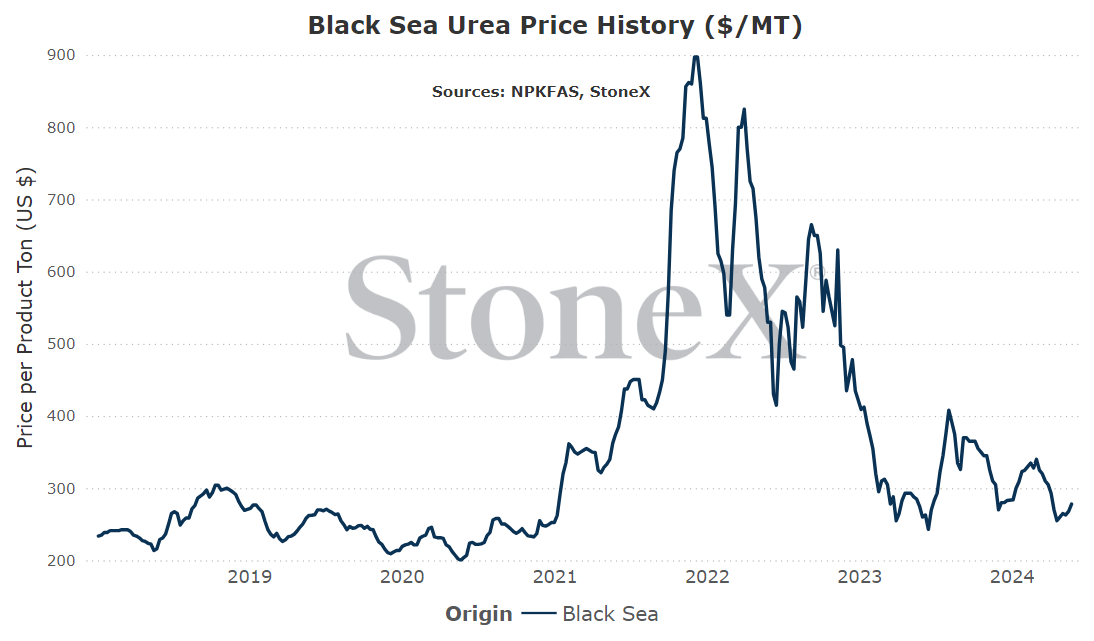
Black Sea
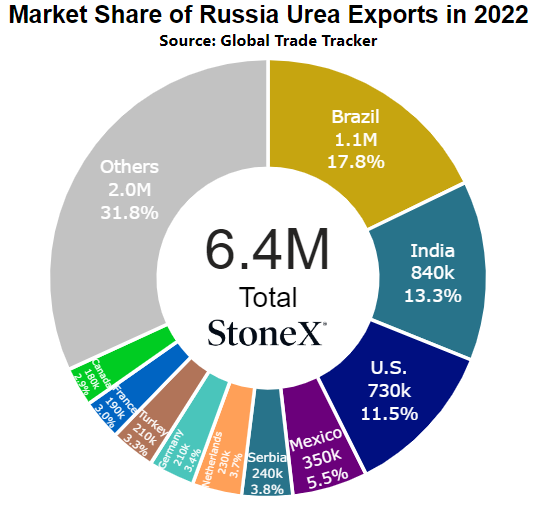
Number 1 global exporter in 2022
Price comparisons
Vs 30 days ago - +7% or approximately $18 higher
Vs 90 days ago - -15% or approximately $50 lower
Vs 6 months ago - -9% or approximately $28 lower
Vs 1 year ago - +1% or approximately $3 higher
China
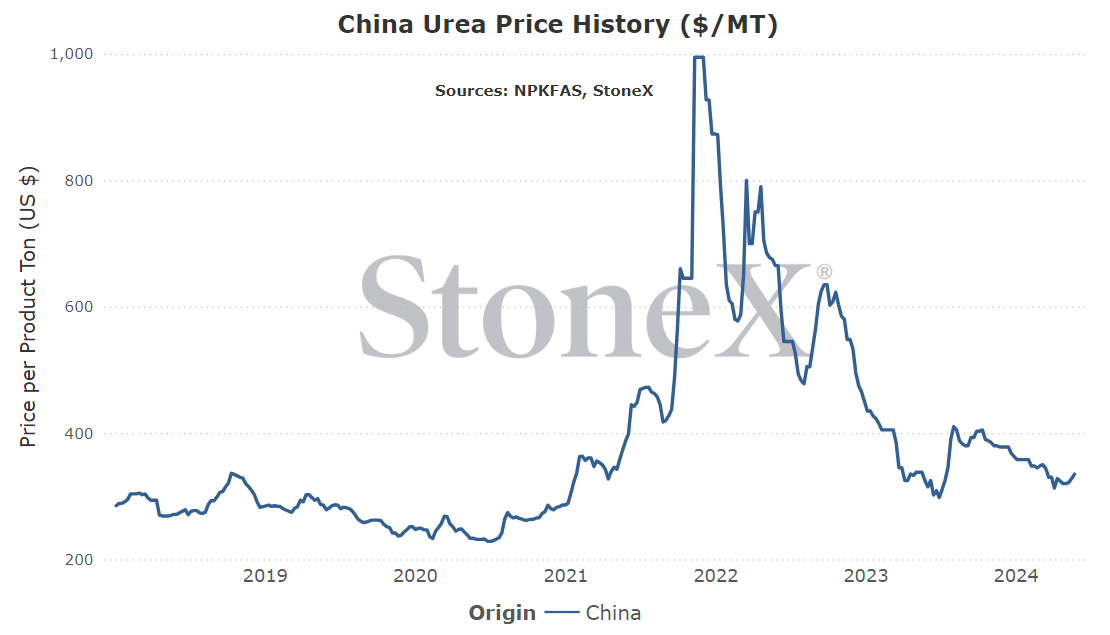
Number 9 global exporter in 2022
Price comparisons
Vs 30 days ago - +5% or approximately $15 higher
Vs 90 days ago - -3% or approximately $10 lower
Vs 6 months ago - -11% or approximately $43 lower
Vs 1 year ago - +3% or approximately $10 higher
- Buyers keep coming - as long as the buyers keep lining up, the sellers will keep taking advantage by moving pricing higher. Simple S&D.
- Still need to watch for plant shut down/repairs - this is less likely today, with manufacturers selling left and right. No reason to shut the plant down if sales are being made and you have your plant sold out for the next few weeks/months.
- Current urea values make sense vs forward grains - the longer I think about it, the more I think the reason buyers have returned is that current urea prices make sense against grain values. Sure, we could see urea lower, but we could also see grains fall apart. We spend a lot of time talking about the ratio. Others call it other things and have been doing it for a long time. When the value gets low, don't think, lock it in. Hence why we have seen buyers forward and prices up.
- Still a demand dead period looming - it has been surprising to see the amount of demand that has stepped forward recently, especially with several believing that lower prices were on the horizon. That burst of demand has supported the market, but we will still have a demand dead period on the horizon and we know how well fertilizer holds up when it gets quiet.
- If Aussie importers already have supplies secured and demand has disappointed - while there are a lot of reasons globally to see prices higher, we could absolutely see Australia do its own thing. If importers have already secured most of the tons needed for season and demand starts to disappoint, we could see folks get aggressive to stay in front of the competition and get rid of their inventories. I'm not counting on this, but it is something to consider.
- ...I'm struggling for a 3rd - right now, I'm really struggling with a 3rd factor that could push values lower. My summer reset forecast still has prices down a further $25 in the gulf, but right now there is a lot of support from buyers/grain prices/etc. This isn't to say that I am guaranteeing prices higher, just think there is more upside potential than downside.
We believe that only looking at the flat price of either grains or fertilizer can be misleading:
-
Only selling grain can hurt you if fertilizer prices rise substantially
-
Only buying fertilizer can hurt you if grain prices fall
We look at the ratio "value" to get a better indication of where we are or how many bushels of X does it take to pay for 1 ton of fertilizer.
Would you rather:
-
Spend 135 bushels to pay for 1 ton of urea
-
Spend 55 bushels to pay for 1 ton of urea
When we compare the current ratio value against recent years, we start to see if we are high or low.
YOUR VALUES MAY LOOK DIFFERENT
This is a work in progress section! We plan on looking at the relationship between Aussie grains and global price points (and hopefully Aussie specific locations, though that data is hard to secure, very protected). Big reason why we are still in the "trial" stage of this newsletter!!!!
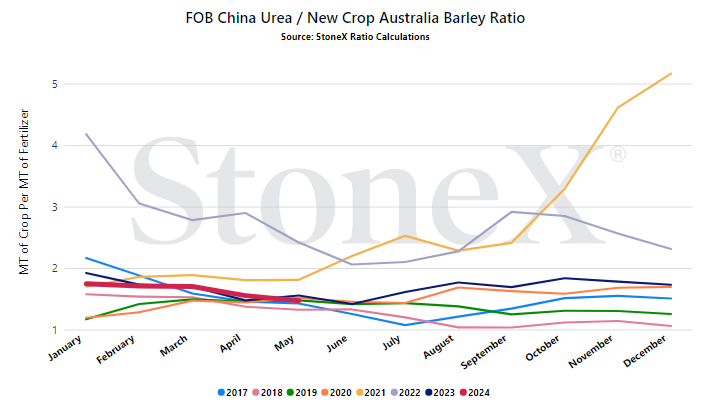
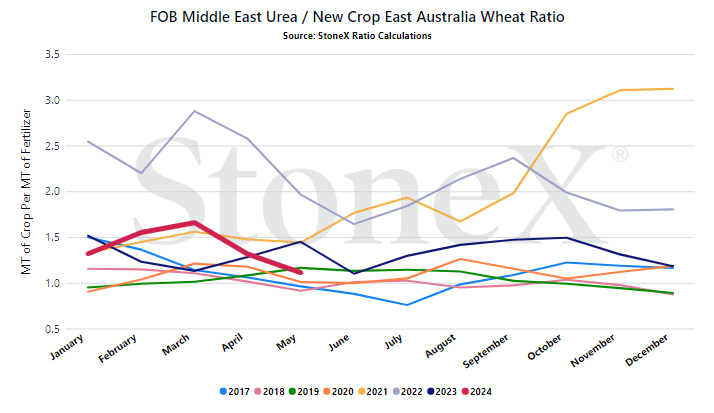
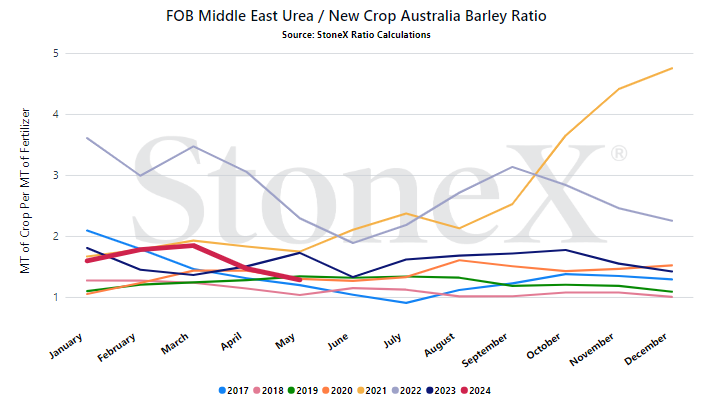
- World demand - as long as buyers continue to step forward, global manufacturers are going to get more bold in their price ideas (think higher priced). As I write this, buyers are continuing to step up and prices are moving higher with them. I cannot believe this will last for a terribly long time...but I've been wrong before.
- Chinese export programs - when the world thought that China was going to resume urea exports, global price ideas started to fall. When the Chinese government stepped in to block exports, global price ideas started to climb. Now, was all of this due solely to China's actions? Certainly not...but it helped. Today, we are a world without China but as we have been taught over and over, that can change literally overnight.
- Aussie urea import levels - in the lead up to season, global urea values were under pressure and I had some angst that import flows might be a little lower than normal. From an importer POV, that is a hard market to prepare for. You have to purchase product ahead of time and then sit on that flat price until it arrives and gets sold. When values are dropping, it makes for a dangerous decision. However, in the last couple weeks, global values have risen. This should have given buyers confidence to lock up the rest of their needs and put Australia in a good spot for supplies. But, like in most things in life, nothing is guaranteed.
StoneX Ratio Calculation
The ratio calculation is derived from Bloomberg historical grains values as well as fertilizer values from StoneX, NPKFAS, and Argus.
The calculation is simply dividing the fertilizer price by each grain price.
All data was sourced from StoneX unless otherwise noted.